
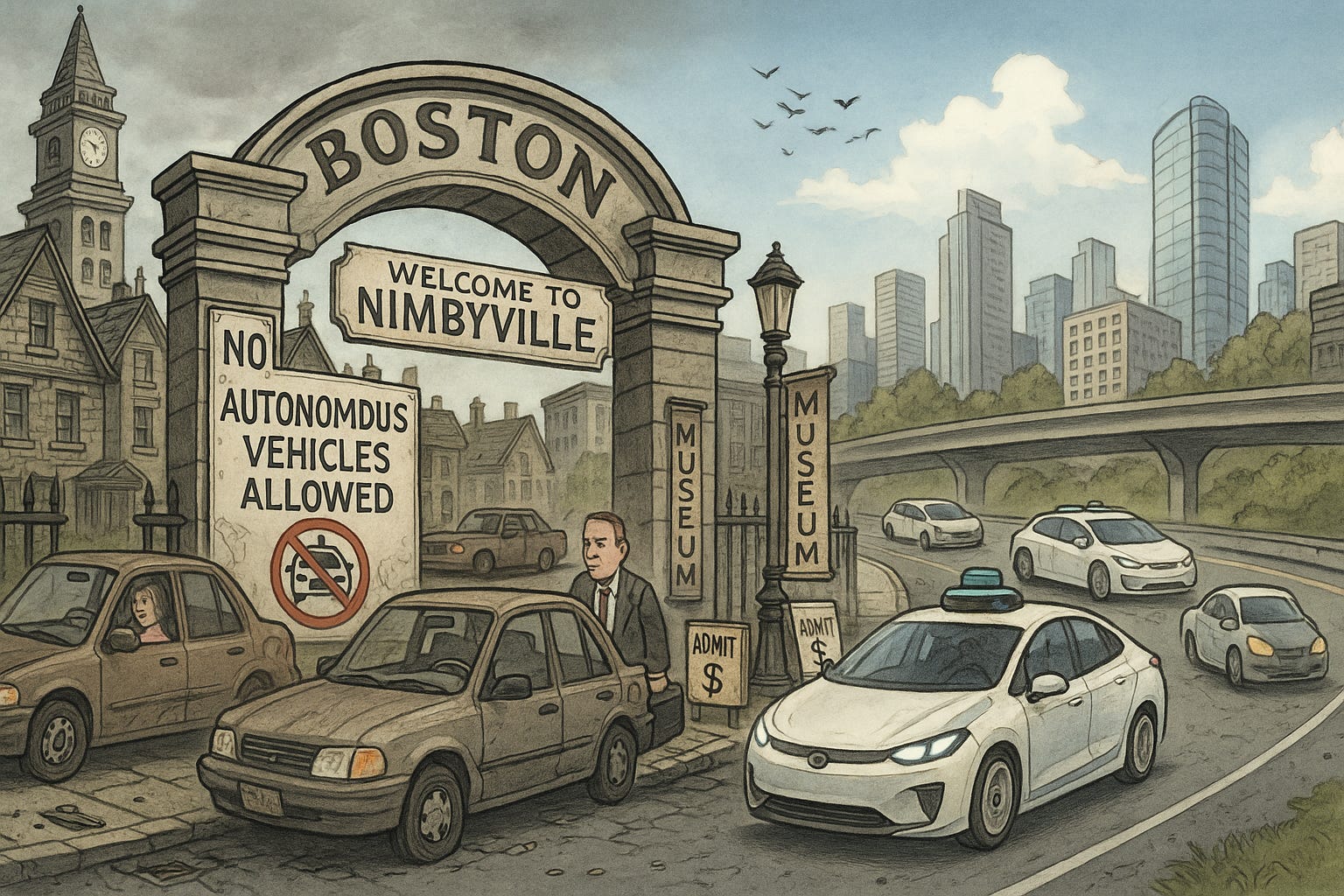
The proposed ordinance would direct the mayor to convene a Commercial Autonomous Vehicle Operations Labor and Small Business Impact Advisory Board to assess how driverless cars might affect rideshare and taxi employment, small business operations, and neighborhood traffic patterns. While city officials have described the measure as a temporary “pause” meant to ensure safety and fairness, its design suggests otherwise. As written, it would halt any fully driverless operation in Boston until at least mid-2026 and, even after that, would require a human safety operator to remain physically present in every vehicle. The draft sets no firm deadline for completing the impact study, and the new permitting bureaucracy it envisions has no clear endpoint. If the human-operator mandate remains in place once the study concludes, Boston could in practice enact a permanent ban on fully autonomous vehicles.
Introduced on August 6 by Councilors Henry Santana and Erin Murphy, the measure remains in the Committee on Government Operations following an October 28 hearing. No vote has yet been scheduled, but for it to advance, it must first clear the committee, win a majority of the thirteen-member Council, and then go to Mayor Michelle Wu, who has not yet taken a public position. Even so, the proposal has drawn interest from labor groups and some councilors, suggesting that some version of the measure is likely to move forward.
The irony is that Boston’s proposal targets a problem that existing law has already addressed. Every safeguard the city claims to need is already in place and has been refined through years of collaboration among federal and state regulators, engineers, insurers, and safety advocates. At the federal level, the National Highway Traffic Safety Administration (NHTSA) oversees autonomous-vehicle safety through defect investigations, mandatory crash reporting, and compliance with Federal Motor Vehicle Safety Standards. The agency holds authority to recall vehicles, suspend fleets, and demand detailed documentation on failures, performance metrics, and software updates.
At the state level, Massachusetts already maintains one of the nation’s more comprehensive autonomous-vehicle frameworks, administered by the Massachusetts Department of Transportation (MassDOT) through its Safe Testing of Automated Driving Systems on Public Ways Memorandum of Understanding (MOU). This agreement governs how any AV company may legally test or operate on public roads and requires that each vehicle function only within geofenced pilot zones pre-approved by MassDOT and local transportation officials, ensuring that no AV drives anywhere it has not been mapped, modeled, and stress tested. Every incident, disengagement, or crash, no matter how minor, must be reported in real time to state regulators and reviewed with police and safety boards. Participating companies must carry insurance policies far exceeding those required of human drivers, guaranteeing full financial accountability for any injury or property damage caused by an AV. The MOU places legal liability squarely on the operating company whenever a vehicle is in autonomous mode and mandates rigorous safety oversight throughout testing and rollout. Companies must also demonstrate that their operators are properly trained, that their systems can safely handle failure scenarios, and that any remote-operation centers meet strict communication and redundancy standards.
Companies such as Waymo go even further than these regulations require. Their vehicles operate only within precisely mapped and validated geofences that are continuously updated to reflect local traffic patterns, signage, lighting, and weather conditions. Before carrying a single passenger, the cars log millions of simulated miles and thousands of supervised real-world miles within those zones, learning to navigate Boston’s unique street geometry and conditions. Waymo’s program includes live operational audits, continuous software validation, and fleet-wide insurance coverage that extends to all autonomous activities, making it among the most transparent and safety-focused technological systems in the world.
Against this backdrop of existing and well-tested safety standards, Boston’s proposed ordinance does not fill a regulatory gap so much as a political one. It would replace engineering-based review with political discretion, handing veto power to committees that could delay progress indefinitely, regardless of evidence—and doing so largely to placate special interests by slowing adoption without clear purpose.
The loudest voices backing Boston’s proposed “safety pause” on driverless cars are not transportation engineers or public-safety experts. They are labor unions and professional groups whose jobs could be directly threatened by automation.
A coalition calling itself Labor United Against Waymo has led the lobbying push. It includes Teamsters Local 25, the App Drivers Union, and SEIU 32BJ, joined by the United Food and Commercial Workers Local 1445, the International Association of Machinists District 15, and the Greater Boston Labor Council. These organizations represent rideshare, taxi, delivery, and logistics workers—the very groups most likely to be displaced by autonomous fleets. Their public statements leave little doubt about their motives. Teamsters Local 25 President Tom Mari recently declared that “these machines don’t benefit working people—they only serve the interests of out-of-state Big Tech billionaires.” That is not a statement about crash prevention or pedestrian safety; it is an open declaration of economic self-preservation dressed in moral language.
The draft ordinance itself reflects this protectionism. Framed as a “safety study,” the advisory board it would create includes no engineers, no data scientists, and no traffic-safety researchers. Instead, it would hand decision-making power over “safety” to the very groups with the most to lose from safer, driverless vehicles. The same unions now lobbying against automation would gain institutional authority to delay or deny its deployment. That is not public oversight, it is a conflict of interest written into law.
If the backers of this measure truly cared about workers, they would say so plainly. There is no shame in wanting to protect jobs; the shame lies in pretending it’s about something else. Honesty would allow for a real conversation about transition: how to retrain drivers, how to integrate unions into the new mobility economy, and how to ensure workers share in the gains of automation instead of being left behind by it.
But that is not the conversation happening in Boston today. Instead, supporters of the ordinance are clinging to the past and calling it prudence. They are pretending progress can be paused—and that by stalling autonomous vehicles, they can somehow freeze the economy in amber. Yet technology does not pause; it migrates. Innovation flows toward places that welcome it and away from those that smother it in bureaucracy. Even if the entire United States tried to stall autonomous development, China would not: its AV programs in Shenzhen, Beijing, and Wuhan are already logging millions of driverless miles each month. Nor would Europe, where Germany, the UK, and France are establishing national frameworks to accelerate deployment, not delay it. Every month Boston spends “studying” what others are already mastering, it risks losing engineers, startups, and investment that could be building its next generation of industry.
The proposal’s other justification is equally thin: that Boston’s streets are “too complicated” for autonomy: too narrow, too historic, too unpredictable. It’s a comforting bit of local exceptionalism that flatters Boston’s self-image but ignores the technology’s actual capabilities. Every city is unique, and that is precisely what autonomous-vehicle systems are built for. Companies such as Waymo and Cruise do not deploy generic code; they build their models through hyperlocal mapping, simulation, and geofencing. Before a single ride ever occurs, each fleet has scanned every lane and curb in high-definition 3D, trained its neural networks on local traffic behavior, lighting, and weather, and run millions of simulated miles to test every imaginable edge case. When conditions fall outside its parameters, the vehicle slows, stops, or disengages.
That is not recklessness—it is precision and restraint. It is also something Boston’s human drivers could stand to emulate.
San Francisco’s vertical streets, Phoenix’s sandstorms, and Austin’s sprawling freeways are all unique, yet autonomous fleets already operate safely in each. In truth, Boston’s geography is the strongest argument for AVs, not against them. The city’s dense intersections, impatient drivers, and heavy pedestrian traffic are precisely the conditions where human error causes the most deaths, and where machine precision can save the most lives.
If enacted in its current form, this ordinance would not make Boston’s streets safer; it would make the city less competitive, less innovative, and ultimately less safe by delaying a technology proven to reduce crashes by more than 90 percent. It is a cynical political maneuver trading short-term populism for long-term responsibility and sabotaging Boston’s ability to best shape how the transition unfolds.
Early evidence from real-world operations strongly suggests that autonomous vehicles are already far safer than human drivers, and that this safety advantage is expanding rapidly. Waymo, for example, has now driven more than 100 million autonomous miles across cities such as San Francisco, Phoenix, Los Angeles, and Austin with extraordinarily low at-fault crashes. In its most recent safety audit, the company reported only a handful of air-bag deployments, almost all resulting from human drivers colliding with the AV, not the other way around. Another major operator, Cruise, has logged tens of millions of driverless miles with a comparable record: in nearly every collision reviewed, investigators found the human driver at fault. These findings are not corporate marketing claims, they draw on public police reports, actuarial insurance data, and independent safety reviews.
Independent analyses reinforce this picture. Swiss Re’s 2024 insurance report found that Waymo’s fully autonomous fleet generated about 92 percent fewer liability claims than comparable human-driven vehicles. A peer-reviewed study of 7.1 million rider-only miles found an 80 percent reduction in injury-causing crashes per mile compared with human drivers. The U.S. Department of Transportation attributes roughly 94 percent of serious road accidents to human error such as distraction, fatigue, intoxication, or speeding.
The implications are staggering. In 2023, an estimated 40,990 people were killed in car crashes in the United States. If autonomous vehicles replaced even half of all human-driven trips at today’s demonstrated safety levels, the country could prevent around 20,000 deaths and more than 300,000 serious injuries each year. If adoption reached 90 percent by mid-century—a plausible scenario given current EV and shared-mobility trends—annual road fatalities could fall below 5,000, saving more than 350,000 lives each decade. Globally, where traffic accidents kill 1.3 million people per year, widespread AV use could save over a million lives annually. The economic benefit would be equally profound: crashes cost the U.S. roughly $1 trillion annually in medical bills, lost productivity, and property damage and costs. With AVs these costs could drop to a fraction of current levels.
If any medical technology reduced mortality by 80 to 90 percent, governments would fast-track it through approval. Yet when software achieves the same for driving, many politicians call for “further study.”
Crucially, autonomous-driving technology keeps getting better. Each additional mile provides new data to refine perception, prediction, and decision-making algorithms. Every new city added to an AV network improves the next one. This creates a self-reinforcing feedback loop: every avoided crash, every rare edge case, every simulated hazard strengthens the model and helps prevent future collisions. Human learning plateaus; machine learning compounds. As of 2025, autonomous vehicles are collectively logging around 10 million new driverless miles each month, feeding millions of unique traffic situations into global safety models.
The promise of autonomy extends beyond crash statistics. It represents a fundamental expansion of freedom, access, and equality. For older adults, AVs mean renewed independence after age or health has taken away the ability to drive. For the more than 25 million Americans with mobility impairments and 4 million who are blind or visually impaired, autonomous vehicles could replace unreliable paratransit with safe, on-demand mobility. For teenagers, AVs could almost eliminate the leading cause of death for ages 15 to 20, while giving them the freedom to travel safely to school, work, or social activities. For parents, shift workers, and night travelers, they promise relief from fatigue, harassment, and risk.
The social effects would ripple outward: families would need fewer cars, commutes would grow safer and more productive, and neighborhoods underserved by public transit would gain reliable, affordable connections. Because autonomous fleets are almost completely electric and mobile, they would also bring cleaner air, quieter streets, and less land devoted to parking.
In this sense, autonomous vehicles are a social equalizer. They restore independence to those who lost it, safety to those who never had it, and priceless time to everyone who spends it behind a wheel. For millions of Americans, this is not merely about convenience; it is about agency, dignity, and freedom.
Autonomous vehicles are already among the most heavily regulated technologies in America. And yet, politicians on Boston’s City Council have decided that even this isn’t enough. Instead, they propose to spend money and time building yet another layer of bureaucracy—a new board, a new study, and a new permit process.
This impulse reflects a deeper national ailment that has paralyzed America’s capacity to build a better future: the reflex to smother progress with process, to speak the language of caution while quietly legislating against prosperity.
It is precisely this mentality that the abundance movement has risen to challenge—and must continue to confront. For half a century, the United States has buried its capacity for boldness beneath procedural red tape and political timidity. We once built the Interstate Highway System in fifteen years; today, it can take fifteen years just to approve a single overpass. We erected the Golden Gate Bridge in four; now we spend four debating an environmental impact statement for a bike lane. Every new “pause,” every redundant review, every act of political cowardice justified as prudence pushes the American project further into decline. Boston’s proposed ordinance is a microcosm of that broader stagnation—the triumph of NIMBYism, fear, and moral vanity over ambition, confidence, and the simple belief that the future can be better than the past.
At the core of this debate lies a moral question that extends far beyond Boston: do we still believe in human progress? Do we still believe that technology, wisely guided, can make life safer, richer, and free?
The opposition to autonomous vehicles is not about safety—it is about fear. Fear of change, fear of displacement, fear of losing control. The loudest resistance comes from those who benefit most from keeping the world as it is, even when that world as is harms the people they claim to protect.
A city that truly cared about its workers would prepare them for the next economy instead of trapping them in the last one. It would invest in retraining programs, strengthen the social safety net, and create partnerships between unions and AV companies to ensure fair wages and fast-tracked employment in emerging mobility sectors.
If America still wants to lead, it must rediscover the spirit that built its foundation—the conviction that the only way to shape the future is to be the one who builds it and that human betterment is worth the risk of trying new things.
Other cities such as Phoenix, San Francisco, Los Angeles, and Austin are already showing what that courage looks like. They are adapting, learning, and saving lives through autonomous-vehicle deployment. They are proving that with political will, safety and prosperity can advance together.
If Boston continues down its current path, the city that once built America’s first subway risks becoming an expensive and dreary museum piece. That would be more than bad policy. It would be an ethical failure and an act of negligence toward future generations that deserve extremely safe, clean, affordable, and abundant transportation.
No posts
Comments
Nothing yet. Say the first thing.
Sign in to join the conversation.