
DONATE HERE or HERE to help people at the grassroots level face the emergency of the terrible back-to-back earthquakes in Venezuela.
I have on direct, on-the-ground authority that the government, communes, and other people’s organizations, along with huge numbers of others, are working together in rescue and aid efforts, and that negative social media comments about these and similar grassroots solidarity efforts do a grave disservice to the rescue effort by discouraging donations and sowing mistrust.
Other points to keep in mind:
Aid sent by the US Government on warships is a drop in the bucket compared to the immense deprivations caused by years of stranglehold sanctions, including 22 billion in Venezuelan assets that it has frozen as part of its anti-humanitarian blockade, which has not been lifted;
US imperialism and global capital are aiming to take advantage of this crisis, as they have in many other crises, to tighten control over Venezuela and its resources;
Mainstream media and the US government blame the Venezuelan government and utilize the disaster to frame it as a proof of the collapse of the Bolivarian Revolution, and that despite years of unilateral coercive measures (sanctions) the Venezuelan people and government are mobilizing massively and in an organized, coordinated fashion.
I am completing a novel called Rainwood House Sings. It’s a story of friendship and activism in a lightly haunted house with its own opinions. Look for publication updates soon, including how you can be an Advance Reader.
This essay deals with the larger universe of creative work that Rainwood House Sings belongs to: art created in the context of movement-building.
I am not arguing with the other universe of art and artists who feel art shouldn’t be used to build movements or anything else, that it should be its own reason for being. Rather, I am focusing on the many folks who feel their art is not diminished by being deployed in the glorious pursuit of justice, peace, and planetary survival.
The arts are key in activism, raising consciousness, raising spirits, mobilizing people, sparking ideas. They’re central in animating, informing, nurturing, inspiring, documenting, promoting, and unifying social movements.1
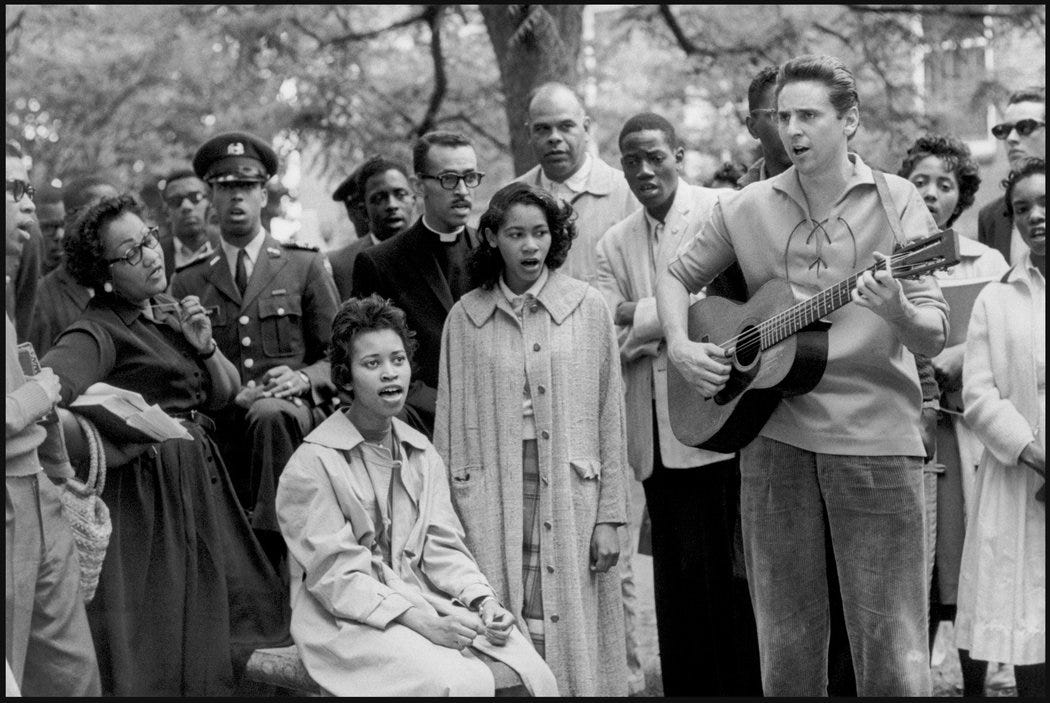
Music is the prime example. We sing and chant together to lift morale and inspire solidarity, unity, and courage. To impart strength and comfort in hard times, celebrate victories, and spur us to action.
Songs tell stories of social movements and of admirable individual activists,2 helping educate new activists and keeping memories of past movements alive.
Music is integral to movement building worldwide, though here I focus chiefly on the US, where music has been a key ingredient of struggles for justice. Examples come readily to mind: songs and chants of Civil Rights and Antiwar struggles of the sixties and seventies, and on into this new century. The anti-nuclear and anti-apartheid movements produced powerful music, as did many others. The examples are too numerous to include but a simple search of music in each of these movements elicits a plethora. Listen to them for an uplifting soundtrack to your day.
Unlike much art, where we listen or watch passively, or else, if we’re an art-maker, we create mostly in isolation, movement art is active, collective, and participatory.
Without necessarily being musicians, union and other types of activists compose new lyrics, often humorous ones, to well-known tunes to bring attention to a current issue, leading the marchers or strikers in song. Groups of community-based singers such as Labor Choruses in various places in the US carry on this long-standing tradition,
We see new music continuously created for present-day struggles, including the vibrant mobilization against the current immigration crackdown (as they did during its precursor, the sanctuary movement of the eighties), where a growing cadre of grassroots movement music makers like the indomitable Raging Grannies, and the Rapid Response Choir add their voices and panache to protests.
Singing and chanting tend to be most common, but instrumentalists like the Rude Mechanical Orchestra and other groups often accompany marches and actions.
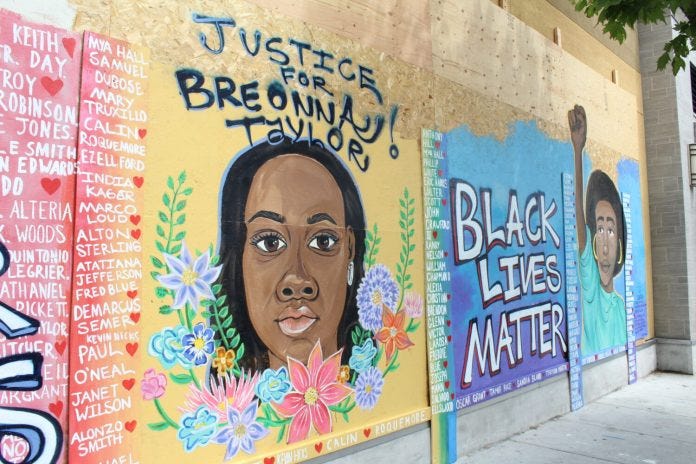
Music is probably the broadest movement art form, but many movements also integrate visual arts: in murals and posters, leaflets, and newsletters, into which activists pour huge amounts of time, creativity, and energy as they design the messages that will motivate people to join in their struggles.
Memorable banners, posters and puppets serve as key visual focal points of movements.
Those of us of a certain age carry indelible images of iconic photographs—“Napalm Girl”, the National Guard shooting students at Kent State, Mamie Till showing the world the maimed face of her son Emmett—which sparked outrage and mobilization. Other visual messages inspire critical thinking and participation, like Woodie Guthrie’s guitar and Pete Seeger’s banjo (note the link between visual image and music), and many others.
Nowadays, with everyone carrying a camera and with access to social media, the making and sharing of such images has become much more integrated into movements, with grassroots journalists’ pictures and videos of the genocide in Palestine, police violence, and other places where political and social contradictions flare up, playing a pivotal role in mobilization and resistance.
Performance art, which combines visual and kinetic elements that can be dramatic, moving, humorous, or chilling, plays a key role in conveying movement messages: dramatic “die-ins,” banner-hangings from bridges and tall buildings, giant puppets heading up demonstrations, symbolic quilts with hundreds of contributors, creative mass use of symbols. For instance, laying out body bags representing the deaths of ill-equipped front-line healthcare workers during the pandemic and, in sadly frequent occasions, piles of shoes, often children’s shoes, representing those killed in war and other instances of mass injustice or genocide.
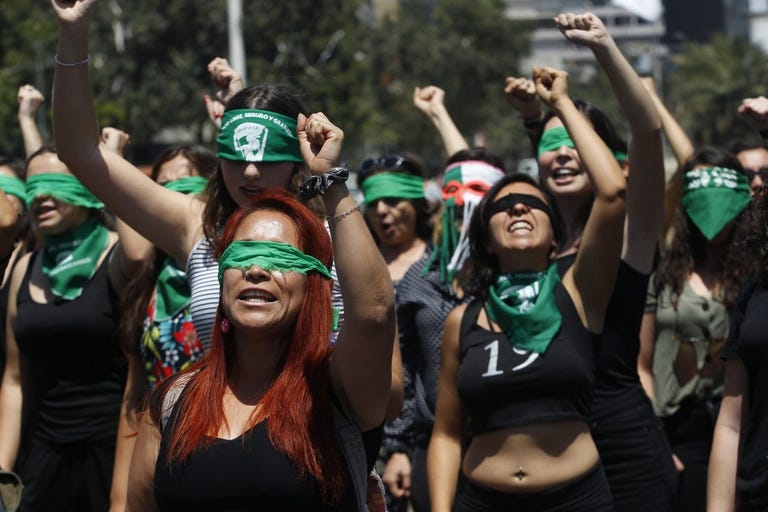
Dance, or rather, collective movement, is a less common form but is becoming a great way for people to make a visual point as an organized group, as well as to show emotion together in a uniquely compelling way, learning and performing mass spoken word and movement works like “El Violador Eres Tú” (You are the Rapist). (Image above.)
In all these cases, art has multiple movement-building purposes: it not only speaks to the activists, bystanders, and viewers witnessing it. Perhaps even more powerfully, those participating in the preparation and performance, whatever its exact nature, experience this as transformative.
Every aspect of activism, no matter the cause, issue, or constituency, incorporates illustration and graphic design on a daily basis to create leaflets and newsletters. Movements are full of unrecognized artists creating materials to educate and mobilize and supporters.
Not only the art itself is central, but also the collaborative process of making it. Painting banners and signs, creating and practicing songs and chants for activist events, and more, all help encourage participation in ways that are accessible, inclusive and fun, and provide key moments of collective work and community-building.
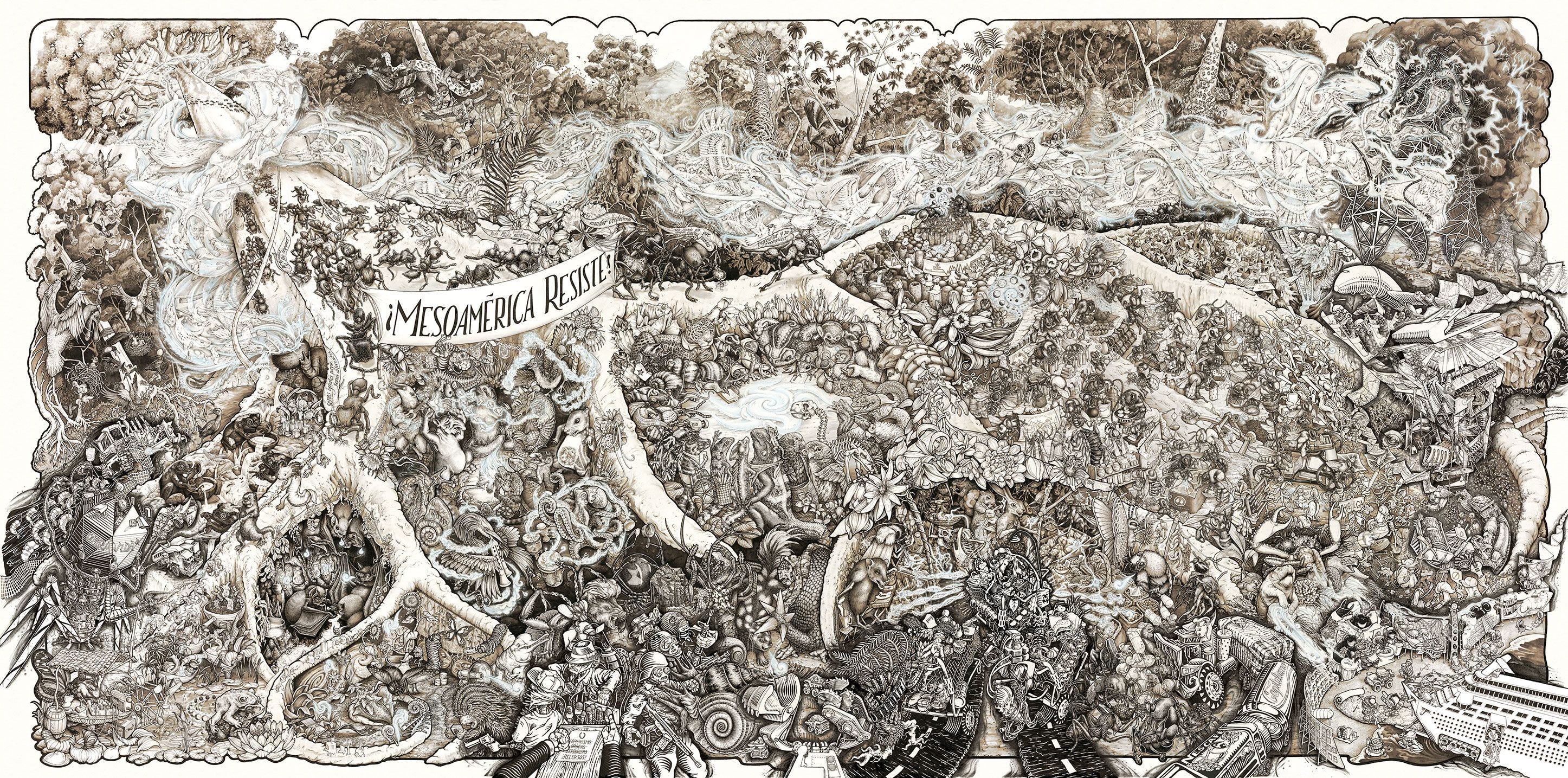
Alongside such mass participatory creativity, social justice movement-building also incorporates highly crafted art work: murals, films, photography, elaborate performance events. Taking more time, resources and expertise, these works have an important place in movement-building, educating the broader public and countering dominant narratives that paint social justice movements in negative, distorted ways. In our individualistic, celebrity-focused culture, well-known musicians and actors who speak out for justice play a positive role in bringing attention and resources to movements.


Theater also has an important role in consciousness-raising and organizing; for example, Theater of the Oppressed and talk-back theater being examples of effective tools for recounting personal experience of oppression and resistance, and for re-imagining empowered responses, as well as rehearsing actions ahead of possible confrontations with authorities, and more. The Chicano Teatro Campesino, Bread and Puppet Theater, and the San Francisco Mime Troupe are prime examples of these forms of political theater in the US, though hundreds of lesser known ones also exist in different communities and movements.
Activists write a lot, though much of this writing is nonfiction. Is there a place in social justice movements for fiction: novels, short stories, oral storytelling, feature films? TV shows? Role play games?
Unfortunately, as far as I know, at this time fiction and creating fiction aren’t really “a thing” in social movements, the way other art forms are.
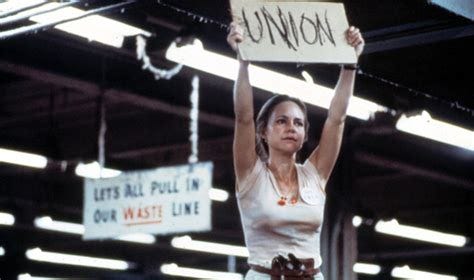
A few feature films show the realities of movement building, though it’s rare for them to focus on this, and especially rare for mainstream movies to do so authentically and empathetically. At times movies serve to start discussions, though with exceptions most of these tend to be documentaries. For discussions on movies featuring activists see my Fiction Featuring Activists series.
To me it seems logical to use such tools in our movements, to raise consciousness and inspire participation. A number of exciting practical uses come to mind.
Fiction is ideal for opening windows into the day-to-day reality of movements and activist life in all their depth and drama. Fiction enables people to share experiences and knowledge in ways that are enjoyable, involving, intriguing, compelling, enlightening.
Fiction creators portray past rebellions and imagine new ones, wrestling with big questions that arise in the midst of movements. Focusing in on interactions of a few characters enables the writer to delve into big questions in a relatable way that pulls the reader/viewer in, which is fiction’s superpower.
How can fiction written by and about activists contribute to movement building?
Humanizing activists and activism, exposing marginalizing stereotypes. Nothing counters stereotypes more effectively than authentic depictions of real people in real situations, in this case, activists engaged in activism, shown with empathy and understanding.
Opening up windows and doors into the activist world and activist culture. Normalizing the portrayal of activists can help prevent erasure, especially when repression steps up. Identifying with activist characters can help engender solidarity, as well as encourage more people to become active.
Fostering understanding, self-awareness, and empathy within the activist community.
Even more intimate than empathy, fiction brings the reader and viewer directly into the minds and bodies of the major characters. Once you identify with somebody, it becomes harder to ignore or condone mistreatment of that person. And easier to feel drawn to understanding their viewpoint.
Fiction can provide a means to explore contentious subjects by having fictional characters tackle real issues in realistic ways—even if they’re doing it in outer space or some fantasy land. The story can have characters delve into difficult issues within the activist community without naming, blaming or shaming; using instead fiction that truthfully represents reality, so participants can wrestle with the questions it raises. “Case studies” are often used in organizations to analyze issues; fiction gives us full-fledged stories, enabling us to identify with the characters and think through their challenges and conflicts along with them, as well as enjoy the excitement of their struggles and hard-won victories.
Where is Rainwood?
Black Swan Academy youth comment on Rainwood House Sings
Social Movements: Collective efforts of groups of people over time to organize and change social conditions to better reflect their interests. Activists generally refer to movements organized by working class people in the interests of justice and equality.
Activists: The highly diverse cohort of folks around the world who, at some time in their lives, step out of their private spheres and become active participants in movements for systemic change at some level, in the direction of greater fairness, inclusion, equality, human rights, compassion, and caring for the world and its inhabitants.
Comments
Nothing yet. Say the first thing.
Sign in to join the conversation.