
A small coffee shop in central Kharkiv is crowded. Late morning, outside windy, with patchy weather – glimpses of sun suddenly replaced with rain. Not a typical end of May locals would expect. At a table, two young women chatting away. “It’s almost summer and one of the pools I used to go to has barely reopened,” says one. They start talking about recreational spots on the outskirts of Kharkiv. “In this weather,” says the other, and adds: “At one pool, they put up a sign – ‘Watch out, FPV drones.’” “Yeah yeah,” the first one chimes in. “Because that’s how the hunt for people begins.” From weather to FPV drones, just like that – the last topic becoming more and more relevant. Kharkiv has lived under Russian Shahed drone assaults for years. They cruise over the city every single day. FPV drones are something the city hasn’t dealt with before.
Russian forces are hitting Kharkiv with both regular FPV drones and fiber-optic ones. And they are not the same. A regular FPV drone is guided by radio signal, transmitting a first-person view to the pilot. A fiber-optic one runs on a cable, making it almost immune to electronic warfare, its range limited only by how much cable fits on the spool, typically 20 or more kilometres. Early reports of FPV drones hitting the city date back to October 2024, when one struck a dormitory in central Kharkiv. But so far, it’s sporadic cases. Instead, the first confirmed fiber-optic drone hit the northern outskirts more recently, on February of this year.
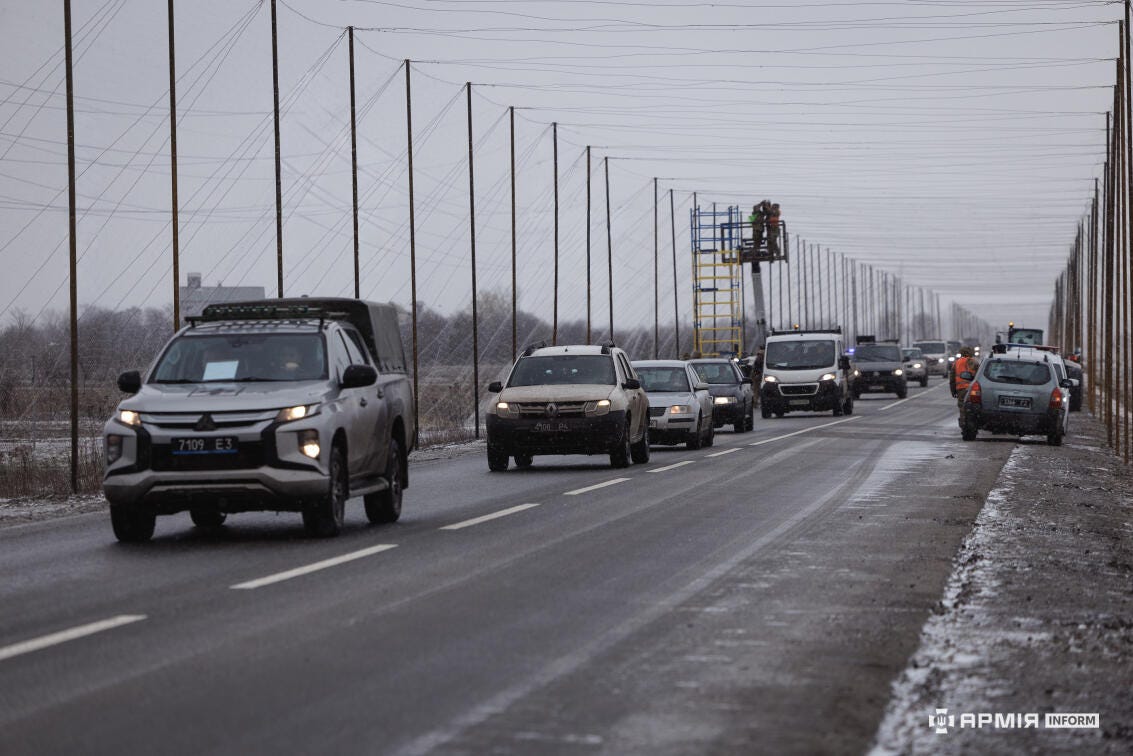
Anti-drone nets protect a section of road in Ukraine. Illustrative photo. Credits: ArmyInfrom / Yurko Stefanyak
So where does this leave Kharkiv? “There won’t be massive drone swarms on fiber optic,” a representative of the Khartia brigade’s air defense reassures the audience – city residents gathered at an event about how the city’s air defense works. Events like these have already become routine, nobody’s surprised anymore, and the interaction between military and civilians is a necessary thing during wartime. When questions start, FPV drones are among the very first – residents are worried, and they have reason to be: there’s the example of Kherson, where Russians hunt civilians using exactly these kinds of drones. For now, not massive danger in sight.
Adding to that concern is a recent attack on the ring road. On May 21st, Russians struck the bypass with five FPV drones – one of them killed a truck driver. “In general, anti-drone nets on the roads do protect. They help, they work,” Kharkiv’s sky guardians continue answering residents’ questions. The ring road is largely wrapped in netting, with the exception of a few spots.
Particularly dangerous are the so-called “waiting drones” – ambush drones. These are still small FPVs, but they don’t operate as strike drones. Instead, they lie in wait for drivers. They can hide in bushes, up in trees, or slip under the nets and sit there for hours waiting for a vehicle. It was exactly this kind of waiting drone – under the net – that killed the truck driver at the end of May.
“If Russians start hitting in a certain direction, they’ll keep hitting there – and that’s where you can reinforce protection,” the military explain. “But in general, the enemy probes for gaps using drones – if they get hit in one spot, they won’t fly back there.”
FPV drones fly low – around 40 meters – and the military mostly detect them using acoustic systems. “Usually these are large attacks, Russians launch a significant number of FPVs, and we respond fast,” one of the soldiers explains. Many get shot down on approach, while individual ones make it through to Kharkiv’s outskirts. Russians use an identical scheme with Shaheds. “Sometimes you fire off 100 rounds, take down one Shahed, and while you’re reloading another one gets through. Overall, air defense work is always about time and scale,” summarize the soldiers of the Khartia brigade.
Russians frequently use the Molniya drone model – both for reconnaissance and for strikes on the city and Kharkiv area. Sometimes Russians use this model as a “mother base” for FPVs, which then detach and fly on independently. “In this way the Molniya keeps circling so the connection isn’t lost,” the soldiers say.
In a single shift, air defense crews can hit up to 5-7 different Russian targets, from missiles to FPV drones. The air defense system overall is a complex one – it can include mobile fire groups, stationary groups, and dedicated Shahed interceptors. When engaging targets, their movement, altitude, and size are all factored in, making the entire air defense system a complex adaptive ecosystem that constantly changes. Different types of drones fly toward Kharkiv and its surroundings, and that demands different approaches to taking them down. “Fundamentally, there’s no difference between city air defense and military air defense. But overall, air defense covers both what’s in front of them and what’s behind,” the military underline.
“Drone on the center,” “UAV of undetermined type on the outskirts of Kharkiv” – messages like these jump onto locals’ phone screens one after another, right behind endless air raid alert. But life in Kharkiv keeps moving, even amid the constant danger.
“Air defense in Kharkiv has improved knock down drones lately,” says S., a Kharkiv native and drone pilot. He works directly on positions at the front line. But that’s already a different use of drones.
Independent journalism takes time and resources. If 50 readers contribute €8/month, I can do more of it. Consider supporting my work.
No posts
Comments
Nothing yet. Say the first thing.
Sign in to join the conversation.