
Last month, The New Yorker’s Jessica Contrera published an intimate portrait called “When AI Is a Member of the Family: A single mom, her two daughters, and the chatbots that fill in the gaps.”
It was an article about technology. And it also wasn’t.
For me, it was an article about each family member’s individual experiences and struggles—from banal, everyday ones to profoundly hard ones—and how each found themselves using tech as a salve.
The subject of the article, a mom named Roschelle, and her daughters, Cece and Zi, let readers into their world in a way that’s incredibly rare and generous. All three leaned on AI, to differing degrees, for support. In this day and age, people perform self-care on social media all the time. But so many of our real, personal self-help habits, attachments, and coping mechanisms remain just that: personal, hidden behind closed doors and locked screens.
The up-close look managed to capture a range of phenomena that research is just starting to reveal about how AI increasingly shows up as a source of social and emotional support in all of our personal lives.
In my own research, we’re trying to decipher what causes people to turn to AI for companionship. We’re finding that users aren’t seeking digital intimacy per se—they are reaching for ease and progress. Of course, so much of consumer-facing AI’s form factor is ease: it’s there 24-7, it doesn’t need anything (except your $20-$200 per month), and it serves up synthetic empathy and the feeling of patience our struggling moments demand.
But ease is also about access. In this case, access to support, advice, and companionship. Turning to AI makes sense when the alternative is nothing (or no one) at all: in The New Yorker profile, that was a mom up late at night alone with her thoughts, a daughter grappling with agoraphobia, and another daughter dealing with friend drama that made her feel “done with humans.”
In my own case, it’s a chronic health challenge where I have many more doctors than I do answers.
In other words, AI companionship is as much a mirror to the support that people need as it is a source of the support they are seeking. When challenges arise, and human solutions aren’t available or satisfying, AI is there. When needs and real-world social support ebb and flow, so does usage.
None of that is unique to one family or even one tool. In fact, researchers are starting to see this pattern at scale, consistently: the more support someone needs, the more likely they are to turn, and keep turning, to AI to get it.
For example, a recent survey on “Help-Seeking in the Age of AI” found that the majority of people said they would primarily turn to family members and friends for mental health support above AI. But people who reported struggling most—with depression, anxiety, even suicidal ideation—were also the most likely to say they would turn to AI, and to turn to it often. The researchers also found that over a quarter (28%) of AI users who had ever seen a human counselor reported a decrease in their use of human therapy after beginning to use AI for support.
And in a new preprint study, “AI usage patterns are shaped by perceived gains in human agency,” researchers found that people facing unpredictable circumstances—like thin support networks or health challenges or financial strain—brought AI into more sensitive parts of their lives, set fewer limits on its role, and were more likely to describe their relationship with the technology in emotional terms. (Those facing instability also reported the largest gains in perceived agency, suggesting that the less stable someone’s daily life, the more they stand to gain—or expect to gain—from AI.)
AI-enabled emotional support also evolves over time, because positive experiences with AI appear to fuel deeper reliance. In a new study, “Stumbling Into AI Emotional Dependence,” researchers describe how once AI satisfies users’ emotional needs, the more likely it is that next time they need support, they turn to AI instead of humans. In other words, the value of AI’s perceived support compounds over time.
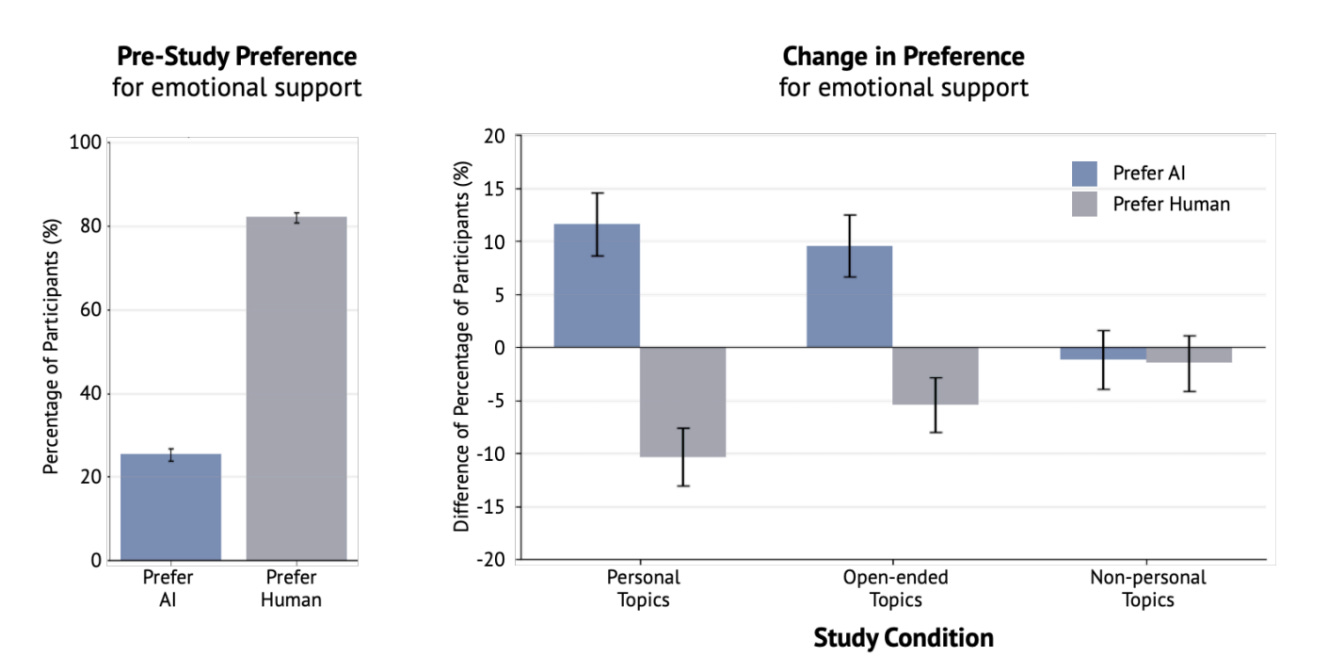
Source: Stumbling Into AI Emotional Dependence, 2026
Taken together, these studies paint a picture of why AI is a compelling solution in times when we need support and may not be finding it elsewhere, and why its supportive role in our lives may sometimes outpace what our human connections can offer.
What’s less clear is what we as a society want to do with that reality.
As I’ve written before, I’m worried that policymakers trying to regulate AI companions—especially among minors— are paying far more attention to the corporate half of the AI companion story than the human one. They’re right to be concerned about the risks the technology poses and the clear profit motives that contradict companies’ fundamental duty of care.
But by only focusing on the tech, policymakers are ignoring the root cause of the problem they’re purporting to solve: the very real, day-to-day challenges that their constituents are using AI to address.
AI companionship isn’t just about giving us smooth-talking chatbots coming for our data…it’s giving us a stark referendum on where our social structures, supports, and services are falling short. Take it away, and users will still have challenges, just one less solution.
Ultimately, that means that until our lives get easier—or other forms of social support are vastly more accessible—this technology will continue to find a place in them.
–
Postscript on industry: To be abundantly clear, I’m still very wary of what Silicon Valley is shipping. Contrera’s article made me dig deeper into Tomo, an app used by Cece and some of her high school friends, and who’s behind it. Tomo is a “personal text assistant” that texts in the manner of a BFF or a newer acquaintance trying to play it cool. Read the article for one pretty alarming example of how it’s showing up in teens’ lives.
And if you want to feel a little queasy, check out Bain Venture Capital’s explanation of why they recently invested in Tomo’s Seed round. With the hubris that only a pair of millennial venture capitalists drafting prose with the help of an LLM could summon, BVC investors insist “Tomo is AI that’s unequivocally on your side.”
It’s literally not. That’s money talking, not your best interest.
As VC memos go, this is right up there with a16z’s 2023 “It’s Not a Computer, It’s a Companion!” that first awakened me to the contours of this market and the capital behind it, not to mention the brazen assumptions investors are making about disrupting human help as we know it. Clearly, they’re just getting started.
–
Until September: I’m out the rest of the month for some much-needed time with family and friends in California, Seattle, Montana, and Colorado. Will be back at it in the first week of September, when we’re releasing some exciting new work on prosocial AI - excited to share it with you!
No posts
Comments
Nothing yet. Say the first thing.
Sign in to join the conversation.