
Last month, a few days into the new year, a friend asked me for my resolutions over dinner. My plans for 2026.
But it was hard for me to imagine the future. I was meant to go to Thailand the following week for a dance facilitation program, but it felt impossible to even believe I was going. I would only believe it once I was physically on the plane.
Later that night, I left dinner, and wondered why it was so hard for me to think past the present moment. And more than anything, to explain to others why it felt so challenging. I then remembered this idea of narrative wreckage, a term coined by sociologist Arthur Frank in his book, “The Wounded Storyteller.” It describes the breakdown of a person’s coherent life story due to overwhelming experiences like serious illness, trauma, or major life disruption, leaving them feeling unable to map out a future, and requiring a process of storytelling and self-reconstruction to find new meaning and coherence.
Frank described 3 main type of illness narratives: the restitution narrative, the chaos narrative, and the quest:
“Restitution involves a sickness which fully resolves, leaving the person “good as new.” The chaos narrative is the opposite of restitution; it has no order and provides no answers. It provokes anxiety in its revelation of vulnerability, futility, and impotence in the face of suffering. Finally, quest narratives meet suffering head-on. “They accept illness and seek to use it. Illness is the occasion of a journey that becomes a quest. What is quested for may never be wholly clear, but the quest is defined by the ill person’s belief that something is to be gained through the experience.” Something transformative (learning or personal growth) happens through this type of illness story, even if healing is impossible.
I felt both of the last two types of narrarives deeply. There was chaos, to be sure, but also this desire to seek meaning and find transformation through this pain. I always felt that despite all the suffering, my illness had still changed me for good, into a more open, vulnerable person. That it was helping me seek something more.
A few days before I left for Thailand, I went on a date with someone I had known for ten years. We first met in a writing class out of college, and then they left New York. But he let me know they were in town for the week. I was surprised when they asked me out on a date— I always thought he only wanted to be friends.
It was nice to catch up after not seeing each other for a few years, to see how much we had both changed. We went to a diner and sipped hot chocolate. At the end of the night, as he walked towards the subway, he stopped and looked at me.
“You know, the last time we saw each other a few years ago, you told me something serious was happening with your eyes. I think you had just gotten surgery. And I could see something had changed in you. You were more open. Easier to talk to. I remember thinking, I wanted to know this new Julia.”
I smiled. I felt the shift too, but it was still surreal to have him mirror this sentiment back to me.
As I prepared for my trip to Thailand, I realized, maybe it wasn’t useful to keep navigating with my old map, my old narrative of how to live. Maybe I needed to create a new one entirely.
This mindset is how I tried to go into this trip. Initially, I was really anxious to go back to the same places I went three ago, afraid to compare them to my old experiences which were so life changing for me and put me on this path towards dance and community gathering. But it’s been better than I imagined.
The two trips have been so completely different. It’s been interesting to be in these same places, but notice the change in myself. Notice I’m not the same person I was then.
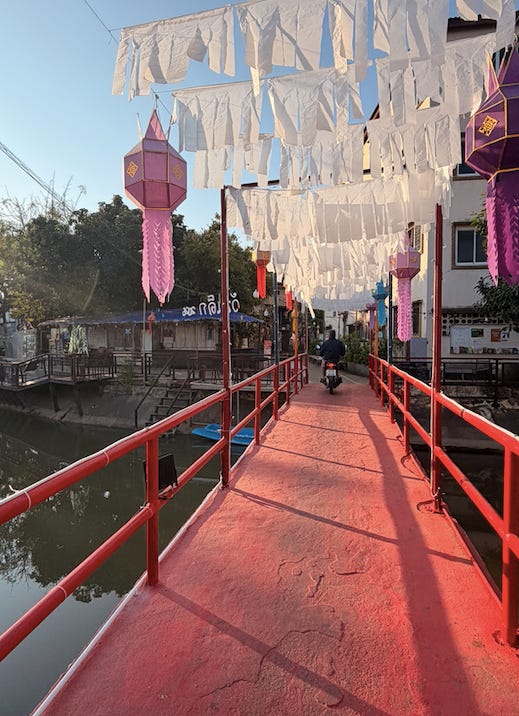
When I was traveling in South East Asia three years ago, it was after multiple eye surgeries, and I was so deliriously happy with my newfound freedom, I couldn’t stop moving around every two days. It was exciting, but I was also traveling as if I might have to go back to the hospital any moment, and it ultimately burned me out quickly.
Now, I’m moving slower, more intentionally. Feeling aware of when I still feel those symptoms of being scared time is running out, which might always be with me, but this time I try to just see it, name it, and let it go. I get to put everything I learned three years ago into practice, and now lead workshops and DJ dances at festivals in Thailand and Indonesia.
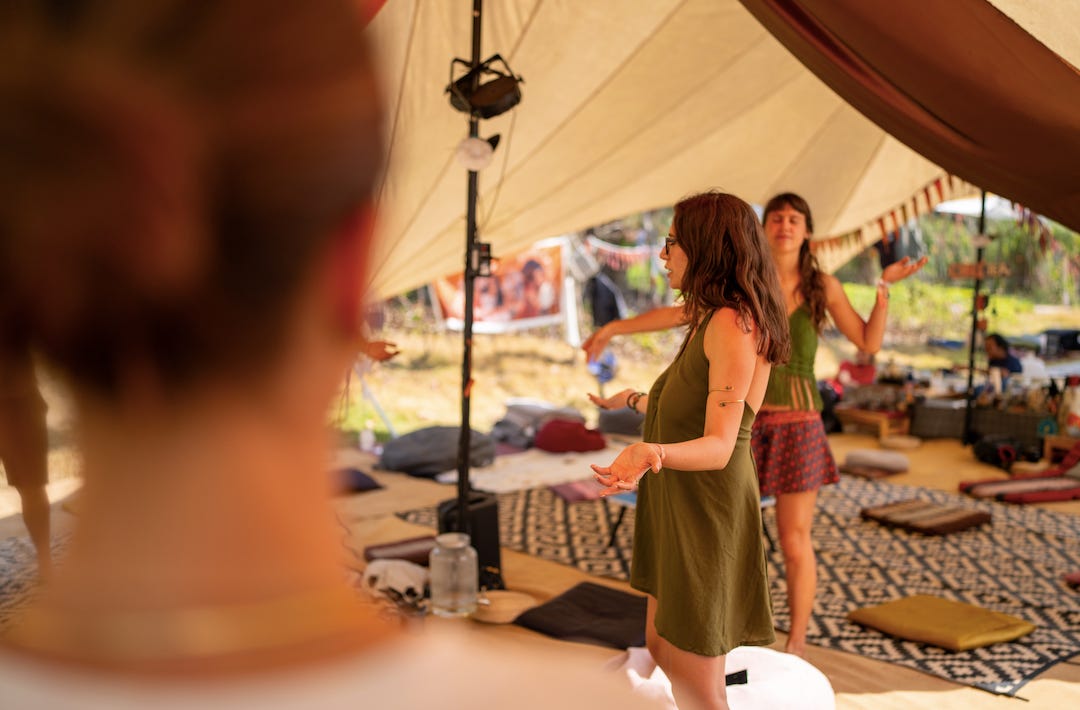
It’s all still evolving and I’m always learning, but it’s been nice to feel and notice this change while I’m here.
I was in Thailand for one month. I started off my trip by taking part in a dance facilitator program to learn about Dance Mandala, a form of dance that originated in Chiang Mai. It’s much slower than 5 rhythms and ecstatic dance, and is almost more of a movement meditation. I first found out about it when I was at Shambala, a festival in the mountains of Chang Dao, and met a woman at a drum circle who had just completed the program. I thought about the program on and off for the past few years, and remembered it again in the fall, when I saw they had an in person program starting in January.
I went into it trying to be as open as I could, but also always carrying my own hesitance when entering any wellness type of space. It’s really hard to hold these kinds of spaces, and to know that the person leading these programs is there for the right reasons. When I first started the program, I had a lot of resistance to it, to be honest. It was really slow, and deeply disorganized. When I asked the leader about the lack of structure, they just told me to be patient and all would reveal itself. But nothing started on time and we rarely got to everything we were meant to in a day. I kept trying to be patient, but also something in me wanted to run.
In fact, I even booked a taxi to leave early. My roommate at the program called me “the runaway.” But I also can acknowledge that I have this tendency to run, especially when I don’t feel safe. Maybe it’s part of my medical trauma, maybe it’s just my natural response at this point. But I always like to have an escape route. Still, I let myself stay. To tell myself I should just enjoy the slowness. Some days, there were small signs encouraging me it was the right choice.
One day, we learned about how the four tenants of Buddhism helped to inform the foundation of Dance Mandala: Metta (Loving-kindness), Karuna (Compassion), Mudita (Sympathetic Joy), and Upekkha (Equanimity). Reading further into it, one of the definitions for Karuna (compassion) was “the tender courage to meet suffering with presence.”
It felt eerily familiar. When I read that, I flipped back in my notebook to an entry from a week earlier, at a journaling workshop I led in the first week of January.
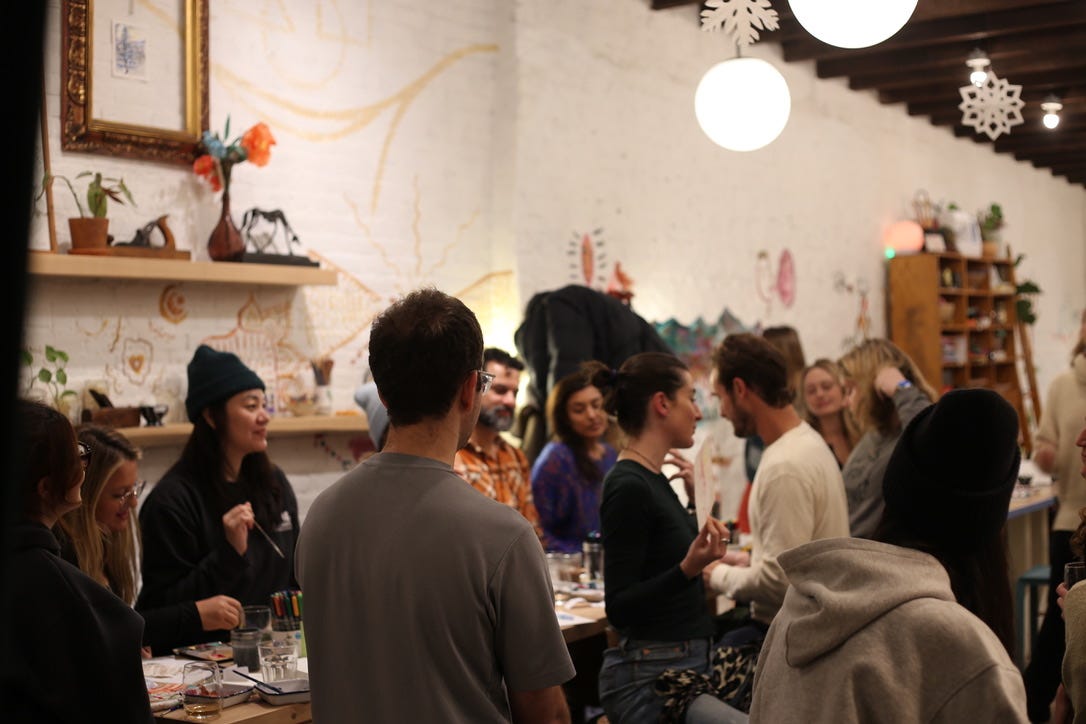
One of the prompts I offered asked for a word or phrase you wanted to embody in this new year. I had written down “gentle courage.” I remember not even being sure what I meant by it at the time I wrote it, but it just flowed out of me instantly. Deep down, I knew it was a courage to be softer, more vulnerable. Braver with my emotions.
And here it was, staring back at me in the workbook for this program. A small sign that it felt okay to stay here, to keep feeling it out.
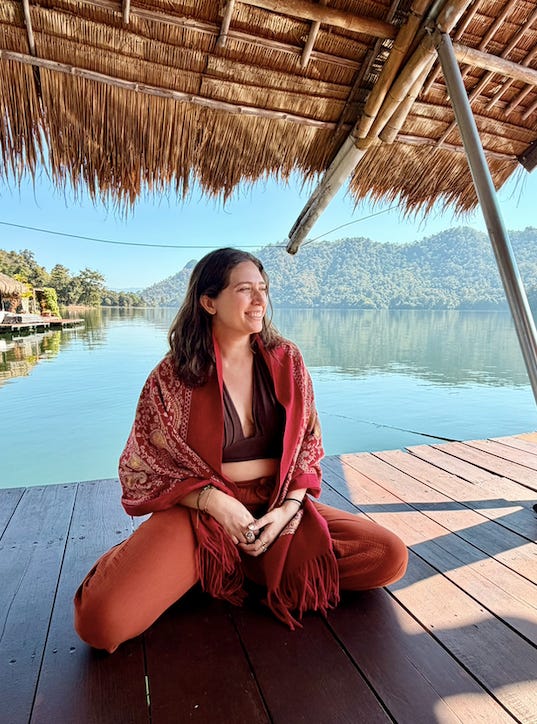
Ultimately, I’m glad I stayed, and think I really did learn helpful tools about dance facilitation, although the program ended up being much more dramatic than I expected.
By the last few days, there was almost no organization in the program. We had stopped dancing completely, and everyone in the program really felt they weren’t getting what they had expected from the experience. The leader of the program was absent a lot, and many people were frustrated. (I don’t want to name them, or dissuade anyone from this program. I think other people enjoyed it. It just persoanlly wasn’t what I expected.)
One day, the leader sensed the frustration and asked me if something was wrong. I noticed everyone was already individually upset, but too afraid to share how they were feeling. So, I suggested a safe way we could all talk together. In the morning, everyone aired their grievances in a share circle, until every single person was crying. She admitted that we were right, it had been disorganized, but she didn’t give herself enough time to prepare or organize the program.
At this point, I was disappointed to hear this, as I had put in a lot of effort to be there, and it didn’t feel like this was matched at all by the leader of the program when she said she put no time into it. After our circle, the leader mentioned that there was clearly a “trickster” in our midst and we had to rid the dance studio of the tricker. I wondered if I, perhaps, could be the trickster. But maybe there was another trickster I wasn’t aware of. She had a girl run to the kitchen and get an orange and place it somewhere in the garden to lure the trickster away. Then we all had to dance backwards with our tongues out to banish the trickster for good…
After hours of this, I couldn’t handle much more. That day I happened to know about a music festival occurring only a hour ago with all local Thai musicians. To me, that sounded like a much better way to spend my time. So, it looked like the ceremony worked. I told them I’d be leaving for the day to go to the music festival, and another girl from the program went with me. After that point, I was not only named “the runaway” but also “the trouble maker.”
I wished the program hadn’t turned out this way, but all just felt very silly to me. Everyone spent more time at the program crying than dancing, and ultimately dance to me was about joy and feeling connected to my body, and I felt none of that at this program. Only deeply frustrated and stressed out, with a constant desire to escape. So, I went to the festival and I’m very glad I did. I danced in that one night more than I had in two weeks, made great friends, and met these incredible ecstatic dancers from South Korea who invited me to DJ there one day.
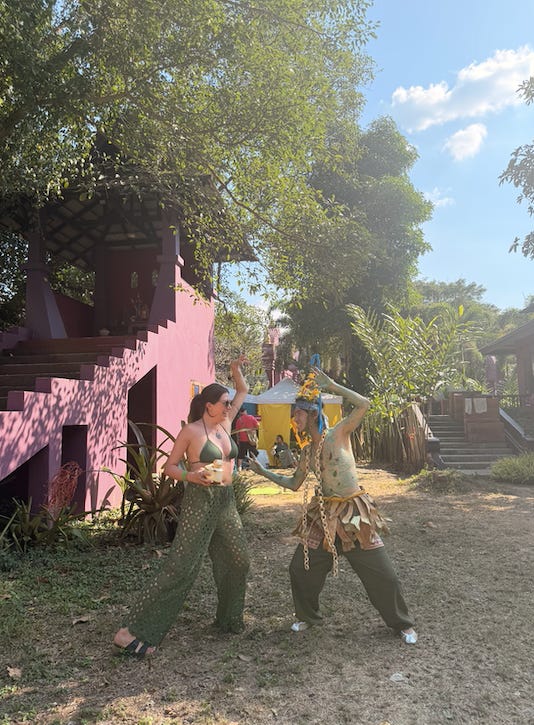
After dancing and practice my Korean, I returned to the program. We all danced one last time and I facilitated a Dance Mandala for some locals from Chiang Mai.
Some of the girls who stayed at the program revealed to me that they had snuck out to the garden and eaten the orange as an act of rebellion. They happened to eat it the day I came back from the festival, so maybe the ceremony worked after all.
Ultimately, no experience is ever a bad one. There’s always an opportunity to learn. It showed me that even when I find it frustrating, it can still be helpful to move slowly. That is can be helpful to stay with an experience, even when I feel the impulse to leave.
It also allowed me a lot of helpful space to think about dance in relation to my body, and to this idea of pain as a powerful portal for dance. How the pain we experience can be used as a tool for dance. I noticed that many other people in the program also struggled with their own medical issues, and I wondered if physical trauma could be another door to understand our bodies in relation to movement in an even deeper way.
Just like how when you are sick and need to be alert and aware when something has changed or is wrong, I think that can extend to connecting to our own body wisdom and inform how we move. I’ll be writing more about this in the future, but it’s was really inspiring to think about pain as a portal to freedom, rather than a locked door.
After the program, as I continued to travel through northern Thailand, I thought about my intentions for the rest of my trip. I wanted to let go of this fear that follows me in my body sometimes. I wanted to get better at naming this fear, and then letting it go. I wanted to let go of this insatiable desire for more. I wanted to feel satisfied. I wanted to feel still.
I wanted to feel what it feels like to be in one place and not want to see another. What would that be like, to simply exist? To not be afraid of not having enough time to live more lives?
One day, my friend told me about an elephant she saw at a rescue sanctuary she visited.
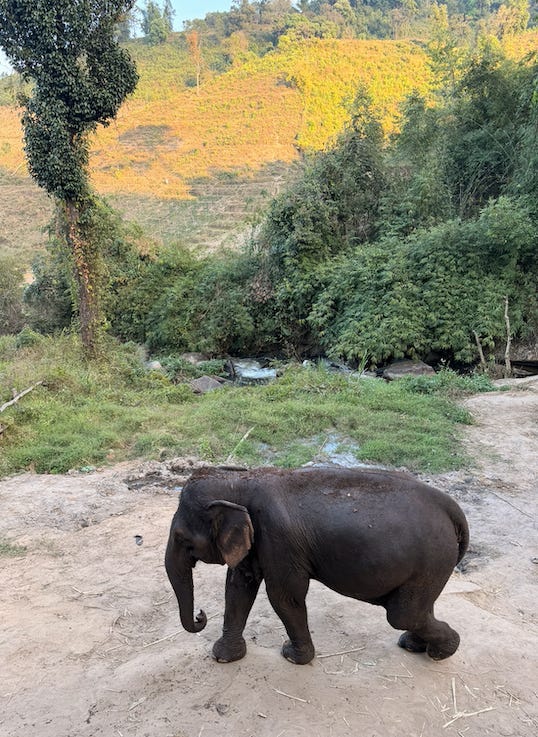
How the elephant used to dance in the circus, and was used to being chained and trained to dance at midday every day. How even now, five years later, even without its chains, it still danced at midday, the memory of its chains still in the elephants body, its back leg stuck to the ground, an imaginary chain always there.
I think dance is how I can free myself of these chains. By moving with my pain, and letting it move through my body, until, eventually, I can feel free and safe.
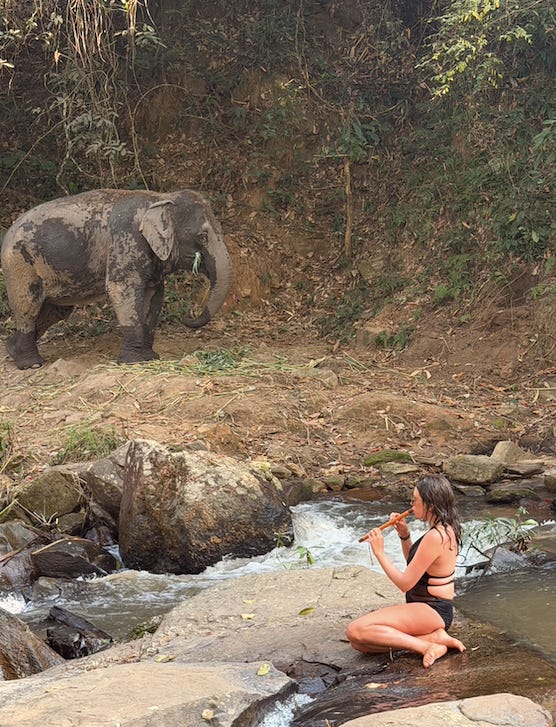
Thank you for reading, and for witnessing this journey.
Love,
Julia
Comments
Nothing yet. Say the first thing.
Sign in to join the conversation.