
Hello, friends! I used to aspire to plan themes for these posts and long ago gave up, only to doom myself to the monthly challenge of reverse-engineering them. This month, I was pleasantly surprised to unearth a very familiar geometric shape at the heart of each of these three novels.
May I present to you a triangle of literary love triangles!
The first novel, a recent release by Eric Puchner, takes the most straightforward approach to the love triangle concept, while the latter two incorporate rather unexpected angles. I’m hopeful that one or more will be a perfect fit for those triangular-shaped holes in your TBR pile.

Dream State by Eric Puchner
“What is it you want to do then? With your life?” “Good question,” Cece mumbled. Also a strange one, as if your life were a tool that had only one function. (Someone had handed you this weird thing, your life, and now everyone kept asking—quite reasonably perhaps—“So what are you going to do with that?”)
Dream State is not my usual kind of novel—among the 100+ books I’ve covered here in the past three years, I’m pretty sure you’ll find none with jacket copy references to impending wedding days (I find the artificial drama of a wedding set-up to be particularly tedious—this may also be why I’ve never managed to get past the first paragraph of Pride and Prejudice). I’m also not particularly drawn to long third-person novels about otherwise very comfortable people blowing up their lives without much external assistance. But damn, this one is a great story, full of tension, complex character development, and delightful reversals.
The novel centers around a modest family vacation house on a lake in northwest Montana (much is made of the highway that interferes with the house’s view of the lake). The house isn’t as initially dominant a character in the way the house in, say, Daniel Mason’s North Woods is prominent through that book. It’s more like the house comes to the fore at the end of the novel much like the dog’s character in William Maxwell’s So Long, See You Tomorrow. Climate change also plays a key role in a way that feels very true to my own experiences of living in the Mountain West. The main human focus of the book is a love triangle between Cece, her doctor fiancé Charlie (whose family owns the house), and Charlie’s old college friend Garrett (who grew up and still lives in the area, working as an airport baggage handler). It begins with Cece and Charlie’s wedding day in 2004 and then repeatedly leaps forward in time, eventually taking us beyond the present to a near future in which we see the long range consequences of the characters’ relationship choices as they age—including the impact on their kids’ lives.
Puchner has a real gift for nailing fresh descriptions of everyday experiences: “sharking” a parking lot, garment bags “heavy as a slain deer,” raspberries “pluck[ed]...from their thorny white middles, like bees from their stingers.” But the real joy of reading for me was in seeing how the larger themes about dreams and love and questioning one’s major life choices kept deepening and resonating in new ways. The weird metaphor that comes to mind is watching someone transform flour, yeast, salt, and water into bread—it’s like Puchner folds the same thematic material over and over itself and to create something fresher and far more remarkable than the original ingredients.
I also enjoyed Puchner’s use of an omniscient roving third person narrator who occasionally breaks the fourth wall in ways that remind me of the Stage Manager in Our Town: “What a simple story this would be, if we paid no attention to Charlie. But here he is, unlatching the gate to the orchard. He looks a bit lost, too—or at least misplaced. He’s wearing a trucker’s cap, something he does only in Montana, which, combined with his pale legs and designer eyeglasses, makes him look faintly ridiculous. He knows this, of course, but it doesn’t bother him.”
In short, Dream State is a place to get lost in for a while. The wedding drama stays a framing device rather than a focal point, and the reader ends up with a nuanced portrait of a love triangle over time.
![What Was She Thinking? [Notes on a Scandal] by Zoë Heller | Goodreads](https://substackcdn.com/image/fetch/$s_!jFU2!,f_auto,q_auto:good,fl_progressive:steep/https%3A%2F%2Fsubstack-post-media.s3.amazonaws.com%2Fpublic%2Fimages%2Fe5fc41e2-533b-4e03-b2da-7baab21d34d6_316x475.jpeg "What Was She Thinking? [Notes on a Scandal] by Zoë Heller | Goodreads")
Notes on a Scandal by Zoë Heller
The only possible explanation that the journalists can find for my having voluntarily associated myself with Sheba’s debauchery is that I am, in some as yet shadowy way, debauched myself. In the weeks since Sheba’s arrest, I have been required, on several occasions, to speak to reporters on her behalf, and as a result, I am now known to readers of the Sun as “the saucy schoolteacher’s spin doctor.” (Those who know me can attest to what an unlikely candidate I am for such a soubriquet.) My naïve hope, in acting as Sheba’s spokeswoman, has been to counter some of the sanctimonious hostility towards my friend, and to shed a little light on the true nature of her complex personality. But, alas, my contributions have done no such thing.
Shortlisted for the 2003 Man Booker Prize, this novel seems to have two titles, depending on where/when it was released. The U.S. version is technically the mouthful What Was She Thinking? Notes on a Scandal. However, it seems most widely known as Notes on Scandal, in keeping with the title of the 2006 film version (which I have yet to see). It’s about a toxic, highly controlling friendship between two teachers at a London school that develops after one of the teachers becomes sexually involved with a student. In this case, the love triangle is not the conventional sort but more of a triangle of enmeshment and infatuation, more codependent than romantic.
The writing is great, but my favorite aspect of the book was the experience of falling under the narrator’s spell, that sense of the story speeding up as it unspools, playing on a certain subversion of expectations. I love an unreliable, slippery first-person narrator, and this is a classic example. Don’t be turned off by the first couple of pages—I was worried at first that the story was going to focus much more in detail in the physical relationship between the teacher and student, but thankfully, that soon takes a backseat to the dynamics between the two adult characters.
I also tip my cap to Heller for writing a novel with a teacher protagonist without including any jarringly implausible professional details. By contrast, I once saw an otherwise perfectly good novel spoiled by a plot point wherein an elementary teacher repeatedly gets away with leaving school early while her class is at elective, failing to consider that…the kids would have to come back and get their backpacks from her classroom before final dismissal. In Heller’s case, I would have guessed she’d spent at least a year teaching in some London high school, though her Wikipedia bio suggests no such experience. Her teachers are fully, unsettlingly human, not tropes.
If you enjoyed Kazuo Ishiguro’s 2005 novel Never Let Me Go, I think this one has some unexpected commonalities. Both take place in the late 1990s/early 2000s England with a school playing a key but not quite central role; they also have similar first-person narrators—direct on their face, but obfuscating in subtle ways. Though the direction Heller’s novel takes is entirely different from Ishiguro’s (no sci-fi or speculative elements), there is a similar sense of swerve, where the book turns out to be not quite the book you initially think you’re reading.
Overall, this was a book that just got better and better, and the ending is pitch perfect, like the ending of Shirley Jackson’s The Haunting of Hill House pitch perfect. It’s been echoing in my mind ever since I finished it.
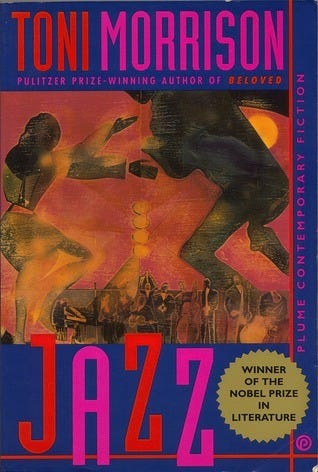
Little of that makes for love, but it does pump desire. The woman who churned a man’s blood as she leaned all alone on a fence by a country road might not expect even to catch his eye in the City. But if she is clipping quickly down the big-city street in heels, swinging her purse, or sitting on a stoop with a cool beer in her hand, dangling her shoe from the toes of her foot, the man, reacting to her posture, to soft skin on stone, the weight of the building stressing the delicate, dangling shoe, is captured. And he’d think it was the woman he wanted, and not some combination of curved stone, and a swinging, high-heeled shoe moving in and out of sunlight.
I have to give a shout-out to Kimberly King Parsons here (if you haven’t already read her fiction, you might remember her name from my November 2024 post after I got back from workshopping with her at Tin House). After reading the previous two novels, I fell into a bit of a reading funk, first because I’d enjoyed those two so much and secondly because I’d made the mistake of picking up a new novel that I knew wasn’t really up my alley purely due to the all the buzz flying around it (literally and figuratively—IYKYK). Unlike with Dream State, my original instinct that it wasn’t for me was correct, then I was really sour and at loose ends for what to read next for a solid week until I discovered Kim’s recent post analyzing the first paragraph of Jazz on her new Substack First Breath. (Kim’s writing is as beautiful in her critical analysis as it is in her fiction, and I will forgive you if you wander off and get lost in her posts now and forget to come back and read this. It will be time well spent.)
Jazz happened to be one of five Toni Morrison novels on my shelves and—bearing out Kim’s observation that it is one of the lesser read of Morrison’s novels—the only one I had yet to read. It’s now my favorite of her works and might well be in my top 10 all-time (I try not to examine this mental list too often because I think it might have almost 20 books on it by now).
First, the writing is off-the-charts, take-your-breath away on every page, every sentence. Second, I’m pretty sure this is the hands-down best novel I’ve ever read about New York City (and there are A LOT of novels about New York City), in this case set mainly in Harlem during the 1920s. And third, if I thought Heller was casting a spell with her narrator, what Morrison has done here defies the first law of thermodynamics. There’s an extremely mysterious first-person narrator, someone who at first reminded me of that neighbor lady in Ann Petry’s The Street who is always sitting in the front window of her apartment snooping on everybody else’s lives. What Morrison eventually does with this narrator in the book’s final pages is a fairly quiet move compared to the characters’ actions, but it feels to me like a move on par with the big reveal at the end of Tim O’Brien’s The Things They Carried or when the true frame of Absalom, Absalom! clicks into place on the last page or two.
In Jazz, Morrison dishes out most of the central plot in the first few pages—an older woman goes back to her husband after she tries to cut the face of a dead girl whom he killed after being her secret lover—so the driving questions are not what happens but how and why (and, most intriguingly to me, how does that narrator fit into all of this???). It’s also like William Faulkner’s Absalom, Absalom! and Fernanda Melchor’s Hurricane Season in that way—giving repeatedly circling and sometimes contradicting accounts of the same key details and events. The most astonishing magic, however, happens in the space of that other triangle: between the characters, the narrator, and the reader.
Though I’m not sure that the adversarial nature of the metaphor holds, reading Jazz for me was a little like getting beaten at chess by a really excellent and gracious player (the kind where you are just excited to have lasted as long as you have into the game to make it feel like a good one but know you have no hope of winning), and when you think the checkmate is imminent but perhaps still a few moves away (say, from the queen), it shows up in a far more elegant and heart-stopping combination that you didn’t even see coming.
If you already love Toni Morrison’s work and haven’t read this one, go read this novel, and if you don’t already love her work, go read this novel. Like all of her books, it’s rich and dense and will thoroughly reward your patience if you give yourself whatever time you need to fully absorb it.
Before I sign off, I have some bittersweet news to share—two weeks ago, I published what may be my last book review for the Pittsburgh Post-Gazette, on T Kira Madden’s debut novel Whidbey. It doesn’t quite fit the triangle theme, but it’s really an excellent book. My review was also quoted on Lit Hub’s Book Marks, which was exciting for me (it’s the first time this has happened!).
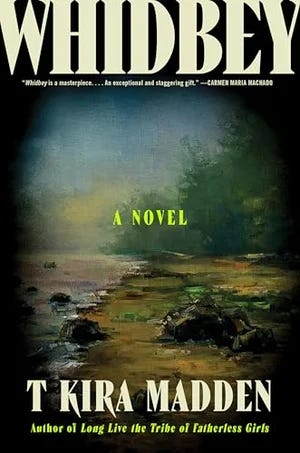
PPG is expected to close down in early May after 240 years of publication (though there’s a glimmer of hope for its survival—I just ran across this cautiously optimistic report from CBS that they might find new ownership). This hits close to home for me not only because it’s where I got my start in writing book criticism, thanks to InReview editor Adriana Ramírez, but because it’s also my hometown newspaper. My grandparents read it back when it was the Pittsburgh Post, and my great-grandparents may have read it as well (though I’m not sure if they could read in English). When I lived in Pittsburgh in my twenties, I subscribed to it and read it daily. My dear 95-year-old cousin Annie still reads it (hi, Annie!) and always looks for and cuts out my book reviews. I’m very sad to see it go.
All of this to say, in a time when a lot of journalism outlets are struggling, if you are fortunate enough to live in a place that still has a local newspaper, I hope you’ll subscribe or stay subscribed if you can, and if not, find some other way to support local journalism, not just for book coverage but more broadly as well.
I also really appreciate your subscription here. :) Here are some handy buttons if you aren’t already a subscriber and wish to be, or have a friend who might enjoy these posts:
As always, many thanks for reading!
Until next time,
Jules
No posts
Comments
Nothing yet. Say the first thing.
Sign in to join the conversation.