

I recently heard a Canadian writer use the metaphor of a fire hose to describe the current output of American literature. Considering that every Tuesday marks the release of another dozen-plus literary fiction titles, this feels like a fair assessment. Deciding what to read amidst so many options can be overwhelming, and as I write these posts, I always hope they might serve as a useful antidote to those seemingly endless “What to Read” lists: the fire hose brought down to the more manageable size of a drinking fountain, with a splash of serendipity.
In this spirit, I’ve been focusing more on the books already on my shelves and seeking out a more recent release only when a friend recommends it. This month, I’m pleased to share with you one brand-new debut as well as two older titles that have been hanging out on my bookshelves for years.
“Who can know what will come? Today a kingdom. A life where you eat and drink from dreams. Tomorrow, the dirt of the grave to rub on your mouth.”
- Qandi Gul, Sharaf Family Friend
“It was a terrible thing. Khud degah. But after everything else, who was surprised? If that was her start, then of course this was her finish.”
– Zarghoona Hamdard, Sharaf Family Friend
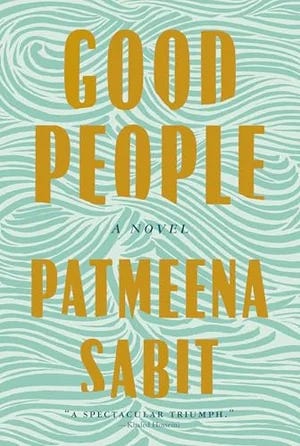
This debut novel came recommended by the same friend who introduced me to Virginia Evans’ The Correspondent last month, and it did not disappoint. It’s a polyphonic page-turner with some thriller elements, focused on the Sharafs, a wealthy Afghan American immigrant family in Fairfax, Virginia; the general premise is that Something Bad happens on what otherwise appears to be an innocuous family road trip to Niagara Falls. Sabit withholds the details of this central tragedy a bit long, but the shift in the tenor after that big reveal lands quite powerfully as a result. So, if you find yourself feeling impatient during the first hundred pages, know that the rest of the book will reward you, once all the cards are on the table and you can really see the conflict at the heart of the book.
Like The Correspondent, Good People has an unusual narrative conceit involving very short chapters, but instead of letters, we get snatches of witness interviews from an ongoing investigation, as well as the occasional news article. Some chapters are only a paragraph or a sentence or two; most are one or two pages. Many narrators repeat—family friends and relatives, the teenage daughter Zorah’s high school classmates—while others are one-offs from hotel employees or gas station attendants who happened to interact with the family in the day or two leading up to the tragedy. Sabit does a wonderful job of playing these distinctive voices off of each other.
Two of my favorites were these catty, two-faced women, Torpekey Rasul and Zarghoona, who are labeled Sharaf family friends but are anything but. For example, at one point, Torpekey Rasul says: “They’re saying I was spreading the word? Let me tell you one thing about these people. These fatherless dogs would slander the Holy Prophet’s own daughter if they could. Yanih, that’s the kind of people they are. The truth is I knew before anyone, but I kept the word to myself. I don’t get involved in such things. All I want is to live with my family in peace and quiet, eating the bread that God has apportioned to us, away from all their filthy gossip. But do you know where most people found out? From Zarghoona. At Farid Wardak’s daughter’s wedding she closed her eyes and opened her mouth and told everyone who had ears. She’s one of our elders and I have great respect for her, but she’s always been like that. The whole world knows it.”
Overall, Sabit does a masterful job both protecting and indicting the Sharaf family—and the broader Afghan American community—with respect to their culpability. She also digs into how the media narratives around the tragedy are inflected by Islamophobia and make it all the more difficult to work out the truth of what happened. She leaves a lot of room for the reader to draw their own conclusions, which sounds like a potential recipe for frustration, but in this case, it’s exceedingly satisfying.
The Last Report on the Miracles at Little No Horse by Louise Erdrich
The bank was a solid square of Nebraska limestone, great windowed with deep blond sills and brass handles on the doors. The high ceiling was of ornate, white, pressed tin set off by thick crown moldings and a center medallion of sheaves of wheat. In the summer great fans turned the sluggish air, and the velvet-roped lanes and spittoons, the pink and gray mica-flecked granite countertops, and the teller’s cages seemed caught in a dim hush of order while outside the noise of the town continued, erratic. The relationship between the getting of money, a scrabbling and disorderly business, contrasted with the storing of money, an enterprise based on the satisfactory premise that human effort, struggle, even time itself, could be quantified, counted, stacked neatly away in a safe.
It’s funny, this book has lived with me now more than a decade longer than the ex who gave it to me, and I can’t decide if I haven’t read it before out of stubbornness or just because the time wasn’t right. I’ve started it at least twice over the years before finally digging in and finishing it this time. I’m glad I did—it’s a good one.
It’s essentially the life story of a woman named Agnes DeWitt, and a Catholic priest by the name of Father Damien Modeste, who are in fact the same person. Much as Agnes/Father Damien lives in this in-between and both/and state with respect to gender, there’s an accompanying exploration of the intersections between Catholic theology and Anishinaabeg faith traditions throughout the book as Father Damien wrestles with the good or harm he may have done over the years in the Ojibwe community with which he has become enmeshed, albeit as an outsider.
This feels like really classic Erdrich, a meaty, wandering novel-to-get-lost-in. This one reminds me a little of Gabriel García Márquez’s One Hundred Years of Solitude as well, both with the complicated, interwoven family trees and the episodic and circular mode of storytelling. (That’s another book that I started and stopped at least twice before finally coming around to finish.) Though the novel was slow-going at times and I regularly had to refer back to the family trees to keep track of who was who and in relation to whom, it was a deep pleasure to read. It’s also worth knowing that piano music figures prominently in the plot in the first 50 or so pages—the main character is obsessed with Chopin—and it helps to have some familiarity with the musical references. Until quite recently, I didn’t know how to pronounce Chopin correctly, much less have any frame of reference for what it would mean for one of the convent sisters to destroy all the music in the convent except for that composed by Bach.
If you aren’t already familiar with her work, Erdrich is a magnificent writer both at the sentence and structural levels, with a wonderful touch of humor throughout. There’s a kind of exuberance in her style, an expansiveness that I find very refreshing. (I’m rooting for Erdrich to be the next American to win the Nobel Prize for Literature—just calling it now.) Whether you’re already a fan or want a great introduction to her work knowing many riches await, don’t wait fifteen years to read this one.
I also have to briefly plug a recent TNY Fiction episode in which Karen Russell discusses Erdrich’s story “The Stone” with Deborah Treisman. It’s an incredible story, and the last line might be one of the very best last story lines I’ve ever read.
Spoon River Anthology by Edgar Lee Masters
It is all very well, but for myself I know/ I stirred certain vibrations in Spoon River/ Which are my true epitaph, more lasting than stone. (Percival Sharp)
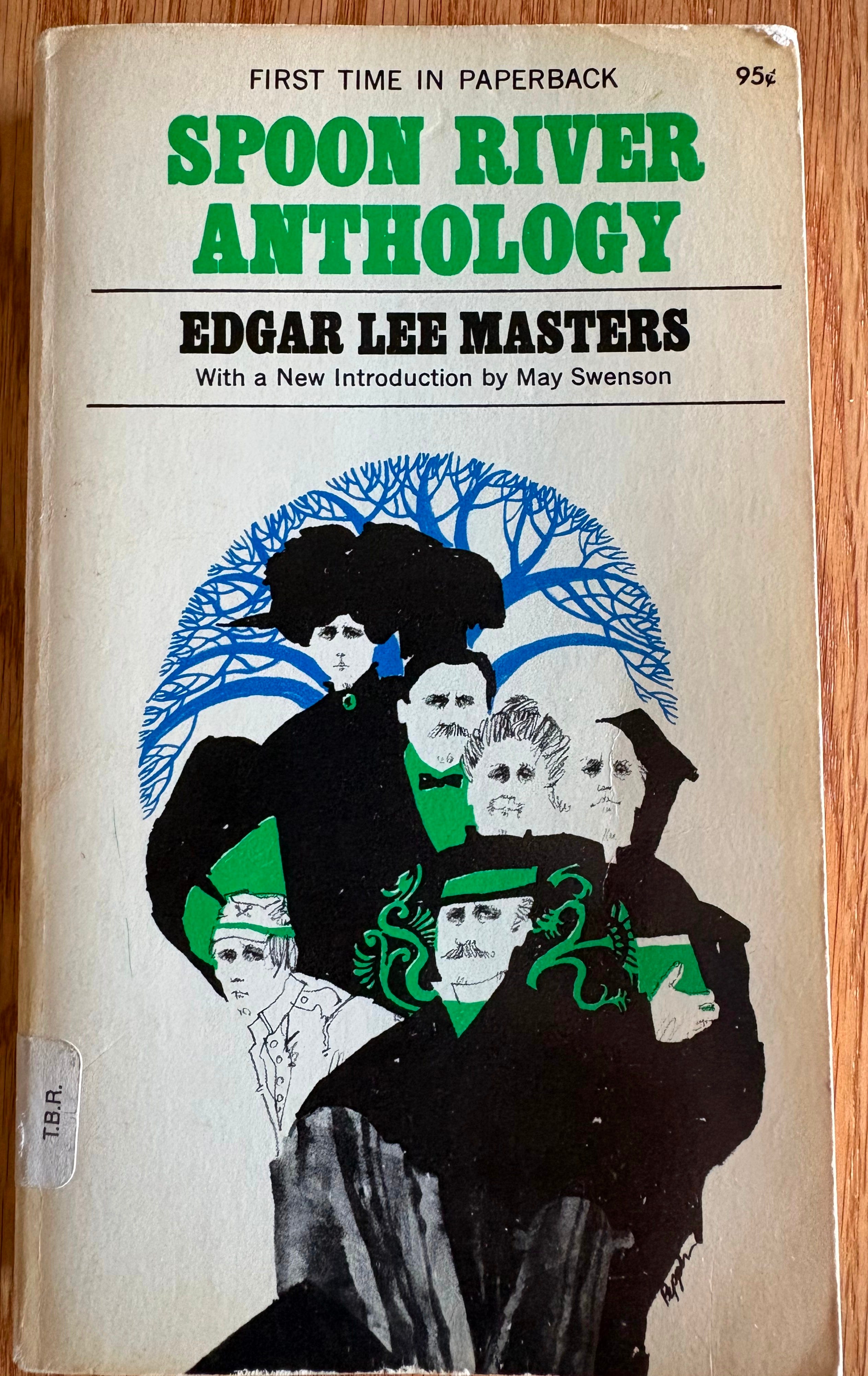
This final book is actually a re-read for me, though it has a much heavier weight this time around. I recently attended the funeral of my biological father whom I never met (long story), but who grew up in a village less than twenty miles from Lewiston, Illinois, which was one of Masters’ main inspirations for this strange, beautiful book. Spoon River Anthology is essentially a vocalized cemetery chorus, like Our Town before Our Town, Lincoln in the Bardo before Lincoln in the Bardo. It has roughly three hundred different first-person narrators, each of whom speaks only once, in the form of a free-verse, epitaph-like poem. I can’t imagine calling it anything other than a novel, though, because of the way these characters’ lives intertwine and are profoundly linked by place. Some focus on the key dramas of their lives, while others tell the stories of their deaths.
Though it’s widely considered a classic, I’m not sure that it’s very widely read these days. In the early aughts, I remember encountering an excerpt in my high school English textbook as a student, but I don’t remember seeing it referenced in the literature textbooks I taught from during the late 2010s and early 2020s. Some of the literary works that it most obviously influenced, like Our Town and Sherwood Anderson’s Winesburg, Ohio, seem more well-known. I don’t know if Patmeena Sabit would consider it an influence for Good People, but for me, her novel reads in its lineage in terms of its bold formal commitment to a communal voice expressed through many narrators.
What I especially love about Spoon River is how much Masters leaves room for the reader to fill in the spaces around these lives, a sense that is visually reinforced by the white space left around each poem, evocative of inscriptions on tombstones. The petty dramas of life never grow old with this one—the regrets and heartbreaks, the extent to which people often carry their secrets to the grave, or else don’t realize that everyone else in town actually already knows their secrets. It’s a very different kind of reading experience, as there’s no central dramatic arc but rather many smaller interconnected arcs and one-off portraits. The deeper in I got, the more I appreciated the Table of Contents, which aids in sorting out the connections and reverberations across epitaphs.
It’s also a book perfect for picking up and putting down and reading a little more slowly, so if you’ve been having trouble focusing on something more sustained, this might be your perfect match.
Before I sign off, I’m excited to share that a flash-fiction story I wrote a few years ago is now out in the current issue of A Public Space. The story was chosen as the winner of their “Stories Out of School” contest in 2024, which they sponsor along with the Academy of Teachers, and it’s an honor to finally get to see it in print. Though the piece is still available to read online, the print issue is worth tracking down if you are in a position to do so and want to support the work of a journal with a strong commitment to helping launch new writers (e.g., APS published Jamel Brinkley’s debut story, “Infinite Happiness,” in 2014).
This particular issue features a new story by Helen Oyeyemi and poetry by Luis Muñoz translated by Garth Greenwell and Idra Novey alongside fiction by emerging writers, such as 2025 APS Writing Fellow Nina Ferraz’s gorgeous story, “Wagon Full of Sand.” (Full disclosure: I’ve never met Nina in person, but we crossed paths in a writing group chat once upon a time and she seems like a lovely soul as well as a fabulous writer.)
Happy summer, and see you back here in September!
Jules
P.S. Just for fun, this is what our tomato seedlings look like at the moment (I’m including my husband, who is also proofreading this post, in this because he plays a key role in soil prep, irrigation, and canning, while I’m the seed-starter and weeder):
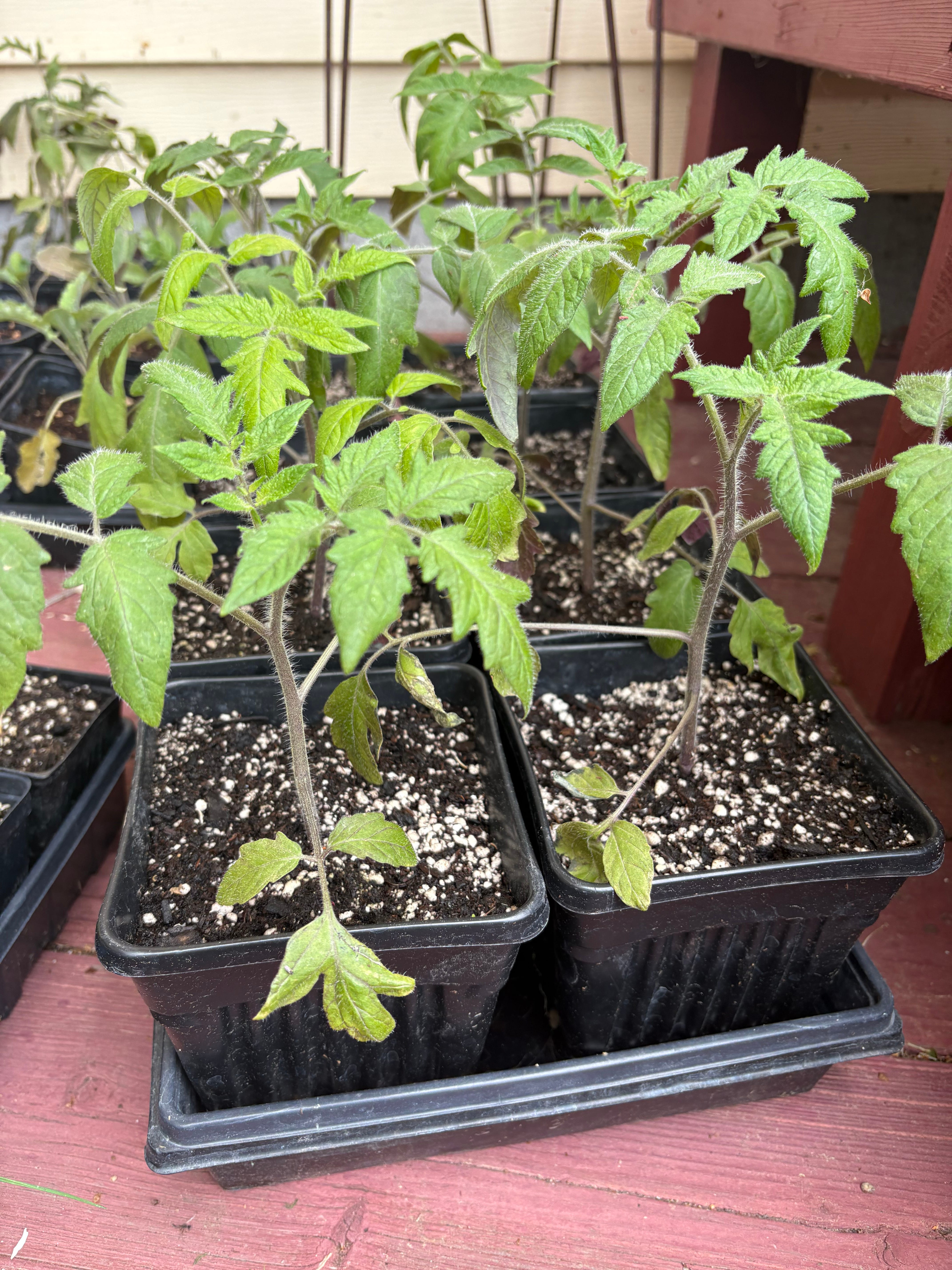
Will post an updated picture in September. In a good year, they get taller than me. :)
No posts
Comments
Nothing yet. Say the first thing.
Sign in to join the conversation.