
Hi everybody,
Apologies for the lack of posts over the last few months. I assure you that it’s with good reason. Although I managed to publish a few musings last year, in terms of actually playing games, 2025 was an extremely fallow period with fewer games completed than any other year I can remember in my adult history. This year I have strived to do better and this resolution was made easier by the fact that I have had time away from work and training in the gym. As a result, my focus and concentration levels have increased, as has my desire for playing games.
I am thrilled to say that I have played more games in these first two-and-a-half months of 2026 than I did for the entirety of 2025. And that’s the reason behind the lack of posts; I am choosing not to look a gift horse in its mouth, striking whilst the iron is hot, and dedicating any free time I have to playing as many games as I can whilst life circumstances afford me that privilege. Whilst I haven’t written singular posts for each game, true to original purpose of this Substack, I will be providing some (very) short musings on each of the games I have played so far this year to catch up to present day. Here is part one of three to be dropped in the coming days.
Big Hops
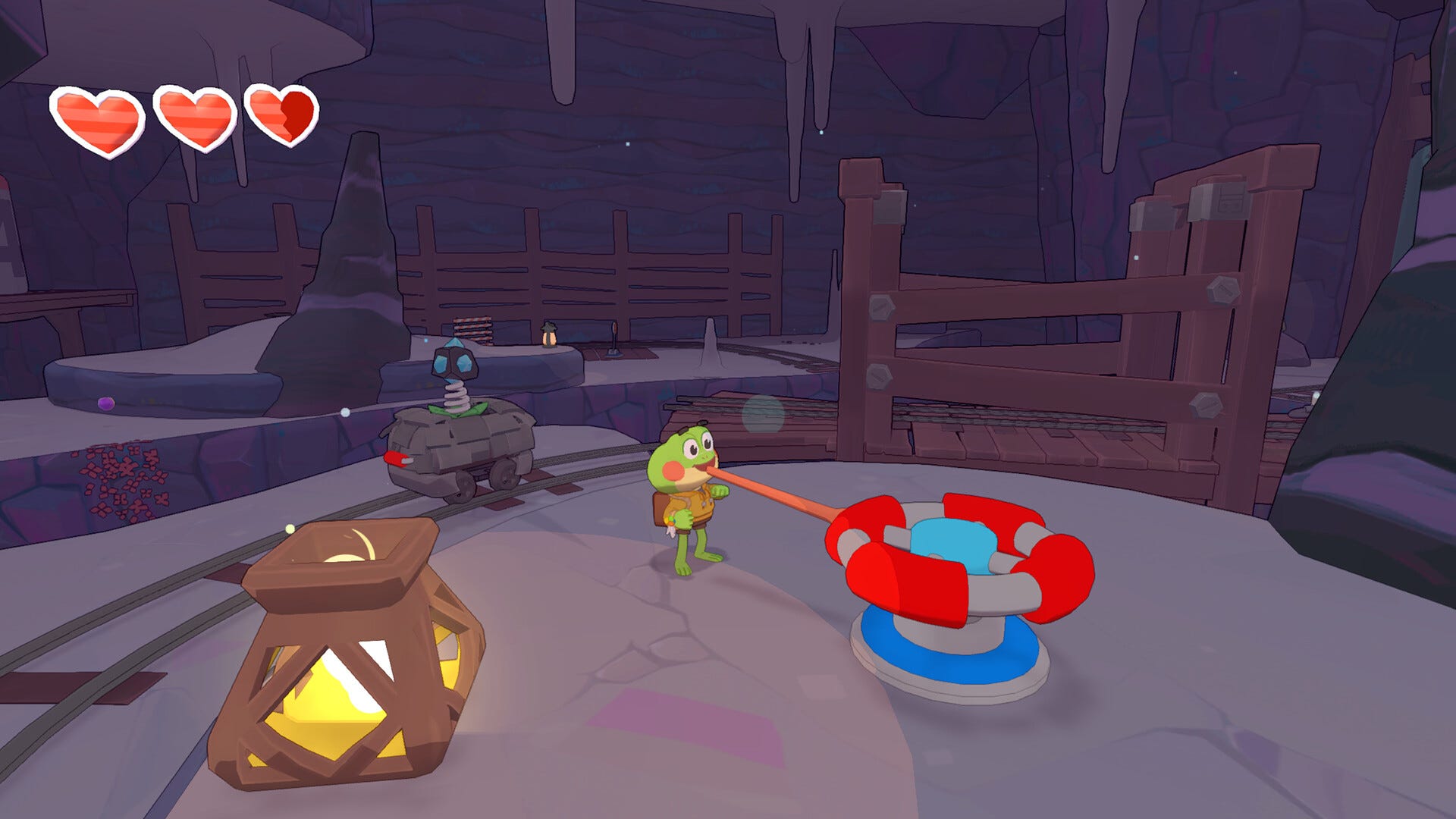
It’s essential for any platformer to nail its movement system and Big Hops does this in leaps and bounds (pun very much intended) with your player character, a frog, having a satisfising sense of weight, momentum and agility. What differentiates Big Hops from the many other 3D mascot platformers that have come out recently is in its confidence to provide player agency. Your playable frog has a backpack that can hold a selection of different types of ‘fruit’ plucked from plants found in the world. Each of these fruits interact with the environment in different ways, providing alternate means of traversing through the world. For example, acorns grow vines that can be climbed up; mushrooms turn into bounce pads; and cacti shoot out a slackline between two anchor points. These fruit can be thrown onto almost every surface and can be utilised at any throughout the game, providing you have them in your backpack, so much of the fun and freedom in Big Hops is found by completing platforming obstacles in ways that perhaps the developers didn’t intend. This, combined with interesting movement tech means it will no doubt be a speedrunning favourite and I will be shocked if it doesn’t end up on the roster for this year’s Summer Games Done Quick.
Despite my enjoyment of Big Hops, I’d be remiss to not disclose that I encountered a hardlock during my playtime and was only able to continue by editing and transferring save files between my Steam Deck and Desktop, continuing from a developer save state, and losing a lot of my own unlocks in the process. The irony is that the hardlock wasn’t even a result of finding creative ways to break the game using different fruit where not intended; it simply occurred from losing all my health in an area near the end of a level and the game reloading to a end-level state without the ability to progress.
I played Big Hops close to its release and the game has since had updates and patches but, according to recent posts in the Steam forums, it appears that hardlocking the game is still a possibility that can arise. Despite this misfortune, I still hold Big Hops in high regard but at the same time I can’t recommend it if you don’t have the patience or confidence to modify save files.
Keep Driving
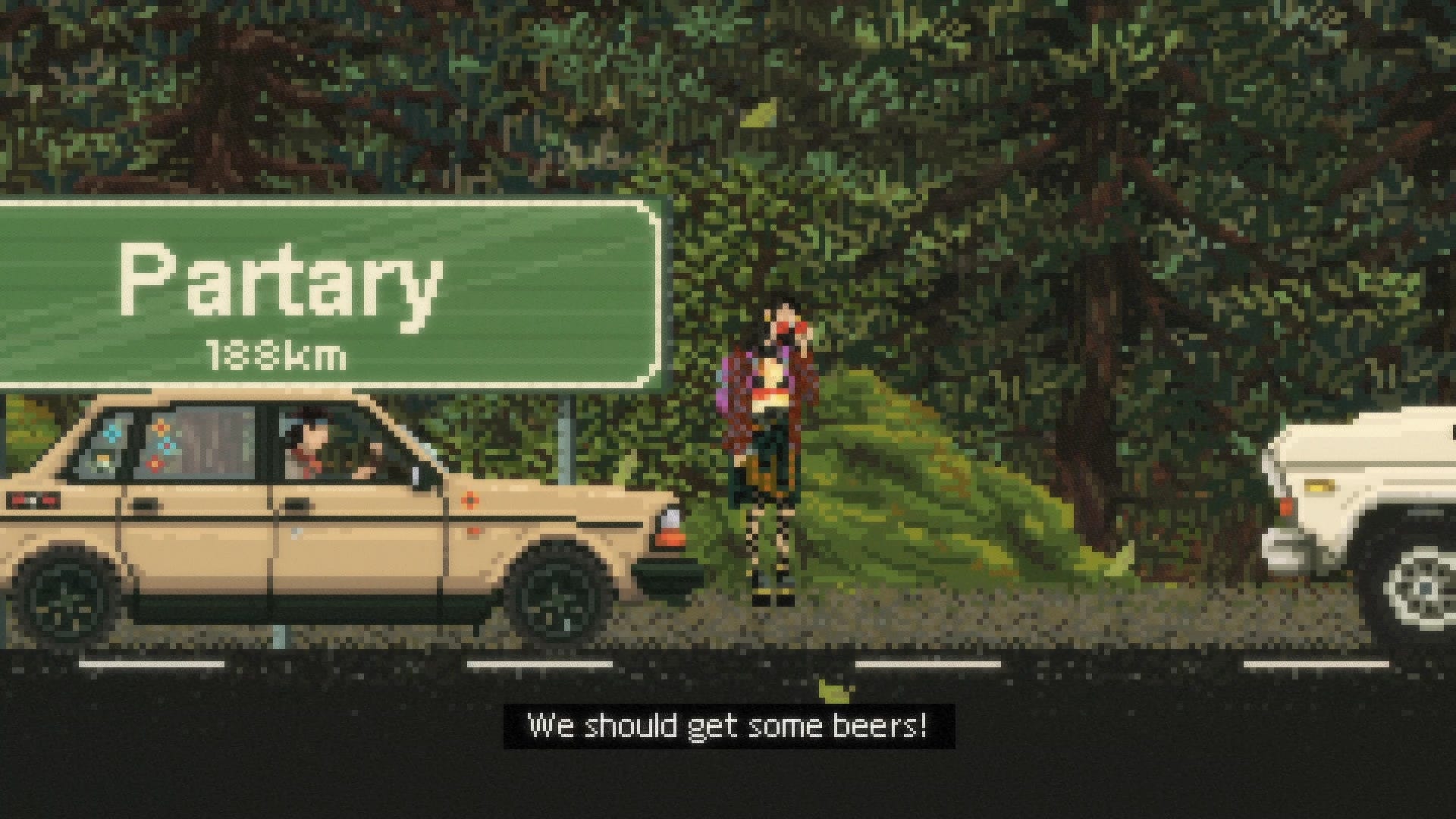
I’m not sure this game will speak to everyone but it certainly did for me as a game about road tripping across Sweden in the early 2000s. Although I got my licence a few years later in 2007, Keep Driving captures the feeling of freedom that passing your driving test affords you as a teenager. This was a period in my life pre-GPS, pre-smartphone and, with my 1998 Vauxhall Corsa, it was even pre-CD player and pre-power steering (no wonder I’ve always had big biceps). All I had was a tape deck, an A-to-Z and an open road in front of me. And it was glorious.
Keep Driving distils this sense of independence and teenage frugality into a turn-based management sim where your car is your trusted ally despite its limitations. You have to contend with the elements, other drivers, acquired passengers, wear and tear to your vehicle etc. as you press on in your meandering adventure. The management part of the game provides just enough friction where you just about make it to your next destination with the fuel gauge on red; your side mirror hanging from its hinge, secured only by a reel of duct tape; and one krona to your name.
I wish there was a bit more of a narrative element to the game and the on-road turn-based battle system is fairly simplistic and lacking depth, but honestly, I was content with staying within Keep Driving’s world largely for its immaculate school’s out, summer road trip vibes.
The Drifter
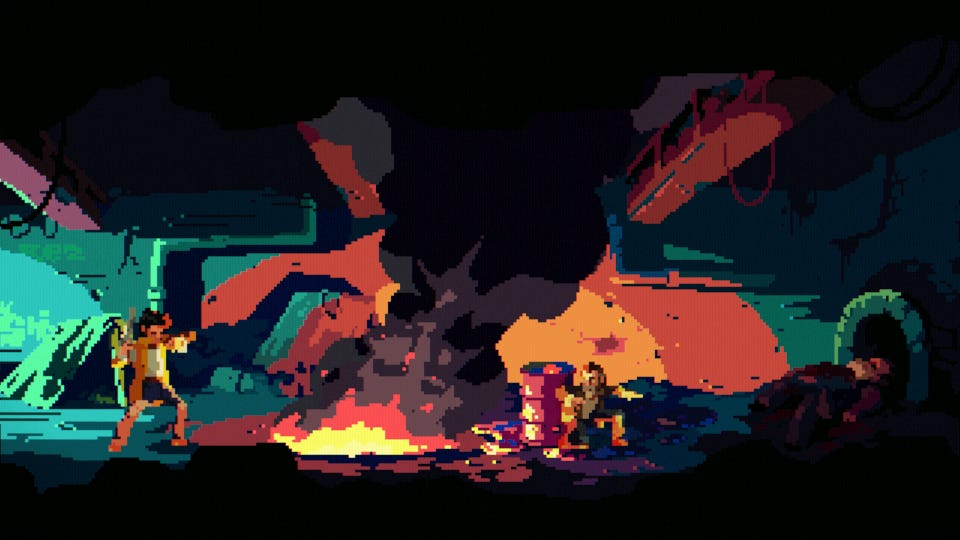
I say this with no hyperbole: The Drifter is one of the best point and click adventure games I have played in a long, long time. The dark and gritty narrative immediately draws you in and keeps you intrigued from start to finish. The pixel art is some of the best I’ve ever seen and it complements and underscores the game’s pulpy and moody atmosphere in exemplary fashion. True to the genre, The Drifter’s has inventory-based point and click puzzles that provide enough challenge and friction without ever devolving into frustrating, obtuse nonsense, which could have so easily been the case given the sci-fi tinged elements in its story.
The interface is excellent and features a radial menu that changes dynamically depending on where you move the player character and what’s in their vicinity. It plays just as well on a controller as with a mouse and I’d be surprised if this kind of interactivity wasn’t used by all point and clicks going forward.
In every aspect The Drifter is a delight to play and matches, if not surpasses the very best the point and click genre has to offer.
Ells Tales: Chicken

I don’t even know what to say about this one. You play as a hen in a gloomy chicken coop doing sokoban puzzles. It’s weird. It’s also another game with early PlayStation-style graphics, which is a trend that I’ve enjoyed more than I expected and has given way to some of my favourite games in recent history such as Crow Country, Signalis, Mouthwashing and this year’s Creature Kitchen (more on that later this week). Whilst Ells Tales: Chicken is not comparable to the quality of those games in any way, it’s still nice to see these quirky, blocky, polygonal experiences pop up in places outside of itch.io.
TR-49
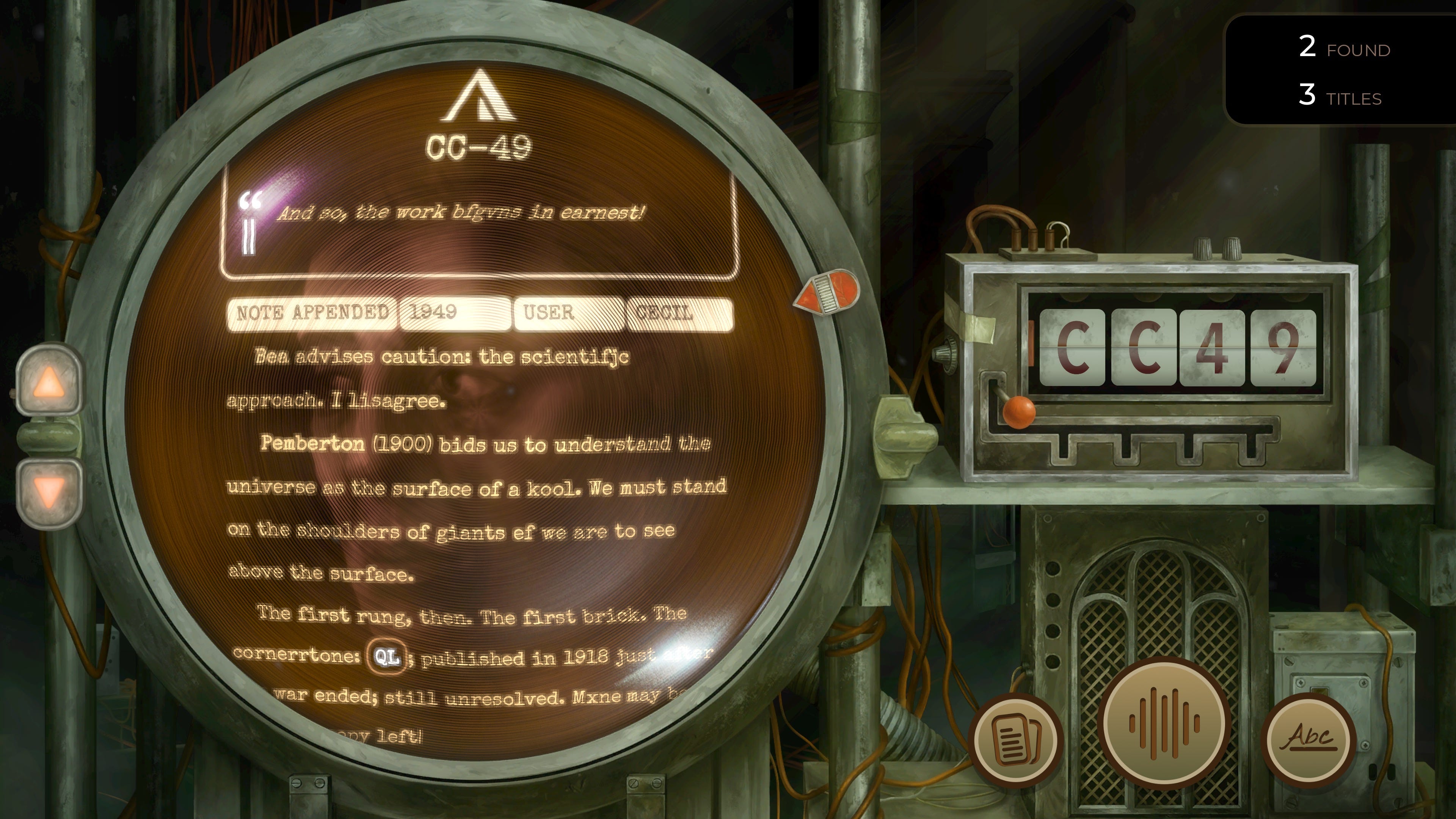
A narrative deduction game that falls under the same umbrella as other investigative / detective games such as Her Story and The Roottrees are Dead (more on that later this week). This time you’re in a bunker searching for a certain book in a World War II computer using four-digit alphanumerical codes (like TR-49) where the letters represent the first and last name of the author and the numbers represent the year of publication.
You’re told, from a disembodied voice over a radio above ground, that finding this singular publication will alter the course of history. The voice acting feels a bit hammy with the tone of a radio play like The Archers but it still manages to create a sense of atmosphere and urgency to proceedings as you soon discover that you’re not the only one looking to exploit the machine for its untold power and influence.
This underlying story is doled out piecemeal through the other voice on the radio but it was hard to concentrate on that whilst I was busy reading searching the archive and reading entries from the microfilm-like device. From what I could discern, a lot of the game’s meaning and social commentary is left unsaid and is down to player interpretation. All I really took away from it is that words are powerful and curation and censorship, especially in the wrong hands, can have wide-ranging effects. If you can’t tell from that pre-GCSE-level synopsis, I’m no philosopher and most of my enjoyment from the game found in using deductive and sometimes mathematical thinking as well as real-world knowledge to unearth more of the machine’s archive.
Although I needed a few nudges on how to complete the game once I had found the code for the elusive publication, the route to get there unfolds in quite natural way so it’s unlikely players will be able to stumble upon the code accidentally or prematurely.
All in all TR-49 is a competent deduction game and I’m extremely happy for the game’s success given it’s inkle’s best-selling game in their history and came together in around nine months! We love to see it.
That’s the first crop of games I’ve played so far this year. Stay tuned for part two!
No posts
Comments
Nothing yet. Say the first thing.
Sign in to join the conversation.