
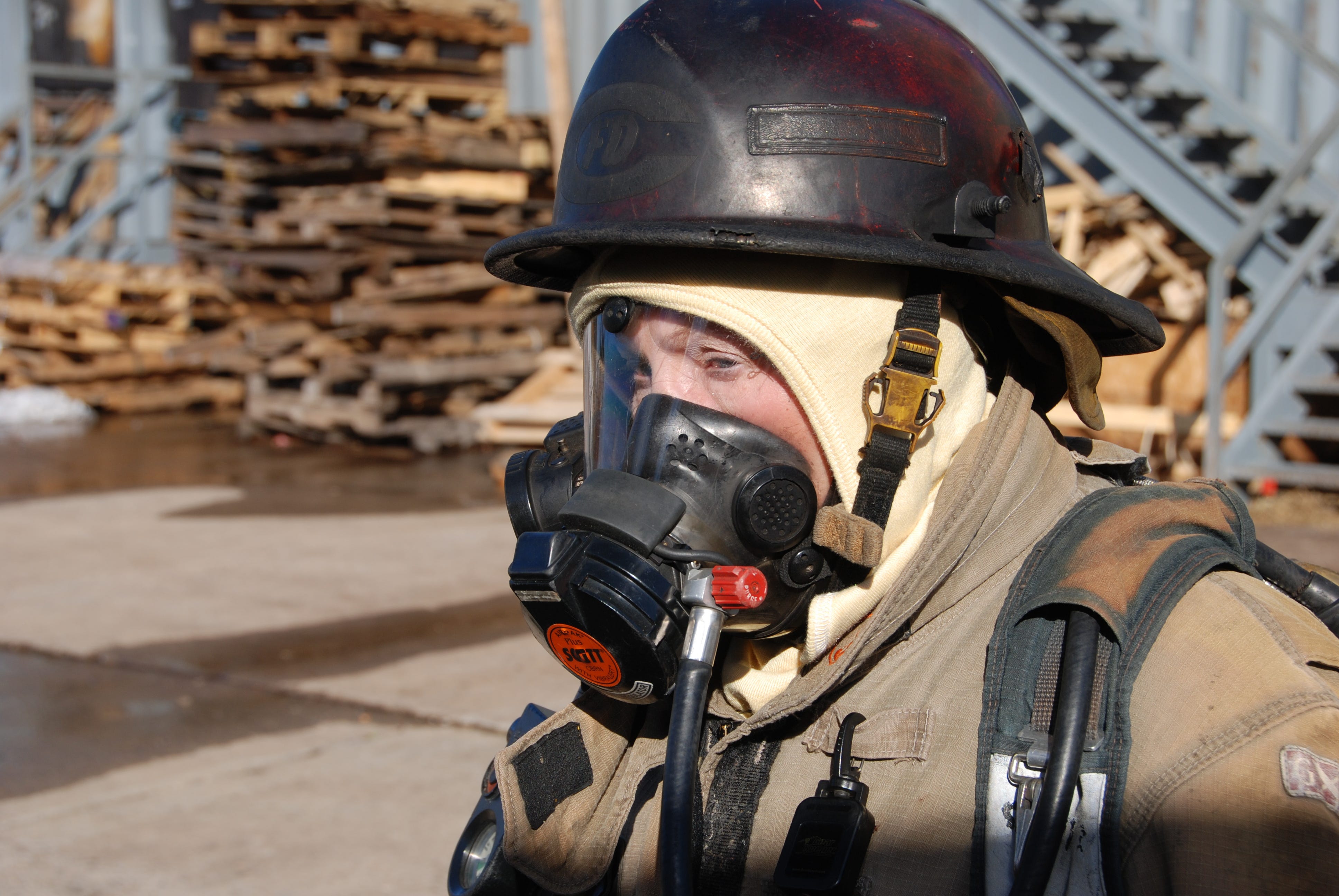
This is me. I’m thinking, “What in the heck am I doing?” [Photo credit: David Rhodes]
Being aware in the moment is the act of “presencing.” Awareness, especially comprehensive situational awareness, is necessary to enable you to guide the dynamics in a situation. It has to happen at multiple levels. You have to be aware of internal feelings and your physical well-being, the presence of others in the environment, and the environment itself. There is no sequential cause-and-effect dynamic between awareness and action. They are one and the same.
I observed my first Georgia Smoke Diver training in November 2011. It was early in the week. The candidates were learning how to use thermal imaging cameras (TICs) in a smoke-filled burn building. Smoke Daddy David Rhodes (GSD #339) asked me if I wanted to go into the burn building. At first, I said, “No.” But then I thought about it. How would I ever really know what they experience, if I didn’t suit up and go in? I changed my mind and said, “Yes.” The instructors had me in full gear before I could protest. Into the burn building I went, with one of the instructors, Captain Charlie Long (GSD #552).
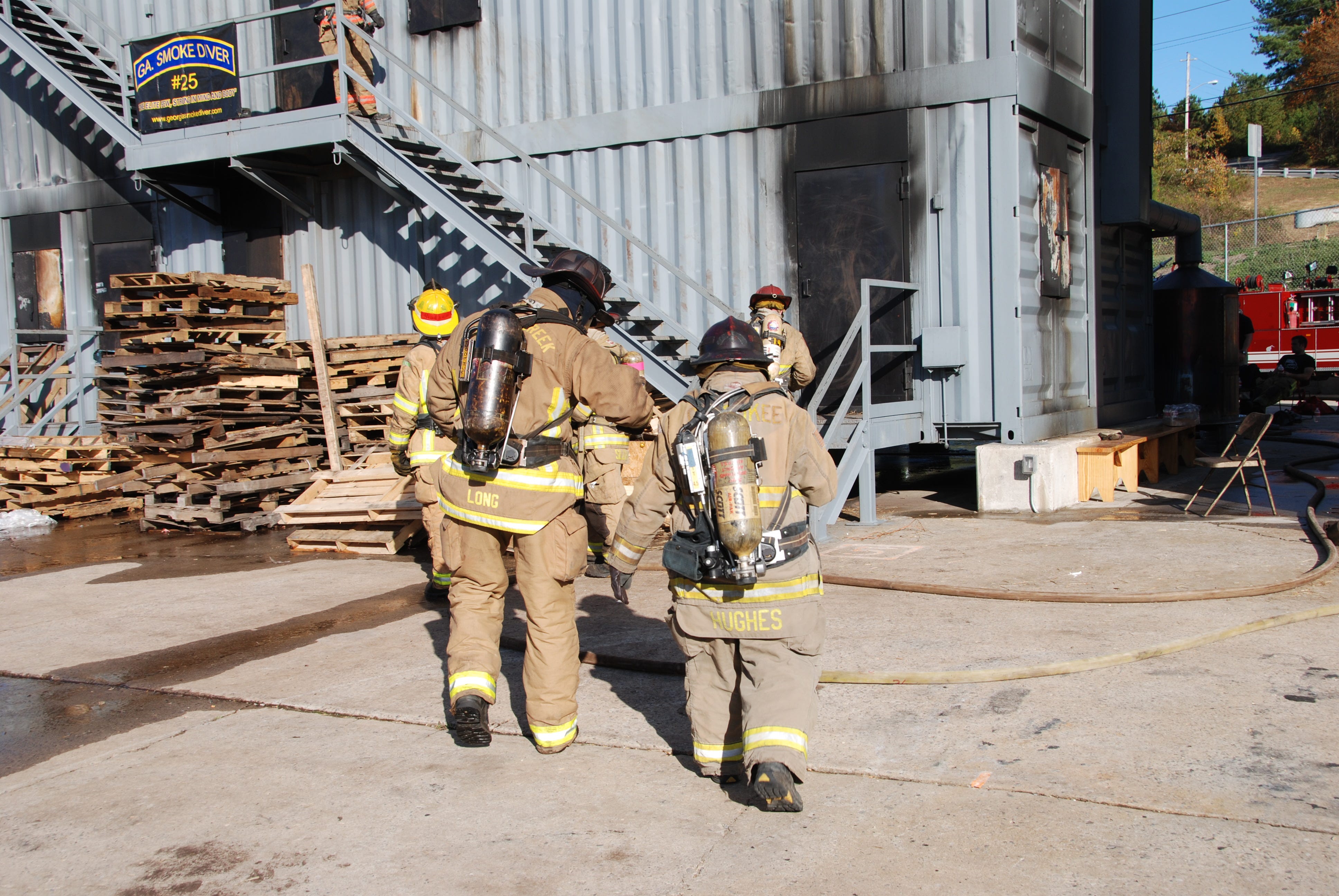
Charlie ‘n me (Charlie’s the tall one.) [Photo credit: David Rhodes]
Everything I had been hearing from all the firefighters in my doctoral study came at me in a rush. I had 70 pounds of gear on my body. At the time, I was not in good physical shape. I felt completely encumbered. All my senses were stripped away. The mask prevented me from tasting or smelling. I couldn’t see for all the smoke. I couldn’t feel anything because of the gloves. I couldn’t hear, because the noise in the burn building was confusing. In a building that is burning, firefighters have told me, the noise can be deafening.
While I am not generally claustrophobic, I felt like I was closed in. I realized that my being frightened was causing me to breathe air too fast. I wasn’t in the building 30 seconds before I said, “Charlie, I have to leave.” He said, “No. No. Look through your TIC. What do you see?” I looked. I could see other firefighters through the smoke. I couldn’t see them without the camera.
Charlie then said, “Look down through the TIC. What do you see?” I looked down at an angle and saw another firefighter, but this was confusing, because of the angle I was looking. Charlie said, “That’s your reflection in a mirror. Now look over there. What do you see?” I told him it looked like a hole. He said, “That’s the hallway. Let’s go down to the burn room.”
We made our way to the room where the fire was burning. Charlie told me to look through the TIC to get the temperature reading. At eye level, the temperature was a little over 300 degrees Fahrenheit. He then told me to point the camera to the ceiling and take another reading. The TIC read over 600 degrees Fahrenheit (still cool, by firefighters’ standards). I felt my internal body temperature begin to rise. Fear overtook me again.
I said, “Charlie, I need to leave.” Charlie said, “Okay. But we can’t go back the way we came. Others have come in behind us. We have to go down the stairs to go out.” I was near panic at this point. I said, not so calmly, “Down the stairs!! Are you crazy!?” He calmly said, “No. No. Look through the TIC. What do you see?” I said, “Another hallway.” He said, “Now, look down. What do you see?” I looked. It appeared to be a hole in the floor. He said, “Those are the stairs.” I suddenly realized the amazing dangers firefighters face on a daily basis, never knowing if the next step will have them plunging into darkness to their deaths.
I made my way down the stairs slowly and carefully, and then out of the building. In all, I spent a total of 15 minutes in the burn building.
Long was an amazing coach. As I turned inward in fear, he refocused me outward. The urge to submit to a panicked state, to rip off my face mask, was huge, but Long helped me resist. That is how many firefighters die in fires, he told me. When I exited, my paradigm had changed dramatically. It is one thing to listen to people tell you their stories. It is another thing to experience what they mean by awareness.
The takeaway was that in emergency situations, firefighters must be situationally aware of themselves (internally), their surroundings, the dynamics of the fire or other relevant variables (individual people, crowds, weather conditions, construction of the building, etc.), and also be able to conduct a search for victims, if necessary. Every incident is different. And yet, there are repeating patterns within each incident that, over time, enable firefighters to act in a way that facilitates their ability to respond in the best way possible. However, they must be willing and able to constantly train, learn about past incidents, and unemotionally deconstruct, discuss, and evaluate incidents immediately following the action with fellow first responders. This enables them to learn what happened (from others’ perspectives) and to determine what they might have done differently to affect the best outcome.
Flow happens in the present. While, awareness is key throughout all the categories of flow triggers, practicing mindfulness enables you to be present and aware within the moment. This, in turn, enables you to recognize patterns, identify complexity, and balance and synchronize activity and challenge. When you begin to learn what triggers flow for you, you can begin to put into place the conditions that bring about flow, thereby maximizing your flow experiences.
In H. L. Thompson’s book, The Stress Effect: Why Smart Leaders Make Dumb Decisions—And What To Do About It, “awareness” is the first best practice in managing stress in Thompson’s ARSENAL™ model for maintaining a stress resilient system.
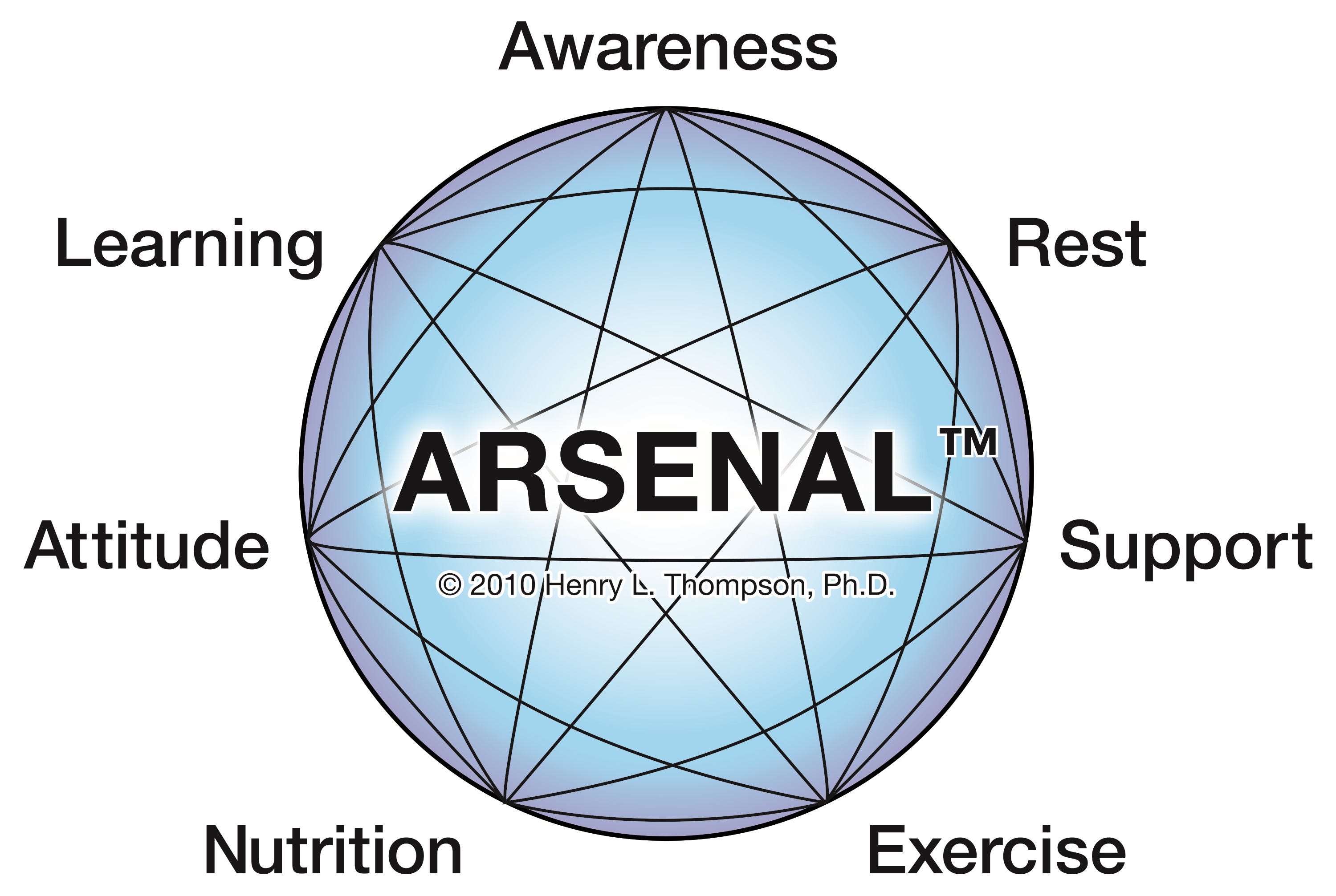
[Used with permission]
When concentrating on the task at hand and through observation in each moment, you can allow awareness and action to merge. This is true not only when you are in flow doing what you love, but even in your day-to-day interactions in your personal life. Learning to be present and aware is a skill that can be learned, practiced, and improved over time with training and experience.
No matter how you subscribe, thank you for reading.
Learn to flow!
Dr. Judy
Comments
Nothing yet. Say the first thing.
Sign in to join the conversation.