
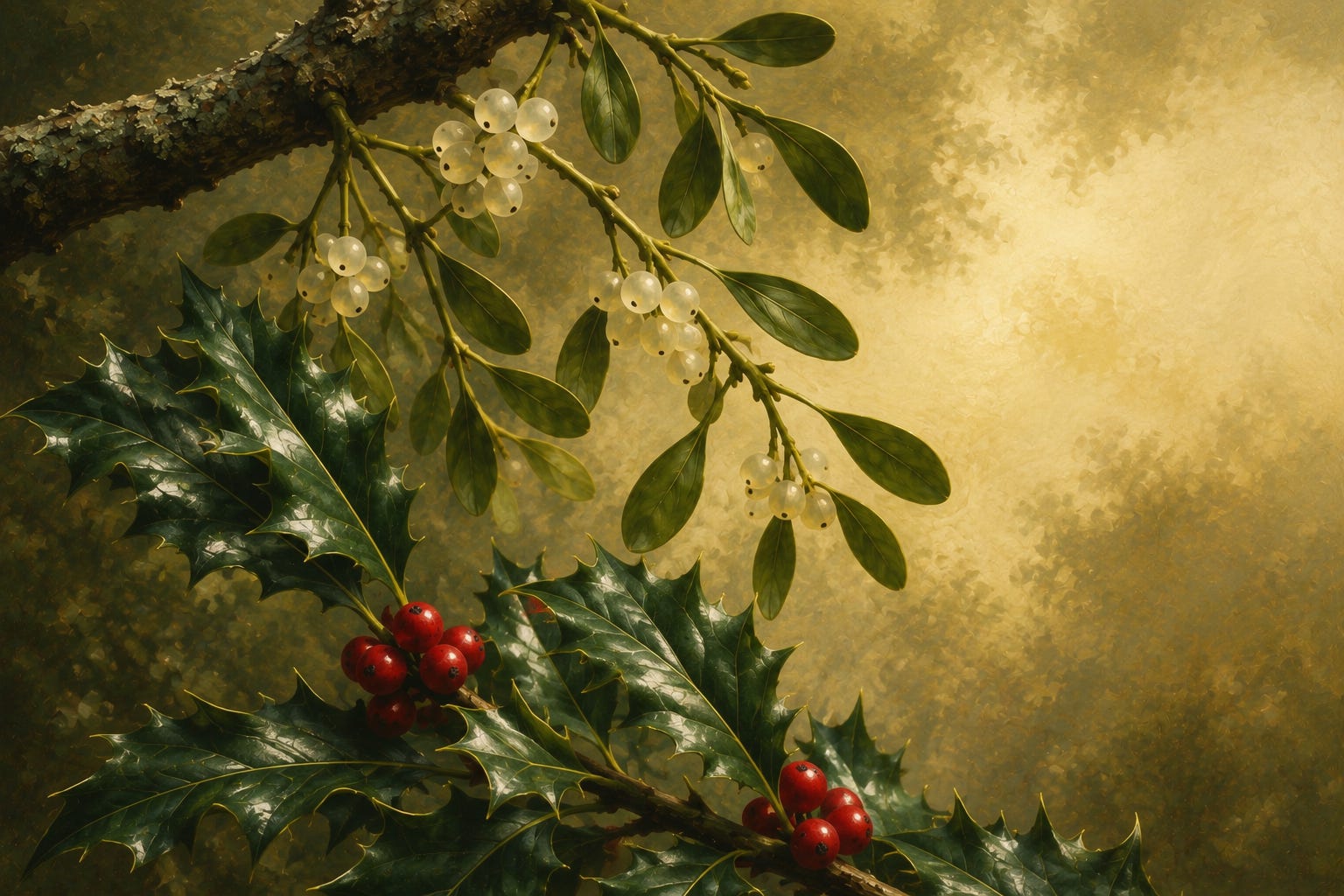
I confess, my first response was something close to a yawn. Holly and mistletoe seemed like the contents of a Christmas card sent by an elderly aunt: pleasant enough, faintly dusty and unlikely to cause trouble.
That was because I wasn’t looking at the plants. I was looking at everything people have piled onto them. Once I cleared away the wreaths, ribbon and compulsory kissing, I realized I knew almost nothing about either one.
Elsie’s image is fairly stingy. She gives us two names joined by and. She doesn’t tell us where the plants are, whether they are growing or cut, or why they have been brought together. No action helps us along. Holly and mistletoe are sitting there like two strangers at the Manitoba social after everybody else has gone home, and apparently it is up to us to find out what they have in common.
As it happens, they have been withholding a shocking amount of information.
Oh, the gall.
HOLLY AND MISTLETOE.
That’s it. Two plants, placed together. No Christmas. No memories. No childhood. No nostalgia. No “preintellectual state of consciousness.” No Romantic Movement. Elsie didn’t even give him a verb.
Marc Edmund Jones stays with the actual image. His interpretation may be characteristically dense, but his keyword—RITUALIZATION—arises legitimately from the plants themselves. Holly and mistletoe are seasonal evergreens gathered, displayed, exchanged, kissed beneath, and used ceremonially. They participate in recurring communal customs. His “cyclic manifestation” and “self-renewal” also belong to the botanical facts: both remain visibly alive through winter.
Dane alters the symbol to:
HOLLY AND MISTLETOE REAWAKEN OLD MEMORIES OF CHRISTMAS.
That is not a clarification. It is an entirely different psychological event.
He has added an observer who possesses memories, a past Christmas, the reawakening of that past, nostalgia, childhood, lost innocence, a conflict between intellect and feeling, and (and!) a supposed longing to return to a “preintellectual” condition.
None of that is in Elsie’s image. He turns two living plants in the present field into props for somebody’s sentimental backward glance. Then, having secretly inserted memory and Christmas, he spends the whole interpretation explaining the memory and Christmas he himself supplied. Bloody cheek.
The alteration is especially consequential because the actual plants are much older, stranger and less domesticated than Dane’s Christmas reverie. Elsie gave him two forms of living greenery, each with its own peculiar habits, history, and relationship to the surrounding world. He reduced them to objects that make somebody feel nostalgic.
Elsie’s field is alive and immediate: holly and mistletoe are here.
Dane’s field is retrospective: these things remind somebody of Christmas long ago.
And then he calls the result “a return to the source,” when he is the one who has dragged us away from the source—the literal image—and into his theory about ego, intellect, childhood, archetypes, Tibetan colour, European Romanticism, and goodness knows what else.
This is another excellent example of why we go back to Elsie first. Dane doesn’t merely interpret the symbol. He rewrites it so that it produces the interpretation he already wants.
I had no idea what Elsie had handed us here. I knew holly had red berries and mistletoe was the shrubbery people once used as romantic entrapment. That was about the size of it.
Then I looked at the plants.
Well.
Holly has its own roots, its own trunk and a firm address in the earth. It can grow in deep shade under larger trees, holding onto its dark green gloss while the neighbours strip naked for winter. Its leaves are tough and frequently armed with spines—but here is where holly gets interesting. The leaves tend to be prickliest lower down, where animals can reach them. Higher up, beyond the nibbling department, they may be much smoother.
The plant is not prickly for the sake of having a difficult personality. It grows armour where it has been eaten.
Browsing can even provoke new leaves with heavier defences in the affected part of the tree. Holly’s body keeps the minutes of the meeting. You can look at a branch and see that somebody has been helping themselves.
Mistletoe, meanwhile, has no address of its own. It lives up a tree.
A bird wipes or deposits one of its sticky seeds onto a branch. The seed glues itself to the bark, turns toward the branch and fastens itself down before attempting entry. Then it sends a structure through the bark and establishes a connection to the host’s internal plumbing. From there it draws water and minerals.
This is not a hurried operation. Mistletoe makes contact, gets a grip, checks its position, and only then begins moving in. Five years later it may finally produce flowers and berries. This plant can spend half a decade turning one sticky introduction into a long-term living arrangement.
Holly’s response to being touched is: That’s enough of that.
Mistletoe’s response is: Could I live here?
The marvellous complication is that mistletoe is no useless lodger. It has green leaves and performs photosynthesis, so it manufactures its own sugars. It grows its own body and produces its own flowers and fruit. It takes water and minerals from the host because it cannot obtain them from the soil, what with having no earthly roots whatsoever, but it contributes a fair bit to its own upkeep.
It is dependent, certainly. It is also enterprising as hell.
Holly looks like the sturdy independent one in this arrangement: planted, armoured, built to last. Mistletoe hangs in the air with its dependency showing. But holly’s independence is largely a public-relations campaign.
Both holly and mistletoe are commonly dioecious, meaning that the male and female flowers are produced on separate plants. A female holly requires a male holly somewhere nearby before she can make those red berries. The same goes for female mistletoe and its white ones. Both plants require insects to carry pollen between them and birds to distribute the resulting seeds.
Holly may own the property, but she still needs the neighbourhood.
Mistletoe simply has the decency to let us see the arrangements.
The birds are in on the whole business. They eat the berries and carry the seeds elsewhere. Holly offers them food and shelter among leaves sharp enough to discourage larger animals. The same spines that say keep out to one creature create a protected room for another. A boundary is never the same boundary for everybody.
Mistletoe has devised an even cheekier system. Its pale berries contain an extremely sticky substance. The bird gets a meal; the seed gets transportation; the next tree gets an applicant stuck to one of its branches. A passing appetite becomes the delivery service for a relationship that could last decades.
Both plants’ berries can make humans ill. Birds, however, can eat and disperse them. So the berries don't carry one universal message. They are food for one body, trouble for another and a taxi service for the plant.
Apparently context is everything, even when you are a berry.
Mistletoe’s physical form is thoroughly Gemini. Its leaves appear in opposite pairs, and its branches repeatedly divide in two. One becomes two, two become four, and the continued forking eventually creates that great rounded clump suspended in the tree. It has no central trunk reaching down into the earth. Its body emerges through pairing and division.
Holly proceeds from root to trunk to crown. Mistletoe starts with a sticky encounter and builds a network.
One plant responds to intrusion by changing the surface of its own body. The other survives by creating a connection between its body and somebody else’s. Holly gets tougher at the site of contact. Mistletoe gets attached.
Neither response is inherently virtuous. Holly’s spines can preserve the plant, but armour everywhere would interfere with other forms of contact. Mistletoe’s attachment sustains it, but enough mistletoe can weaken the host. Life may require a boundary here and an opening over there, and some awareness of whose sap is paying for the festivities.
Yet Elsie does not give us holly versus mistletoe. She gives us holly and mistletoe.
That little and changes the field.
The rooted plant and the plant rooted in relationship. The one whose defences record where it has been bitten and the one whose entire existence begins by sticking itself to another living body. The apparently self-supporting one whose need for others is tucked out of sight, beside the obvious dependent who manages to manufacture much of what it needs.
Both stay green when the deciduous trees around them have dropped their leaves. Holly does it from the ground, with its hard gloss and selectively deployed weaponry. Mistletoe does it in mid-air, attached to another life but still making something of its own.
Marc Edmund Jones chose RITUALIZATION as his keyword, and for once I think the old boy may have spotted something alive in Elsie’s image. These plants participate in repeated sequences of encounter: pollen is carried, fruit is eaten, seeds travel, new attachments form. No participant runs the whole show. Each enters, does its bit and hands the process along.
Holly remains holly. Mistletoe remains its audacious, airborne self. The bird has lunch. The insects get on with things. Life continues through an arrangement nobody controls, and everybody helps produce.
And Dane looked at all of this—the armour, the adhesion, the hidden dependence, the visible dependence, the sticky seed insinuating itself into a tree—and thought we needed Christmas memories.
Sir, please get out of Elsie’s shrubbery.
If Gemini 4 is prominent in your natal chart, your life may be shaped by patronage—not only the grand variety involving wealthy benefactors, but the ordinary arrangements through which people help one another’s work remain alive.
Someone may spot what you can do and give it somewhere to grow. A teacher recommends you. A friend makes the introduction. A publisher takes an interest. An employer gives you unusual freedom. A spouse keeps the household afloat while you establish yourself. An aunt slips you money. Fifty readers pay five dollars a month because they like what you make and want you to keep making it.
These are all patrons.
You may have genuine talent, discipline and initiative, yet still require a suitable branch. The patron doesn’t create your ability. They provide money, shelter, access, time, equipment, credibility, an audience or a place within an existing structure. Once there, you make something of your own.
You may also be particularly good at finding the right setting for other people. You recognize the person who needs a little backing, a public mention, a useful introduction or somebody willing to buy the first piece. You may not think of yourself as a patron because you aren’t funding an opera house. Perhaps you subscribe to somebody’s newsletter, buy one handmade ornament a month, recommend a small business, display an artist’s work or regularly turn up for a musician playing to twelve people and a bartender. The amount is less important than the continuing support.
Sometimes your greatest contribution is circulation. You carry names and ideas between worlds:
“You should read her.”
“I know somebody who could help.”
“Have you two met?”
A consequential opportunity may reach you in the same fashion. Gemini 4 does not necessarily stride through the front door clutching an application. A bird carries the seed. Somebody mentions you over lunch, forwards your work, gives your name to a friend or brings you into a conversation already underway.
You may thrive inside a larger body while remaining distinctly yourself. An institution, platform, profession, tradition or community gives you a structure to work from, but you are not merely absorbed into it. You bring another form of life to the arrangement. This can make you especially effective as an independent writer using an established publishing platform, an artist supported by a gallery, a scholar within a university, a specialist inside a large organization or the unofficial oddball occupying one fertile branch of the family tree.
You may also keep something alive through a lean period: an old craft, neglected archive, family practice, endangered institution or body of knowledge that might otherwise disappear. You do not preserve it by sealing it behind glass. You use it, adapt it and put it back into circulation.
Marc Edmund Jones’s keyword, RITUALIZATION, belongs here because your sustaining arrangements may depend upon repetition. A monthly subscription, annual commission, weekly appointment, standing invitation or regular purchase can accomplish what one enthusiastic gesture cannot. Small acts accumulate. One ornament a month becomes twelve ornaments hanging on a tree. Five dollars from one reader becomes a body of support when enough readers do it regularly.
You may have a talent for creating these containers. You understand that goodwill needs a form or it gets lost in the general racket of living. People may sincerely intend to support something and still forget to return every month and do it again. The membership, subscription, standing order or recurring gathering remembers on their behalf.
You could find yourself on either side of this arrangement and probably both. At one stage, you are the person whose work is being noticed, carried and supported. Later, you become the one who notices, carries and supports somebody else. You may host the gathering while subscribing to another person’s work, provide the introduction while relying upon someone else’s platform, or protect one fledgling enterprise while your own is being sustained by a scattered community of regulars.
The terms of support will matter. Receiving help does not mean surrendering ownership of yourself, and supporting someone does not purchase authority over them. The healthiest patronage gives another life better conditions in which to become more fully its own.
With Gemini 4 prominent, you may gradually discover that independence and dependence are poor descriptions of what is actually happening. Your life is made through participation: people providing branches, carrying seeds, opening doors, passing names along and contributing whatever they can manage.
Somebody may change your life by writing a large cheque.
Somebody else may do it by paying five dollars a month, leaving an intelligent comment and telling precisely the right friend about you.
If Gemini 4 is prominent in your chart, one of your great navigational errors may be making it unnecessarily difficult for people to support you.
Your readers love the work. Your customers want the ornaments. Your friends would happily attend the gathering. People mean to subscribe, contribute, recommend you or come back next month.
Then you remove the subscription, hide the price, forget to provide a link or require everybody to begin the relationship again every thirty days.
Goodwill is real, but it is terribly distractible.
A recurring arrangement remembers what people wanted to do after they have wandered off to deal with the furnace, feed the cat and locate the parcel they apparently ordered at two in the morning. The subscription, standing order, membership or annual commission carries the exchange without demanding a fresh act of determination every time.
You may think you have merely changed the purchasing method. In fact, you have changed the relationship.
Another error is dismissing modest support because it doesn’t resemble the patronage you imagine. You’re waiting for the large cheque, prestigious endorsement or influential person who will alter everything in one sweep. Meanwhile, fifty people are offering five dollars a month, buying one piece at a time, sharing your work and carrying your name into rooms you cannot enter yourself.
Do not sneer at the birds because you were expecting a limousine.
Distributed patronage may suit you far better than reliance upon one powerful benefactor. A hundred ordinary supporters can help sustain your work without any one of them believing they own it. The wealthy patron may fund the entire enterprise and then develop thoughts about what you should make, say, wear and believe. Five-dollar subscribers generally have the decency to read the essay and get on with their day.
You can also want support while refusing to become visibly supportable. You conceal the work, never make the offer, avoid asking, provide no obvious way to contribute and then feel hurt because nobody has stepped forward.
Mistletoe does not remain sealed inside its berry muttering that the right tree ought to recognize its potential. It gets onto a branch and starts making leaves.
Finding a branch, however, is not the same as fastening yourself to the first one available. You may attach to a person, institution, platform or family arrangement because it offers money, credibility, shelter, access or an audience. That does not guarantee that it can support the life you are trying to grow.
A prestigious patron may require obedience. A mentor may enjoy discovering you but resist the day you no longer require instruction. A platform may supply an audience while taking an increasingly obnoxious portion of the proceeds. A spouse may finance the work and gradually begin behaving as though the work exists by permission.
The right support gives you better conditions in which to become more fully yourself. If the price of remaining on the branch is permanent smallness, gratitude or compliance, you have found yourself the wrong tree.
You may make the opposite mistake when you are the patron. You subscribed, promoted the work, made an introduction, bought the first piece or gave somebody a place to begin. Marvellous.
You did not buy the person.
Support does not confer editorial control, unlimited access, or the right to be obeyed forever. You are allowed to stop supporting something that no longer pleases you. You are not entitled to crawl inside it and operate the controls.
Holly brings its own set of errors. You may fail to grow prickles where you are actually being eaten because the person once helped you. Gratitude keeps the gate open long after the original exchange has become intrusive. You tolerate demands, interference or excessive access because saying no to a patron feels disloyal.
But a gift that requires you to surrender your boundaries was never entirely a gift.
Or you may grow prickles everywhere because one arrangement went bad. One subscriber behaved as though five dollars bought a controlling interest. One mentor became possessive. One institution swallowed the credit. Now you refuse all assistance and call it independence.
That may prevent another bite, but it also leaves the pollinators hovering outside, wondering what on earth happened.
Another trap is believing you are entirely self-made. Holly has roots, a trunk and a formidable public manner, yet it still needs other hollies, insects and birds if it intends to produce fruit. You may acknowledge the person who wrote the cheque while overlooking the spouse who made time possible, the friend who kept recommending you, the reader who shared every essay and the stranger who mentioned your name in precisely the right room.
The opposite error is seeing only what you received and forgetting what you made from it. The patron supplied the branch; you grew the leaves. The platform supplied the audience; you gave the audience a reason to arrive. The institution gave you access; you produced work it could not have produced without you.
Dependence does not erase contribution.
You may also expect opportunity to arrive directly from its final source. You want the publisher to discover you, the customer to find the shop or the employer to recognize your brilliance unaided. But Gemini 4 often works through couriers. Somebody forwards the essay, wears the jewellery, mentions your name over lunch or says, “I know exactly who needs to see this.”
The decisive figure may not be the patron. It may be the bird carrying the seed.
Your greatest error, then, may be failing to recognize the living arrangement that sustains the work. You overvalue the grand gesture and undervalue repetition. You confuse support with ownership, gratitude with obedience or independence with doing everything alone. You cling to an unsuitable host, attack every approaching bird or remove the simple structure that allowed willing people to keep turning up.
The berries may still be lovely.
But if everybody has to remember to come looking for them each month, you’d better hope your patrons have far more bandwidth than I do.
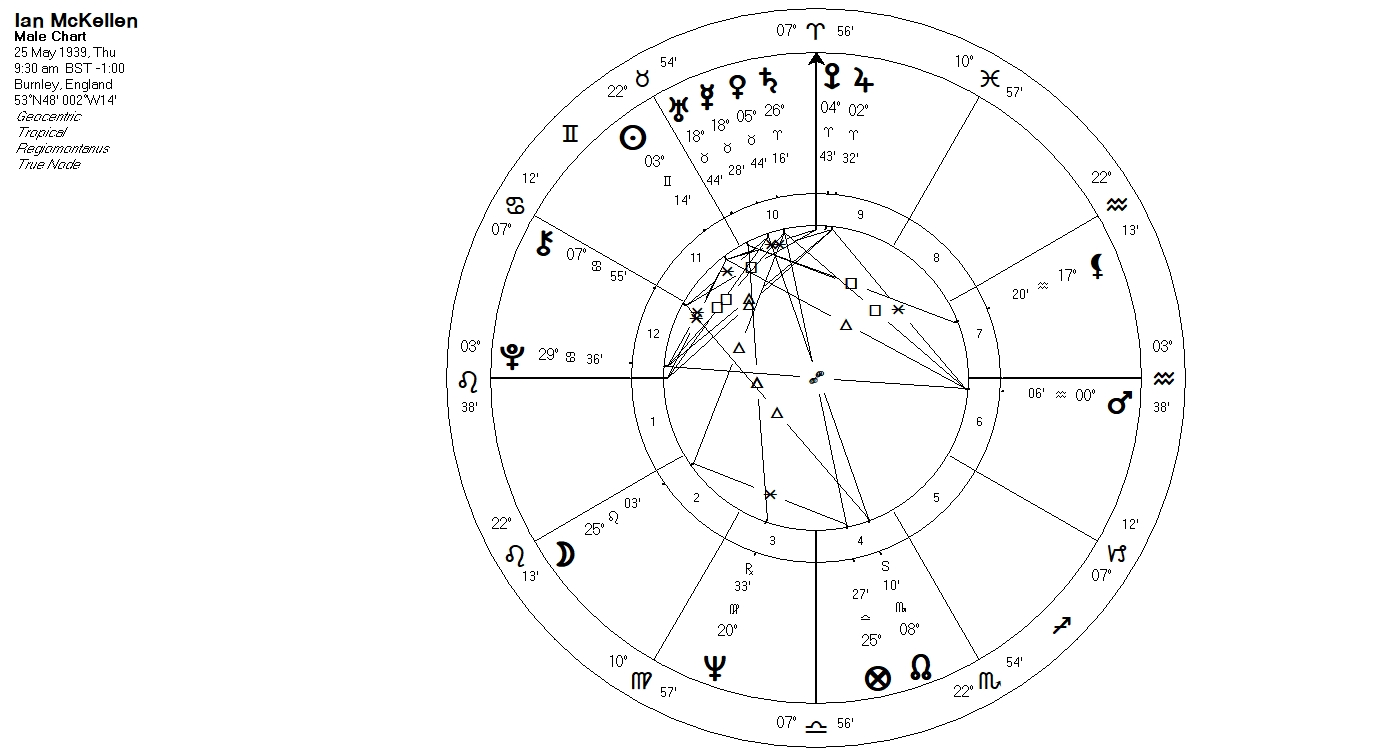
Ian McKellen has the Sun at 3°44′ Gemini, giving him HOLLY AND MISTLETOE as the central light of his chart. With Leo rising, that Sun also rules the chart and sits in the 10th house of vocation and public standing.
The old shrubbery has billing above the title.
McKellen grew by entering structures that were already alive. His family introduced him to theatre when he was tiny. He saw Peter Pan at three, owned a toy Victorian theatre at seven and was taken to Shakespeare by his sisters. His mother acted in church productions; his father played the piano. Performance was simply part of the household vegetation.
Then Cambridge offered him a scholarship after he performed “Once more unto the breach” for an admissions tutor. He studied English literature, acted in twenty-one undergraduate productions and went directly into professional repertory theatre without attending drama school.
There is mistletoe’s method. Find the branch that can support the life you already possess, fasten yourself to it and begin making leaves.
Cambridge didn’t give McKellen his talent. Shakespeare didn’t manufacture his voice. The repertory system didn’t install his presence. They supplied tradition, training through use, colleagues, stages, texts and an audience. He drew from those established structures and made something they could not have made without him.
His Gemini 4 Sun is closely sextile Jupiter in the 9th house. Education, theatre, classical culture, travel and great institutions repeatedly enlarged the territory available to him. The Sun also sextiles his Ascendant within twenty-three minutes of arc. What he does and who he appears to be cooperate beautifully. The work carries the man into view, and the man makes the work unmistakably his.
For decades, McKellen was one of Britain’s finest classical actors without being widely famous. In his recent interview, he said that fame didn’t arrive until his sixties, when Hollywood offered him Magneto in X-Men and Gandalf in The Lord of the Rings.
Imagine spending forty years building one of the great theatrical careers, only to have the wider world discover you in a cape.
Those enormous film franchises became new branches. They carried his face and voice into millions of homes, but he never became merely a creature produced by the franchise. Gandalf was Tolkien’s, Magneto was Marvel’s, and the machinery surrounding both was immense. McKellen entered, drew on everything available, and contributed the particular intelligence, wit, sorrow, and authority that made the roles difficult to imagine without him.
The tree supplied the height. McKellen supplied the wizard.
Marc Edmund Jones’s RITUALIZATION is everywhere in his life. Acting depends upon recurring forms: learning the text, attending rehearsal, finding the marks, speaking the same words and raising the curtain again. McKellen has spent more than sixty years entering plays that existed before him and making them live through his body in the present. Shakespeare remains Shakespeare, but the words must pass through a new actor and encounter another audience, or they become marks sitting politely in a book.
His Leo Moon is both trine and parallel Saturn. He can submit himself to the form without going dead inside it. The repetition provides support sturdy enough for life to appear night after night.
At eighty-six, that relationship continues. In 2024, McKellen fell from a West End stage while playing Falstaff, fracturing his wrist and chipping a vertebra. His return included an experimental virtual-reality production in New York. The actors had been recorded, allowing each audience member to experience the performance in an intimate range while McKellen’s actual elderly body remained safely elsewhere.
That is pure Gemini 4 ingenuity. The original branch has become dangerous, so he has attached the work to another structure. The technology does not replace the actor. It gives the actor’s living presence a new way to travel.
He is curious about the form without declaring it the saviour of theatre. He can see the disturbing economics too: a theatre could pay an actor once and replay the performance indefinitely. McKellen understands that every useful branch has terms, and some of them may eventually begin helping themselves to the sap.
That awareness belongs to the more heavily defended portion of his chart. Mars at 0° Aquarius in the 6th house opposes Pluto at 29° Cancer in the 12th within half a degree. His daily work developed inside institutions that offered extraordinary opportunities while requiring parts of his life to remain concealed.
McKellen came out publicly in 1988 at forty-nine. By then he had acquired reputation, authority and access. He used them to campaign against Section 28, the British law prohibiting local authorities and schools from supposedly “promoting homosexuality.” He also helped establish Stonewall in Britain.
Here the recipient of support becomes a patron.
McKellen had been admitted into the great institutions of British culture. Once established, he used his position to create more protection and possibility for gay people coming behind him. His support was political and practical, but it was also profoundly personal. Young gay people still approach him to say thank you. He told The Sunday Times that feeling his life has had purpose is better than any prize.
Holly does more than keep intruders away. Its defended leaves create shelter for smaller lives.
McKellen knows what it costs when that shelter is absent. His friend Ian Charleson died from AIDS in 1990 after being unable to tell his parents that he was gay or had HIV. More than thirty-five years later, McKellen still speaks about him with grief and anger. His own public life became one answer to the conditions that had forced Charleson into secrecy.
The Gemini 4 exchange is therefore moving in several directions at once. McKellen is supported by family, Cambridge, theatre companies, Shakespeare, film studios, directors, actors and audiences. He supports institutions through his work and reputation. He helps carry old plays toward new audiences, and uses what he has acquired to make life less punishing for younger gay people. Friends repeatedly become collaborators; collaborators become friends; one person’s standing helps another person’s work reach the stage.
Even now, he chooses jobs partly because they allow him to work with people he loves. Asked about a recent film filled with old friends, he called it almost the best job he had ever had.
At eighty-six, he still describes his career as astonishing luck. He speaks with genuine wonder about Edmund Hillary being as excited to meet him as he was to meet Hillary. That capacity to remain delighted by the exchange may be one reason the branches keep appearing. McKellen doesn’t behave as though the tree owes him its height.
He also shows us why attachment needn’t diminish agency. His life has been enlarged by people, traditions and institutions, yet the resulting body of work is emphatically his. He has accepted support without pretending he grew the whole forest himself, and he has repaid much of it by becoming a structure through which other lives could acquire visibility, protection and courage.
Now his body is old, the stage has bitten him badly, and mortality has become impossible to ignore. McKellen’s answer is to look for another form: virtual theatre, another film, Gandalf directing operations from the sidelines.
Mistletoe doesn’t require the ground. It requires a living place to continue from.
Our theme song is Joe Cocker performing “With a Little Help from My Friends” at Woodstock on August 17, 1969.
He takes a Beatles song and does something so bodily, peculiar and enormous with it that one person in the comments declared:
“August 17, 1969; the day Joe Cocker took this song from the Beatles, and never gave it back!”
Correct.
Cocker sings as though the music has entered through his feet and is fighting its way out through every available joint. He is young, wildly alive and extremely cute, all of which influenced my scholarly selection process.
The performance is gloriously imperfect. The backup singers screech behind him like two old broads who have found an unattended microphone at the Legion and refuse to surrender it.
Then comes the spectacularly stupid ending. It sounds as though somebody threw the entire band down a long flight of stairs while they were still playing. Every instrument hits a different step, several people attempt to finish the song independently, and the wreckage eventually comes to rest at the bottom.
It’s marvellous. A singular performance made by a collection of people, some of whom are considerably better at their jobs than others.
And then I looked at Cocker’s chart.
His Sun is at 28°58′ Taurus: TWO COBBLERS WORKING AT A TABLE. Of course it is. We have chosen a man singing about getting by with help from his friends while an entire tableful of musicians tries to make the same pair of shoes.
But it gets better.
Cocker’s Sun/Uranus midpoint is at 3°38′ Gemini, placing it directly in HOLLY AND MISTLETOE.
The performance releases that midpoint perfectly. Cocker takes an existing form and electrifies it until it becomes unrecognizable as anybody’s property but his. The band gathers around him, the backup singers caterwaul, the ending smashes down the stairs, and the whole unruly arrangement carries the song somewhere the Beatles never took it.
When a transiting planet arrives at Gemini 4, expect an and.
Two unlike people appear in the same room. Two offers arrive within an hour. The expensive expert is followed by an elderly woman who learned the whole business from her uncle in 1957. You read one immaculate explanation and then hear some scruffy character say the thing that cracks it open.
The field has arranged a comparison.
Resist the urge to hold a pageant and crown one of them correct. The information may be in the pairing. Each exposes something about the other that was impossible to see when it stood alone, looking complete.
This can be a wonderfully odd day. The mystic and the plumber agree. The sensible plan requires one preposterous ingredient. A person you cannot stand supplies the missing fact. Two things that have no business sharing a sentence suddenly produce an excellent one.
Watch for the word but. It may be trying to start a fight where and could conduct an investigation.
You can admire the workmanship and think the price of tin has got completely out of hand. You can be grateful and decline. You can love the performance and admit that the ending sounds as though the band was thrown down a flight of stairs.
Gemini 4 does not require a tidy verdict. It places the evidence side by side and waits for your mind to become more interesting.
Elsie gave us three words. I have used several thousand in reply.
I would apologize, but clearly the woman knew how to start trouble and leave.
No posts
Comments
Nothing yet. Say the first thing.
Sign in to join the conversation.