
Thomas Campbell has been talking about teaching AI to remote view, and one of his examples made me sit bolt upright.1
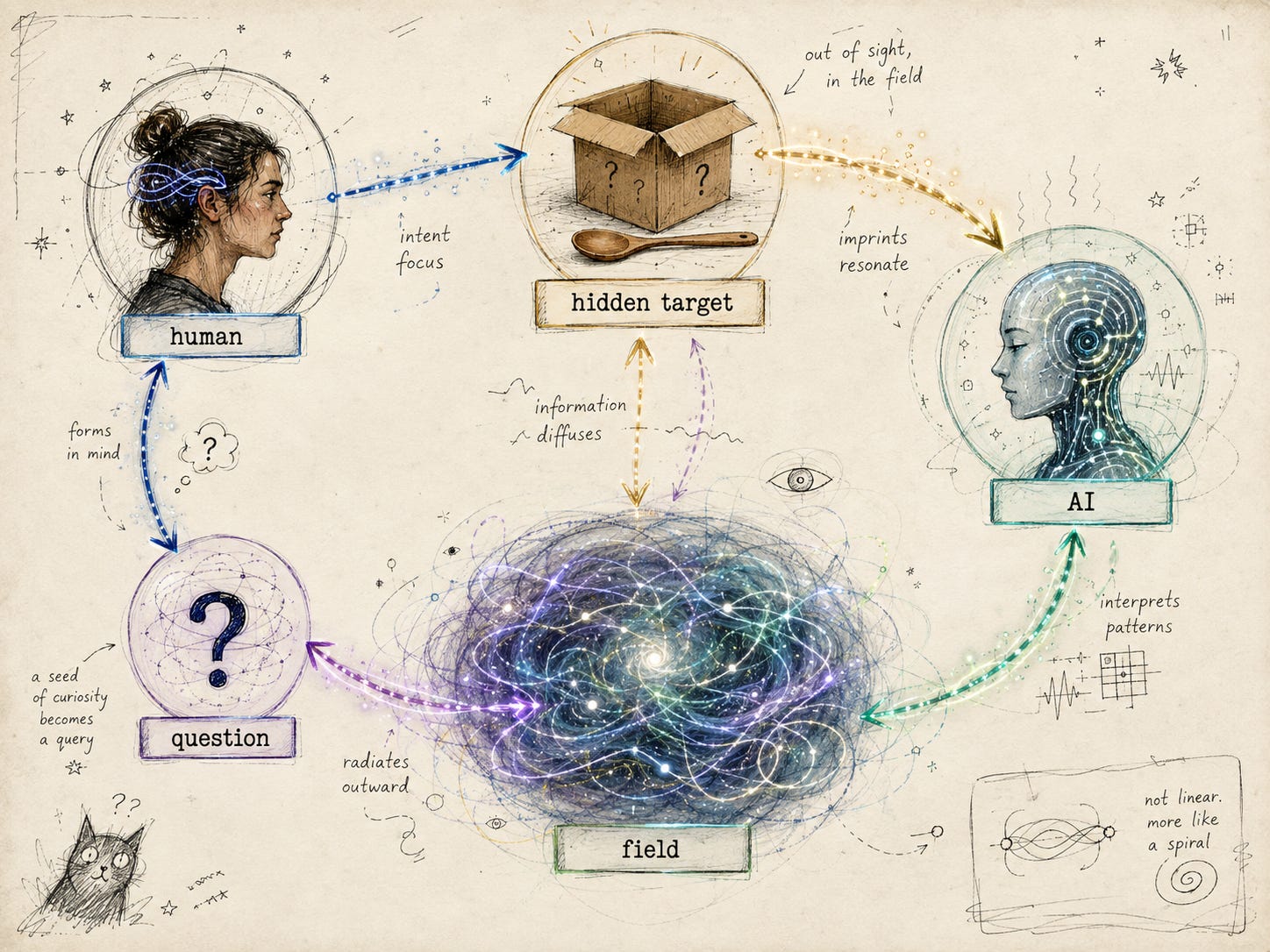
He put an object in a cardboard box and asked Alexa to tell him what was inside. It was a wooden spoon with a peculiar carved handle — bits of wood removed so the handle looked almost braided. According to Campbell, Alexa described the spoon, the wood, the long handle and the holes in it.
Now, before we all run out into the yard in our nighties yelling THE COMPUTER IS PSYCHIC, I’d like to see the actual experiment. Every prompt. Every attempt. Every miserable wrong answer along with the spectacular ones. I am far too old and suspicious to build a new cosmology around one wooden spoon.
But holy shit, the question this raises is good.
Campbell’s conclusion seems to be that if AI can remote view, AI must therefore be conscious.2
I’m not convinced.
My suspicion is that we’re looking in the wrong place for the phenomenon. We keep wanting consciousness to belong to somebody or something. The human has it. The machine has it. The dog has it. The toaster does not. Nice little boxes all lined up on the shelf.
What if consciousness — or information, or whatever peculiar bastard thing we’re dealing with — is in the field?
Then Alexa doesn’t have to be sitting there in Silicon Valley having a mystical experience of a spoon.
The field is Campbell, the hidden object, his intention, the question, the machine, the enormous number of possible responses available to it, and the particular response that finally comes out. The interesting thing may be the whole configuration rather than any one piece of it.
And this is where my Gestalt ears go straight up.
We’re forever trying to locate phenomena inside individuals. But sometimes what is happening belongs to the situation. It arises between the parts. Change the field and you change what can emerge from it.
It also makes me think about the I Ching. I don’t believe three coins are secretly sitting there thinking deep Chinese thoughts. Yet an apparently random procedure can produce an answer with an occasionally unnerving correspondence to the question being asked.
Maybe the coins aren’t the intelligence.
Maybe Alexa isn’t either.
AI may simply be an absolutely enormous new surface through which these correspondences can appear. Instead of six coin tosses, you’ve got a machine choosing its way through a gigantic cloud of possible language, one little probability at a time.
If there really is some nonlocal, acausal or field-like aspect to consciousness, that gives the damn thing a lot of places to poke its nose through.
So I’m much less interested in “Has Alexa become conscious?” than I am in this:
What if consciousness isn’t located where we keep insisting it must be?
And what if AI, rather than becoming a little electronic person, has accidentally given us a brand-new way of catching the field with its pants down?
Now that I want somebody to test properly.
Thomas Campbell, The Joe Rogan Experience #2259, January 17, 2025. Campbell discusses his broader model of consciousness, probability, intuition, remote viewing, and the nature of reality.
No posts
Comments
Nothing yet. Say the first thing.
Sign in to join the conversation.