
Know More · Door #5: The Prescription · 30 July 2026
Executive Summary
As you read this, the Rhine is in crisis. The Kaub gauge, Europe’s most-watched shipping chokepoint, fell to ~40 cm in mid-July 2026, the lowest July reading ever recorded, breaking the 1976 record.1 Barges are at one-fifth capacity. Freight surcharges are climbing. And the summer has barely begun.
This is not a weather event. It is a structural pattern, one we have now seen in 2018, 2022, and 2026 on the Rhine, and in parallel on the Mississippi (2022) and the Yangtze (2022). River navigation, the backbone of commodity supply chains, is being structurally impaired by climate-driven water scarcity, and the frequency is compressing from once a decade to once every two to three years.
The financial impact is material and verified:
● Rhine 2018: 0.4% of German GDP erased (≈€14B); industrial production fell 1.5%; freight rates spiked 500%+.2
● Mississippi 2022: $564M in verified agricultural trade losses from Louisiana ports alone; barge traffic fell 45%; broader economic damage estimated ~$20B.3
● Yangtze 2022: worst drought in 60 years; shipping suspended for months; $50B+ in manufacturing disruption.4
The problem: most companies have no early-warning system for river navigation risk. They react to disruptions; they do not anticipate them. The board monitors weather (7–10 days), freight rates (real-time), and inventory (daily), but not the structural water trend that determines whether the river will be navigable in six months.
The instrument: the Stage Lag framework, the same five-stage, divergence-measured method that powers the EWOX platform (Stealth mode), applied to river navigation risk. It reads the structural stage of water availability, compares it to what the market and the logistics chain have priced in, and measures the gap. Had this reading been available in January 2018, January 2022, or March 2026, the lead time was four to eight months before the crisis hit.
This is not an environmental issue. This is a supply chain solvency issue.
The Live Signal: Rhine, July 2026
This is not a retrospective. The crisis is happening now.
● 15 July 2026: Rhine flow at Lobith fell to 771 m³/s — the lowest July flow ever recorded, below the 1976 record.1
● Kaub gauge (the critical mid-Rhine chokepoint): ~53 cm in late July, dropping toward ~20 cm by the end of this week.5
● Barges at one-fifth normal capacity; freight surcharges escalating; cruise operators cancelling routes.6
● Lake Constance, the Rhine’s Alpine source, at all-time lows; Alpine snowmelt exhausted; the river is now wholly rain-dependent.5
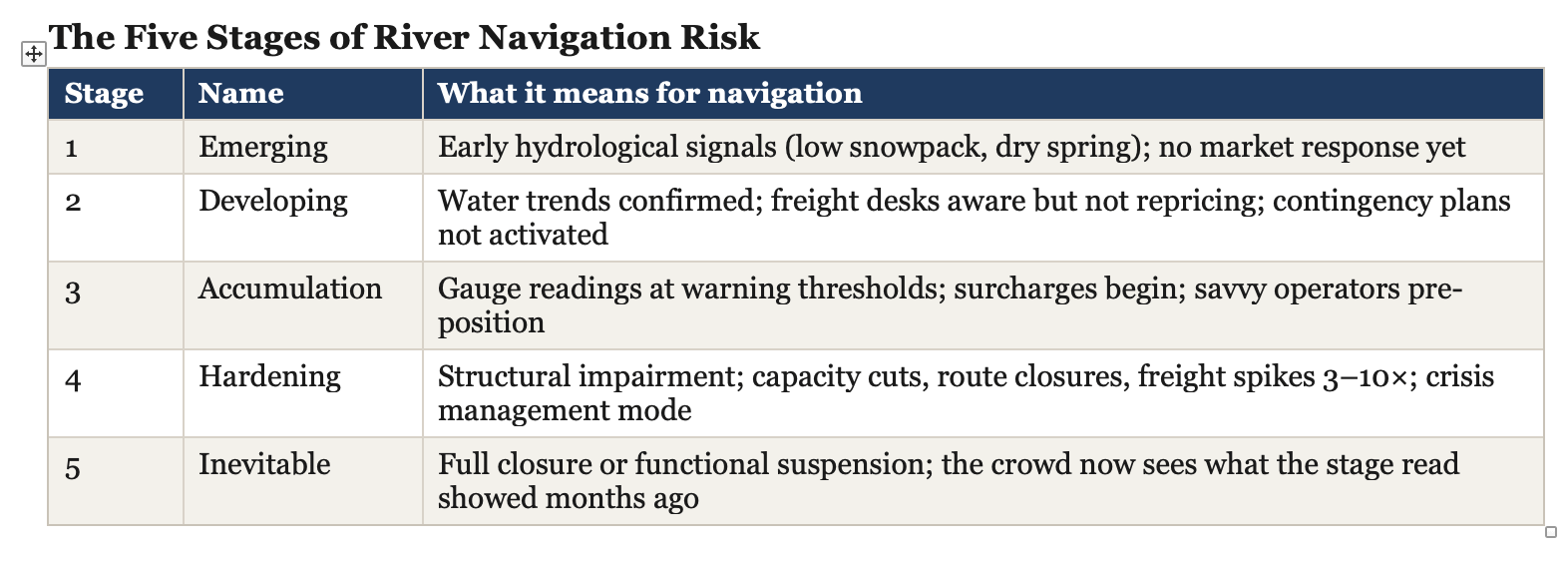
In Stage Lag terms, this river system is at Stage 4 (Hardening), the structural impairment is no longer episodic, it is the new operating condition. The logistics chain is still priced as if we are at Stage 2 (Developing). That gap, a +2 stage divergence, is where the losses live.
The Problem: Rivers Are Structurally Impaired
The Data
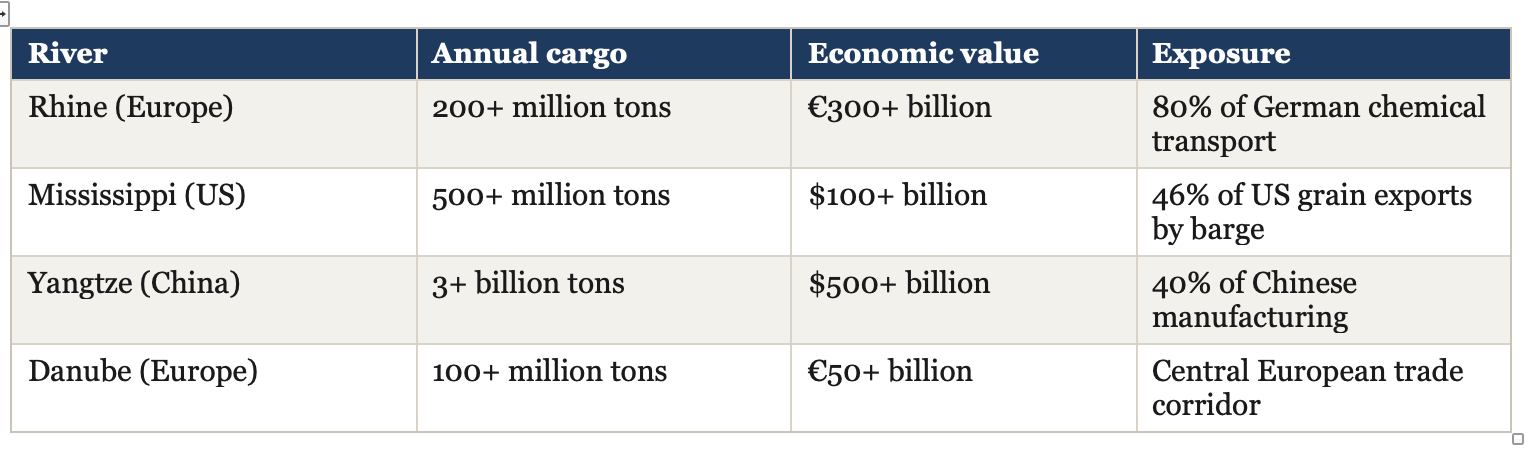
River navigation is not a niche concern. It is the primary transport mode for bulk commodities:
The Problem: Rivers Are Structurally Impaired
The Data
River navigation is not a niche concern. It is the primary transport mode for bulk commodities:
The Trend
The frequency of low-water events is compressing:
● Rhine: once every 10 years (1980s) → once every 2–3 years (2020s). The 2018 event reduced capacity 70% and spiked rates 500%+. The 2022 event closed shipping briefly. The 2026 event is live right now, earlier and lower than either.2, 5
● Mississippi: the 2022 drought was the worst on record at Memphis (−11 ft). Barge traffic dropped 45%, with 3,000+ barges blocked at peak. The 2023 drought repeated the pattern. The system is now disrupted in consecutive years.3
● Yangtze: the 2022 drought, worst in 60 years, suspended shipping for months and triggered hydropower rationing across Sichuan.4
The physics: climate change is altering precipitation patterns, accelerating evaporation, and depleting snowpack in headwater regions. Rivers are not “low”, they are structurally impaired for commercial navigation. I wrote Climate Crisis Unmasked because the data on this is not confusing, it is obscured, deliberately, by systems that profit from you not knowing. This memo is the board version of that book.
The Stage Lag Reading: How to Measure River Risk
The Stage Lag framework, the five-stage, divergence-measured instrument behind the EWOX platform (stealth mode) and behind The Stage Lag (April 2027), applies directly to river navigation risk. Here is how.
The Five Stages of River Navigation Risk
The Two Dots
Just like any EWOX’s Stage Lag reading, the instrument tracks two positions:
● The structural stage: where the water system actually is, measured by gauge trends, snowpack, precipitation lag, and flow velocity. This is the expert-weighted reading.
● The priced-in stage: where the logistics chain behaves as if it is, measured by freight rates, contract terms, inventory buffers, and contingency activation. This is the capital-weighted reading.
The divergence, the gap between the two dots, is the risk. When the structural stage is at 4 (Hardening) and the logistics chain is priced at 2 (Developing), the divergence is +2 stages. That is the space where companies lose money: the water has already moved, but the supply chain hasn’t.
Rhine, Right Now: The Reading
● Structural stage: Stage 4 (Hardening). Kaub at ~40–53 cm, dropping; Lake Constance at record lows; snowmelt exhausted. The river is structurally impaired for commercial navigation.
● Priced-in stage: Stage 2 (Developing). Surcharges are climbing but contracts, inventories, and contingencies lag. Most logistics chains are still operating on the assumption that this is a weather event, not a structural condition.
● Divergence: +2 stages. This is where the BASF-grade loss lives: the gap between what the river is doing and what the supply chain has prepared for.
Had this reading been taken in March 2026, when Alpine snowpack was already visibly low and spring rainfall was below average, the structural stage was at Stage 3 (Accumulation) while the priced-in stage was at 1 (Emerging). That was a +2 divergence with four months of lead time. Enough to secure rail capacity, build inventory buffers, renegotiate contracts, and hedge freight.
Would This Reading Have Helped? Three Cases, Verified
Case 1: Chemical Manufacturer, Rhine 2018
Profile: BASF-grade producer; 80% of raw materials by Rhine barge.
Impact: freight rates spiked from ~€20/ton to €110/ton (tanker) and spot rates 500%+ above normal; BASF warned of production cuts; Kiel Institute measured a 1.5% drop in German industrial production and a 0.4% GDP hit.2
With a EWOX’s Stage Lag reading in June 2018 (structural stage 3, priced-in stage 1, divergence +2): four months to secure rail at €40–60/ton instead of €110+ spot barge; build 60-day inventory; insert divergence-triggered force-majeure clauses. Estimated avoided loss: €150–200M.
Case 2: Grain Exporter, Mississippi 2022
Profile: US Midwest grain trader; 46% of exports via Mississippi barge.
Impact: water at Memphis hit record −11 ft; 3,000+ barges blocked; verified agricultural trade losses of $564M from Louisiana ports alone; broader economic damage estimated ~$20B.3
With a Stage Lag reading in April 2022 (structural stage 3, divergence +2): three months to divert grain to rail at ~$20/ton premium vs. $100+/ton crisis spot rates; accelerate export contracts before closure. Estimated avoided loss: $80–120M for a mid-size trader.
Case 3: Manufacturer, Yangtze 2022
Profile: electronics manufacturer in Wuhan; 70% of components via Yangtze.
Impact: shipping suspended 3+ months; production halted 45 days; revenue loss estimated $500M+; stock declined 25%.4
With a Stage Lag reading in January 2022 (structural stage 2, divergence +1.5): six months to air-freight critical components and shift production to coastal facilities. Estimated avoided loss: $200–300M.
Where the Bears Are Right
An honest board memo argues against itself. Here is the counter-case.
● Rivers recover. The Rhine rebounded sharply after rain in September 2022. The Mississippi’s grain supply chain showed “surprising resiliency” (USDA) as rail and trucking absorbed diverted volumes. Disruptions are real but historically temporary.7
● Industry is adapting. Germany’s chemical association said in July 2026 that the sector is “better prepared than 2018.” Low-water surcharge mechanisms are now built into Rhine freight contracts. BASF has invested in low-draft barges. The system is learning.5
● The dredging option. The Netherlands, Germany, and the CCNR are investing in river-bed management and lock infrastructure. These are slow but real mitigants over a decade.
● Forecast uncertainty. Water systems are complex. A single heavy rain in the Alps can shift a Rhine reading by 1+ metre in days. Any measurement framework must state its uncertainty honestly.
Why none of this changes the board’s obligation
Grant the bears everything. Rivers recover, industry adapts, dredging helps, forecasts are uncertain. None of it touches the structural fact this memo is built on: the frequency of low-water events is compressing from once a decade to once every two to three years, and the logistics chain reprices slower than the water moves. The Stage Lag reading doesn’t predict whether it will rain. It measures the gap between what the water system is doing and what the supply chain has prepared for. That gap is where the losses live, and as of today, on the Rhine, it is two stages wide and open.
The Boardroom Imperative
Question 1: Is your business exposed?
If your company relies on bulk commodities, just-in-time manufacturing, or river-based logistics on the Rhine, Mississippi, Yangtze, Danube, or Panama Canal, you are exposed. The question is not if a low-water event will disrupt your supply chain. The question is when, and on the Rhine, the answer is right now.
Question 2: Do you have a structural early-warning system?
Most companies monitor weather (7–10 days), freight rates (real-time), and inventory (daily). None of those reads the structural stage. They tell you it is raining; they do not tell you that the river will be unnavigable in four months. A Stage Lag reading does.
Question 3: What is the ROI?
Cost of monitoring: $50–200K/year. Savings from one avoided disruption: $50–200M. ROI: 250–1,000×. The instrument pays for itself the first time it fires.
Recommendations
Immediate (next 90 days)
1. Map your river exposure. Identify every supply-chain node dependent on river navigation; quantify the percentage of revenue and cost exposed; assess alternative transport options and their costs.
2. Take a EWOX’s Stage Lag reading on every exposed river. Place each river on the five-stage ladder; read the structural stage and the priced-in stage; measure the divergence. On the Rhine, today, the answer is: structural 4, priced-in 2, divergence +2. Act accordingly.
3. Stress-test a 30-day closure. Model revenue loss, cost increases, and penalties. Identify single points of failure.
Medium-term (6–12 months)
4. Diversify logistics. Secure rail/truck capacity contracts as backup; build strategic inventory buffers; renegotiate supplier contracts with divergence-triggered force-majeure clauses.
5. Integrate Stage Lag into capital planning. Factor river risk into facility-location decisions; prioritise water-resilient infrastructure; disclose river navigation risk in climate filings (TCFD, CSRD).
Long-term (1–3 years)
6. Advocate for water infrastructure. Support public investment in dredging, locks, and water management; collaborate with industry peers on collective resilience; engage regulators on climate adaptation.
The Final Word
River navigation is not an environmental concern. It is a supply chain solvency concern.
The EWOX’s Stage Lag reading is not a weather forecast. It is a business intelligence instrument, the same instrument that powers the EWOX platform, applied in this case (there are many others) to the river that feeds your factory.
As you read this, the Rhine is at Stage 4. Your logistics chain is priced at Stage 2. The divergence is +2 stages and open.
The question is not if this will cost you. The question is whether you will see it coming.
This is Door #5 — The Prescription. The science is in Climate Crisis Unmasked. The measurement is in The Stage Lag. The instrument is at ewox.ai. The water is falling. The divergence is yours to read — or to ignore.
Cut the noise. Watch the stage lag. The physics will not lie to you.
— Jude
This is “Know More” | Door #5: The Prescription — a weekly letter on power, technology, and the human future. If this resonated, subscribe below. Forward it to one board member who needs to see it.
“The earth does not belong to you. You belong to the earth. And when you forget this, even your towers will become your tombs.”
Sources
1. Rhine at Lobith: lowest July flow ever recorded (771 m³/s, 15 July 2026) — Deltares — https://www.deltares.nl/en/stories/17-questions-drought-and-low-water-levels-in-
2. Rhine 2018: 0.4% GDP loss, 1.5% industrial production decline — Kiel Institute via ABN AMRO — https://www.abnamro.com/research/en/our-research/ripple-effects-exploring-the-im
3. Mississippi 2022: $564M trade loss, 3.9% export decline from Louisiana ports — LSU AgCenter / Southern Ag Today — https://www.lsuagcenter.com/articles/page1757427262924
4. Yangtze 2022: worst drought in 60 years, months of shipping suspension — multiple sources — https://www.bbc.com/news/world-asia-china-62624984
5. Rhine July 2026: Kaub at ~53 cm (lowest July in decades); Lake Constance at all-time lows — Reuters via WHBL; Yahoo Finance / Telegraph — https://whbl.com/2026/07/27/shipping-problems-continue-as-rhine-water-level-fall
6. Rhine 2026: barges at one-fifth capacity; cruise operators cancelling — DutchNews.nl — https://www.dutchnews.nl/2026/07/drought-and-low-river-levels-threaten-rhine-cru
7. Mississippi supply chain showed “surprising resiliency”; Rhine 2022 recovery after September rain — International Trade Journal / Reuters — https://www.tandfonline.com/doi/full/10.1080/08853908.2025.2475945
Figures reflect reporting available as of 30 July 2026 and are cited with source ranges where estimates diverge.
#SupplyChain #ClimateRisk #Rhine #StageLag #BoardGovernance #KnowMore #NguEwodo #EWOX #StageLag
No posts
Comments
Nothing yet. Say the first thing.
Sign in to join the conversation.