
Are you a fan of the oxymoron? If so, I have one for you: “quietly suspenseful.” It’s right up there with jumbo shrimp and deafening silence and awfully good. I know some writers aren’t fans—though Shakespeare and others famously were—but please hear me out.
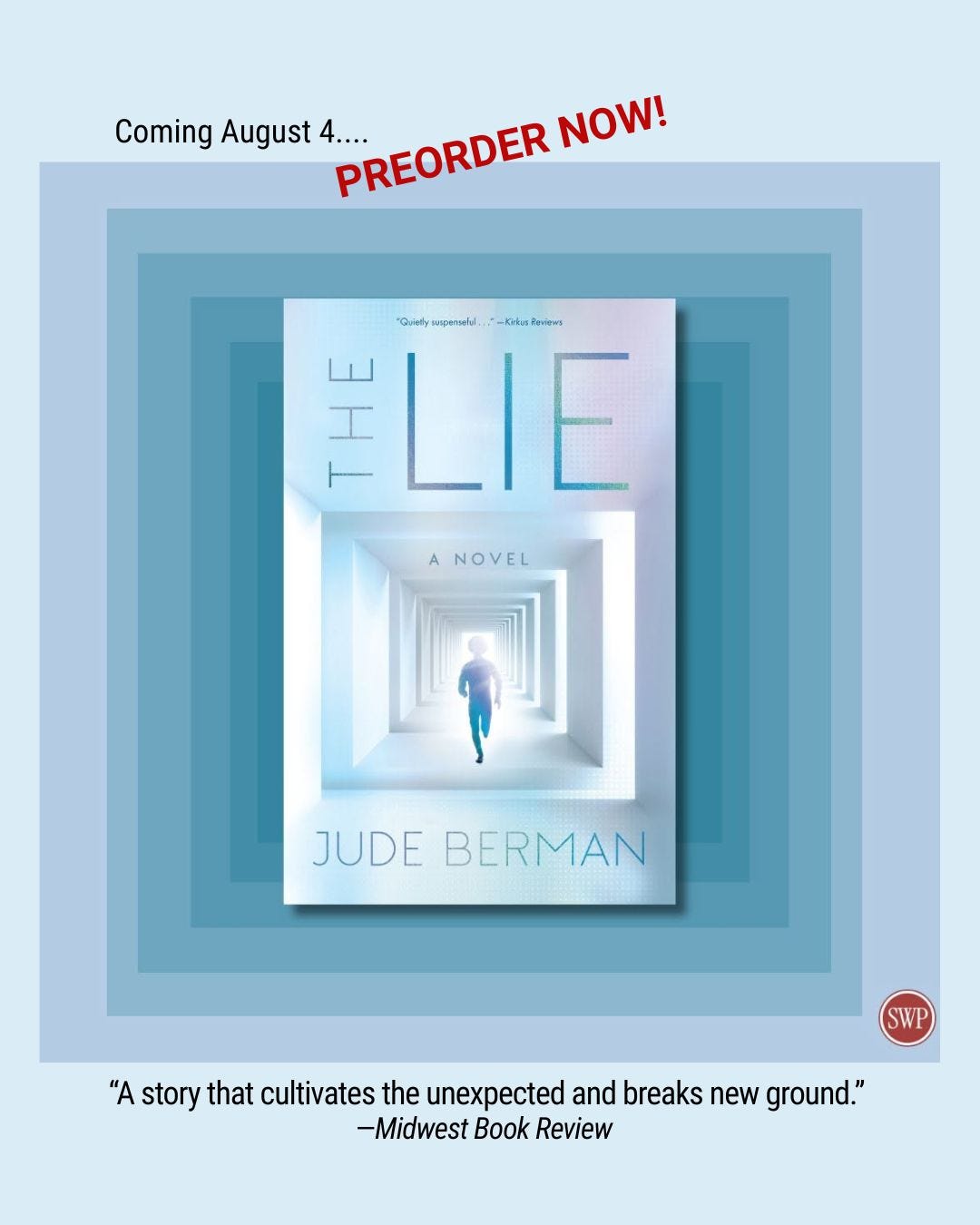
When I read the Kirkus review of my latest book, The Lie, my eyes went to the phrase “A quietly suspenseful dystopian novel. . .” The book is more utopian than dystopian, but other than that, I was thrilled. I thought, They got it! They understood what I’m trying to do!
I did have a moment of doubt, thinking perhaps I was too eager to see the best and this was a backhanded compliment and they were really saying the book drags. But this sentence cleared that up: “Berman draws out revelations for maximum theatrical delivery and builds an atmosphere of steady accumulating tension.”
I asked my publisher if we could put “quietly suspenseful” on the front cover of the book so my intentions would be crystal clear to readers. And there it sits. Every time I look at it, I smile.
But—perhaps no surprise—not everybody gets it. A reviewer who read an advanced copy recently left a long and detailed review that said wonderful things. But he gave the book only 4 stars. To be clear, I’m not someone who complains about 4 stars. But I was curious why.
Here’s what he said: “The main reason it stops just short of a full five stars is that the pacing can feel slightly disjointed as it balances so many different narrative threads at once. . . . Certain high-stakes moments are paused for internal reflection just as the suspense reaches a peak. Additionally, while the metaphysical layer adds wonderful complexity, readers looking for a purely fast-paced, straight-ahead techno-thriller might find those reflective passages slowing down the central rescue mission.”
Much as I appreciate the review, I had to shake my head. Because he didn’t get it.
We live in the world that is diced up into genres, and these genres come with rules and expectations. Not only is it virtually impossible to avoid these expectations in the literary marketplace, but genres subtly and not so subtly train readers to narrow what they want to read. You end up with, for example, “readers looking for a purely fast-paced, straight-ahead techno-thriller.”
I’m not saying it’s wrong to look for a book with a narrow focus. But what is problematic is when that reader then judges a book because it delivers something more than or different from their narrow focus.
On the other end of the equation, this hits the writer too. If your book is a romance, it has to have a happy ending. If your book is a thriller, it needs to live up to that; it has to be “loudly” suspenseful. “Quietly” suspenseful is essentially a fail.
As a writer, I bristle at this because it is telling me what I can and cannot do if I want my book to have a chance “out there.” Truth be told, I’m neither a reader nor a writer of thrillers. I use the element of suspense to tell a good story, but I’m more interested in character, in moral dilemma, in philosophy, in message. Those are what drive my writing, and they are all quiet elements. If you want to put a formula to it, you could say my book is three parts quiet and one part suspense. Yet I have little to no control over how the marketplace pigeonholes my book(s).
I’m writing about this because I want to name the problem and I want to push back against the constraints. I’d like to believe I’m not the only one who values quiet suspense, or for that matter, appreciates a good oxymoron.
I want to read books that are unique creations of the author rather than written to genre specifications. How about a near-future historical novel? Or historical dystopian fiction? Maybe a tearjerker happily-ever-after romance? I’m being silly, but can we please push the boundaries with our books?
And . . . The Lie is available for preorder wherever you buy your books.
Comments
Nothing yet. Say the first thing.
Sign in to join the conversation.