
I’d like you to meet Emma Schindler.
She was my great-aunt. I don’t think I look much like her, but my mother did—same dark eyes and wavy black hair.

Earlier this month, the lecture theater at the Eye Clinic of the University Medical Centre Hamburg-Eppendorf was renamed in her memory. If I lived closer, I would have gone for the ceremony. But I didn’t. Instead I’m telling you a little bit about her.
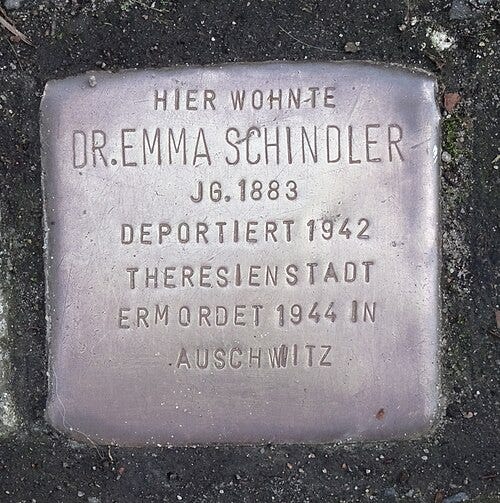
Emma was born in Berlin in 1883. Against all odds in a male-dominated medical profession, she completed her medical studies and obtained a doctorate. Her dissertation refuted the notion that iris color changes in early infancy are a sign of degeneration (as promoted by eugenicists at the time) and instead demonstrated the influence of malnutrition.
She set up a practice in Hamburg. In 1926, she was the only woman among the thirty-seven ophthalmologists practicing in the city. She was also a promising scientist, working at the Eppendorf Eye Clinic. Her research on dark adaptation, the glial system of the intracranial optic nerve, and neuroglia staining was published in renowned journals of the time.
All this came to an end in 1933.
First her registration with the health insurance fund was revoked and then, like all Jewish doctors, she lost her medical license. Her brothers were able to flee Germany, but she stayed.
I remember my mother telling me that when the family tried to persuade Emma to leave, she said she could not imagine things would get much worse, that eventually sanity would be restored. She was unwilling to walk away from her work—which she loved, and to which she had dedicated her life—fearing it would be too hard to start over elsewhere. So she stayed.
She had another reason to stay: She was caring for her mother, Blanca, for whom travel would have been difficult. Emma stayed by her side until he mother died in 1939 at age eighty-seven—a decision that ultimately sealed her own fate.
For the next several years, she served as a nurse, attempting as best she could to provide medical care to the Jews who had remained and who were increasingly being forced into hard labor. The Gestapo made medical staff in the Third Reich decide on the transportability of Jews: If staff deferred someone on medical grounds, that could temporarily save their life but meant another person would be deported. A similar dilemma arose in the case of suicide attempts: Survivors were medically cared for, only to face deportation once recovered. Thus medical staff found themselves in constant conflict between medical ethics and a reality in which help often meant nothing more than a delay of the inevitable.
In 1942, Emma received a deportation order to Theresienstadt. There she ran an eye clinic, and even under inhuman conditions, tried to do everything she could for her patients with eye conditions.
On October 19, 1944, she was deported along with 1,500 other people to the Auschwitz extermination camp. Emma’s life ended at the age of sixty-one. Officially she was listed as “missing.”
Comments
Nothing yet. Say the first thing.
Sign in to join the conversation.