
Hello there!
If you’ve been around entrepreneurs or marketing teams lately, you’ve probably noticed something odd.
The conversations about lead generation feel polarized.
On one side, there are businesses saying things have never been more predictable. Their pipelines are full. They’ve dialed in acquisition. Conversion rates feel steady. They can forecast with a level of confidence that wasn’t always possible.
On the other side, there are equally capable teams saying the opposite. Ads cost more than they used to.
Email engagement is inconsistent. Funnels that once converted reliably now feel fragile. It’s harder to tell which lever actually moves the needle.
Both groups are operating in the same general market conditions. They have access to the same platforms, similar automation tools, and comparable distribution channels. The external environment isn’t radically different between them.
What seems different is how tightly the entire system is connected.
There was a time when you could rely heavily on one strength.
A strong ad account could compensate for an underdeveloped follow-up process.
A talented sales team could make up for loose qualification.
A well-performing webinar could carry more weight than it probably should have.
The tolerance for imbalance was higher.
That margin has narrowed.
As acquisition costs increase and buyers become more selective, weak transitions inside the system are harder to hide.
If the messaging attracts the wrong audience, activation suffers.
If follow-up is disconnected from the initial promise, sales conversations feel colder.
If onboarding is inconsistent, retention quietly erodes the gains made upstream.
None of these breakdowns are dramatic on their own.
But collectively, they make growth feel unstable.
That’s why some businesses feel like everything is working and others feel like nothing is.
It’s not randomness. It’s cohesion.
And when cohesion weakens, adding more traffic rarely solves the underlying issue. It simply adds pressure to a system that isn’t fully aligned.
The practical question becomes: how do you identify where cohesion is breaking down?
When results feel unstable, it’s tempting to diagnose everything at once. Messaging, targeting, follow-up, sales process, retention. But trying to fix the entire machine simultaneously usually creates more noise than clarity.
What has been more useful for me is breaking lead generation into a sequence of connected paths and evaluating each one independently.
Not as a theoretical exercise, but as a way to isolate pressure points.
Instead of asking, “Is our funnel working?” the better question becomes, “Which transition is underperforming?”
Most online lead generation systems can be understood through four distinct paths:
The Prospect Interest Path
The Lead Activation Path
The Sales Conversion Path
The Client Fulfillment Path
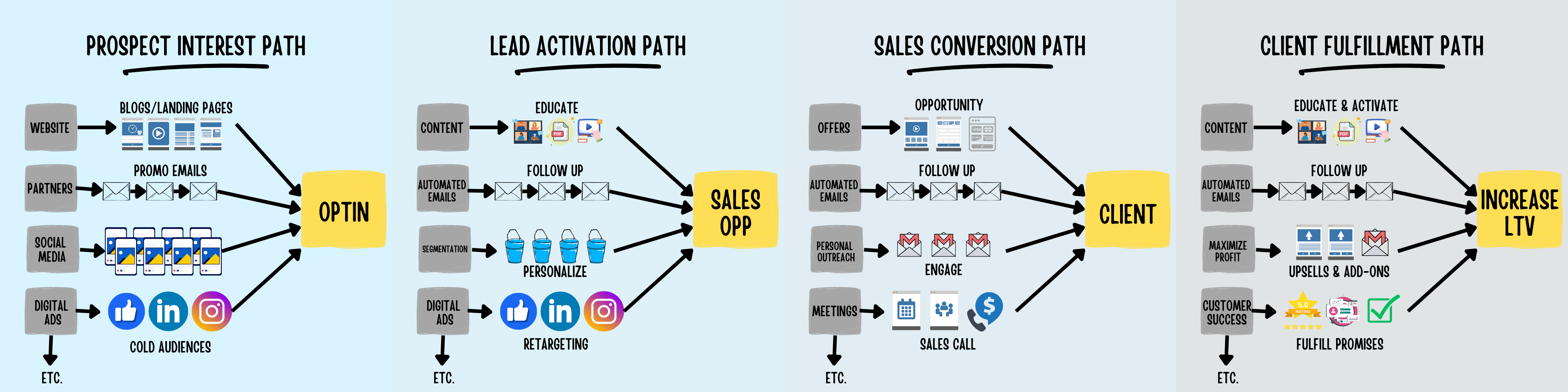
Each path has a clear objective.
Each path has a defined entry point and exit point.|
And importantly, each path can succeed or fail on its own.
When performance weakens, the issue is rarely spread evenly across all four. More often, one transition is carrying too much weight or failing to move people forward the way it should.
Before adding more traffic, launching another campaign, or restructuring your offer, it’s worth stepping back and auditing each path in isolation.
The goal isn’t to rebuild everything.
It’s to identify which part of the system is no longer doing its specific job.
From there, the next step becomes much clearer.
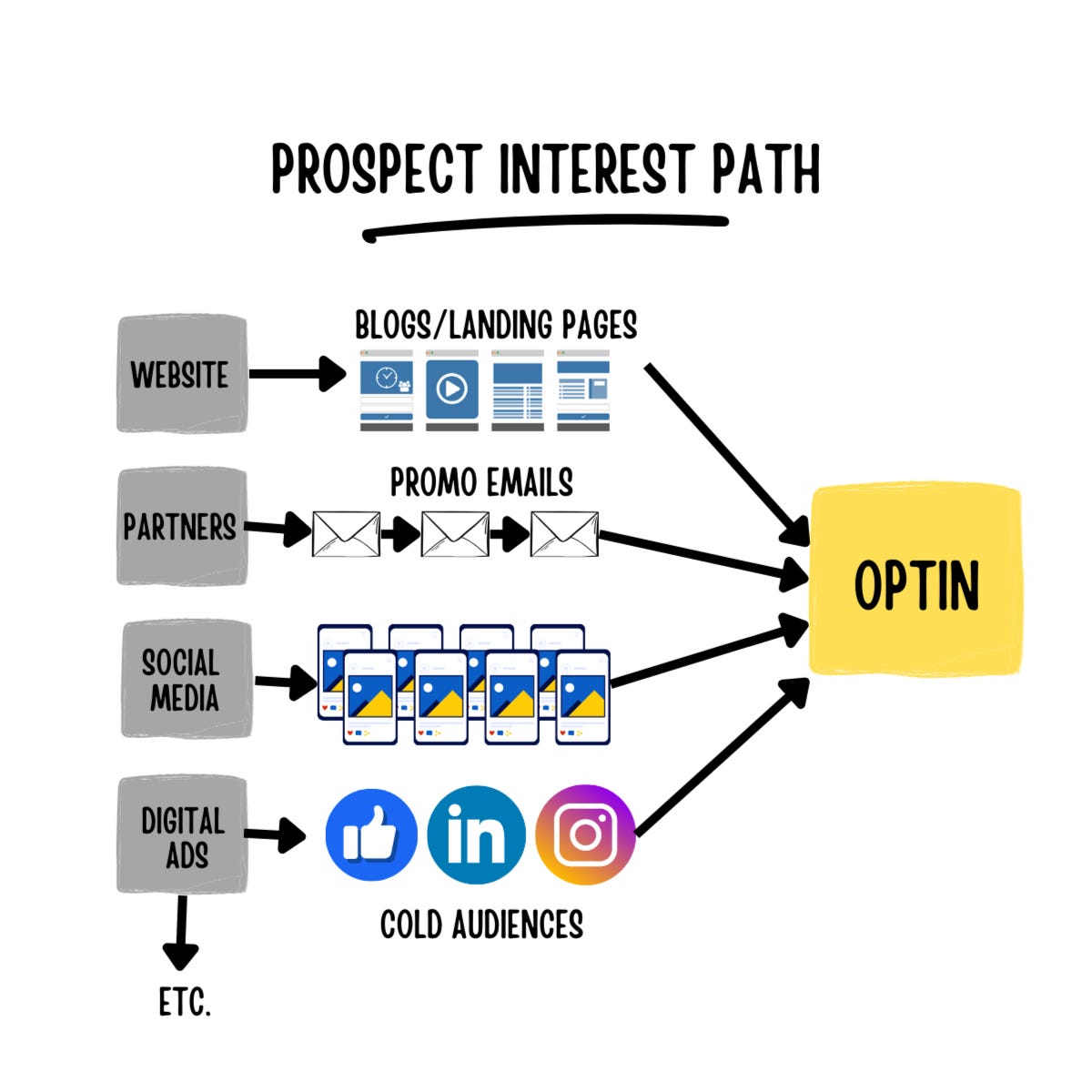
The Prospect Interest Path is where the relationship begins.
This is the stage where someone first encounters your brand through content, advertising, partnerships, referrals, or any other form of outbound or inbound visibility. The objective here is not conversion in the final sense. It is alignment.
You are trying to attract the right type of attention and create enough relevance for someone to take a small but meaningful next step.
That distinction matters.
When this path weakens, the symptoms often show up later. Sales conversations feel less qualified. Activation rates drop. Retention becomes harder. But the issue frequently starts here, with the type of attention being generated.
One of the most common mistakes I see is mistaking activity for alignment. Traffic may be steady. Click-through rates might look reasonable. But if the messaging is broad or the targeting slightly off, the system begins feeding itself the wrong inputs.
And downstream stages can only work with what they are given.
There are a few questions worth asking when evaluating this path.
First, is the audience definition specific enough to guide targeting decisions? A loosely defined audience may generate reach, but it rarely generates precision. When messaging tries to appeal to too many variations of a buyer, it often resonates deeply with none.
Second, does the initial promise connect clearly to what happens next? If someone encounters an ad, a blog post, or a piece of content, the transition to opt-in should feel logical. When the bridge between attention and action feels abrupt or disconnected, engagement suffers.
Third, is the opt-in itself aligned with the offer downstream? If the content attracts one type of interest but the eventual sales conversation addresses something slightly different, the path becomes misaligned before activation even begins.
This stage is less about volume than it is about signal quality.
If you are bringing in 1,000 visitors but only a small fraction truly match the profile of someone who benefits from your offer, the system will feel heavier at every stage that follows. Sales conversations will require more convincing. Follow-up will feel colder.
Conversion will feel inconsistent.
That friction rarely gets traced back to the top of the path, but it often starts there.
The goal of this audit phase is not to overhaul your acquisition strategy immediately. It is to determine whether the attention you are generating is precise enough to support what happens next.
If the Prospect Interest Path is aligned, downstream improvements tend to compound quickly. If it is not, every other stage is forced to compensate.
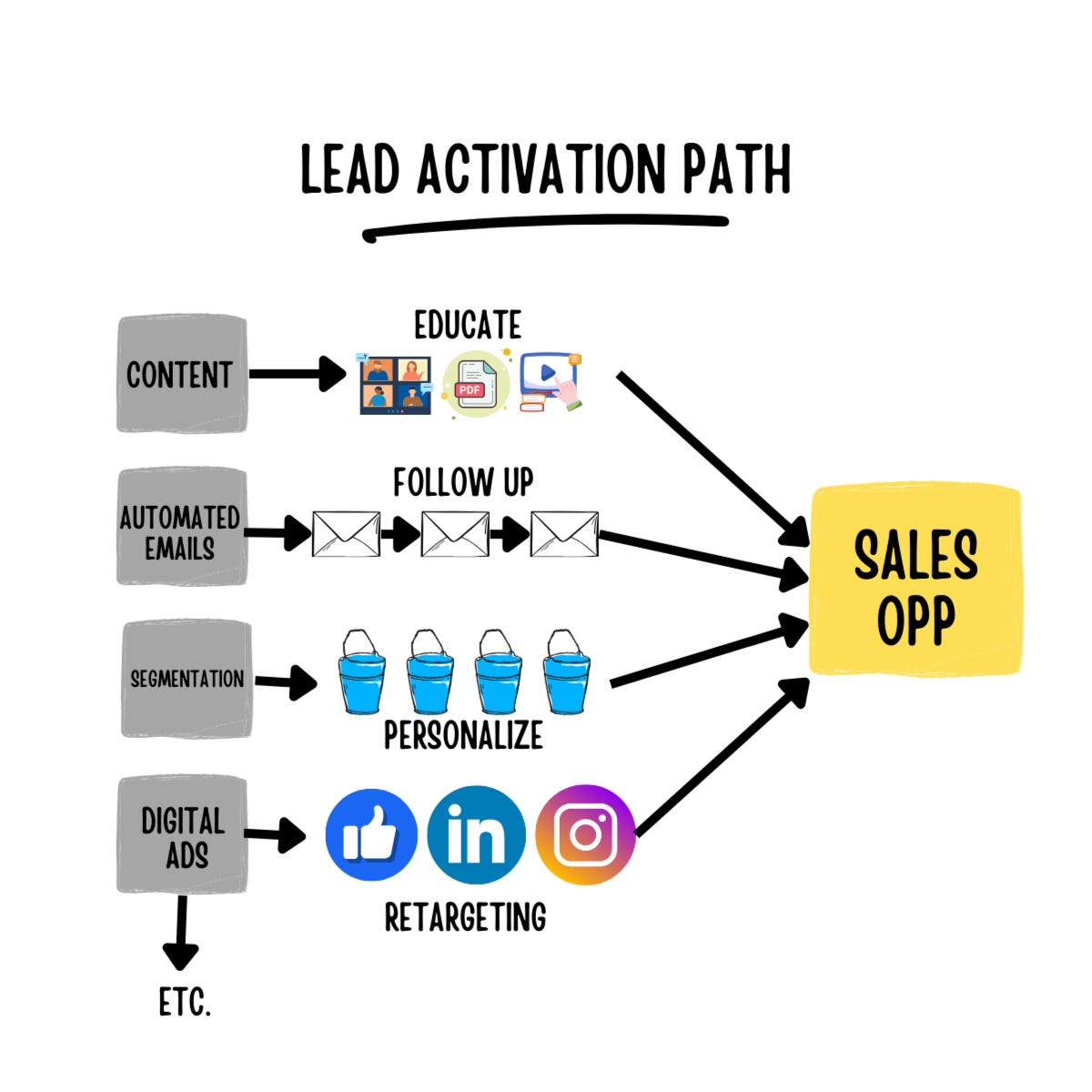
If the first path is about attracting aligned attention, the second is about building momentum.
The Lead Activation Path begins the moment someone opts in. At this stage, a prospect has raised their hand. They have expressed interest in a specific topic, resource, or problem. What happens next determines whether that interest deepens or fades.
This is where many systems quietly stall.
A lead comes in. An automated email is sent. Maybe a short sequence follows. After that, communication becomes inconsistent or overly generic. The initial curiosity that drove the opt-in is not reinforced with enough clarity or continuity.
Activation is not the same thing as follow-up.
Follow-up simply maintains contact. Activation moves someone forward.
A healthy activation path gradually increases engagement. It encourages the prospect to consume what they requested, to interact with additional content, and to demonstrate small behavioral signals that suggest rising intent.
Those signals matter.
Clicks. Replies. Page visits. Webinar attendance. Scheduling a call.
If opt-ins are steady but meaningful engagement is low, the issue often sits here.
One of the more subtle breakdowns at this stage is misalignment between the promise that generated the opt-in and the messaging that follows.
If someone opts in to solve a specific problem but the nurture sequence pivots to broader positioning too quickly, engagement declines. The system begins speaking past the prospect instead of guiding them.
Another issue is a lack of defined transition. Many teams generate leads without clearly identifying what qualifies someone as a sales opportunity.
Without that definition, marketing and sales operate on different assumptions. Conversations feel colder than they should because the activation phase never did its job.
The purpose of this path is not persuasion. It is clarification and momentum.
Prospects should exit this stage with a clearer understanding of their problem, a stronger sense of relevance, and a natural reason to move into a sales conversation.
If that movement feels forced, inconsistent, or heavily dependent on manual effort, the activation path likely needs attention.
When this stage is functioning well, sales conversations begin warmer and more focused. When it is not, downstream friction increases, even if traffic and opt-ins appear healthy.
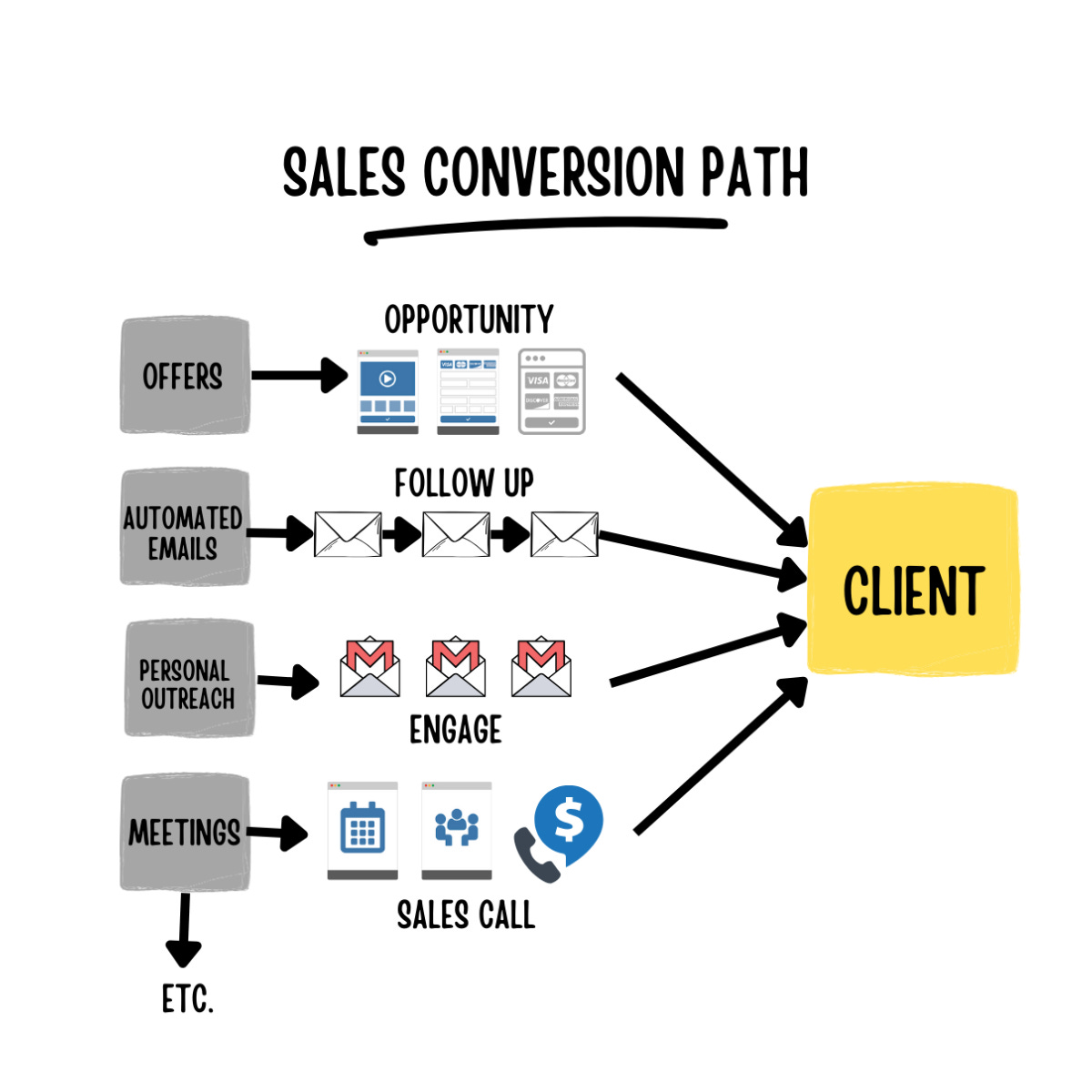
If activation is about building momentum, conversion is about resolving uncertainty.
By the time someone reaches this stage, they have demonstrated intent. They have consumed content, responded to follow-up, or taken an action that signals genuine interest. The focus now shifts from education to decision-making.
This is where many teams assume the heavy lifting is done.
A lead books a call. A demo/strategy session is scheduled. A proposal is sent. From the outside, it looks like the system worked. But conversion is not simply about generating conversations. It is about creating enough clarity and alignment that a decision feels logical.
When this path weakens, the symptoms are usually attributed to closing ability or pricing.
Deals stall.
Prospects go quiet.
Calls end with “we’ll think about it.”
Sometimes those outcomes are sales skill issues. More often, they are cohesion issues.
If the Prospect Interest Path attracted a loosely aligned audience, qualification becomes harder.
If the Activation Path did not deepen clarity around the problem, the sales conversation must compensate. The burden shifts to the salesperson to create urgency and conviction that should have been building earlier.
A healthy conversion path does not rely on persuasion alone. It relies on preparation.
There should be a clear and consistent transition from activation to conversation. Prospects should understand why they are booking a call, what problem is being addressed, and what outcome is being evaluated.
When that context is missing, conversations feel exploratory instead of decisive.
It is also important to examine whether the sales process itself is defined and repeatable. If every conversation unfolds differently, diagnosing performance becomes difficult.
Conversion rates fluctuate, but there is no stable baseline to measure against.
This stage does not need to be complex. It needs to be intentional.
The goal of the Sales Conversion Path is to help a qualified prospect make a confident decision with minimal friction. When that happens consistently, growth becomes forecastable.
When it does not, pressure builds upstream as marketing tries to compensate with more volume.
If conversion feels inconsistent despite steady interest, this path deserves a closer look.
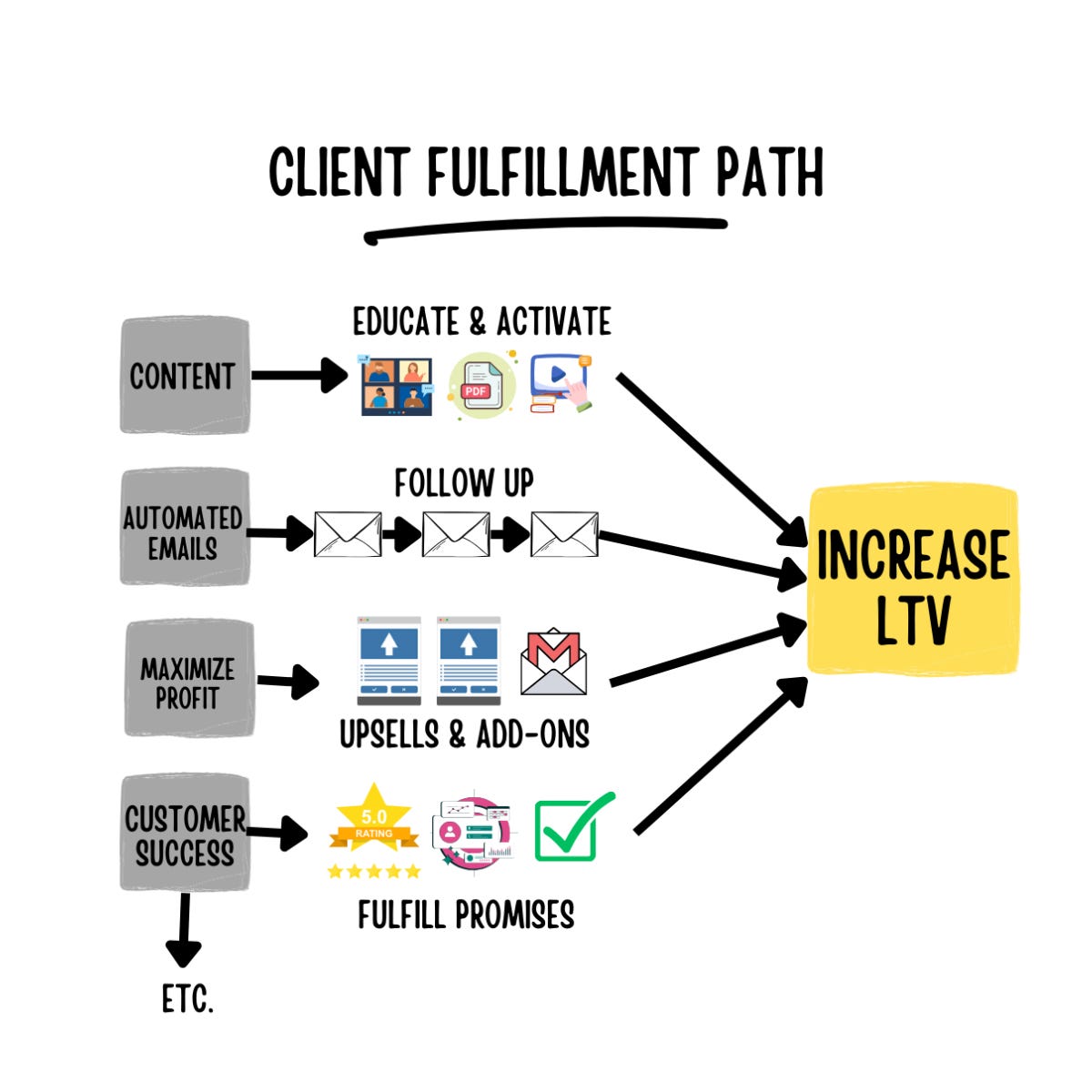
Lead generation conversations often stop at the sale.
But from a systems perspective, that is where long-term stability is either reinforced or quietly undermined.
The Client Fulfillment Path begins the moment someone becomes a customer. At this stage, expectations are high. The decision has been made. The next few interactions shape how that decision is evaluated internally.
If onboarding is unclear, if early communication lacks structure, or if value realization is delayed, retention becomes fragile. That fragility does not always show up immediately. It surfaces later in the form of churn, reduced lifetime value, or a constant need to replace clients at the top of the funnel.
When this path is strong, the opposite happens.
Clients gain clarity quickly. They understand what success looks like. They see progress early. Communication feels proactive rather than reactive. As a result, renewals feel natural, referrals happen more frequently, and upsell conversations are easier because trust has already been established.
Retention reduces acquisition pressure.
That connection is often overlooked.
When fulfillment is inconsistent, marketing and sales teams feel the strain. More leads are required to maintain the same revenue levels. Acquisition targets increase, even though the root issue sits post-sale.
Evaluating this path does not require a complex retention dashboard. It starts with simpler questions.
Is onboarding structured and consistent?
Do clients understand the milestones ahead of them?
Are there defined moments where expansion or renewal is introduced intentionally rather than opportunistically?
If the Client Fulfillment Path is weak, growth will always feel heavier than it needs to be. If it is strong, the entire system becomes more resilient.
Lead generation does not operate in isolation from delivery. It is part of a larger cycle. When the final stage is aligned, the earlier stages gain margin.
When you look back at the split we started with, the difference between the two camps becomes easier to understand.
The businesses that feel steady right now are not necessarily using radically different tactics. They are not operating on secret platforms or hidden strategies. What they tend to have is alignment across the full path.
Attention is targeted.
Activation builds momentum.
Sales conversations are prepared for, not improvised.
Fulfillment reinforces the promises made upstream.
Nothing is carrying more weight than it should.
On the other side, when growth feels unpredictable, the issue is often not a lack of effort. It is that one stage of the system is compensating for another. Marketing is trying to make up for activation gaps. Sales is compensating for loose qualification. Acquisition targets are rising because retention is uneven.
That imbalance creates pressure.
And pressure tends to show up as tactical churn. New channels. New campaigns. New tools. All in an effort to restore momentum without first identifying where cohesion has slipped.
The purpose of this audit is not to suggest that everything must be rebuilt. In most cases, only one path is materially underperforming. But without isolating it, the symptoms blur together and make diagnosis harder than it needs to be.
Before increasing traffic, expanding spend, or restructuring your offer, it is worth asking a simpler question:
Which transition is no longer doing its job?
When you answer that clearly, the next move usually becomes obvious.
Talk soon,
Ryan Farrell
Owner | Poppin Consulting
Marketing Systems Consultant
When you look at your own lead generation right now, which path feels the most solid, and which one feels heavier than it should?
If you know someone who’s working hard on lead generation but still feels like results are uneven, feel free to pass this along.
Comments
Nothing yet. Say the first thing.
Sign in to join the conversation.