
GraphicMEMOIRBlog | Creator Conversation #40
Since publishing The English GI: WWII Graphic Memoir, I have discovered a number of graphic novels and graphic memoirs exploring WWII. Several tackle the atomic bombings of Hiroshima and Nagasaki. Earlier this year, after seeing original artwork in Paris, I reviewed Barefoot Gen, and last year I also surveyed a number of other graphic works on the subject.

As we approach the 81st anniversary, it seemed a good time to revisit one of the most accessible and informative: Trinity: A Graphic History of the First Atomic Bomb by Jonathan Fetter-Vorm. Trinity is a work of graphic history rather than graphic memoir. Yet, as Fetter-Vorm reveals in this interview, the story has a personal connection: his grandfather worked at Hanford, one of the secret sites of the Manhattan Project, unaware of the weapon he was helping to build.
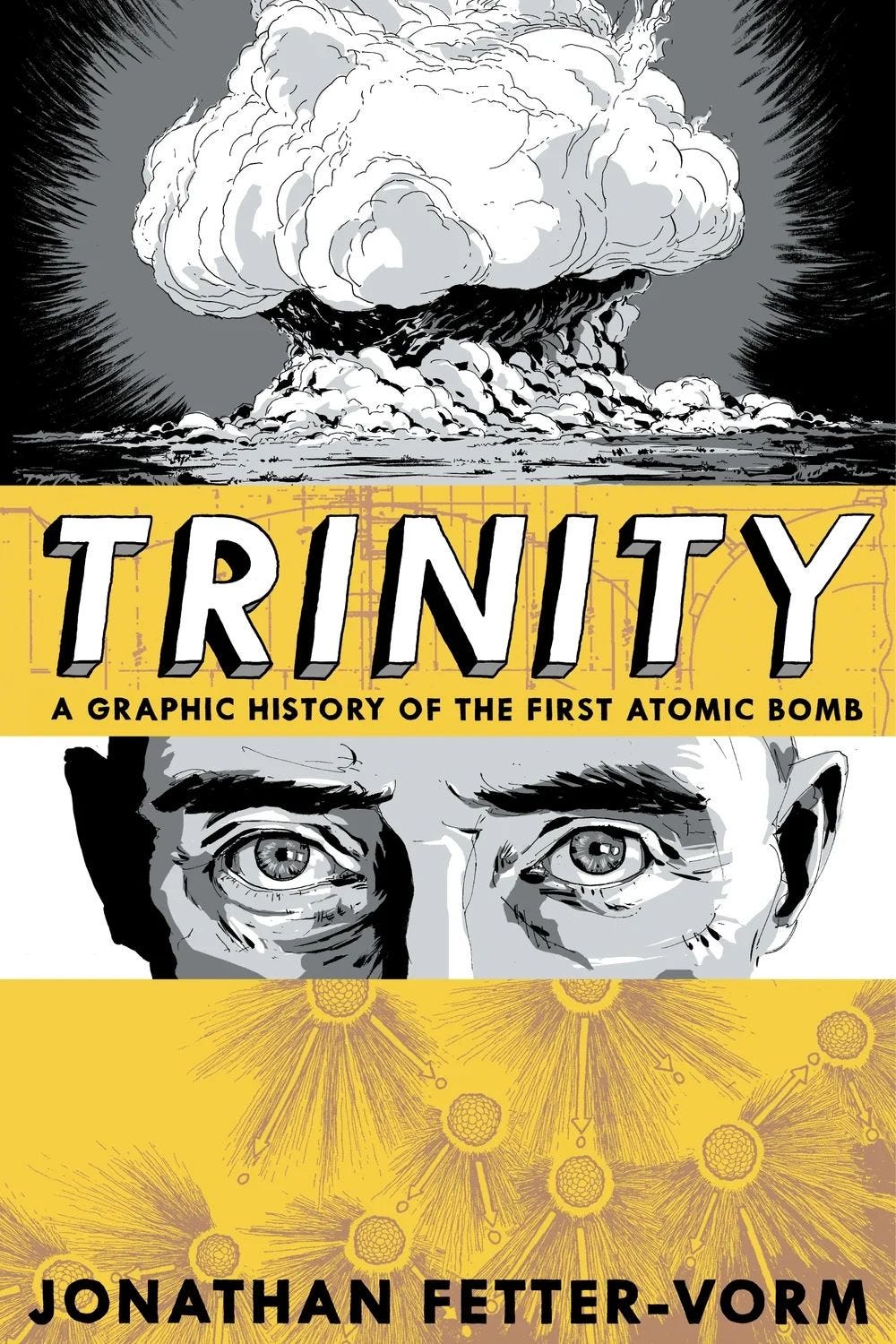
Fetter-Vorm was partly inspired to create Trinity because of his grandfather, who worked at Hanford, one of the secret facilities connected to the Manhattan Project.
Rejected from combat service during the Second World War because of a 4F classification, his grandfather spent the war welding in the desert, unaware of the full significance of the weapon he was helping create.
One story particularly stayed with Fetter-Vorm. Workers were issued mysterious pens, one of which his grandfather accidentally dropped into a vat of water. Fearing reprimand, he retrieved it, only later discovering it was a Geiger counter and the water was radioactive. No one explained what had happened.
It was only after Hiroshima that the truth emerged.
“I had no context for these stories,” Fetter-Vorm recalled. “Until I started reading about atomic history. Then it all clicked. It was fascinating — and haunting.”
Fetter-Vorm was careful from the beginning that Trinity would be a work of history, not memoir.
“I was allergic to memoir for a long time,” he admits.
His one regret is that he did not ask his grandparents more questions about their stories. However, he found a subtle way to honour them within Trinity: they appear briefly reading about Hiroshima in the newspaper in the book.
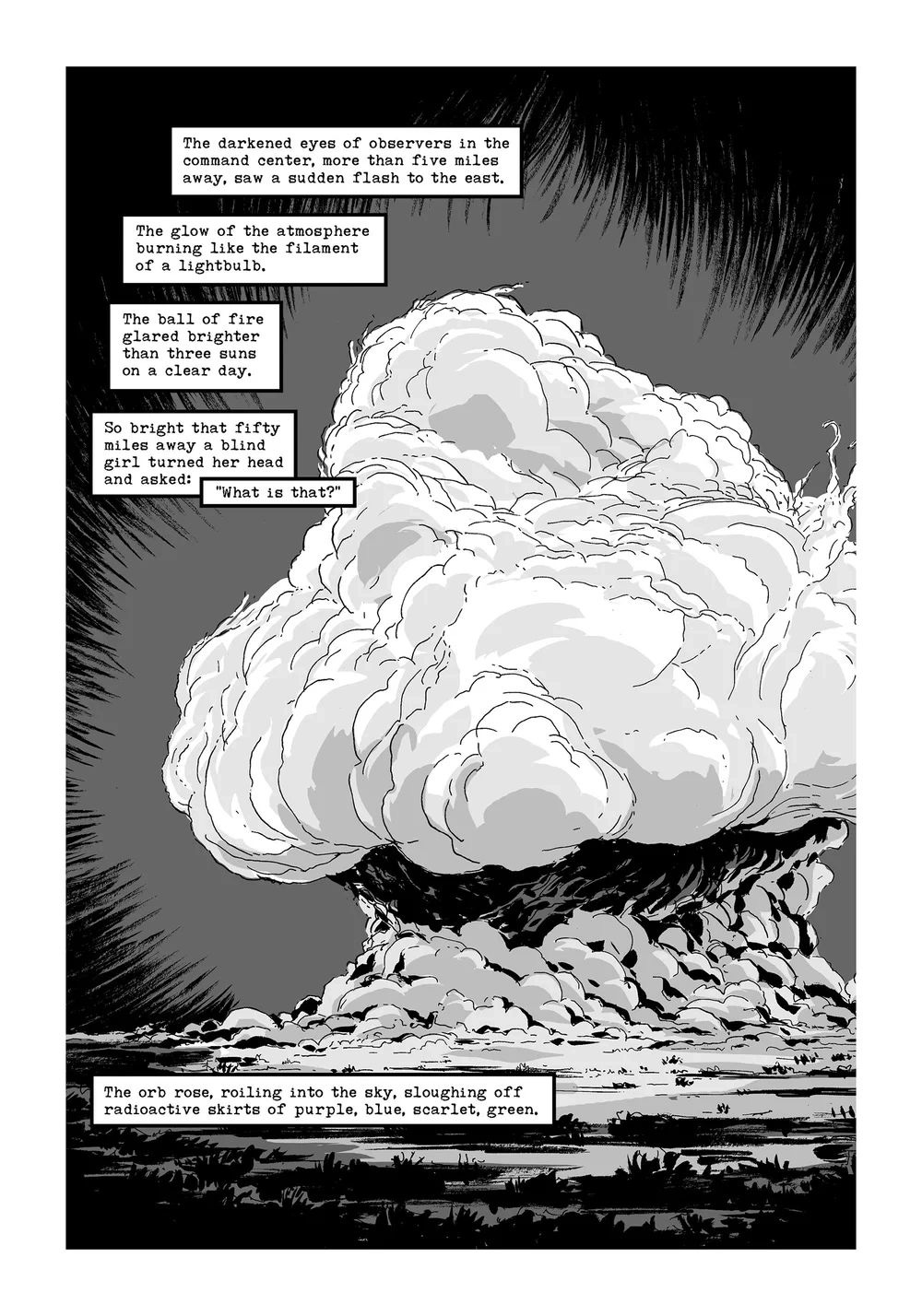
The creative spark for Trinity came from an unexpected source: a photograph.
While visiting New York, Fetter-Vorm discovered an art book featuring high-speed photographs from the earliest nuclear tests, images capturing the first milliseconds after detonation.
The surreal images of enormous, ghost-like shapes and expanding forms astonished him.
“These were images from a time before CGI,” he said. “They boggled my imagination.”
The photographs presented a unique artistic challenge: how do you draw something you cannot truly see? How do you illustrate an event too fast, too vast, and too destructive for human eyes to fully comprehend?
That tension between the visible and invisible, the known and classified, became the heart of Trinity.
Fetter-Vorm had been drawing comics since childhood, but his serious commitment to the medium came during college when he illustrated part of Beowulf as an academic project, translating Old English while combining scholarship with visual storytelling.
“I realized I wanted to make historical, academic comics,” he said. “Comics that communicate, educate, and engage with real events.”
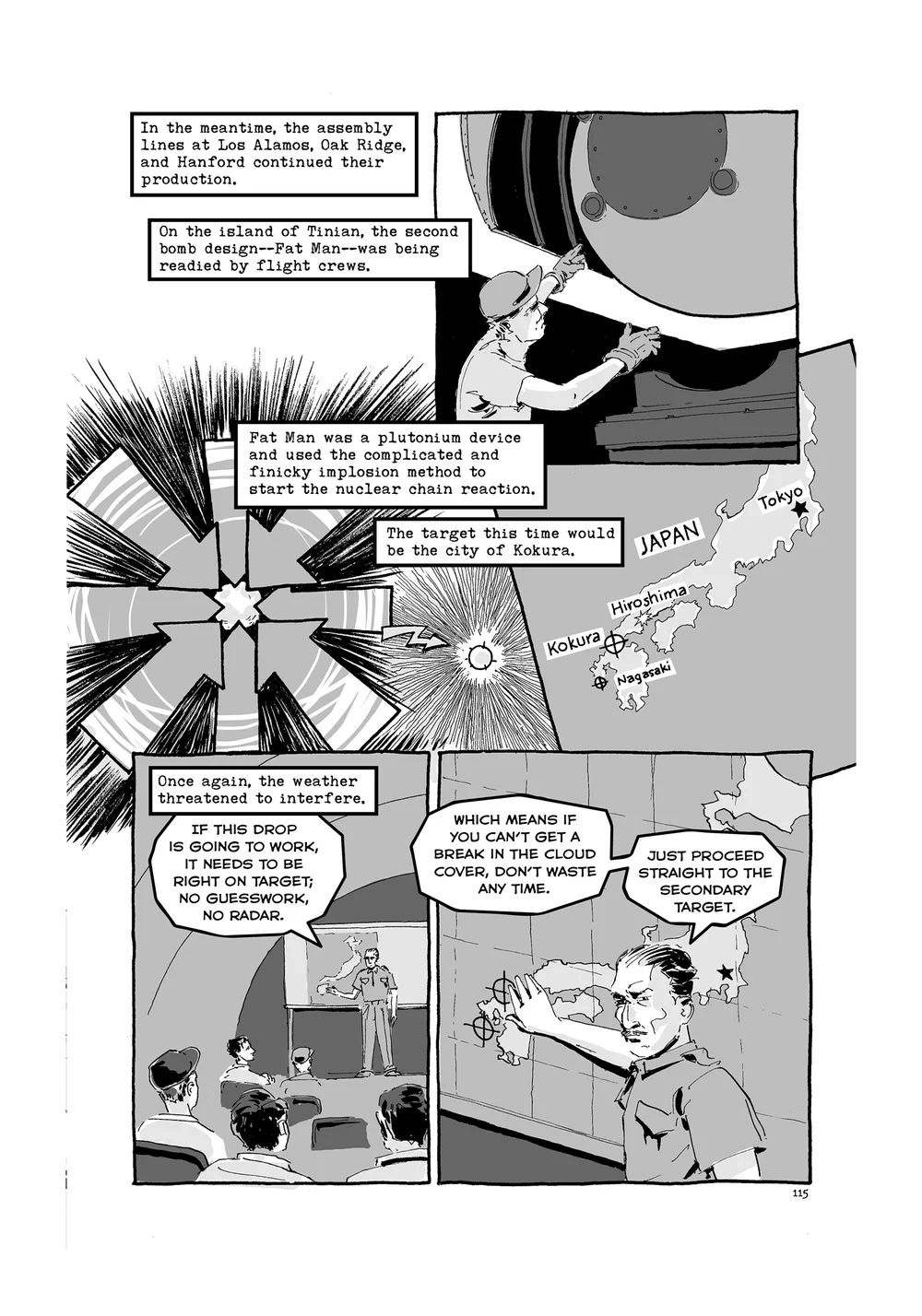
Initially dismissive of the traditional nine-panel grid, Fetter-Vorm came to appreciate its power through works such as Watchmen and From Hell. Trinity also embraces collage, presenting documents, photographs, and archival material as layered historical fragments.
The book’s stark grayscale style was partly artistic and partly practical.
“I was terrified of doing colour,” he admitted.
A last-minute scramble to add grey tones became one of the defining features of the book.
Depicting historical figures also required careful choices. J. Robert Oppenheimer appears as a distant, almost mysterious figure, often positioned on the edge of the frame.
“I liked the idea of not actually talking about him very much,” Fetter-Vorm explained.
In contrast, General Leslie Groves is portrayed as a forceful military presence, while Truman’s brief appearance reveals much about his later relationship with Oppenheimer.
Although Trinity remains Fetter-Vorm’s most widely read book, he does not necessarily consider it his strongest work from a craft perspective.
“It was largely a scramble to figure out how to make a comic book,” he explained.
But that struggle became a learning experience. Trinity taught him how to combine historical research with visual storytelling.
The book took around five years to complete, while his later book Moonbound: Apollo 11 and the Dream of Spaceflight was finished in just two years, even while adjusting to fatherhood.
Although Fetter-Vorm outlines carefully, he believes the real discoveries happen during the drawing process.
“You think you’re being productive with all that planning — but you learn the most by just jumping in.”
His approach to materials has also changed. Trinity was drawn by hand, while Moonbound was created digitally. His current memoir is being drawn entirely on paper.
“At some point, I realized I don’t have to stare at a screen all day,” he said. “Paper forces you to let go of perfection a little, and I think that serves the work in the end.”

Comics as History
For Fetter-Vorm, comics and historical research share a similar challenge: distillation.
“You want to render a picture in as few lines as possible,” he explained.
Historical events are complicated, but comics can reveal meaning by carefully choosing what to include and what to leave out.
Following the release of Christopher Nolan’s Oppenheimer, Fetter-Vorm noticed renewed interest in Trinity.
“Cillian Murphy has kind of replaced Oppenheimer in my head,” he joked.
He has also seen the book become a valuable teaching tool. When discussing the balance between artistic ambition and wider impact, he acknowledged the importance of purpose.
“Sometimes you have to be pragmatic about what you’re achieving. This is going to be an education tool — it may not be the best comic in the world, but it’s going to work in that context.”
While Trinity was a solo project, Fetter-Vorm’s Battle Lines: A Graphic History of the Civil War was created with historian Ari Kelman. Their collaboration brought together different strengths: a cartoonist seeking deeper historical understanding and a historian embracing the possibilities of comics.
“It was a really productive mix,” Fetter-Vorm said.
The partnership also helped the book reach beyond the comics audience. “Nonfiction, especially educational nonfiction, offers a bridge,” he noted.
For me, Trinity achieves both. It is a gripping account of one of the most consequential moments in modern history, an important educational resource, and a great example of how comics can explain subjects that words alone often struggle with.
This interview was originally published in 2025 and has been edited and abridged for Substack.
Article written by Jonathan Sandler, author of The English GI: World War II Graphic Memoir, curator of the GraphicMEMOIRBlog, and Advisor to Mensch Publishing.
No posts
Comments
Nothing yet. Say the first thing.
Sign in to join the conversation.