
GraphicMEMOIRBlog | Creator Conversation #91
Andre Frattino’s new graphic novel We Are Pan (IDW / Top Shelf) explores Operation Pedro Pan — the early 1960s programme that saw more than 14,000 Cuban children sent alone to the United States following political upheaval in Cuba.
Illustrated by Yasmin Flores Montañez, the book reconstructs that experience through multiple fictionalised child perspectives, drawn from extensive interviews with people who lived through it.
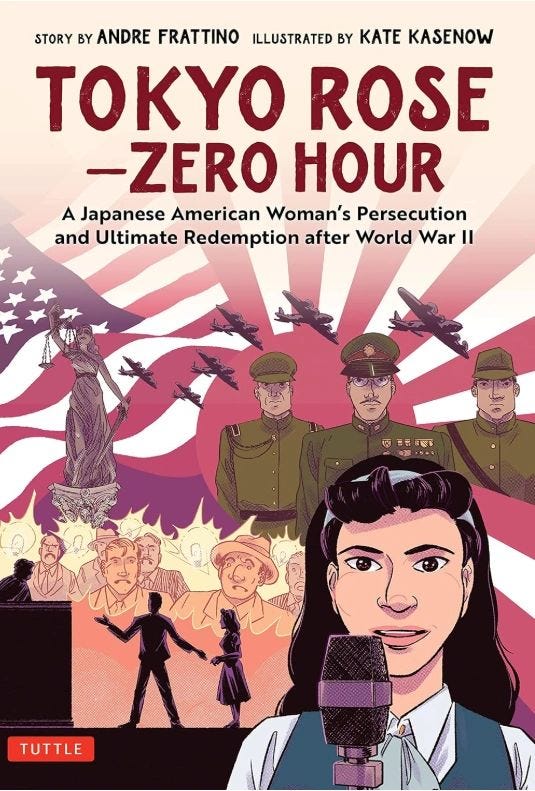
I first interviewed Frattino in 2023, shortly after the release of his graphic novel Tokyo Rose, a historical narrative that explored the life of Iva Toguri D’Aquino, the Japanese-American woman controversially accused of being the wartime propaganda broadcaster during the Second World War.
With Tokyo Rose and now We Are Pan, Andre Frattino is quietly building a body of work that explores overlooked chapters of twentieth-century history through the graphic novel. His latest book, published by IDW / Top Shelf and illustrated by Yasmin Flores Montañez, examines Operation Pedro Pan — the early 1960s programme that saw more than 14,000 Cuban children sent alone to the United States following political upheaval in Cuba.
One of the more interesting aspects of Frattino’s career is that, although he began by writing and illustrating his own graphic novels, he has increasingly chosen to collaborate with other artists. Tokyo Rose paired him with Kate Kasenow; We Are Pan sees him work with Yasmin Flores Montañez. As Frattino explained, that decision reflects a belief that “illustrators are storytellers just as much as writers are,” and that collaboration can strengthen a book rather than dilute an author’s vision.
I first interviewed Frattino in 2023, shortly after the publication of Tokyo Rose, his graphic novel about Iva Toguri D’Aquino, the Japanese-American woman controversially accused of being the wartime propaganda broadcaster known as “Tokyo Rose” during the Second World War. Two years later, our conversation turned from wartime Japan to Cold War Cuba, but many of the same questions remained: how history is reconstructed, how testimony becomes narrative, and how comics can bring overlooked stories to new readers.
For Frattino, the project began around 2017.
“My wife is Cuban-American,” he said. “Her mom was actually born in Cuba… and we were looking through some old photos of her grandparents back in Cuba in the 1940s or early 1950s.”
The images left a lasting impression.
“These photos… they all look like they could have been movie stars,” he said. “I told my wife, ‘There’s a story here.’”
That instinct eventually led him toward Operation Pedro Pan.
“She got to telling me about it,” he said. “One of her Spanish teachers had been part of it, and that really resonated with me.”
From there, Frattino began developing what would become We Are Pan — a graphic novel built around one of the most unusual child migration programmes of the twentieth century.
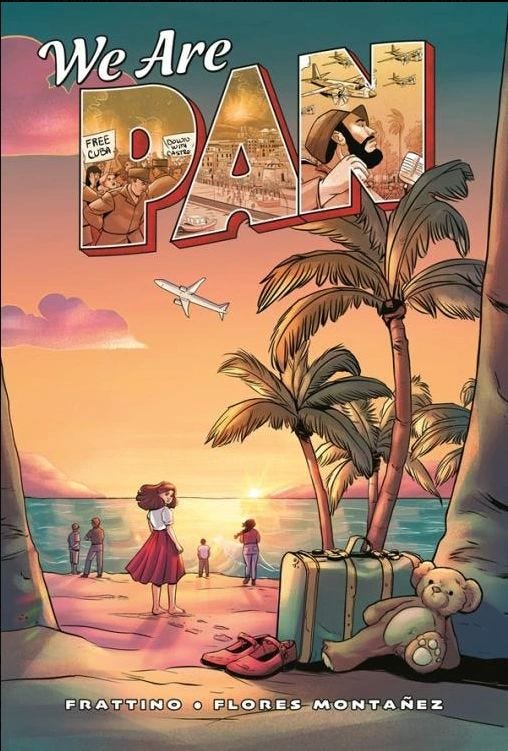
The structure of We Are Pan emerged directly from interviews Frattino conducted with people who experienced Operation Pedro Pan.
“I interviewed over a dozen Pedro Pan participants,” he said. “Each one had experiences that were amazing, tragic, or traumatic.”
Unlike Tokyo Rose, which follows a single central viewpoint, We Are Pan disperses its narrative across multiple voices.
“It’s told through the eyes of several children who experienced it,” he said. “Coming from different backgrounds and different walks of life.”
The characters are fictional, but constructed from testimony gathered in interviews, which form the emotional and structural foundation of the book.
Many of the people Frattino spoke with are now in their 60s and 70s, having built professional lives across the United States as doctors, lawyers, artists, educators, and business owners.
“They’re all grandparents now… and they’ve made a life for themselves here in America,” he said. “But it’s still very present in their lives.”
Some accounts are defined by permanent separation.
“There are some who said, ‘I never saw my father and mother again,’” he said. “Or it was decades before they were reunited.”
Others describe children scattered across the United States, growing up far from their origins while adapting to a new language and culture.
“There is still that sense of loss,” Frattino said.
This approach sits within a wider tradition of historical storytelling, where personal testimony becomes the raw material for reconstruction.
Frattino also drew on written accounts of Cuban exile, including Waiting for Snow in Havana by Carlos Eire, The Red Umbrella by Christina Diaz Gonzalez, and 90 Miles to Havana by Enrique Flores-Galbis. These works helped shape the broader emotional and historical contours of displacement, though none served as direct templates.
Collaboration has become central to Frattino’s practice. For Tokyo Rose, he worked with longtime friend and fellow Savannah College of Art and Design graduate Kate Kasenow.
For We Are Pan, the subject demanded a different kind of partnership — one shaped by cultural perspective as well as visual interpretation.
Frattino and editor Heather Antos reviewed a range of artists before selecting Yasmin Flores Montañez.
“My first four graphic novels I wrote and illustrated,” he said. “If I could do the whole project, I would. But I’ve learned that illustrators are storytellers just as much as writers are.”
That shift in thinking shaped the collaboration from the outset.
“Yasmin read the book and got back to me and said, ‘There is so much here to unpack,’” he recalled. “Through the process, she would say, ‘I’m going to do this visual because I think this is the best fit,’ or she’d have questions about what I was trying to achieve.”
Rather than prescribing visuals, Frattino treated the process as interpretive.
“There’s never been anything in anybody I’ve worked with where I’m like, they just didn’t nail it,” he said. “Most of the time I look at the pages and think, ‘That’s exactly what I envisioned.’ And then there are times where she brings something extra to it that I hadn’t considered.”
“It’s a dance,” he said. “It’s a partnership, you’re raising a child together, essentially building this fully living creature of a book and sending it out into the world.”
The book was published by IDW and its Top Shelf imprint, under editor Heather Antos.
“It resonated instantly,” Frattino said. “They saw the strength in the story.”
It still moved through editorial development, but support remained consistent. “Ultimately, the entire editorial staff was behind it.”
Frattino’s wider career spans Boom Studios, DC Comics, Tuttle Publishing, IDW, and Top Shelf, but remains anchored in historical storytelling. Reflecting on his publishing journey, he noted: “I’ve been super fortunate to publish with the people I’ve published with.”
Tokyo Rose was published by Tuttle, a publisher with deep roots in post-war Japan and East-West cultural exchange, making it a particularly fitting home for a book about Iva Toguri D’Aquino. We Are Pan, meanwhile, found its place at Top Shelf.
Top Shelf, in particular, has become closely associated with major works of historical graphic nonfiction, including March and They Called Us Enemy, two of the most significant American historical graphic novels of recent decades, helping redefine how contemporary comics engage with political and historical memory.
While We Are Pan is often positioned as YA or crossover, Frattino is less concerned with categorisation than reach.
“I want my books to be picked up by someone who’s never read a graphic novel,” he said.
Article written by Jonathan Sandler, author of The English GI: World War II Graphic Memoir, curator of the GraphicMEMOIRBlog, and Advisor to Mensch Publishing.
No posts
Comments
Nothing yet. Say the first thing.
Sign in to join the conversation.