
Guest Spotlight: Nnamdi
Welcome to Nnamdi we are so happy to have him with us today! Nnamdi researches what happens when Worlds Collide.
His newsletter Worlds Collide by Nnamdi explores adaptation, identity, systems, newcomerhood, institutional friction and what happens when environments change faster than people do.
Let’s dive into Nnamdi’s article
AI is not only changing tools. It is destabilizing prediction, fluency, and professional identity.
You can sit in the same office. Hold the same title. Work in the same industry for twenty years. And still wake up a newcomer.
Not because you crossed a border.
Because the language of competence moved while you slept.
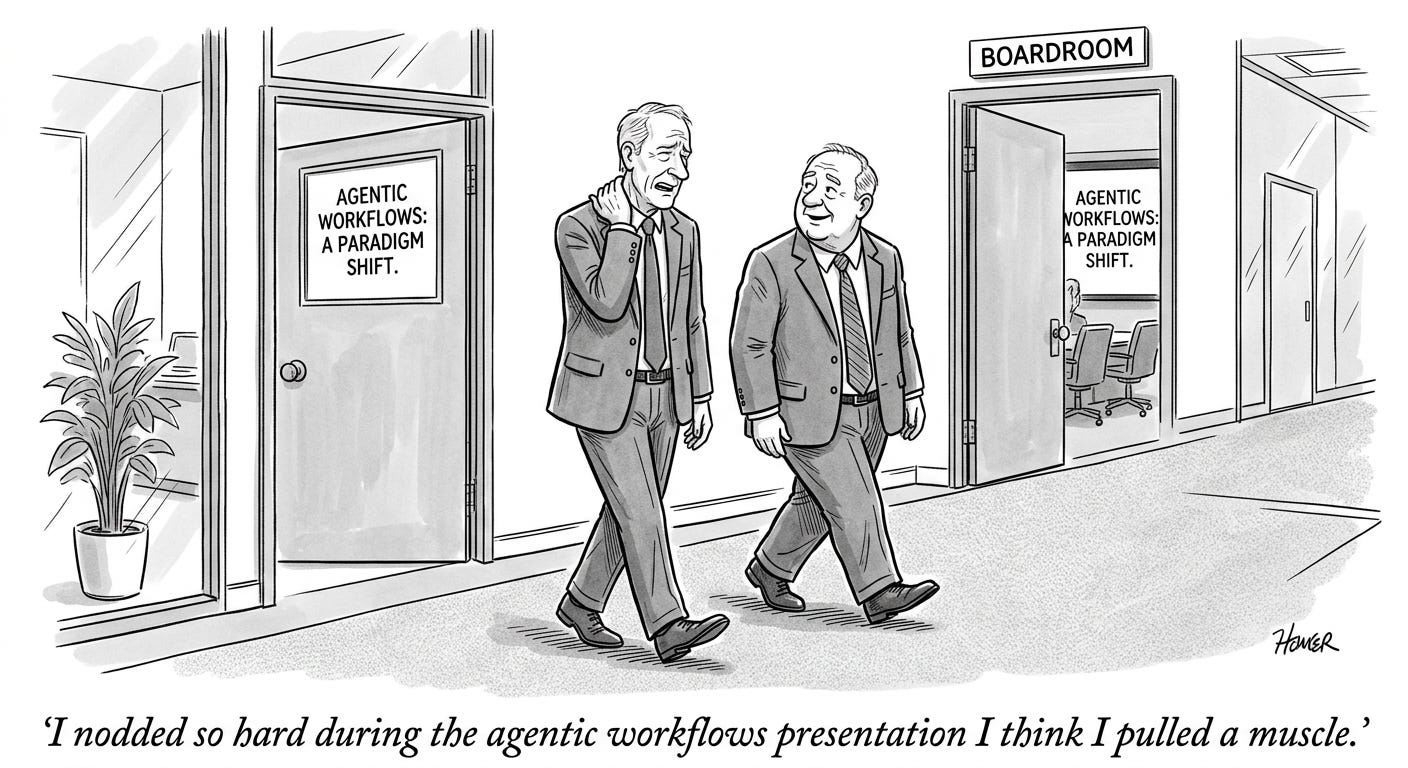
A meeting opens. Someone says agentic workflow, context window, multi-step reasoning. The room shifts. Everyone nods. You nod too. The half-second of judgment lands before you have said a single useful thing.
You could ask what the phrase means. Asking costs nothing technically. But you are the person other people usually ask.
The old problem was reading the room. The new problem is being read by it.
This condition deserves a clearer name.
Call it technological newcomerhood:
• your legibility drops without relocation,
• you perform fluency while privately orienting,
• and the environment stops reading competence through the same markers.
The invisibility is what makes it brutal.
A physical newcomer is visibly new. People expect hesitation. Translation. Delay. Technological newcomerhood receives no such grace. You still look experienced, so the room assumes fluency you may no longer feel.
Least of all do you extend patience to yourself.
Let me keep the claim proportional.
This is not the hardest part of the AI transition. It does not happen equally to everyone. And technical skill still matters enormously.
The argument is narrower.
A significant part of the AI transition may be adaptive before it is technical.
Not because skill stopped mattering. But because many competent people are rebuilding prediction, confidence, and legibility while still being expected to perform mastery publicly.
That is a different kind of pressure than learning a tool.
Everyone performs. Erving Goffman explained this decades ago. Social life has a front stage and a backstage. Competence is partly performance. That is normal, not deception.
What AI changes is the object of the performance.
Most professional mastery stabilizes eventually. A software suite. A legal framework. A body of literature. You learn it once and trust the learning.
Large language models do not hold still.
The outputs shift. The interfaces shift. The vocabulary shifts. You prompt, iterate, revise, and still cannot fully predict what the system will hand back.
So when people say: “Yes, we have an AI strategy.” “Yes, we’re integrating workflows.”
They are often performing command over systems that resist stable command.
This is not fraud.
Karl Weick’s work on sensemaking helps explain why. Under uncertainty, people act first and stabilize understanding afterward. The performance is orientation.
But the backstage where professionals used to recover is shrinking.
Even the harmless question — “How’s the new tool working out for you?” — now feels partially evaluative.
The fatigue lives between public fluency and private orientation.
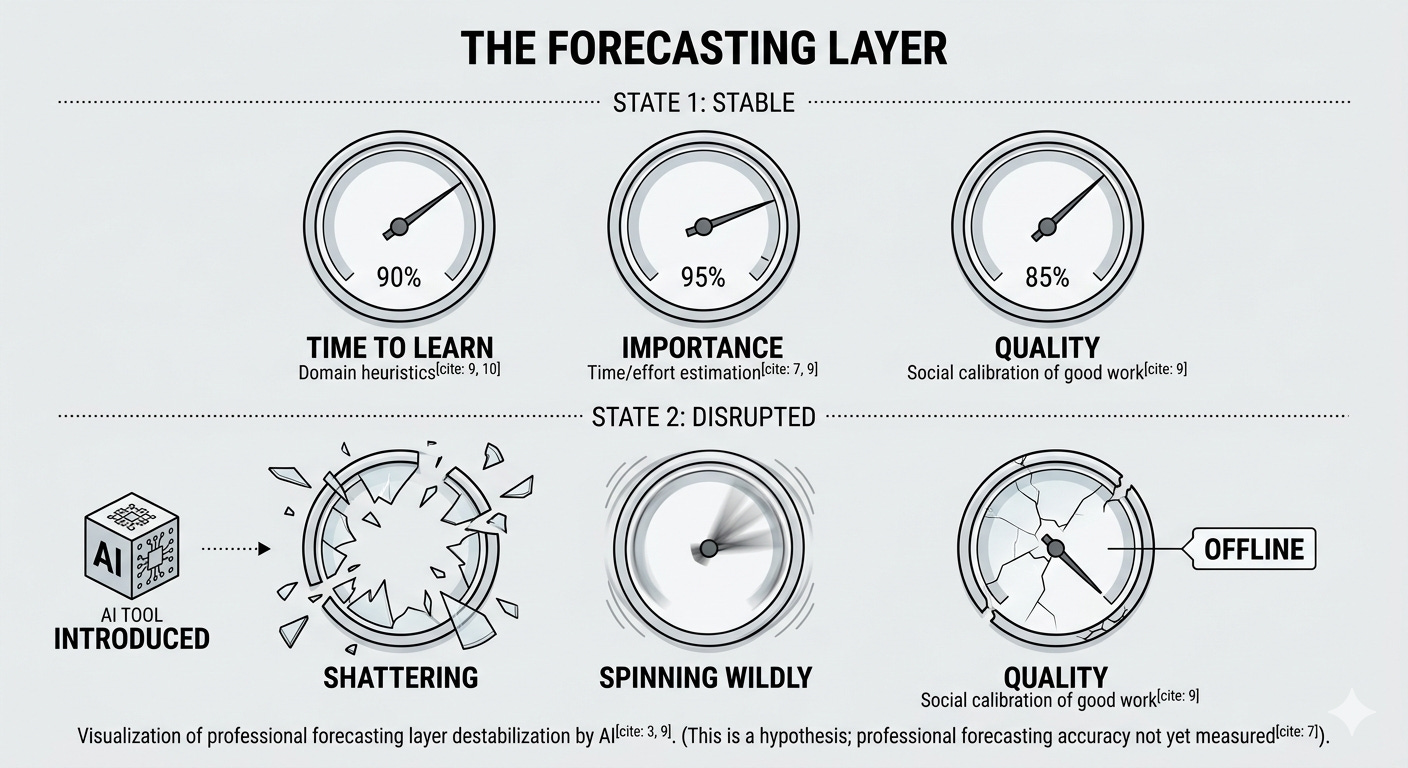
The stress is not coming from one tool.
A new tool is manageable. So is a new workflow. The deeper pressure comes from something less visible.
Every experienced professional develops an internal forecasting system:
• How long will this take to learn?
• How much does this matter?
• What still counts as good work?
• Where is the floor under my value?
Reliable forecasts become invisible. You stop noticing them because they keep working.
But AI destabilizes the forecasting layer itself.
John Sweller’s work on cognitive load suggests that unstable environments consume attention that would otherwise go toward the task. Gloria Mark’s research on interruption suggests switching carries real recovery costs.
Experienced people feel slow when attention gets reassigned to the environment.
The deeper problem is this:
The gauge you would check became one of the changed gauges.
From inside, this feels like: “I’ve lost my edge.”
A more accurate reading may be: “My forecasting layer is temporarily offline while the criteria themselves are moving.”
That distinction matters.
Because if the forecasting layer remains stable, adaptation feels difficult but navigable.
When forecasting destabilizes, the same transition starts feeling personal.
This is where the newcomer comparison becomes useful.
A cultural newcomer misreads signals because assumptions built in one environment no longer transfer cleanly into another.
Professionally, something similar can happen.
Not because AI is identical to relocation. It isn’t.
But because both conditions involve temporary legibility collapse.
You still possess capability.
The room simply stopped reading capability through familiar signals.
A strong skeptic could object here.
Correctly.
Some of what people describe as identity destabilization is ordinary skill obsolescence. Some workers simply need straightforward re-skilling. Others are absorbing media panic more than real disruption.
And people have always performed competence they did not fully feel.
All true.
The stronger version of this essay survives those objections.
Skill and identity are not cleanly separable. Learning a new tool changes how people understand themselves. But the two also get confused.
A person who misreads an adaptation problem as a pure skill problem may spend all their energy on tutorials while neglecting the deeper recalibration underneath.
Sometimes the tutorial is not the binding constraint.
Sometimes the binding constraint is losing confidence in your own predictive system.
Current evidence complicates the picture further.
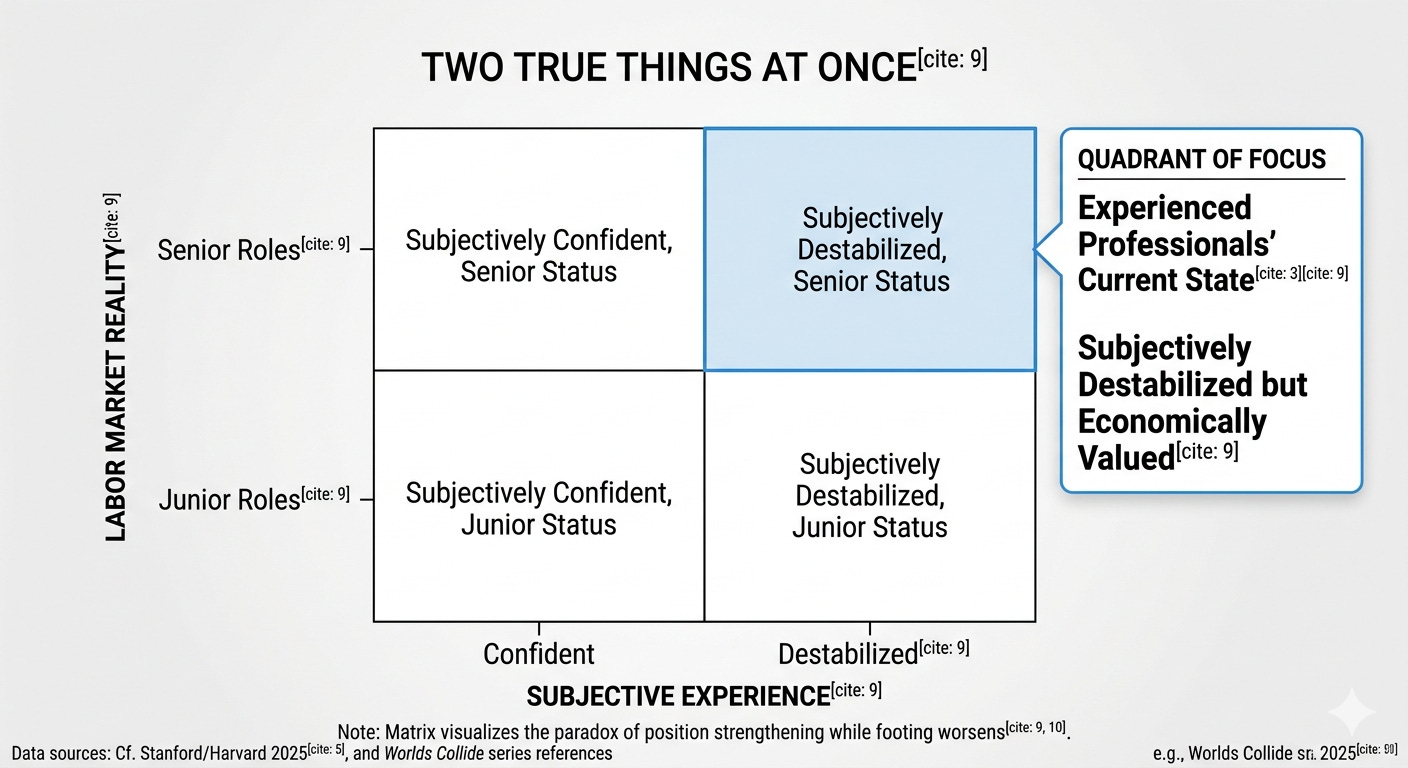
Recent studies from Stanford and Harvard suggest senior workers are often benefiting from AI adoption relative to junior workers. Experience and judgment still matter. In many cases, they matter more.
Your position may strengthen while your footing worsens.
Both can be true simultaneously.
The destabilization is real. It is also not necessarily a verdict on economic value.
So here is the wager, stated as a wager:
Adaptive capacity — how someone handles uncertainty, temporary incompetence, and recalibration — may matter as much as raw technical skill.
Not more in every case. Not universally. But enough to matter.
And the claim should remain falsifiable.
If adaptation outcomes ultimately track technical proficiency far more strongly than appraisal style, organizational conditions, or tolerance for uncertainty, then this framework weakens.
That possibility should stay open.
Overclaiming helps nobody.
What reads from inside as: “I’ve lost my edge”
is often closer to this:
The skill didn’t leave. The room changed what it counts.
Research on neuroplasticity suggests expertise is not fixed permanently. Skills weaken and rebuild through use. Professional fluency likely behaves similarly, though the comparison is analogical, not literal.
The important point is simpler.
Temporary illegibility is not permanent decline.
Think about a fluent speaker dropped into a dialect of their own language. The grammar remains. Most vocabulary remains. But suddenly they hear their own pauses again.
They have not lost the language.
They have acquired an accent.
That is the truer metaphor for many experienced professionals right now.
Not fluency disappearing.
Fluency becoming accented.
You still know how to think. You are simply hearing your own pauses again.
And pauses terrify people who built identities around never having them.
If that is true, then another tutorial may not solve the deepest layer of the problem.
More useful questions might be:
• Which part of the stress is a real skill gap?
• Which part is forecasting instability?
• Which parts of your identity became attached to one environment’s definition of fluency?
But the sharpest distinction may sit less inside individuals than between environments.
Amy Edmondson’s research on psychological safety found that teams adapt faster when people can admit uncertainty openly.
That matters enormously here.
Some rooms allow: “I don’t fully understand this yet.”
Others punish hesitation before understanding arrives.
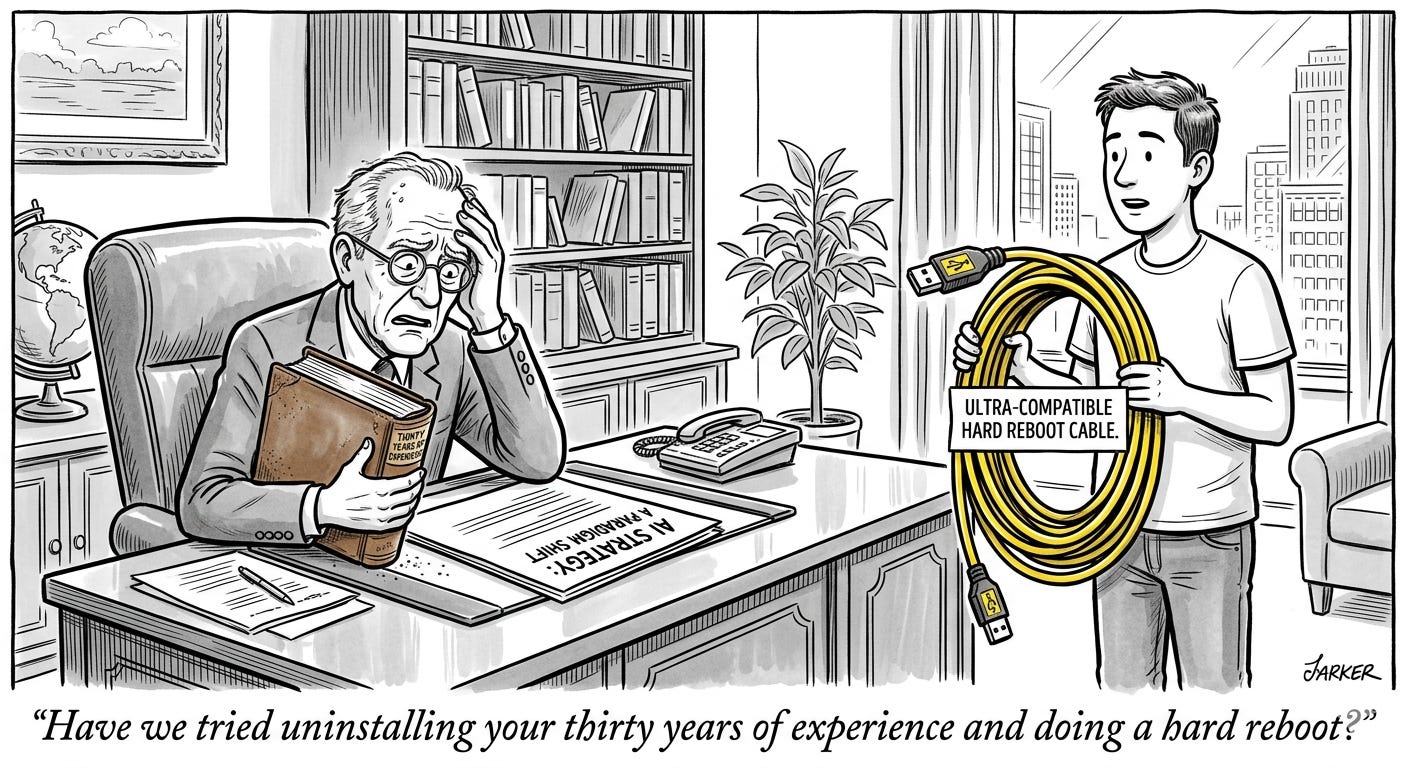
Organizations keep treating human transitions like software rollouts.
But human beings do not update like software.
They protect status. They conceal uncertainty. They study how beginnerhood gets punished before deciding whether it is survivable.
Teams adapt faster when beginnerhood is survivable in public.
That social layer shapes adaptation speed more than many organizations realize.
I have already survived one fluency collapse before.
Not technological.
Cultural.
Years ago I moved into rooms where I barely understood the script. The pauses, the accent, the exact calibration of confidence — everything was graded before the substance arrived.
I knew who I was and still felt unreadable.
It felt permanent.
It wasn’t.
And the pattern feels familiar now, even if the terrain is different.
I recognize the shrinking backstage. I recognize the half-second of judgment. I also recognize the moment the forecasting layer slowly comes back online.
Surviving one recalibration does not make the next one easy.
It makes it less apocalyptic.
There is an old Igbo idea about the hunter who knows one forest and enters another. The old skill is not worthless in the new forest. But it is no longer automatic.
The loss of automaticity is not the loss of skill.
The hunter who mistakes the loss of automaticity for the loss of skill stops hunting too soon.
That may become one of the defining pressures of modern professional life.
Not avoiding newcomerhood.
Repeatedly surviving it.
The future may belong less to the people who never lose fluency than to the people who can survive temporary illegibility without interpreting it as disappearance.
The room decides first.
Your job is to make sure it eventually decides correctly
Thanks Nnamdi for joining us today! If this essay resonated, subscribe to Worlds Collide by Nnamdi — a series exploring adaptation, identity, systems, and what happens when environments change faster than people do.
You may also enjoy:
• “The Room Decides First”
• “Everyone Is Performing”
• “The Normality Trap”
• “Simultaneous Reconfiguration Load”
Share it or restack it so more people can find the Worlds Collide by Nnamdi
Consulting / Advisory
Nnamdi works with organizations, schools, and teams navigating:
• adaptation under instability
• cross-cultural integration
• newcomer systems
• identity transition
• organizational recalibration
• and human infrastructure during periods of rapid change.
Until next time
This is JR,
Keep your heart open, your curiosity alive, and your hope rooted.
Remember you are helping shape the future through how you connect, how you communicate, and how you choose to show up.
Comments
Nothing yet. Say the first thing.
Sign in to join the conversation.