
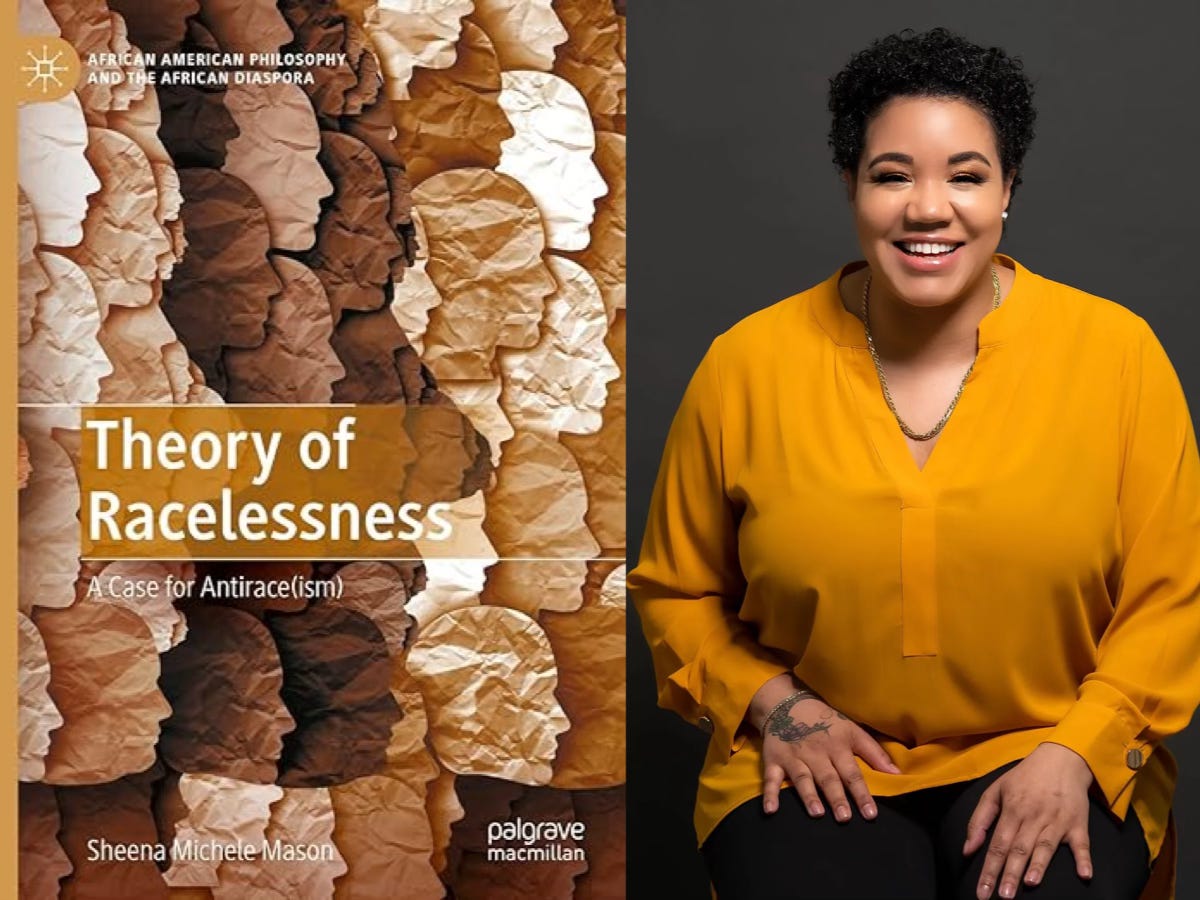
On the website Free Black Thought, Dr. Sheena Mason published an article titled “Theory of Racelessness: A Case for Antirace(ism).”
Mason’s thesis is simple: To eliminate racism, we must eliminate the concept of race itself.
The article is based on Mason’s book Theory of Racelessness: A Case for Antirace(ism) (African American Philosophy and the African Diaspora). In her article, Mason challenges the status quo and “presents a skeptical eliminativist philosophy of race and racism that results in her signature ‘theory of racelessness.’”
In this post, I’ll review Dr. Mason’s Theory of Racelessness as outlined in the article and explore its compatibility with the Christian framework for race. At the end, I’ll offer a real path forward for Christian institutions, churches, and families looking to heal the racial divide.
Mason’s Theory of Racelessness is grounded in the controversial claim that we should be skeptical of ideologies that center race because human beings are, in fact, raceless. Given that most sociologists agree that race is a social construct, she concludes, the only way to eliminate racism is to abolish the categories of race. Mason writes the following:
The thing called “race” does not exist, but people imagine it does, and this sustains it. “Race” needs to be abolished. To abolish race from a position of skepticism is a radical act of acknowledging one’s racelessness: one’s existence outside the bounds of race(ism), one’s rejection of a nonsensical means of subjugation and elevation that has no positive or forward-moving value even if it has had practical utility for various groups across time and place.
As more folks, I hope, begin to discuss Mason’s theory, there are some key words she uses that you’ll need to know: “race(ism),” “race(ist),” “raci(al/st), and “antirace(ism).” Mason argues that these terms help us recognize the essentially negative concept of race. The concept of race is not neutral because it forces us to treat one another as “raced” humans.
The racial categories used by society ultimately lead us to treat abuse as a form of justice.
Mason notes that non-whites are insulated from the charge of being racist against whites and are therefore allowed to say and do terrible things to whites. Likewise, in many cases, a black person can attack another black person using any racial slur they like or cancel them for any perceived slight. The race problem is a vicious cycle where race creates racism and racism creates race. Consequently, to eliminate racism, we must eliminate the categories of race altogether.
Mason takes some time to explore the history of race and then dives deeper into the philosophical underpinnings. She points out that there are two basic theories of race: metaphysical theories, which define the nature of race; and normative theories, which establish criteria for how we should respond to race. You can read Mason’s article for all the details, but the upshot is that most of the popular activists, such as Ibram X. Kendi, fall into the category of normative reconstructionists. Activists like Kendi, writes Mason,
argue that we should not eliminate racial discourse. Instead, it remains possible to rehabilitate race in a way that renders it accurate; thus, concepts of race can be positively reconstructed.
Mason goes on to say of Kendi,
He thinks race was, in essence, created by humans, but that we can in some sense purify our discourse about it and eliminate our racist ideas and practices.
And while it may seem counterintuitive, Mason concludes, Kendi’s approach (and that of others who share his ideology) actually reinforces racism rather than dismantles it.
Mason’s Theory of Racelessness takes a metaphysically skeptical stance on race, asserting that the Theory of Racelessness is a truly antirace(ist) philosophy in that it seeks to end racism by eliminating the concepts of race from our social structures. She writes:
Theory of Racelessness helps people recognize and imagine themselves outside of race(ism). It enables people to see themselves and others more clearly, without the distorting filter of “race.” In this way, the theory also helps people become more astute at recognizing and solving race(ism). Importantly, the theory’s core is bringing our shared humanity to the forefront in ways that the divisive presence or insertion of “race” ideology precludes. Together, we can do anything, including uphold race(ism). But we can also reconcile, heal, resolve, and eliminate the problem, too.
Mason concludes that no matter how people choose to classify her, she refuses to be defined by the hierarchy of race and, instead, chooses to see herself as raceless.
One question some readers may have is this: Is the Theory of Racelessness a form of color-blindness, which some critics claim ignores race and racism? In short, no. Mason’s theory is not a denial that the construct of race exists, nor is it a denial that racism has had a negative impact on society. On the contrary, I see her theory as a reflection of what Justice Clarence Thomas wrote in the 2007 case of PICS v. Seattle. In his concurring opinion, Thomas notes:
The dissent half-heartedly attacks the historical underpinnings of the color-blind Constitution. Post, at 28–29. I have no quarrel with the proposition that the Fourteenth Amendment sought to bring former slaves into American society as full members. Post, at 28 (citing Slaughter-House Cases, 16 Wall. 36, 71–72 (1873)). What the dissent fails to understand, however, is that the color-blind Constitution does not bar the government from taking measures to remedy past state-sponsored discrimination—indeed, it requires that such measures be taken in certain circumstances. See, e.g., Part I–B, supra. Race-based government measures during the 1860’s and 1870’s to remedy state-enforced slavery were therefore not inconsistent with the color-blind Constitution.
Like Thomas’s defense of the color-blind Constitution, Mason’s Theory of Racelessness is not blind to the cultural reality of racial injustice, nor does it sabotage the effort to correct problems in our systems of law. What Mason’s theory does is open our eyes to see that race itself is the cause of racism.
This question is related to the first and the answer is still, no. Mason rejects race as a useful concept,, not the history, culture, or experience of how race produced racism. Shared histories and real harms do not require race to be metaphysically real. In fact, Mason argues that race has been the primary tool used to justify black subjugation, not to preserve dignity.
This is a central point to Mason’s argument. Racism presupposes race. As long as race remains intact, racism will reappear in new forms. Mason’s position is that you cannot permanently solve a problem while preserving its cause. Justice can address historical wrongs without re-centering race as a permanent feature of human identity.
A second question many readers are likely to ask is this: Is the Theory of Racelessness just another form of Critical Race Theory (CRT)? While Mason never addresses CRT by name, I’d say the answer is no. Mason’s theory is not “CRT Lite” or even CRT–compatible. In fact, it runs counter to the fundamental commitments common to all CRT advocates (If you need a primer on CRT, check out my video.) CRT treats race as an enduring and necessary lens for justice. Mason rejects that premise entirely.
Let me give an analogy. Let’s assume racism is like a cancer in our body. CRT does not actually cure the cancer because it lacks the tools to remove the cancer at its source. At best, CRT purports to eliminate the melanoma on your face (racism), but it still allows the tumor in your brain (race) to grow. In stark contrast to CRT, the Theory of Racelessness seeks to cure not just the symptoms of the cancer but to eliminate its root cause.
In Mason’s view, if you eliminate the cause of the cancer (race), you cure the symptoms (racism).
Yes—potentially so. Although Mason is not a Christian, her view does allow for the Christian ideal of human worth grounded in the image of God which transcends racial classifications that distort of view of reality. Let me support that claim using two lines of argument: the Christian worldview and biblical theology.
In terms of worldview, Mason’s theory is a potential fit with the Christian worldview. Not only does her theory allow for the universal truth of human sacredness (a truth resisted by CRT advocates), but its emphasis on our common humanity is treated by Mason as the ultimate solution to racial hierarchies. Even more, Mason’s theory encourages reconciliation and healing from the evils of racism (two things I argue are impossible within the CRT framework).
In terms of theology, Mason’s theory is potentially compatible with biblical anthropology and soteriology. Race, like many other social constructs, was invented as a tool to divide humanity. And, as Paul reminds us in Galatians 3:23, any wall that is used to divide us was torn down by the cross of Jesus Christ. The biblical solution to the problem of racism, therefore, is to eliminate race—not to center it or to redeem it.
The final question you might have is this: Can the Theory of Racelessness help end racism? Without a doubt some people will dismiss Mason as “white-aligned,” marginalize her as a “black face of white supremacy,” or simply ignore her. However, I believe that her Theory of Racelessness can provide a genuine solution to the evil of racism.
The Theory of Racelessness reinforces the Christian ethic that demands we seek biblical justice, offers a tool to attack the societal symptoms of racism, and eliminates the core problem of race itself.
Our recent project, The Los Angeles Statement on Race, Justice, and Unity is a fabulous starting point for understanding what Christians have historically believed about ethnicity and unity. This is statement offers a positive framework, a way forward, through our troubled times.
A version of this article was originally published on Jul 26, 2022 with the Center for Biblical Unity where I serve as a member of the Academic Advisory Council. Consider volunteering or making a donation in support of CFBU.
Comments
Nothing yet. Say the first thing.
Sign in to join the conversation.