
Maybe you’ve heard the accusation that Christians reject the scientific “fact” of evolution because we are blinded by our mythic-theology of creation. But is that attempt to intellectually shame us justified? To gain the respect of skeptics should we adapt our theology to match the scientific consensus? No, we don’t need to go the far. However, to effectively show the error of the accusation against or faith, we need to define two key terms: evolution and creation.1
NOTE: the word “evolution” often functions as shorthand for atheistic naturalism or materialism—a worldview rather than a domain of philosophically neutral scientific inquiry. I’ll address this usage throughout, since it tends to smuggle metaphysical commitments into ostensibly scientific claims.
There are at least three distinct meanings of the word evolution: Cosmic, Chemical, and Biological.2 Let’s start with the first meaning, Cosmic Evolution, which can be divided into five categories.
Cosmic Evolution concerns the origin and large-scale change of the universe. Astronomers study celestial bodies such as stars and galaxies, together with the physical properties of space-time, to build theories about if, and how, the universe began and later expanded to its current state.
There are many competing theories about cosmic origins that are technical and nuanced. For the purposes of this article, I’ve organized them into the following five categories
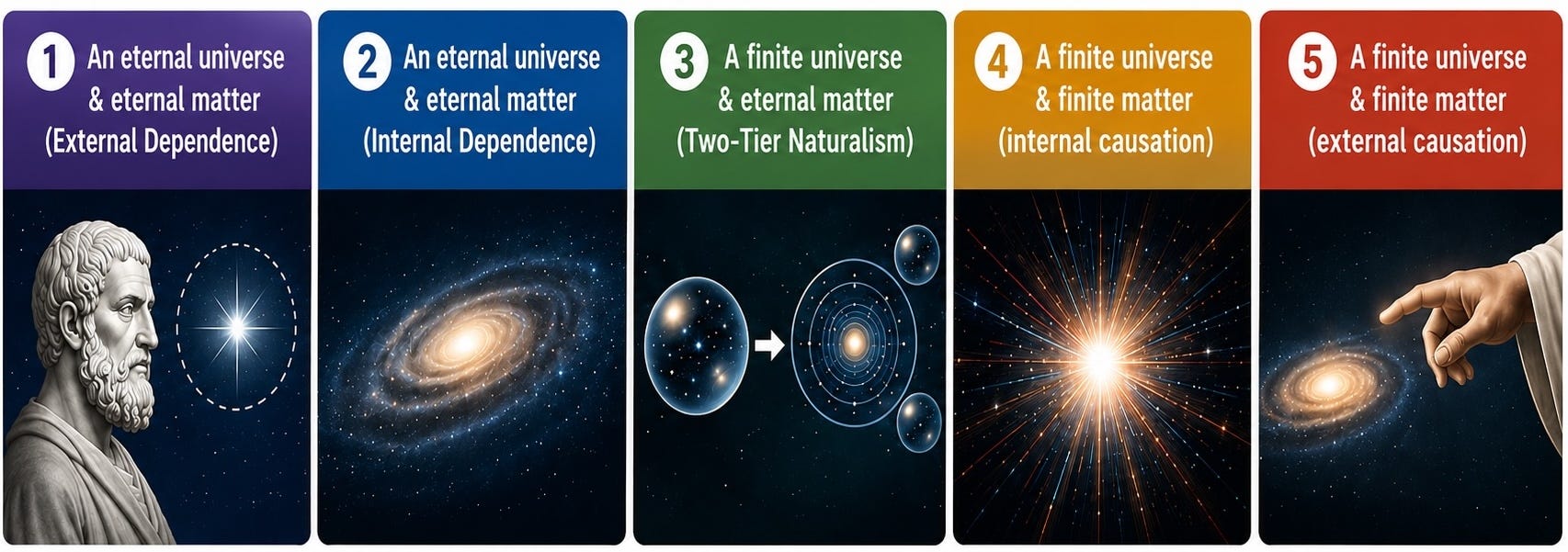
This idea dates back to Aristotle who argued for an eternal cosmos sustained by an Unmoved Mover. In a similar vein, Platonic systems viewed reality as an eternal emanation from “the One.” The medieval theologian Thomas Aquinas, trusting in biblical revelation, held that the universe began ex nihilo and argued that even if the universe were eternal, it would still require divine causation.
The consistent element across these positions is that the eternality of matter (whether affirmed or, in the case of Aquinas, merely hypothesized) does not eliminate metaphysical dependence on an external power.
This next category closes the door to any external or divine causation and considers only models that are internally self-sufficient.
This category fits with the pantheistic and atheist worldviews.3 The Modern atheist view (my focus for this article) starts from a materialistic presupposition and therefore favors models that presuppose the observable universe had no beginning. Researchers in this tradition read all cosmological data through a lens of internal dependence: whatever explains the cosmos must come from the cosmos itself.
“Because materialists think that matter and energy are the foundational realities from which all else comes, they deny the existence of immaterial entities such as God, free will, the human soul, and even the human mind conceived as an entity in some way distinct from the physiological processes at work in the brain.” — Stephen C. Meyer. Return of the God Hypothesis.4
In the 20th century, Fred Hoyle advanced the Steady State theory to support his atheist worldview. The model rested on three assumptions: eternal expansion, constant density, and the continuous creation of matter to fill the gaps left by cosmic stretch. On this view, the universe was predicted to look roughly the same at every point in time.
Steady State theory fell apart once observations such as the cosmic microwave background radiation pointed clearly toward a hot, dense early state. A small number of contemporary models still defend an eternal observable cosmos, but they sit on the fringe of mainstream cosmology. Big Bang cosmology, with its implied beginning point, became the consensus.5
The defining feature of Category #2 centers on the claim that the universe we observe is itself self-existent. No prior state, no deeper substrate, no external cause: the cosmos simply is, and always has been, therefore, no external or supernatural causation is needed.
The next category keeps the commitment of eternal matter but exchanges the eternal universe for a finite universe.
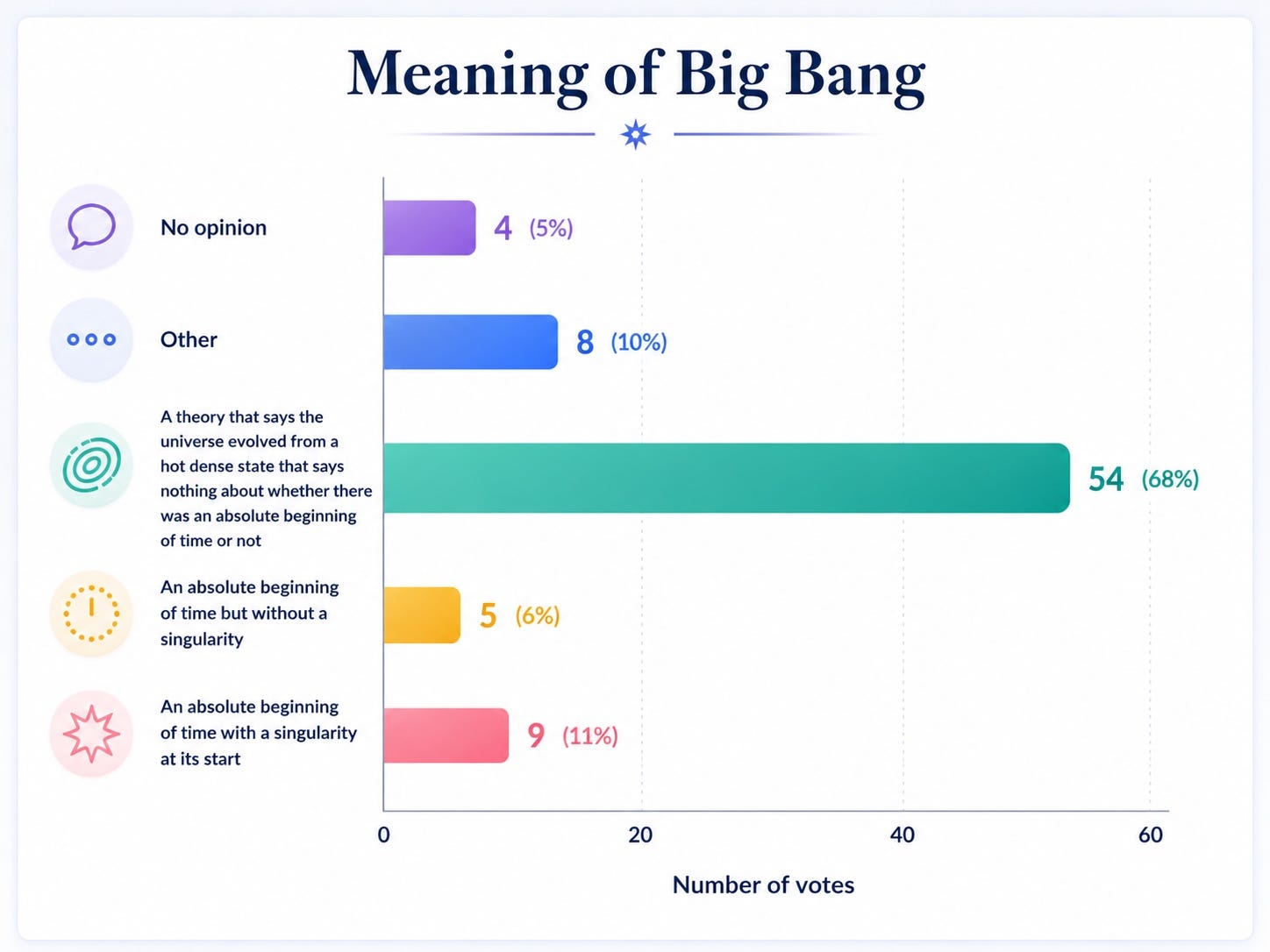
Supported by observations of redshift and cosmic microwave background radiation alongside principles established by the Second Law of Thermodynamics, the Big Bang model gained broad acceptance in the mid-to-late 20th century. The Big Bang revolution (a term whose definition scientists also disagree about)6 forced atheists to shift some of their philosophical commitments and sparked a plethora of novel models. Each new model attempted to explain how our current universe began while preserving their primary commitment to naturalism (both methodologically and ontologically). Several models fall into this category.
Some scientists “imagine a cyclic cosmology” which propose that our cosmos forms one phase in an endless sequence of bangs and crunches7 Quantum vacuum models propose that our universe arose as a fluctuation within an eternal quantum field; speculation over Dark Matter and quantum trajectories are all connect to this family of models.8 Inflationary landscape and multiverse hypotheses propose that our universe forms one bubble among many produced by an eternal field of inflation, with each bubble shaped by different physical constants.
The common thread across these models centers on a two-tier ontology;
Our universe is finite and
the substrate that produced it is eternal.
These models place eternality not in the observable cosmos but in a prior natural reality, which preserves the atheistic-materialist commitment that no external or supernatural cause (God) applies.
The next category keeps the commitment to a finite universe and rejects eternal matter.
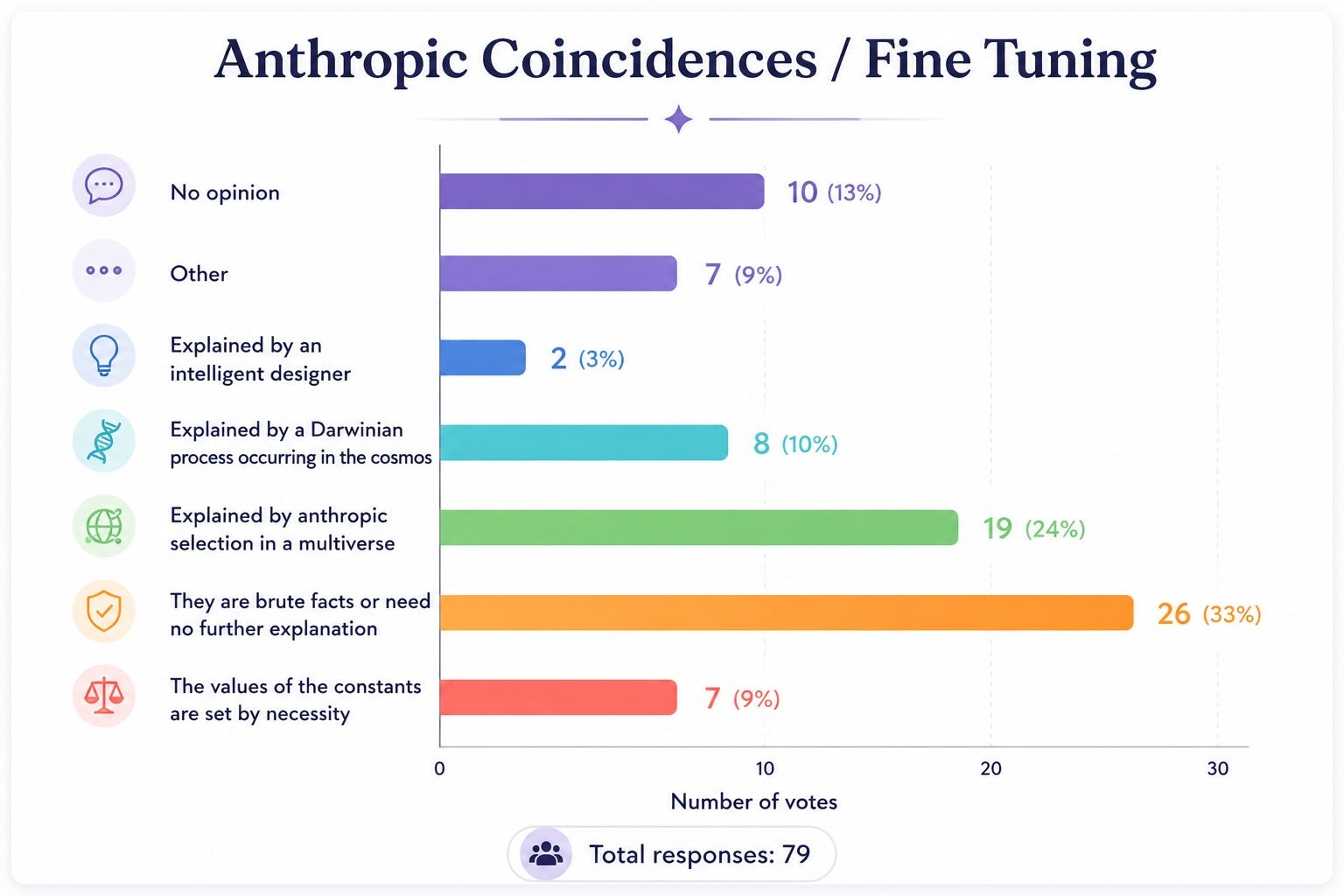
Just like those in Category #3, physicists in this category respect both Big Bang cosmology and the evidence for a fine-tuned universe9 but, relying on different explanatory theories about those physical constants, they propose models that assume matter and the universe had a beginning.
Category #4 of Cosmic Evolution begins with the presupposition that matter itself came into existing at the Big Bang and shifts eternality onto the laws of physics.
The causal force for this spontaneous beginning is the internal work of the laws of physics. This quote from Stephen Hawking’s talk titled, “The Beginning of Time,” emphasizes the importance of internal causation crucial to this category of cosmic origins:
The conclusion of this lecture is that the universe has not existed forever. Rather, the universe, and time itself, had a beginning in the Big Bang, about 15 billion years ago. The beginning of real time, would have been a singularity, at which the laws of physics would have broken down. Nevertheless, the way the universe began would have been determined by the laws of physics, if the universe satisfied the no boundary condition.10
Hawking’s no-boundary proposal is one of several Category #4 models. Alexander Vilenkin’s quantum tunneling proposal posits that the universe emerged from a state of “nothing” through a quantum fluctuation in which the laws of physics themselves supply the causal mechanism. The Hartle–Hawking state and Lawrence Krauss’s account of a universe arising from quantum vacuum fluctuations belong to the same family of models.
The next category breaks with that final naturalist commitment and asks whether physical laws can serve as an explanatory cause, or whether the explanation must reach beyond nature altogether.
Scientists in this category are open to the empirical evidence behind the various theories within Category #4. However, scientists who fall into Category #5 reject methodological and philosophical naturalism which allows them to explore supernatural causation outside the laws of nature as a possible explanation for the existence of both the universe and matter itself.
Representative thinkers for Category 5 of Cosmic Evolution include mathematician John Lennox, physicist Stephen Barr, and scientists within the intelligent design community such as Stephen Meyer, Bill Dembski, Casey Luskin, and many more associated with the Discovery Institute. In addition, there are a plethora of Christian physicists/cosmologists such as Hugh Ross who trust in creation ex nihilo and argue that various scientific observations, such as cosmic fine-tuning, point beyond the natural order to the God of the Bible.
What distinguishes Category #5 from Category #4 is not the underlying physics but the philosophical commitment to a transcendent cause: where Category #4 holds that the laws of nature are themselves sufficient to account for the universe’s existence, Category #5 holds that the existence of those laws, and of the matter they govern, requires an explanation outside the natural order.
These five categories cover the first meaning of Cosmic Evolution and I’ll address how they fit with the Christian view of creation shortly. First, let me define the second meaning, Chemical Evolution.
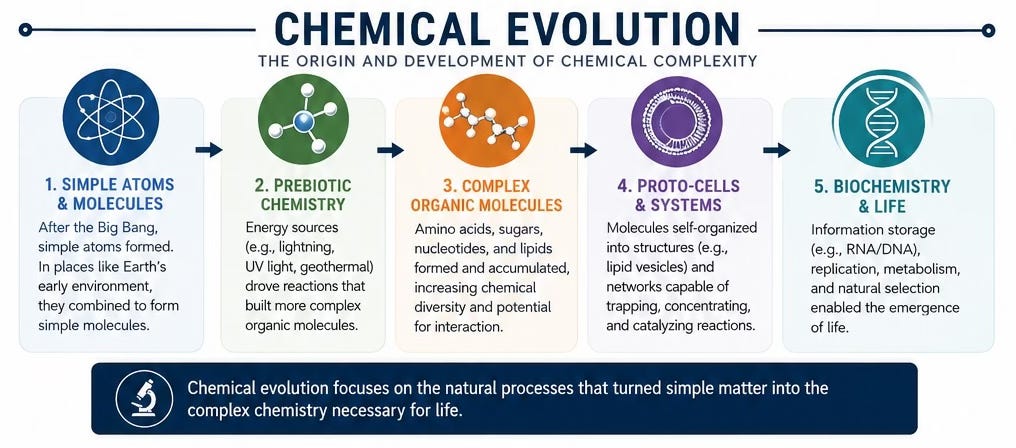
Chemical Evolution (sometimes called prebiotic or biochemical evolution) is a theory that organic life originated spontaneously based on natural laws from non-living chemicals.11 Swindoll and Zuck provide a simple explanation that includes some of the important terminology surrounding this discipline.
Darwin himself spoke of “some warm little pond” in which appropriate organic compounds were exposed to light, heat, and electricity, eventually producing proteins. Those proteins would have experienced further chemical reactions, and eventually the process would yield very primitive, single-celled organisms that would begin to carve out niches for themselves in the environment of the early earth. This has been called “prebiotic evolution” (evolution prior to life itself), “chemical evolution” (since it involves chemicals, not living things), or “abiogenesis” (beginnings from nonlife).12
It’s worth noting that while Darwin understood the problem, his theory of biological evolution did not in any way address this challenge.
Chemical evolution attempts to address the origin of life itself. The persistence of chemical evolution as a research program raises a question the next sections will return to: whether the theory survives on its empirical merits or whether it persists, as Nancy Pearcey has argued, solely as a presuppositional commitment of the naturalistic worldview that demands it.
However, even if such a theory of Chemical Evolution could account for the leap from non-living matter to the first living cell, a separate question remains: once life exists, what accounts for the diversity of organisms that populate the earth? That question shifts the discussion from prebiotic chemistry to biology which points to our third meaning of the word evolution.
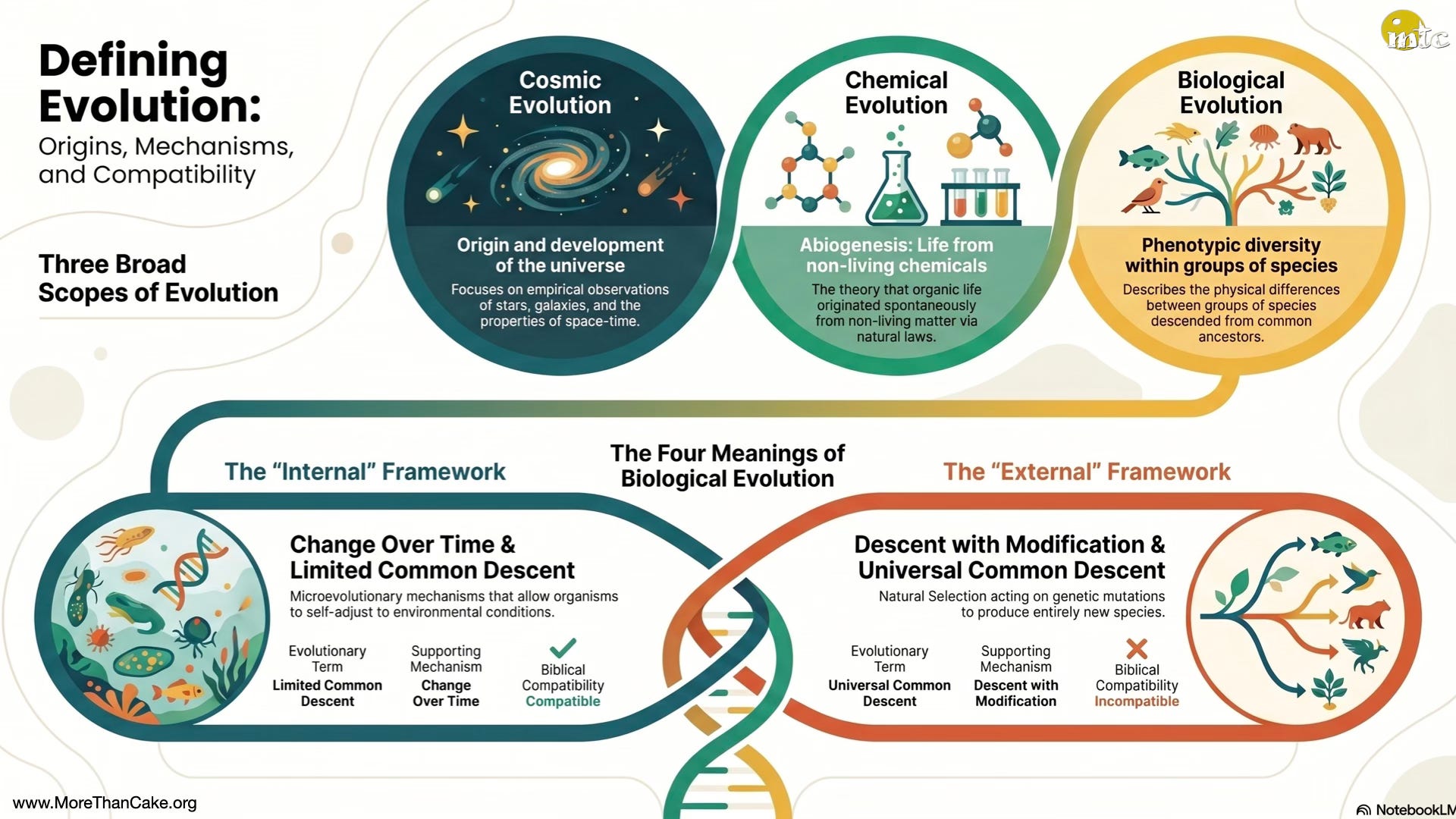
Biological Evolution is the term most often thought of when we think of the word evolution, especially as it relates to human origins.
The theory of Biological Evolution was refined by Darwin and rooted, not in the science, but in his philosophical commitment to naturalism.
The terminology of Biological Evolution is probably the most confusing of our three meanings because the term evolution itself is sometimes used to describe the worldview of Darwinian naturalism, sometimes to describe the explanatory theory, and other times used to describe the biological mechanisms. In an effort to simplify things, I’ll split these competing ideas into two frameworks: Internal Evolution and External Evolution.
The explanatory theory for the Internal Evolutionary Framework is Limited Common Descent (LCD). LCD describes the phenotypical diversity (things like beak shape and fur density, coloration, etc…) between a select groups of species which are descended from a common ancestor.
The testable mechanism for the Internal Evolutionary Framework is Change Over Time (COT) or sometimes referred to as Microevolution. COT refers to the instantaneous epigenetic regulation of traits and/or the long-term change in allelic frequency that does not create new information but allows organisms to self-adjust when faced with various environmental conditions. COT explains the various biological mechanisms from inside the organism that foster adaptations in response to external conditions.
The explanatory theory for the External Evolutionary Framework is Illustrated by Darwin’s tree of life, which holds that every living organism—no matter how diverse—descended from a single ancient common ancestor.
The testable mechanism for the External Evolutionary Framework is Descent with Modification (DWM) or sometimes referred to as Macroevolution. DWM describe the purely naturalistic and undirected mechanism of Natural Selection that allows nature to unintelligently “select” from various positive genetic mutations within an organism that, over long ages, produce new and unique species. Natural Selection is a broad term that covers a set of possible mechanisms external to the organism that induce an internal change in the organism.
Given these two frameworks, there are several important observations.
Change Over Time is a set of evolutionary mechanisms separate and distinct from Descent with Modification.
Limited Common Descent is a theory of evolutionary origins separate and distinct from Universal Common Descent.
Limited Common Descent relies on—and cannot survive as a theory without—the mechanism of Change Over Time.
Universal Common Descent relies on—and cannot survive as a theory without—the mechanism of Descent with Modification.
These distinctions matter because what I’ll argue in the next section is that special creation is compatible with the Internal Evolutionary Framework. Therefore, special creation accepts ‘evolution’ as it pertains to Limited Common Descent and Change Over Time. but rejects’’evolution’ as it pertains to Universal Common Descent and Descent with Modification. Separating these ideas out makes it possible to test any proposed scientific models/theories of creation.
Armed with definitions for these three meanings of evolution; cosmic, chemical, and biological, we now have the vocabulary needed to ask whether evolution and the biblical account of creation actually conflict. The first step is to define what Genesis is and what it is not.
There are many hermeneutical approaches to Genesis and some are quite idiosyncratic, which makes a complete and fair analysis impossible for this post. The four positions below, however, offer a good thumbnail sketch of how biblical scholars tend to handle Genesis 1–11:
Genesis is myth with no historical content. The language is entirely mythic, figurative, and theological with no literal meaning (see John Walton, Lost World hermeneutic),
Genesis is mostly myth with thin historical content. The language is predominantly mythic, figurative, and theological with limited use of the literal. (see Joshua Swamidass’ Genealogical hermeneutic),
Genesis is mixed myth and history. The text mixes mythic, figurative, theological and literal language which is untangled based on the reasonableness of each passage. (see William Lane Craig’s mytho-historical hermenutic), and
Genesis has no myth and offers a reliable historical narrative. So while the literary styles can be a mix of mythic, figurate, theological, and prose, the meaning itself is analyzed through the plain reading of the text in its full context (see my work on theo-history).
If the first three approaches are correct, then the rest of Scripture which traces human origins to the direct act of God must also be, to some degree, ahistorical and, at best, misleading. Given those assumptions, every definition of evolution becomes potentially compatible with the Bible, including those rooted in philosophical naturalism, because the Bible has nothing significant to say about the material origins of the universe or organic life.
I take option four as the strongest approach to Genesis. The plain-reading hermeneutic that governs the rest of the Old Testament historical literature should also govern Genesis 1–11 (what I call Theo-History). If that hermeneutic is correct, then the Bible does in some way describe cosmic and human history, even if not exhaustively. Consequently, some definitions of evolution are fundamentally incompatible with Scripture.
Given this hermeneutical approach, I can now answer the question of compatibility between evolutionary science and biblical creation.
Traditionally, both Jews and Christians have celebrated Genesis 1 and 2 for its revelatory insight regarding God’s ex nihilo creation (the eternal uncreated God created everything). Genesis 1:1–2:3 gives us a historical narrative—distinct from all Ancient Near East polytheistic myths in its essential qualities and similar only in its accidental qualities. Consequently, Categories #1,#2, #3, and #4 are incompatible with biblical creation. Any theory that falls within the scope of Category #5 of Cosmic Evolution is, however, is a viable option.
So, if the Bible teaches the cosmos had a beginning, does that mean all Christians must believe in the Big Bang? No. As mentioned earlier, even scientists committed to a naturalistic worldview do not accept the Big Bang as settled science. Natalie Wolchover writes for Quanta Magazine,
The leading hypothesis about the universe’s birth—that a quantum speck of space became energized and inflated in a split second, creating a baby cosmos—solves many puzzles and fits all observations to date. Yet this “cosmic inflation” hypothesis lacks definitive proof. Telltale ripples that should have formed in the inflating spatial fabric, known as primordial gravitational waves, haven’t been detected in the geometry of the universe by the world’s most sensitive telescopes.
So while belief in the Big Bang is a live option for Christians, it does not mean the Bible teaches the Big Bang—a theory which only addresses physical causation and speaks nothing about the Divine origin through God’s spoken word. That said, elements of the theory are compatible with biblical cosmology. Most notably, the Big Bang theory points toward an absolute beginning of space and time, which comports with the biblical teaching of creation ex nihilo (Gen. 1; Psa 33:5–6). The history of Big Bang science reveals this close connection.
Georges Lemaitre (mathematician, priest, and physicist) first proposed an expanding universe in 1927, then in 1931 advanced the hypothesis of the primeval atom.13 His theory looked at the evidence for the expanding universe as evidence for a smaller, denser ex nihilo beginning, and it supported the idea of an expanding universe stretched out by God’s hand (Job 9:8; Isa 42:5; Jer. 10:12). Lemaitre’s theory ran counter to thousands of years of Aristotelian science that held to an eternal and unchanging universe. Ironically, anti-religious bigotry that assumed a naturalistic cause kept some scientists from examining the evidence on its own merit.
Physicist Fred Hoyle’s philosophical commitments led him to deride the “Big Bang” model as an “irrational process” that “can’t be described in scientific terms,” akin to creationism.
In 1965, Hoyle scrambled to find an ad hoc solution to explain the cosmic microwave background data and save his Steady State Theory. Hoyle rejected all the evidence for the Big Bang theory until his death in 2001.
In his book God and the Astronomers, atheist scientist Robert Jastrow summed up why so many atheist scientists feared Big Bang cosmology:
Astronomers now find they have painted themselves into a corner because they have proven, by their own methods, that the world began abruptly in an act of creation to which you can trace the seeds of every star, every planet, every living thing in this cosmos and on the earth. And they have found that all this happened as a product of forces they cannot hope to discover. That there are what I or anyone would call supernatural forces at work is now, I think, a scientifically proven fact.14
Still, compatibility does not constitute proof, because while the Bible does speak to material origins, it is not a science textbook that explains “how” God created. The Big Bang theory itself does not explain all the observational evidence, and because of these weaknesses, good scientists continue their work with an openness to new evidence and new theories. Regardless, the Christian can know with certainty that the universe had a beginning, but cannot guarantee the Big Bang is the right scientific answer as to how.
Genesis 1 traces the origin of matter to God’s spoken word. From that matter, God formed Adam out of the dust of the earth, and from Adam he formed Eve. While some theologians like William Lane Craig reject Genesis 1 and 2 as prehistoric myth making, I believe that God created each diverse animal kind (genus or species) and even plant life by a unique act, not through an evolutionary ascent from inorganic matter.
Theological considerations aside, scientists have no empirically verifiable theory to justify the claim that inorganic matter can spontaneously produce life. Without empirical evidence, there is no scientific reason to believe that chemical evolution could occur.
And yet belief in chemical evolution persists, not because new evidence has shifted the calculus but because the alternative—an intelligent source of life—conflicts with the naturalistic worldview many scientists hold as a prior commitment.
As I said at the start, this illustrates how the term "evolution" often functions as a stand-in for naturalism itself. "Chemical Evolution" operates less as the description of a verified observable process than as a placeholder for the conviction that life must have arisen by purely natural means, regardless of the missing evidence.
Francis Crick acknowledged this tension with rare honesty in his 1981 book, Life Itself: Its Origin and Nature, where he wrote that the origin of life appears "almost a miracle." The full passage reads:
An honest man, armed with all the knowledge available to us now, could only state that in some sense, the origin of life appears at the moment to be almost a miracle, so many are the conditions which would have had to have been satisfied to get it going. But this should not be taken to imply that there are good reasons to believe that it could not have started on the earth by a perfectly reasonable sequence of fairly ordinary chemical reactions. The plain fact is that the time available was too long, the many microenvironments on the earth’s surface too diverse, the various chemical possibilities too numerous and our own knowledge and imagination too feeble to allow us to be able to unravel exactly how it might or might not have happened such a long time ago, especially as we have no experimental evidence from that era to check our ideas against.15
Crick's response was not to follow the evidence against his naturalism but to propose directed panspermia—life seeded from elsewhere in the cosmos—because the alternative violated his prior philosophical commitment.
But, the rejection of chemical evolution does not answer the question of biological evolution, what accounts for the staggering diversity of organisms that fill the earth? That question moves us into the third meaning of evolution.
In Genesis 1:27 and Genesis 2, God reveals Himself as the creator of the first human couple—made in His own image and distinct from all other created things. As I noted above, I trust Genesis as both divine revelation and a historically reliable account of human origins through God's special creation of Adam and Eve in the garden of Eden. The term special creation entails five foundational aspects of biblical anthropology:
God created Adam from the dust of the earth and Eve from his side.
God created Adam and Eve as a soulish biological kind, distinct from the animals.
God created Adam and Eve as the first two humans—male and female—who became the sole biological progenitors of every human.
God created Adam and Eve, and each of their descendants, to bear the image of God.
God created humankind for a unique purpose as caretakers for one another along with the animals and the earth.
This set of doctrines matters for three reasons. First, the New Testament affirms each of them. Second, special creation as defined above is a first-order doctrines which unites Christians who otherwise might disagree about the age of the earth (a point I’ll address later). Third, this set of doctrines offers a concrete framework to evaluate the observational data on biological evolution.16
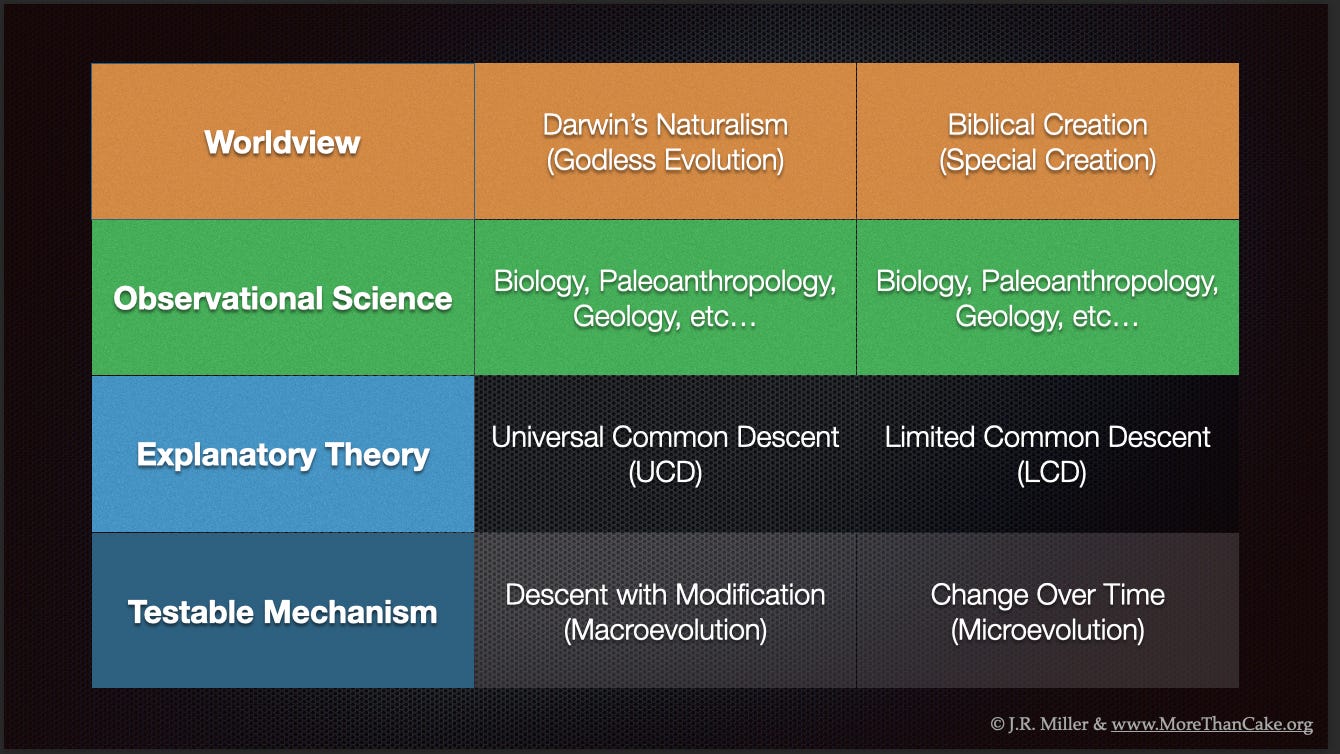
Recall that there are at least four distinct definitions of biological evolution, which divide into two frameworks:
The Internal Evolutionary Framework begins with the worldview of special creation and accepts evolution as the theory of Limited Common Descent through the mechanism of Change Over Time.
The External Evolutionary Framework begins with the worldview of Darwinian naturalism and accepts evolution as the theory of Universal Common Descent through the mechanism of Descent with Modification.
Let me be clear: the Bible does not directly teach either framework or any of the four definitions of evolution. Even more, no specific verse demonstrates that God used evolution to create. Even so, the silence of Scripture on the mechanics of biological adaptation does not prevent reasonable conclusions about which of the two frameworks fits the biblical story and which does not.
The Internal Evolutionary Framework is compatible with special creation because the kind of ‘evolution’ it describes fits the biblical narrative.
Scripture permits the conclusion that God created each “kind” in Genesis with genetic diversity sufficient for environmental adaptation—such that when the two parents pass alleles to their offspring, the offspring manifests the qualities needed to survive its environment without ever moving outside its kind. This explains how a small number of animal kinds on Noah’s ark could have “evolved” into the variety of species we observe today.
The External Evolutionary Framework is incompatible with special creation because its definitions conflict directly with God’s special creative work. On Universal Common Descent, for example, Meyer concludes:
Strictly speaking, common descent is an abductive or historical inference, as Professor Ruse himself acknowledges when he speaks more accurately of “inferring historical phylogenies.” As defined by C. S. Peirce, abductive inferences attempt to establish past causes by viewing present effects. (As such, it is more accurate to refer to common descent as a theory about facts, i.e., a theory about what in fact happened in the past.) Unfortunately, such theories, and the inferences used to construct them, can be notoriously underdetermined. As Elliot Sober points out, many possible pasts often correspond to any given present state. Establishing the past with certainty, or even beyond reasonable doubt, can therefore, be very difficult.17
If theological coherence is the first strength of special creation, the second is empirical: it makes the best sense of the scientific data. Independent of theological considerations, Limited Common Descent and the mechanism of Change Over Time are non-controversial, empirically verifiable, and highly probable. By contrast, Universal Common Descent and the mechanism of Descent with Modification are highly controversial, empirically unverified, and highly improbable.
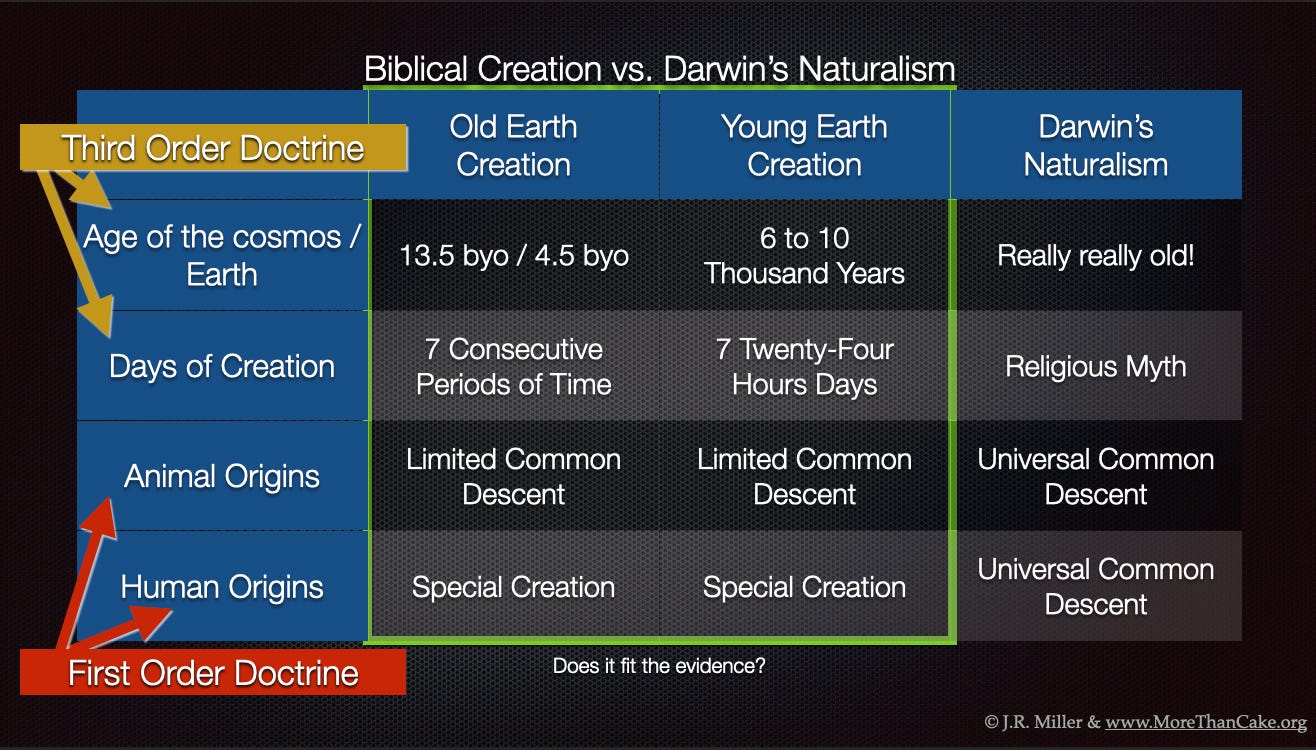
It is true that within the broader public and scientific discourse, "Creationist” is most often a derogatory term and used almost exclusively in reference to Young-Earth Creationism (YEC). Throughout this article, I’ve used the term in a more precise theological sense to cover advocates of both Old-Earth and Young-Earth models, both of whom affirm the core doctrine ex nihilo origins and of Adam and Eve’s sole biological progenitorship. This usage does create some confusion about the differences between Christians who identify as Old Earth or Young Earth creationists.
By including both groups in my definition of “creationists,” I hope to open a door through which we can overcome those differences on our view of earth’s age by recognizing the deeper unity we share in our commitment to the authority of Scripture.
In my article Doing Theological Triage with Winsome Conviction, I define what I consider first, second, and third-order doctrines. First-order doctrines are essential to the gospel of Jesus Christ and set the guardrails for the universal church. I count human origins—the rejection of godless Darwinian evolution and the affirmation of purposeful creation in the imago Dei—among these first-order doctrines. That shared ground for both Old and Young earthers lets us stand hand-in-hand as brothers and sisters against materialistic naturalism and reject, both philosophically and scientifically, the definitions of evolution incompatible with special creation.
Our disagreement over the age of the earth, in contrast, is a third-order doctrine. Consequently, we should welcome rather than avoid open debate on that question, since honest engagement has the potential to strengthen our theology, refine our worldviews, and expand our Christian witness.
So in answer to the questions we started with: do special creationists deny the so-called “scientific fact” of evolution? No. Evolution is a term with multiple definitions, and some of them are compatible with special creation. The problem comes when atheists committed to naturalism turn science into an ideology and refuse to teach the limits of their models or the strengths of the competing models.
Is special creation a rejection of science? No. Science is not a unified voice free of the philosophical assumptions that drive scientists. Special creation rejects two things: the way some scientists interpret the data, and the metaphysical assumption of naturalism that undergirds their worldview. Many other scientists examine the same data and posit valid theories amenable to special creation—theories that affirm cosmic origins through external causation, the irreducible distinction between non-life and life, the distinct creation of biological kinds, and the special creation of humanity in the imago Dei.
The good news is that special creation does not divide the church. Christians who differ on the age of the earth and the mechanisms of speciation can stand together on the first-order doctrines that matter most: that God created the universe and life by His own creative act, that He purposefully formed Adam and Eve in His image, and that Scripture tells us the true history of those events. On that shared ground, Old and Young Earth creationists can engage the scientific data together, welcome the debates that remain, and bear a unified witness against the materialistic naturalism that has captured so much of modern science.
For a detailed discussion of the many meanings of evolution, see Jonathan Bartlett’s post, Evolution is a Big Word: The Many Theories of Evolution and Why They Matter. Bartletts categories include, Evolution by Natural Selection, Front-loaded Evolution, Evolutionary Developmental Biology (Evo-Devo), Evolution by Natural Genetic Engineering, Somatic Selection, Structuralist / Platonic Evolution, Biological Self-Organization, Multilevel Evolution, Epigenetic Evolution, Evolution by Symbiogenesis, and Teleological Selection.
A close friend mentioned that he has identified nearly ten distinct meanings of the word “evolution,” including concepts such as Social Evolution. This does not even take into consideration how the term has “evolved” over the past 150 years such that Darwin’s use of the term bears little resemblance to its modern use. So, while each of these unique definitions deserves careful consideration, I don’t think it is necessary to address every usage over the long history of the debate in order to evaluate the central accusation in this post that special creation necessarily rejects evolution.
Two notes here. First, pantheism fits this category because even though it allows for some power like consciousness to exist, this force is a part of the universal fabric of reality and not external to it. Second, there is no singular atheist worldview, at least not in terms of how their metaphysical naturalism is applied. For example, William B. Provine (1942–2015), an evolutionary biologist and historian of science at Cornell University, embraced hard determinism. He argued that there are no gods, no purposeful forces in nature, no life after death, no ultimate metaphysical foundation for ethics, no ultimate meaning, no purpose in life, and no genuine free will. Provine differed significantly from other atheists such as Daniel Dennett, who defended compatibilist free will; Alex Rosenberg, whose “nice nihilism” accepts similarly stark conclusions but frames them as livable; and Sam Harris who argues that free will is ultimately illusory.
This is a good point to note two key definitions. Cosmogony is an account or theory explaining the origin of the universe. Cosmology is the study of the origin, structure, and evolution of the universe. As I argued in my book, Set Apart, I find that in practice even the most “scientific” models blend these concepts together so I’ll use the term cosmology to cosmogony.
Alice Y. Chen, Phil Halper, and Niayesh Afshordi, “Copenhagen Survey on Black Holes and Fundamental Physics,” arXiv preprint arXiv:2503.15776 (2025), 10, accessed May 26, 2026, https://arxiv.org/abs/2503.15776.
AccessScience, s.v. “Cyclic universe theory,” by Paul J. Steinhardtlast reviewed November 2019. https://www.accessscience.com/content/article/a176017. Note how some scientist do not hide their existentialist commitments.This article, for example., makes a direct appeal to Nietzsche's doctrine of eternal recurrence with this quote, “The eternal hourglass of existence is turned over again and again, and you with it, speck of dust!” Carroll, Sean M., N. Diachenko and Saakshi Dulani. “Toward a Phenomenologically Acceptable Quantum Cyclic Universe.” (2026), p. 1. https://arxiv.org/pdf/2605.30405. And although I’ve footnoted this article here in category 3 based on Carroll’s use, Nietzsche’s belief that the universe has no beginning and no end fits quite naturally with category 2.
Hawking's lecture cites a figure of 15 billion years, which reflected estimates current at the time of his talk. The present scientific consensus places the age of the universe at approximately 13.8 billion years.
Chemical Evolution is also used to refer to the history of the formation of all 92 elements in red giant stars and supernova explosions. It is important to note something about my graphic which states, “After the Big Bang, simple atoms formed. In places like Earth's early environment, they combined to form simple molecules.” Specifically, the Big Bang produced only hydrogen (80%) and helium (20%), with a trace of lithium. Our solar system was still 9.2 billion years away, as were the rest of the elements in the Periodic Table. How were these formed? This is also an unknown. That said, my focus here for this post is really on the biochemical aspect.
Lemaitre published his proposal of an expanding universe in 1927 ("Un Univers homogène de masse constante et de rayon croissant rendant compte de la vitesse radiale des nébuleuses extra-galactiques," Annales de la Société Scientifique de Bruxelles A47, 49–59). He advanced the "hypothesis of the primeval atom" in 1931 ("The Beginning of the World from the Point of View of Quantum Theory," Nature 127, 706).
My list of five foundational aspects of biblical anthropology (special creation) grew out of my PhD dissertation as a theological framework for my argument against racial hierarchies.These five aspects each rest on a mix of Scripture, philosophy, and church tradition which I used to make sense of the science of human origins. While each aspect finds support in both testaments, the weight of that support varies. Points 1 and 4 rest on explicit statements across both testaments (Gen 2:7, 21–23; 5:1–3; 9:6; 1 Cor 15:45–49; Jas 3:9). Point 3 rests on texts whose plain reading supports sole progenitorship, a reading that theistic evolutionists contest (Gen 3:20; Acts 17:26; Rom 5:12–19), and it also draws on my understanding of the genetic evidence for a founding pair which is also not addressed in this article. Point 2 rests on several texts that treat the human spirit, which I include under the broader concept of “soulish” nature, as a gift given from above rather than a property that emerged from matter (Zech 12:1; Isa 42:5; Eccl 12:7; Acts 17:28–29; Heb 12:9). This point in particular blends philosophy and theology to counter emergent monism and animal-to-human evolution. Point 5 rests on the creation mandate alongside several texts that offer deeper insight about it (Gen 1:26, 28; 2:15; 9:1–3; Ps 8:6–8; 115:16; Lev 25:2–5, 23; 1 Cor 4:1–2; Heb 2:5–8). Each of these passages listed above carries its own history of interpretation, and a full exegetical defense of all five aspects lies well beyond the scope of this article (my dissertation was 358 pages). My narrower aim here is to show that my framework of special creation, if granted as sound, supplies a coherent standard to test the competing definitions of evolution.
S. C. Meyer, “Laws, Causes, and Facts: Response to Michael Ruse,” in Darwinism: Science or Philosophy? ed. J. Buell and V. Hearn (Richardson, TX: Foundation for Thought and Ethics, 1994), 36.
Comments
Nothing yet. Say the first thing.
Sign in to join the conversation.