
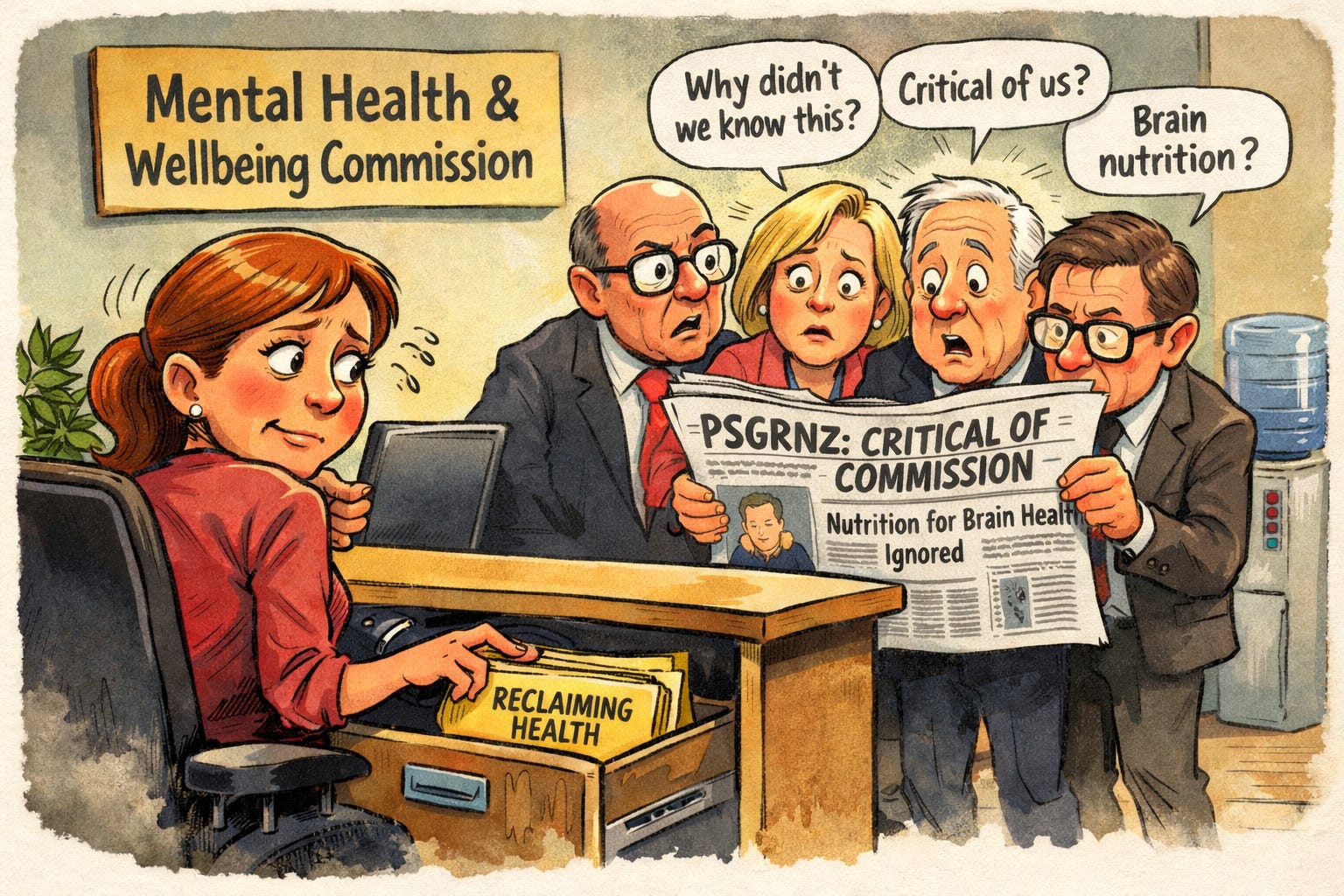
The Mental Health and Wellbeing (MHW) Commission have enormous powers of enquiry, but the evidence suggests that they are simply resorting to information gathering inside the system, and downplaying their power to conduct wide ranging enquiry outside the system. The MHW Commission was put in place to help solve a seemingly intractable problem: an under-resourced, overburdened system and increasing rates of brain-related psychiatric illness and suicidality. A system challenged by people with complex chronic conditions that remain inside the system for decades.
The MHW Commission’s primary focus concerns ensuring better and equitable mental health and wellbeing outcomes for Kiwis. What must be addressed for this to be achievable?
There’s extensive evidence that demonstrates that mental - but let’s call it brain - health is intertwined with biological, psychological, spiritual and social factors. Current treatment approaches to health are sub-optimal. They don’t address biological health and brain nutrition, and they can.
The MHW Commission just let the Physicians and Scientists for Global Responsibility New Zealand (PSGRNZ) know that nutrition for the brain is a topic they do not want to consider – for the next four years.
A familiar manoeuvre in public governance is to grant a Commission formal powers without providing the resources required for robust scientific enquiry. It is therefore possible that the Commission does not have the budget to engage expert scientists in metabolic nutrition to review the evidence base. If this is the case, it should be stating this openly and publicly.
However, I suspect that institutional framing in the first three years set the Commission’s agenda in ways that placed inquisitorial research beyond its perceived remit, and outside the hearts and minds of senior decision-makers.
PSGRNZ sent them an open letter, addressed to senior executives and the board, together with a recently released paper Reclaiming Health: Reversal, Remission and Rewiring. The paper highlights the association of poor dietary intake and inadequate nutrient status with not only psychiatric illness, but many of the symptoms that underlie diagnoses. One working day later, the front desk responded with an email advising us that:
‘The paper you have sent falls outside areas we have prioritised in our Statement of Intent it is not something we can bring our immediate attention to.’
In a quick, dismissive email, New Zealand’s MHW Commission informed PSGRNZ that the issues contained in this in-depth paper, which explicitly discussed mental health, and interventions that would support mental health, particularly for children, youth, pregnant women, and people who are treatment-resistant or suffer from psychiatric drug side effects, are not relevant to their work programme.
We asked whether the board and senior executives had received our open letter. We received no reply.
PSGRNZ understood that the MHW Commission had extensive powers of investigation. As the primary author who appreciated the drivers of the initial 2018 inquiry, the He Ara Oranga findings, and the legal function of the MHW Commission, I had believed that the MHW Commission would take the Reclaiming Health paper seriously, given that it contained new information not held by the Commission. The report contains over 600 citations to support the information, and experts, including in brain and paediatric health, have widely supported it.
The brush-off then spurred us to look deeper into policy development and framing problematisation at the MHW Commission. What we appear to be observing here is a situation of an institution focussed on the efficiency of systems where the priorities are timeliness of general practitioner, psychiatric, emergency, community and counselling services. But the services are based on speed of access, cultural appropriateness and feeling seen and heard. Biological brain health is not in the mix.
The evidence suggests that the MHW Commission has integrated the Ministry of Health approach, where brain health is exclusively a function of psychological and social factors to be addressed by counselling, behavioural shifts, medical prescribing, exercise and community connections, and to ensure that the system focuses exclusively on promoting these issues.
This is not just incorrect, but wrong. It is morally, ethically and scientifically wrong.
The MHW Commission is directly tasked with contributing to better and equitable mental health and wellbeing outcomes for people in New Zealand. Equitable mental health outcomes for people involve symptoms receding, and people waking up every day and wanting to live healthy, loving, creative lives. All people suffer from different levels of trauma and grief; however, nutrients can have powerful effects in recovery and improving resilience. People with poorer nutritional status are less resilient.
Let’s get this straight: Health equity isn’t a person being ‘OK’, but taking multiple medications. That is medical equity. Health is political. It’s just as political to ignore nutrition as it is to discuss it. It’s just as political to fail analyse and disclose risks from psychiatric medication, the extent and degree of treatment resistance (including by dosage). Does the prescribed treatment directly improve a patient’s quality of life?
These are viewed as scientific concepts, yet they are well understood by people in the ‘system’ with lived experience. However, prevailing health agency cultures and human decision-making have demonstrably ignored the multi-system, complex benefits of optimum nutrition, while failing to fund independent research into drug risks and drug failure by age and gender. This can occur via systematic literature reviews and by regular data-gathering inside the system.
People on psychiatric medication are likely to be on medication for other illnesses. It is more normal in New Zealand to have multiple conditions (multimorbidity) than a single condition. When people are diagnosed with multiple conditions, they will most likely be prescribed multiple medications.
For years, the science on nutritional psychiatry has exploded. It makes sense, because:
‘The brain consumes 20–40% of the nutrients and energy we ingest, which is disproportionately higher than its weight’ (Rucklidge, Johnstone, Kaplan 2021).
For decades people have been told that their brain is chemically imbalanced, but the only answer seems to be psychiatric medication and counselling. Yet the brain metabolism is dependent on nutrients to function. Just as people are more likely to be deficient in a spectrum of nutrients, the evidence suggests that multinutrient formulations support mental health more effectively than treatment with a single vitamin or mineral.
The question is, what can be enacted at a policy level to improve brain health and brain function, interventions that that might improve equity, act protectively and preventatively and reduce the potential for substance use, that is not currently integrated into the health system?
This is where the Mental Health and Wellbeing (MHW) Commission can step in and address Ministry of Health failure. The Commission was established in the first place to shine a light on what hadn’t been done in the past, because what was being done in the past was not working.
Reclaiming Health explains how and why many vulnerable groups would benefit from a nutritional approach to mental health and that interventions could go a very long way to improving equity for brain health and wellbeing outcomes.
This includes children, youth and young people in important developmental stages whose symptoms and challenges may reflect insufficient nutritional status; pregnant women for whom psychiatric medication may be judged too high a risk for the developing foetus; people who are treatment-resistant (for whom medications do not work); people who are likely to experience adverse effects; and people who experience adverse effects and then who are likely to be labelled ‘non-compliant’ due to the intolerable character of those side-effects.
These groups, which form a large sector of at-risk people, fall outside the presumed ‘traditional medical model’.
Children, young people and pregnant women may be the most poorly served if a system exclusively prescribes counselling and psychiatric medications. Unfortunately, independent, longitudinal, real-world, multimorbidity-sensitive safety data is not published for the latter. These therapeutic modalities cannot address nutritional deficiencies.
Reclaiming Health highlights a key and not well understood issue – our nutrition guidelines, and macronutrient recommendations (protein, fat and carbohydrate) do not concern optimum health, but relate to preventing abject deficiency. The macronutrient and micronutrient evaluations which establish the guidelines have not reviewed the relationship between nutrient intake and mental health, particularly in the vulnerable populations – which involve growing humans in key developmental stages.
New Zealand has one of the world’s most expert scientists on brain health. Professor Julia Rucklidge should be an invited advisor from an early stage, but from what we can see, her expertise is out-of-scope.
…. the full article is published on the Daily Telegraph website.
- NUTRITION & ISSUES WITH PSYCHIATRIC MEDICATION OUT OF SCOPE BY DESIGN?
- BRAIN HEALTH IGNORED IN PAPER AFTER PAPER, INFOGRAPHIC AFTER INFOGRAPHIC.
- BRAIN NUTRITION IS AN ISSUE THAT THE COMMISSION CAN ‘BRING THEIR ATTENTION TO’
- THE COMMISSION: EXPLICITLY REQUIRED TO IDENTIFY TRENDS AFFECTING OUTCOMES
- SYSTEM EFFICIENCY IS ONLY ONE ASPECT – IT’S THE INFORMATION INSIDE A SYSTEM THAT DRIVES SUCCESS
- DOES THE COMMISSION APPRECIATE HOW BROAD THEIR POWERS ARE?
No posts
Comments
Nothing yet. Say the first thing.
Sign in to join the conversation.