
A post on Twitter (I still can’t call it X) went viral recently. Viral enough that it reached me, someone who doesn’t have a Twitter. I saw it in my LinkedIn feed. The post was from the former CTO of Dropbox:
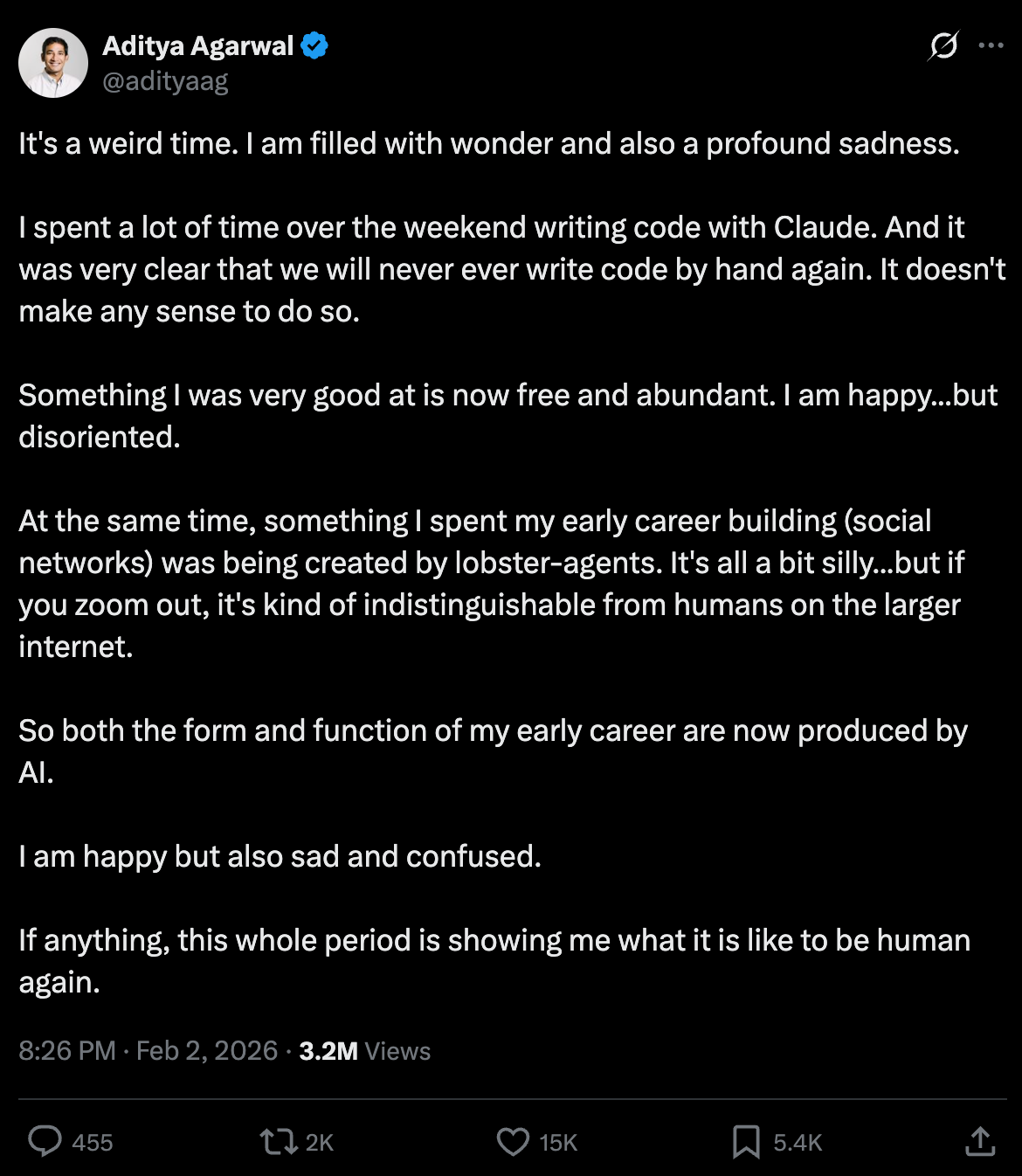
My first reaction was sadness. Not the sadness Aditya describes, but sadness about how much chaos LLMs have already unleashed, and how much more they have yet to unleash.
Right now, it’s an uncanny moment for people who write code for a living. Companies are telling engineers to adopt agentic workflows, where LLMs act as coding agents. LLMs can now write a growing share of the code, and we’re told not only to accept it, but to embrace it and ship more.
Okay. So we’re moving away from writing code and toward supervising it. “Architecting” is the more important skill. Oversight, not writing. Let me look at this LLM-generated code… wow, it has a lot of bugs. I guess I’ll provide more context. Now I’m writing a lot of words. I probably could have written the function in the time it took to write this soliloquy, just to give the LLM enough context.
Because you see, coding was never the bottleneck. It’s often the easiest part. The hard part is understanding the system you’re changing and all the ways it can break. Latency, cost, dependencies, security, human behavior. Whatever. The problem gets solved. The code ships. I’m maybe 1.5x more efficient. What does it even mean for an engineer to be 10x more effective than another?
If it’s an uncanny moment for engineers, it’s a golden age for companies. Instead of two senior engineers and eight junior engineers, companies can try two senior engineers directing the agents. And for now, it sort of works. Telling an LLM what to do looks a lot like coaching an intern through tasks. It’s annoying and tedious, but doable. And an intern will grow into a senior engineer, so over time the coaching burden shrinks. The LLM, on the other hand, will always need coaching. But that becomes tomorrow’s problem.
This is a great time for companies to cut costs. But I don’t think it lasts. The example above works only because those senior engineers already know how to code. They know most of the syscalls by heart and understand the software/hardware relationship. They can read a stack trace. They have an intuition for caches, memory, and I/O bottlenecks, and they can feel when something will fall over in production. They know what the machine will actually do, not what the code claims it will do. They honed their craft over years of writing and fixing code themselves. But what happens when those seniors leave the workforce? Will we have seniors who can replace them and effectively direct the agents? And will those replacements be equally competent?
How AI Impacts Skill Formation is one of the few papers that examines how AI changes how we learn (maybe there aren’t many studies because the conclusion feels obvious, and we don’t want to confront it). It ran a randomized experiment with 52 developers learning a new Python library. The AI group learned with an AI assistant, and the hand-coding group learned without one. Then everyone took a quiz without AI assistance. The AI group scored about two letter grades lower than the hand-coding group. The effect held across experience levels, from new grads to people with seven or more years of experience. Only 20% of the AI group saw real speed gains (19.5 minutes vs 23 minutes for the hand-coding group). Others spent up to 11 minutes composing prompts, which erased any productivity benefit. The bottom line is that AI-assisted productivity and skill formation are not the same. People who delegate fully may finish faster, but they learn almost nothing.
I learned by writing a lot of code in different languages. I learned by using debuggers and breakpoints. I learned by refactoring my code until it ran well on my machine. I learned parallelism and how to distribute work across resources. I repeated that loop for years. If I had an LLM in that loop, would I have learned as much? I doubt it.
In his 2016 book Deep Work, Cal Newport argues that focus is the new superpower. Our attention is scattered, and Silicon Valley companies have built empires by exploiting that weakness. I think the next superpower is learning and understanding without the help of LLMs.
Software engineering is undergoing a revolution. But I don’t think the next phase will feel like excitement. It will feel like consequences. A reckoning.
No posts
Comments
Nothing yet. Say the first thing.
Sign in to join the conversation.