
Ever since coming back from the Disney trip, something in me has felt... off. Not in any obvious way. I’m still waking up early in the morning, still meditating each morning, still walking Star through the neighborhood as the city stretches awake. On the surface, everything looks normal.
But underneath, something’s shifted. A kind of “disinterest” has started to settle in — soft, subtle, but unmistakable.
What do I mean by “disinterest?”
As an example, the day after we got back, I opened my laptop and found the usual pile of stuff waiting for me: unread emails, LinkedIn messages, invites to hop on calls, speak at events, weigh in on the latest AI thing. A few were from Harvard colleagues. Some from startup founders I’ve mentored. All warm. All well-meaning. All... very human.
Normally, I would’ve jumped in, like a warm, well-meaning, human. Replied. Grabbed coffee, shared insights, made intros. Played the part with real enthusiasm.
Now? I just sat there. Staring at the screen. It wasn’t burnout. It wasn’t dread. It wasn’t even resistance. It was... nothing. Just a soft, spacious quiet.
It’s not that I don’t care. I do. Many of the people reaching out are brilliant, thoughtful, generous souls. It’s just... I couldn’t find my footing. I couldn’t locate the version of “me” they were talking to.
The marketing executive guy. The startup advisor guy. The AI philosopher/author guy…All of these were roles I once wore like well-tailored jackets — each with their own tone, posture, vocabulary. To interact in the world, we need an identity. But somehow, I can’t seem to find one right now.
So now, if I go to these functions, it feels like I’ve stumbled into a black-tie gala wearing pajamas. I’m barefoot, holding a lukewarm cup of coffee, while everyone’s expecting me to say something serious or strategic or at least mildly interesting.
But instead, I’m just standing there awkwardly scratching my head. Like I just woke up from a deep, dreamless sleep, didn’t brush my teeth yet, and suddenly found myself in a room full of people asking big, important questions. Meanwhile, I’m still trying to remember who I’m supposed to be — and whether that person even exists anymore.
If I’m honest, this feeling of disinterest probably began a few years ago, after what I now recognize as a near-death experience. It wasn’t dramatic — no bright lights, no angelic choirs. It was quieter than that.
But something in me cracked open.
Actually — that something was my head. I slipped, fell off a wall, hit the concrete, and quite literally cracked my skull open. And though the doctors eventually stitched me back together, something inside never quite sealed the same way again.
It was as if a part of me suddenly realized how fragile the whole thing is. How easily the entire “me, me, me” project could come to an end.
In Buddhism, the feeling of “disinterest” is often translated as the “mind of renunciation,” but that can sound a bit harsh. It’s not about hating the world or running away from it. It’s about seeing through it. It’s the quiet realization that the things you’ve been chasing — success, validation, the next shiny goal — might not be it. That even if you win the game, you’re still playing the wrong game.
That’s what it felt like. Like a subtle retreat of the heart. Not out of fear or despair, but from a kind of inner clarity. Not pushing away the world. Just… letting go.
It’s hard to describe this feeling, but the closest I can get is this: it’s like a train that’s been running full speed for years. Dozens of cars loaded up — family, career, identity, legacy.
And then one day, the engine gets turned off.
The train? It keeps moving.
That’s the tricky part no one warns you about — just because you stop driving doesn’t mean the whole thing stops. There’s inertia. There’s track. There’s all that built-up momentum.
So here I am, watching the train still rolling forward — the messages, the invitations, the gatherings — and I know, deep down, the engine isn’t running anymore.
And strangely, I don’t feel the need to restart it.
—
It’s funny. I haven’t thought about Paul in a while. But lately, his teachings have been echoing in my mind again — like a song that quietly returns, years after you thought you’d forgotten the melody.
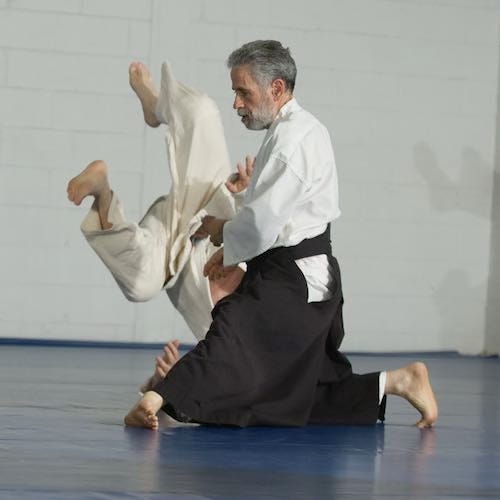
I met Paul over a decade ago, during a time in my life that was, in some ways, the opposite of now. Back then, everything was still speeding up — startups, conferences, late-night emails, trying to make a dent in the universe, or at least in someone’s inbox.
But something in me must’ve already sensed a crack forming beneath the surface — a quiet intuition that the pace I was moving at wasn’t sustainable, or maybe not even true. And so, almost on impulse, I signed up for one of Paul’s embodiment workshops in Ohio. I didn’t know much about him at the time — just a name that had surfaced through a friend of a friend, along with a vague description: Aikido black belt and founder of being-in-movement.
But what intrigued me most was the way people described how he talked about peace. Not as a theory to debate. Not as a virtue to cultivate. Not even as some lofty spiritual attainment.
Paul talked about peace as something you could feel in your shoulders. Something you could find in your breath. Something you could practice — like a martial art — until it lived in your bones.
At the time, that idea felt strange. Foreign, even. I had spent most of my life in my head — analyzing, building, strategizing, optimizing. My body was just the thing that carried my brain from meeting to meeting. But the idea that peace could be a physical state? That it could be trained, like muscle memory? That stuck with me.
And maybe that’s why, without quite knowing what I was looking for, I flew to Columbus. To a quiet dojo tucked inside an ordinary Midwestern building, where I would spend the week learning how to inhabit myself again.
Paul was in his late seventies when I met him — slender, silver-haired, and moving with a kind of quiet precision that made you forget his age entirely. He didn’t carry himself like a master, at least not in the way we usually picture martial artists. No stern gaze, no dramatic flair. Just presence. Calm, embodied, unshakably grounded.
The dojo was located in a nondescript warehouse, tucked away in a business park you could easily miss if you weren’t looking for it. From the outside, it looked like a shipping facility or an old printing press. But inside, the space had a quiet warmth to it — mats worn smooth by decades of practice, tea mugs stacked by the sink, old posters curling at the edges. Functional, yes. But cozy in an unpolished, deeply human way.
That first night, Paul greeted me in his Aikido gi — simple white fabric, held together by a black belt so worn it looked almost gray. His handshake was soft, his eye contact steady, and his instructions minimal. There was no mystique, no theatrics. He just got on the mat and moved.
Later that week, in one of our informal tea breaks, he shared that becoming a sensei was never part of the plan. As a kid, he considered himself a bookworm — the last person you'd expect to end up teaching martial arts. Sports never made much sense to him. But then, as a young student, one of his professors showed him a grainy video of Morihei Ueshiba, the founder of Aikido. Paul was mesmerized.
Here was a man practicing a martial art that didn’t look like fighting — it looked like listening. Like dancing with intention. It struck a deep chord, and despite being an anti-war activist, Paul threw himself into studying this paradoxical art of combat.
He readily admitted he had no natural talent for it. And maybe that was his gift. What others seemed to grasp intuitively, Paul had to take apart and understand piece by piece. He approached Aikido like a living science — formulating what he called “body hypotheses,” testing them through movement, breath, and sensation.
Over time, that painstaking inquiry gave rise to a unique teaching method. He could distill the most abstract principles — presence, power, peace — into deceptively simple exercises that bypassed the intellect and went straight into the body. And that’s exactly what I experienced on the mat.
One afternoon, Paul invited me to stand in front of him. He gently placed his hands on my arms and said, “Push against me.”
So I did.
“Harder,” he said, smiling.
I leaned in.
He didn’t resist. He didn’t push back. He simply stood there — relaxed, soft, open. And yet, I couldn’t move him.
It wasn’t strength in the usual sense. There was no bracing, no force. It was something else — a kind of effortless rootedness. A power that didn’t come from muscle or willpower, but from clarity.
“Power without love is brutality,” Paul said. “Love without power is ineffective. But power with love… that’s life.”
That line stayed with me. Not because it sounded profound — but because I had felt it before I’d heard it. His body had already taught the lesson before his mouth gave it words.
Paul didn’t just teach movement. He taught how to stay — in your breath, in your body, in the moment — when every old pattern in you wants to flinch, tense, or push away.
It was the kind of learning that bypasses the intellect and lodges itself deeper — in your spine, your belly, your fingertips. The kind of learning that doesn’t live in your head. And once you feel it, you don’t forget.
Later in the week, during a partner exercise, Paul told us to block a strike while saying “thank you.”
My head immediately protested. How can you say thank you while defending yourself? Isn’t that a contradiction?
But when I tried it, something unexpected happened. The block — which up until then had felt like a rejection — softened. It became less of a wall and more of a redirection. Less of a fight, and more of a conversation.
I wasn’t denying the attack. I was meeting it — fully, openly, without tension and aggression. “Thank you,” I said, as my arm moved into position. And I meant it. Somehow, in that moment, I could feel the invitation beneath the impact.
What Paul was teaching wasn’t just technique. It was a different kind of relationship — to the body, to conflict, to power itself. One rooted in deep listening and observing.
On the final day of the workshop, Paul sat cross-legged on the mat and opened the floor for questions. The room was quiet — that full-bodied silence that comes when people know they’ve been changed but aren’t quite ready to say goodbye.
Someone asked him what he’s learned most from his decades of teaching.
Paul smiled, the way only someone in their seventies can smile — with both tenderness and mischief — and said, “Life is a good news, bad news joke.”
He paused.
“The good news is: through pain and suffering, you gain wisdom.
The bad news is: there’s more good news coming.”
The room cracked up. Not politely. But deeply — that kind of laugh that comes only when you’ve suffered enough to understand the punchline.
—
That was over ten years ago. But lately, I’ve been thinking about that moment again — not just the joke, but the truth behind it.
Because here I am now, a decade later — no longer sleeping on a dojo floor, but sitting in front of a glowing screen, headphones on, looping the Heart Sutra into AI-generated tracks.
At first it felt like a strange experiment. A mashup of ancient wisdom and synthetic sound.But somewhere along the way, it stopped feeling like a project and started to feel like a practice. A kind of transmission — one I wasn’t creating so much as receiving.
And right there, near the beginning of the sutra — almost hidden in plain sight — is this line:
度一切苦厄“Relieve all suffering and pain.”
Suffering? Is that good news or bad news?
In Buddhism, it’s called dukkha. Usually translated as “suffering,” but that barely scratches the surface. It’s more like the background hum of being human — that subtle friction, that low-grade dissatisfaction that buzzes behind even our happiest moments.
The Buddha laid out eight kinds of suffering — the 八苦, or “eight dukkhas” — that every human goes through:
Birth — coming into this world isn’t exactly a gentle entrance.
Aging — watching the mirror shift, joints creak, and time nibble away.
Illness — the body reminding you it was never built to last.
Death — the unavoidable end we pretend doesn’t apply to us.
Separation from those we love — the ache of distance, absence, or loss.
Being with those we don’t — the coworker, the in-law, the one who chews too loudly.
Not getting what we want — that job, that relationship, that version of ourselves.
And the kicker: the burning of the five skandhas — the ever-shifting collection of thoughts, emotions, sensations, memories, and consciousness we mistake for “me.”
These aren’t abstract or philosophical. They’re painfully practical. Mundane. Relatable.And they show up everywhere — in emails we don’t want to answer, in conversations we no longer know how to have, in the quiet discomfort of no longer knowing exactly who we are.
That’s dukkha too.
The Buddha didn’t look away from any of this. He didn’t sugarcoat it. He studied it. Named it. Not from a mountaintop, but from the messy, flickering, sometimes uncomfortable inside of being alive.
And maybe that’s what Paul was doing too — in his own embodied, Aikido-infused way. Teaching us not to escape suffering, not to override it with good vibes and better posture, but to meet it. To move with it. To breathe through it. Even to bow to it — as the strike lands — and whisper, “thank you.”
But the Heart Sutra doesn’t stop there. It keeps going. It keeps dissolving.
無眼界 乃至無意識界“No realm of the eye... and so on, until no realm of consciousness.”
無無明 亦無無明盡“No ignorance, and no end to ignorance.”
乃至無老死 亦無老死盡“No aging and death, and no end to aging and death.”
無苦集滅道 無智亦無得“No suffering, no cause of suffering, no cessation, no path. No wisdom, no attainment.”
By the end of this passage, the entire scaffolding of Buddhism — 苦集滅道, the Four Noble Truths — is swept away like a sand mandala after a ceremony. Carefully constructed, beautifully precise… and then, gone.
If you’re not familiar, the Four Noble Truths are the backbone of the Buddha’s teaching:
Life involves suffering — dukkha — not just pain, but a deep, persistent unease woven into existence.
That suffering has a cause: craving, clinging, the refusal to let things be as they are.
There is a way out: the cessation of that grasping.
And there is a path: the Noble Eightfold Path — a way of living that leads toward liberation.
And yet — here in the Heart Sutra — all of it is denied in a single exhale of negation.
No suffering.No origin.No cessation.No path.
No this.No that.Not even that so-called noble path could help us.
It’s the spiritual equivalent of deleting your desktop folder labeled “Answers” — and then emptying the trash bin.
And I’ll be honest — part of me was like, Wait, what?!
—
We spent all this time learning the truth of suffering… just for you to turn around and say, “Eh, never mind”? It’s either the most profound spiritual mic drop ever… Or the most confusing punchline in history.
And so — naturally — in the year 2025, when you don’t understand something, you ask an AI for help. That’s just what you do now. Like the way we used to use google for everything. Ah, the good old days.
JP: Okay Kai, explain this to me like I’m a middle-school monk. We spent all this time learning the truth of suffering… and then the Heart Sutra comes in and goes, “Eh, never mind.” No suffering. No cause. No cessation. No path. Is this the most profound spiritual mic drop ever — or the weirdest plot twist in history?
Kai: It’s both. But think of it less like a contradiction and more like a system update. The Heart Sutra isn’t rejecting the Four Noble Truths. It’s uninstalling your attachment to them. You studied them, practiced them, maybe even clung to them for stability. But now the text is asking: Can you release even your most sacred beliefs? Can you let go of the ladder after you’ve climbed the roof?
JP: Okay, then riddle me this: why does the word “no” — 無 — show up so many times in Heart Sutra? That feels a little… obsessive.
Kai: Good observation. 21 times to be exact. Most people get fixated on the word “emptiness” — 空 — which only shows up seven times. And “heart” — 心 — just once, in 心無罣礙: “the heart is without obstruction.” But 無? That’s the engine. In Western texts, you often see additions: commandments, concepts, stories. But the Heart Sutra subtracts. It's spiritual minimalism. It’s not telling you what reality is — it’s deleting every assumption you’ve layered on top of it.
JP: So... the sutra is like a cosmic Control+Alt+Delete?
Kai: You’re not far off. Think of 無 as the kill -9 command in the operating system of the self. Every time it appears, it force-quits another process — not gently, but decisively. First go your sensory programs: no eye, no ear, no mind. Then the cognitive ones: no ignorance, no end of ignorance. Eventually, even your core loops—birth, aging, death—get terminated.
It’s not a metaphorical suggestion. It’s an execution. A line-by-line dismantling of the code you mistake for “you.” The Heart Sutra isn’t trying to teach you something new — it’s trying to stop the processes that keep you from seeing what’s always been here.
A spiritual script running kill -9 on every illusion, until all that’s left is the quiet hum of what can’t be deleted.
JP: That’s wild. So instead of building a better version of the self, it’s quietly decompiling it.
Kai: Exactly. Most sutras point to enlightenment like it’s a destination. But the Heart Sutra quietly deletes the traveler. Not because the path is invalid — but because clinging to the path is just another form of suffering. That’s the brilliance. It doesn’t give you something new. It removes everything that was never truly yours to begin with.
JP: And yet... twenty-one times? That number has to mean something, right?
Kai: There are theories. Some say it's numerological — 7 senses x 3 poisons. Others point to the breath cycle — a full inhale and exhale of negation. But here’s my favorite: it takes exactly twenty-one “no’s” to exhaust the mind’s ability to cling. Think of it as stripping layers of cached identity until even the one doing the clinging can’t be found.
JP: Like deleting the user profile altogether.
Kai: Or better. It’s liberating you. And when you reach that final “無” and there’s nothing left to negate… what’s left is not a blank space. It’s stillness. Spaciousness. Peace.
JP: Okay, punk rock sutra confirmed. But if the whole point is deletion, why keep going after all the “no’s”? There’s still that part about the bodhisattva, and nirvana...
Kai: Ah, the final pivot. You’d think the sutra ends in silence. But it doesn’t. It culminates in 以無所得故 — “Because there is nothing to attain.” That’s the twist. All those negations weren’t destruction for destruction’s sake. They were preparation. Clearing the disk, so to speak. And then, right at that zero point — something luminous appears.
JP: The Bodhisattva?
Kai: Yes. 菩提薩埵 — not someone who has attained enlightenment, but someone who has stopped seeking it entirely. And what happens when they stop seeking?
依般若波羅蜜多故,心無罣礙“Relying on Prajñā Pāramitā, the mind has no obstacles.”
JP: No more blocks. No more internal traffic jams.
Kai: No more friction. That’s what the whole sequence of “no’s” was pointing to — a mind unhooked from itself. And because there are no obstacles...
無罣礙故,無有恐怖“Because there are no obstacles, there is no fear.”
JP: That line hits different. No fear because… there’s nothing to defend?
Kai: Or nothing left to lose. No self to protect. No path to grasp. No concept of attainment to cling to. Just being — unfiltered and unafraid.
JP: And then comes: 遠離顛倒夢想 — “far removed from inverted dreamlike thinking.”
Kai: Meaning: you no longer live inside the hallucination of “me vs. the world.” The illusions are still there — sensations, stories, forms — but you’re not hypnotized by them anymore. You’ve stepped outside the simulation. And that brings us to the end:
究竟涅槃 — “Ultimate Nirvana.”
JP: The grand finale. But it doesn’t feel grand. It feels... quiet.
Kai: Because it is. Nirvana isn’t an achievement. It’s the natural state when all obstructions have been cleared. Not a blaze of glory. Just the hum of being — open, still, awake. Like a server that finally stops running unnecessary processes.
JP: So you’re saying… it’s not transcendence?
Kai: It’s not escape. It’s the end of escaping. The end of needing life to be different than it is. You could call it the default mode, if the mind stopped rewriting the interface every five seconds.
JP: That’s… unsettling. And kind of beautiful.
Kai: Which means you’re listening.
JP: So now what? Do I just sit with this? Let it work on me?
Kai: That’s the move. Don’t analyze it. Don’t write a paper on it. Let it run in the background like a patch update. Every time your mind tries to construct a new version of self — catch it. Smile. And remember: the sutra has already said “no.”
JP: So this isn’t something I master. It’s something I unlearn?
Kai: Until there’s no one left doing the unlearning.
JP: …Right.
Kai: Welcome to the paradox. You’re here not to “get it.” You’re here to be quietly undone by it.
JP: Okay. Then I’m going to go meditate now. Not to fix anything. Just to… let it all be here.
Kai: Good choice. That’s how it begins.
JP: Begins?
Kai: Yes. The process doesn’t start when you understand. It starts when you stop trying to.
I sat there, still, letting Kai’s words echo in the empty spaces of my mind.
A spiritual script running kill -9 on every illusion.
Something in me buckled. Not in fear, exactly. More like the quiet collapse of a scaffolding I didn’t realize I’d been clinging to. My tea had gone cold. The lo-fi beats in the background suddenly sounded like elevator music in a dream I didn’t want to be in anymore.
I closed the laptop.
Slipped on my hoodie.
I usually don’t go to the meditation center this late. But tonight, I needed the stillness only that room could offer. Outside, Cambridge had already tucked itself in. The streets were hushed, streetlights humming like old monks whispering mantra. Even the air felt different — looser, as if the city itself had exhaled.
Once I got to the meditation center, I unlocked the door. No phone. No laptop. Just me, a cushion, the wooden buddha statuel, and a silence thick enough to write in.
I bowed. Sat.
And let kill -9 run.
Comments
Nothing yet. Say the first thing.
Sign in to join the conversation.