
0:00
-6:18
In an ancient land bathed in the golden glow of an eternal sunrise, nestled beside the whispering waters of the River Kairos, there once lived a people who synchronized their lives with the natural rhythms of the cosmos. They lived by Kairotic time, what they lovingly referred to as "God's time." With subtlety, nuance, and complexity, each moment was a pearl on the necklace of existence, hanging seamlessly with purpose, and beauty.
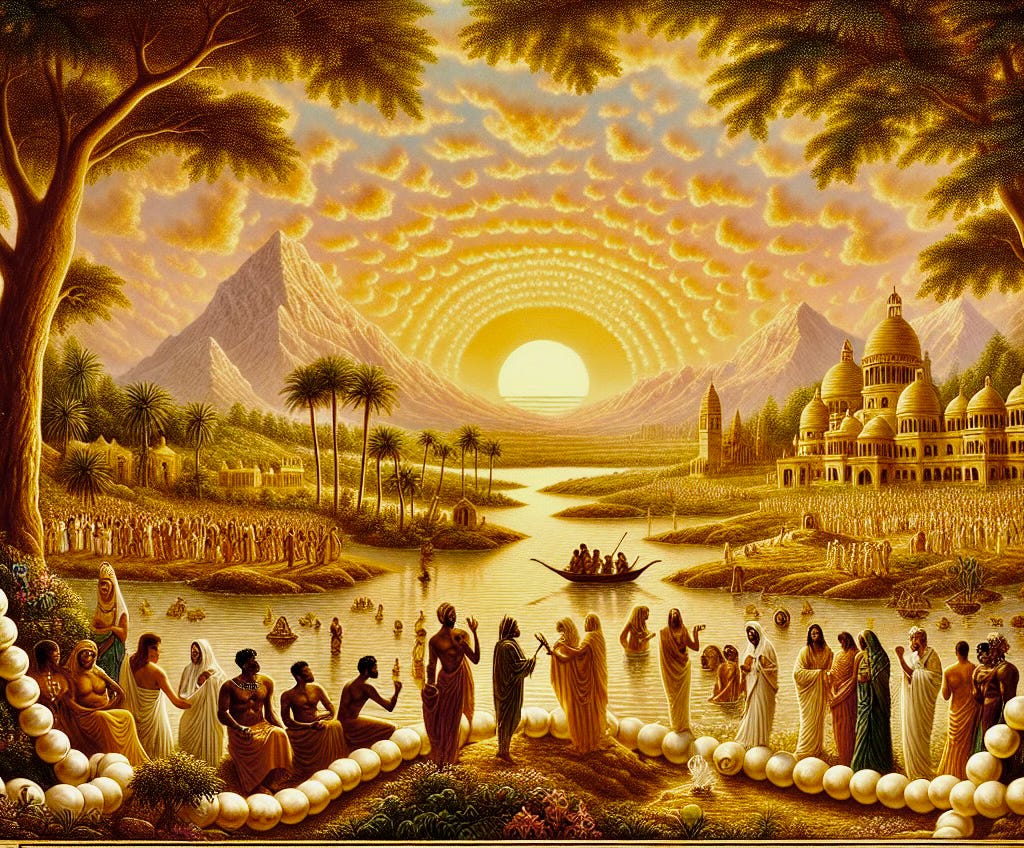
But as centuries rolled on like the River Chronos that eventually met the River Kairos, things began to change. One day, a wise elder from the distant lands of Mechanica arrived with a curious contraption. "Behold!" he declared, unveiling what he called a 'clock.' "With this device, we can measure time accurately. We can plan, build, and conquer lands far and wide."
The people were enthralled. With the advent of the clock, town criers had specific hours to announce the news, and the baker began setting his oven by the tick-tock rather than the rise of the sun. Calendars were devised to chart out days, months, and years. The empire flourished. Structures grew taller, markets buzzed tirelessly, and productivity soared as everything fell into alignment with Chronos, the God of Sequential Time.
However, as the minutes and hours clicked away like a metronome gone mad, the harmony of the land began to unravel. The emphasis shifted away from balance of quality and quantity, to quantity alone. People, now slaves to the regimen of the clock, rushed through their days heedless of the natural cycles nesting within the island's soul. They became obsessed with "more" — more work, more achievements, more wealth — and coined a troubling phrase, "Time is money."
The industriousness came at a cost. Families rarely sat together to share a meal, laughter echoed less in the markets, and musicians found their songs out of sync with the world's heartbeat. The cities grew massive, their towers piercing the sky, yet they felt hollow, as if missing a crucial essence of life. That was when a strange malady befell the populace, known grimly as "Mad Human Disease." Minds grew frenzied, hearts restless; relationships fractured under the weight of endless lists and measurable tasks.
A wise sage named Poincare, who had found solace in the rolling meadows of Kairotic time, tried to reason with the emperor. "Your measurements, O great one, are but approximations. How can you capture the essence of eternity in the fleeting chatter of seconds?" But his words fell on deaf ears.
One starry night, as the city lay restless under the mechanical hum of its colossal gears and gadgetry, a miracle transpired. The cosmos, patient and timeless, decided it was time to intervene. Orion, the hunter, and Cygnus, the swan, descended upon the emperor’s dreams.
"Great ruler," spoke Orion, his voice a gentle roar, "You have overlooked the sacredness of Kairotic time, the essence that connects us all. Align once more with the heavens and witness the magic of natural rhythms."
"Chronological time," added Cygnus, her feathers shimmering, "is but a shadow. The true light lies in kairos, the moments of divine opportunity and eternal wisdom."
The emperor awoke, sweat-drenched but enlightened. He gathered his people and decreed a great festival to honor the cosmos. For one week, clocks were covered, and the city's grandeur was embraced by the timelessness of God's time. Songs filled the air, laughter wove through the streets, and the meadows once again became meeting grounds for joy and unity.
Over time, a balance was struck. They retained their clocks and calendars but also reserved sacred moments for kairos. Gardens were planted and tended according to the moon's phases, craftsmen worked in tune with the seasons, and families dined under the constellations. Technologies evolved but in harmony with the natural laws of the cosmos.
As the years turned, the Mad Human Disease faded, and the people rediscovered the joy of living. Poincare's wisdom resonated more than ever: all measurements are but arrows aiming for life's true essence. Technologies based on chronological time were marvels of human ingenuity but were always to be revered as tools, not masters.
And so, the rivers Kairos and Chronos, once divided, now flowed together once more, blending the divine dance of kairotic moments with the pulse of chronological rhythm. Balance restored, the people lived in kinship with the universe, riding the waves of time with both purpose and peace, and humor when things didn’t go as planned. After all, they learned, the cosmos always had better jokes.
No posts
Comments
Nothing yet. Say the first thing.
Sign in to join the conversation.