
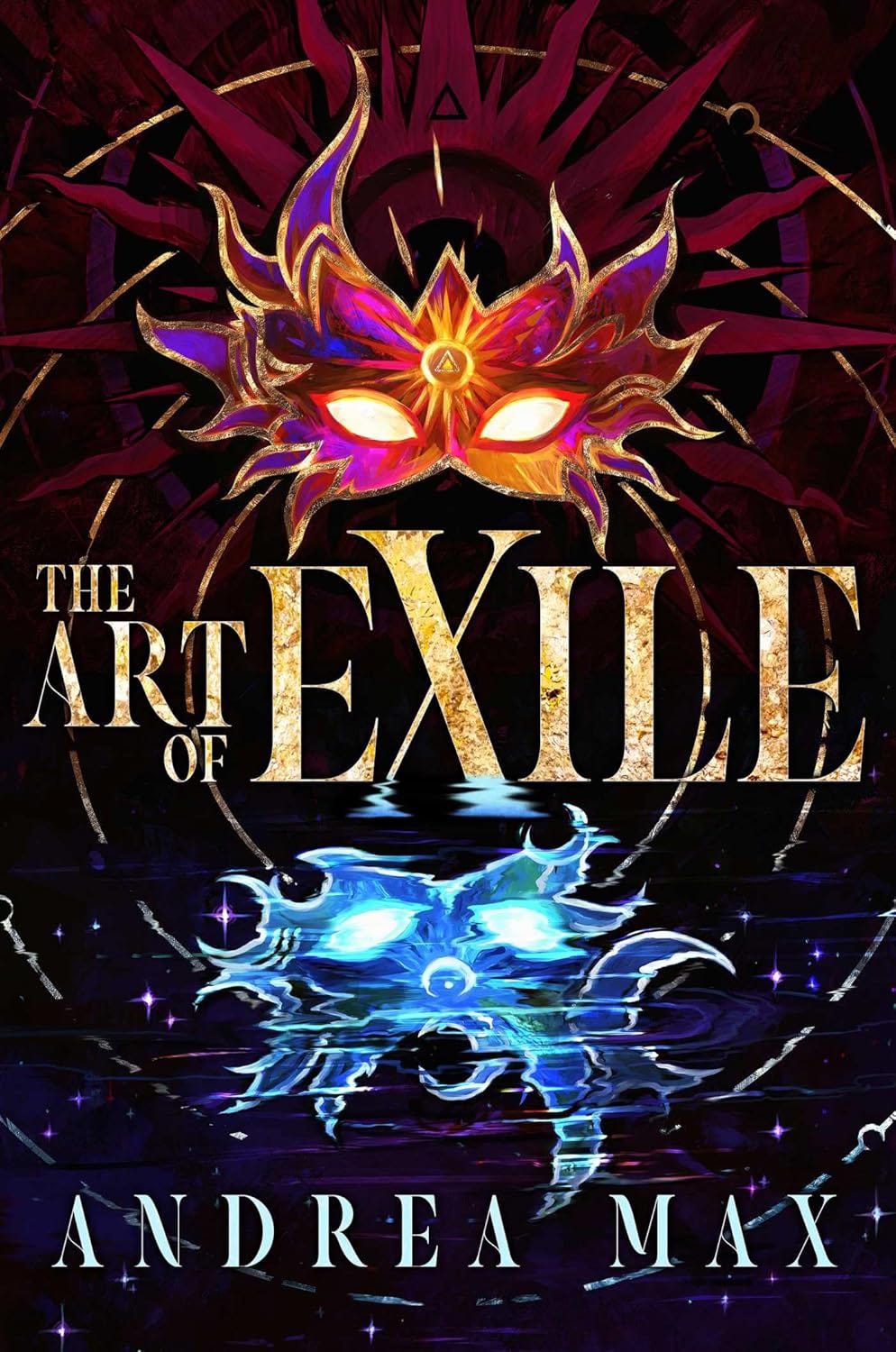
One of the delightful benefits of joining together with a group of other Jewish authors with books for children and teens out this year, is getting to know writers who are new to me. And that includes Andrea Max, whose YA novel, The Art of Exile, has just arrived from the Margaret K. McElderry Books imprint at Simon and Schuster. Kirkus has called it “an inventive, compelling debut.” And a quick plot summary goes like this: “Legendborn meets The Da Vinci Code in this captivating light academia contemporary fantasy following a teen who infiltrates a secret school for the descendants of exiled Renaissance masters to steal their long-lost arts and sciences.” Add in a spunky main character and a sprinkling of Jewish history and mythology, and the book definitely grabbed me! So of course, I was thrilled to get to interview Andrea about the project. Here’s what we talked about.
Joy: I’m curious about your various inspirations were for The Art of Exile. I do very much love fantasy and light academia, not to mention a lost arts and sciences heist type plot, among the many fun components to this YA. Given that you’ve got so many elements at play here, could you spill the tea about how this story evolved for you?
Andrea Max: On one hand, this story was born by me pouring all of my favorite tropes into a blender. But there were two questions that really sparked the premise in my mind. The first came from the concept of "man being created in the image of God," and trying to understand what that meant. If a society viewed it as their purpose to "complete the creation of the world," what are the skills they would need to do so? That line of reasoning led to my development of the Maker Guilds, and also to the concept of some people having Sire abilities--the ability to create something from nothing.
The second question that contributed to the premise was: What would a society look like if it succeeded at creating a Utopia without devolving into a dystopia? In forming the insular Maker society, I tried to really poke at what it would take to have a more ideal version of our society without it being at anyone's expense.
While exploring a Utopian society of people committed to advancing the world, that naturally led me to the concept of the Renaissance man. Pulling from the Renaissance period worked extremely well for the story I wanted to tell, both because it would make sense that a group exiled by an inquisition would have made their way to the New World at that time, and because it is a period in history that everyone has strong associations with, so it works particularly well to explore the themes of the book that highlight how the version of history we think we know is limited to a very narrow, incomplete perspective that ignores so much else that was happening in the world at the time.
Joy: Wow! That is a fascinating progression! And it opens so much food for thought, especially the question about whether can truly ever have an ‘ideal’ society. And in the midst of it, you toss your main character, Ada! But for this next question, I’m going to narrow the focus a bit. Since this interview is part of a series with Jewish authors writing books that have various amounts of Jewish content, I’d love you to talk about how and why you worked to interweave Jewish mythology into the fabric of the book.
Andrea: I didn't originally seek to make the book overtly Jewish. Rather, I just wanted to use Jewish history and traditions to be the inspiration for shaping my worldbuilding. Most classic fantasy relies on the default of Christianity as the basis for their fictional cultures, without it having to mean those characters are meant to be Christian. And that's what I sought to do with interweaving Jewish ideas into my fantasy world. That approach led to me writing about a people who are defined by their exile. I wanted to explore the beauty and the dangers of what happens when a people keep themselves insular as a way to preserve their culture and ideas. It also led to me utilizing Hebrew language and creating a magic system based on Nazir. But as the story evolved, and as publishing was becoming more open to diverse authors writing diverse stories, I decided that I also wanted to add in some Jewish characters and comment more explicitly on how Jewish history was relevant to the themes of the story.
Joy: Interesting. I like that you worked to purposefully move beyond the default. And this opens up a whole conversation for another day about whether any group of people would truly define themselves primarily by their state of exile. But the question of what happens to a people in Diaspora is fascinating to me, and certainly another longer conversation! So shifting back to YA in general, as YA author myself (that’s where my career began, although I’m now happily writing picture books), I’m always interested in the YA authors and novels that you admire. What are your favorites? And to narrow the question, what favorite Jewish-themed titles do you recommend?
Andrea: My two favorite series of all time are The Queen's Thief by Megan Whalen Turner and The Lumatere Chronicles by Melina Marchetta. In fact, Finnikin of the Rock, the first in the Lumatere chronicles, was a big inspiration for me.It is a story about a group of people who have been exiled from their country and their conflict of whether they should try to make a new home for themselves or try to return to their cursed land. The way the story felt so deeply familiar to me, even though it was a foreign fantasy world with no similar traditions or anything else, really inspired me to want to attempt something similar.
In terms of Jewish YA, there has been a wealth of amazing Jewish YA releases in recent years! Truly, it has been miraculous to see. I'll name drop a few of the other authors who are specifically writing Jewish YA Fantasy, because within the scope of Jewish stories for mainstream audiences, that is a pool that is still relatively small: A. R. Vishney, Aden Polydoros, Sacha Lamb, Kalyn Josephson–all of them have been putting out excellent books that integrate Jewish representation into Fantasy in really interesting ways.
Joy: Some of my own favorites in those lists! Sacha Lamb’s work is quite compelling, as are the rest! And speaking of writing, what’s next for Andrea Max?
Andrea: My main focus at the moment is finishing up the Academy of Muses series, but I am hoping to sell another project soon, and there's one that is the most likely contender--if I'm smart enough to write it, which is not guaranteed as it's quite ambitious. A more Jewish-adjacent project that I'm very excited to hopefully start working on as well is a Hillel and Shamai meets The Chosen Dark Academia Fantasy, which sounds pretty bizarre when I say it out loud, but it sounds pretty awesome in my head.
Joy: That last idea sounds AMAZING!!! Please do write it ASAP! Thanks for this great convo!
For more on Andrea Max, please head to: https://www.andrea-max.com
Comments
Nothing yet. Say the first thing.
Sign in to join the conversation.