
This modulation source list comes from the Kickstarter specs for the M0SS-101 instrument. You can read diagram as sending signal from one module to another. For example, the signal output of the Low Frequency Oscillator (LFO) to the Control Voltage (CV) input of the VCA. With Semi-Modular Synths this is accomplished by “normalled” (pre-wired) connections beneath the hood, and with Semi and Modular synths, connecting sections to send signal with patch wire cables in combination with splitters, mults (multipliers), or buffered (powered) mults. In the case of the M0SS, these signal pathways are user selectable and don’t use external patch cables.
LFO -> VCA
LFO -> Filter cutoff frequency
LFO -> Oscillator 1 pitch
LFO -> Oscillator 1 pulse width
LFO (square wave) -> ADSR trigger
ADSR -> VCA
ADSR -> Filter cutoff frequency
ADSR -> Oscillator 1 pitch
ADSR -> Oscillator 1 pulse width
Note that with Semi and Modular synths you can also use an Oscillator as a mod source for the above, as well as external sound source and/or LFO wave shapes combined in a mixer as a mod source.
While one ADSR (Attack Decay Sustain Release) envelope can be sent to several inputs, it’s just as fun to have different ADSR envelopes for each input control you want to modulate. The trick is to send a gate signal or square wave or clock signal (which is a pulse wave, or a high-low wave shape) to the ADSR Envelope Generator (EG) trigger/gate input. But multiple envelope generators may not make an audible difference. For example, the SV-1b has a single ADSR Envelope Generator prewired to Filter cutoff and Voltage Controlled Amplifier volume control. Having a second ADSR Envelope Generator isn’t always necessary, as other analog synths are far less interesting despite 2 ADSR Envelope Generators.
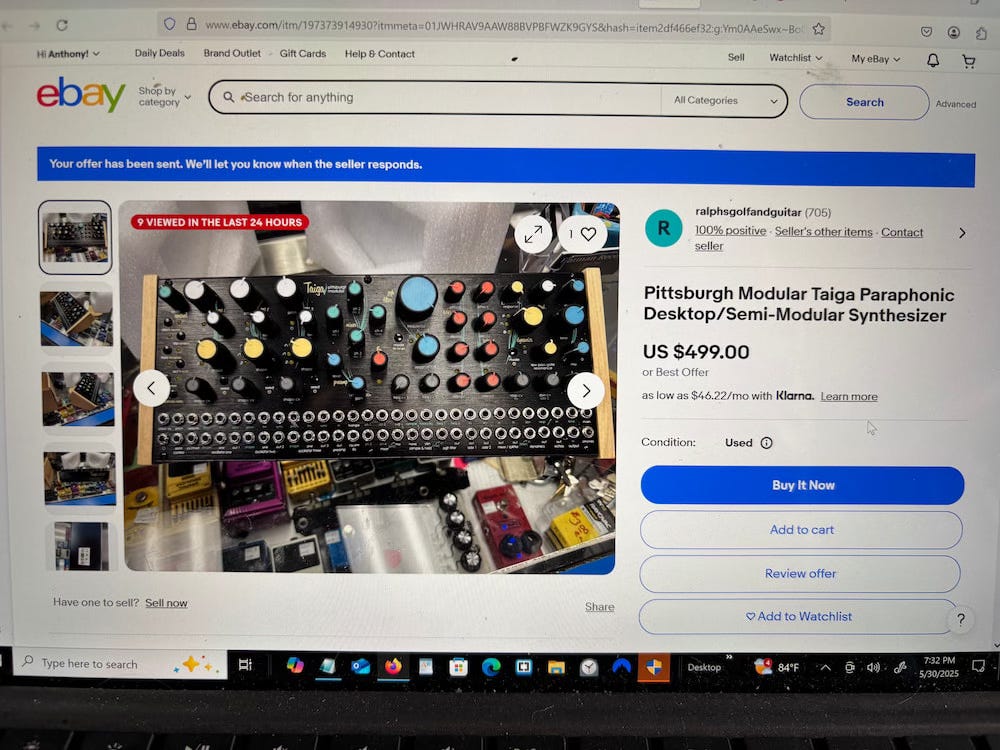
I came across this on eBay before it rightfully disappeared shortly after. A new Taiga is $799. While some semi-modular synths have touch pads or buttons and sequencers, with the Taiga you’ll need to add a controller in the form of a MIDI or CV keyboard or sequencer.
For this auction, one has to add shipping and sales tax which brings $499 to $580-ish. That’s still $200 less than a new Taiga, but $580 opens you to a range of semi-modular synthesizers. There also seems to be more than a few used Taiga synths available for $650. Again, add shipping and sales tax.
Alas, I own the Taiga Keyboard so this original Taiga minus controller is not necessary. In my unique unicorn situation, Taiga Keyboard was $855 w tax new thanks to a battered Amazon box resulting in a 20% discount coupon. The Black Friday 2024 sale was $999 for a Taiga Keyboard, down from $1299. This is an amazing instrument if you can find it for $999, considering all you get for an additional $200 above the $799 Taiga.
Alto Music listed this for $299 on eBay. (Also Alto Music on Amazon but that sold). Everywhere else is $399.
Analog synths are great for exploring the creation of bass drum, snare, and hi hat sounds before investing in a dedicated drum machine box. Here is a 2015 link demo-ing that by the designers of the Boom Chick.
Here is a pdf from Moog about creating percussive sounds with an analog synth. Read it. Of course this takes a whole synthesizer to create one sound, so it’s not practical to haul around 3 semi-modular synths for a snare, bass drum, and high hat.
You can consider that Boom Chick can be viewed as 5 modules in a box with a built in sequencer and buttons. Put another way, 3 of the circuits were released as Eurorack Modules by Pittsburgh Modular for $199 each. Per Soy SOS on Modwiggler: the Drum 1 & 2 are very much based on the Elephant with additional noise modulation options. Snare and cymbal are based off Polar Bear and Narwhal circuits. The kick drum is a new design.
Granted some of those modules had some CV modulation input jacks, whereas Boom Chick has no CV modulation inputs.
Making sense of why you need an analog drum machine is up to the individual. This is not something to start exploring synthesis with, as the circuits are already set to produce a sound. Keep in mind that accents are an important part of percussion playing. So do research into the product to verify if an analog drum machine has an accent or dynamics feature. A workaround is to use a hi hat to cut through lower frequencies and add emphasis on a downbeat.
Again, Boom Chick has 5 voices. In contrast, Arturia DrumBrute at $299 may make more sense if you are seeking more analog percussion.
Cre8Audio Boom Chick Pure Analog Drum Machine | eBay
DaVinci Resolve released version 20.0 at the end of May, moving it off Beta. A PC will only allow for one Revolve installation. A Mac allows for multiple Resolve installations so long as you rename the “DaVinci Resolve” folder to “DaVinci Resolve 19” or whatever. You’ll have to launch the version you want to work with from the Applications folder, as I haven’t sorted how to rename icons on the dock.
I didn’t overwrite or remove DaVinci Resolve 19.1.3, which allows me to verify if a bug in 20 is indeed a bug. So far, in the Color Page, Resolve 20 does not allow the Scopes section to pop up into its own window. Rather, it overtakes the screen as though I had a second monitor. Given how important this floating Scopes window is for guiding color corrections, I’ll keep working with DaVinci Resolve 19.1.3. (I did more research. This is a Mac problem going back at least 3 years. You need to launch Resolve, open the project, press green button to take Resolve from full screen mode, press Reset Layout from Windows menu in Resolve, Quit Resolve, then relaunch Resolve and then expand the Scopes. They should now be in a small window. Strange that this was not a problem in Resolve 19.)
The other thing is Resolve 20 created or updated projects will appear in Resolve 19’s Project Manager launch window, though these projects can’t be opened in Resolve 19. Bear in mind that Resolve and Resolve Studio projects can be shared freely on the same version number. Finally, the AI features are greyed out in Resolve 20 free. I have yet to install Resolve Studio 20 to explore the many updates, though I don’t have a strong need for AI tools yet.
I went on a deep dive into used and new analog synthesizer gear, starting with Analog Delay Eurorack Modules. The end result was I did not buy anything. I listened to new and decades old YouTube video play throughs and read through manuals and comments and arrived at the realization that I didn’t much care for the core sounds, and more often than not, something newer, better, smaller was released to replace the module. Or features were absorbed into later semi-modular instruments.
If you live in an area that has a modular synth store then it’s great to support local businesses and explore the Eurorack modules and instruments before purchase. But for everyone else, you’re buying on faith. As always, read the return policies and bear in mind you’ll probably have to eat “free” shipping and return shipping costs and possibly pay a restocking fee for returns made within 14 days of purchase. The alternative is resale, which is okay if you can mark up to offset any seller fees.
It’s through this rabbit hole that it was revealed that Pittsburgh Modular may be releasing a digital wavetable oscillator Eurorack module this Summer that is 16HP, small enough to fit in the Taiga Keyboard 24HP rack. An imaginary cost for this imaginary module is $399. (Local Parks oscillator module is still available for $339).
Since this is maybe someday item, you may want to explore digital wavetable synths to see if you like the sound of them. iOS apps and software synths are a good starting point for Digital Wavetable synthesis for less money. But to be fair, depending on the analog semi-modular synth, you could feed a digital oscillator’s audio into the semi-modular synth’s filter audio input and listen to the result of a digital oscillator going into an analog filter. That’s the basis of the cloned Behringer Wave synthesizer or Behringer Grind synth which uses Brains module digital oscillators feeding into an analog filter and VCA.
On paper the advantage of Digital Oscillators is no warm up time for tuning and more wave shapes. In practice, analog oscillators may sound less harsh than digital oscillators, have more variance so it’s not a constant grating tone at a set frequency or range of frequencies. If you’re somehow less interested in analog oscillators then look and listen to analog wave folding oscillators with modulation inputs or controls.
Next newsletter will release on the 15th and continue on the topic of Sound Design with a focus on 1970s. Cheers!
All Contents Copyright Anthony Torres 2025. All rights reserved.
Comments
Nothing yet. Say the first thing.
Sign in to join the conversation.