

For more than 30 years, I’ve been sharing and teaching principles that I didn’t realize came from this book. If you only read one book, make it The 7 Habits of Highly Effective People by Stephen Covey.
This book fundamentally changed my life.
I’ve read hundreds of books and always feel like the book was worthwhile if I get at least one good nugget from it. If other books are a gold nugget. The 7 Habits of Highly Effective People is a gold mine — packed full of more nuggets than I could share in a single article.
I first read it in my 20s when I started chasing money. I grabbed the book because it was a self-help bestseller at the time. It helped me find some money. It also reshaped my priorities. And the rest of my life.
Covey studied American success literature that had been published since 1776. The first 150 years focused on character — integrity, humility, courage, honesty, and the Golden Rule. But after World War I, something changed. Self-help gurus made success a function of personality. Public image. Attitudes and behaviors. Social skills and quick-fix techniques to change how you appear — rather than who you are.
Using personality tactics without strong character isn’t just ineffective. It’s manipulative. There’s no foundation for long-term trust. No foundation for anything that lasts.
Covey called this The Law of The Farm. You reap what you sow. If you don’t plant in the spring, there’s nothing to harvest in the fall. No shortcuts.
I know this better than I’d like to admit. My undergraduate strategy was simple: have fun and cram for tests the night before. I passed most of them. But I don't remember much of anything from those classes.
Human relationships follow the same natural law. There are no shortcuts. Positive relationships are built on trust. Which takes time to earn but only a moment to lose. You can’t talk yourself out of what you behaved yourself into.
Character is grounded in principles — not practices, not tactics, not behaviors. Principles are fundamental truths that apply everywhere. Integrity. Humility. Fairness. Empathy. They don’t change based on circumstances. They don’t bend to convenience. They guide you whether anyone is watching or not.
Focusing on core principles is far more effective than trying to change an attitude or a behavior. Principles are the foundation for your attitudes and behaviors.
Covey talks quite a bit about paradigms — how we see the world. Not how it actually is. How we believe it is. And how we believe it should be, based on our values.
We think we’re objective. We’re not.
The most subjective person is the one who believes they are objective.
Our views are shaped by everything around us — family, friends, school, work, cultural norms. If you grew up in an affluent Southern white Christian family, your view of the world is very different than a person of color who grew up poor in a Muslim country. Neither view is right or wrong. Just different. Both are paradigms.
Most of us never question the paradigms we were born into. Christians tend to raise Christians. Republicans raise Republicans. To truly think for yourself, you first need to become aware of the paradigms you’ve blindly accepted as truth. Only then can you decide if they still work for you.
I didn’t start questioning my paradigms until I was 36. That’s when I became an adult. I questioned everything. I decided for myself how I really see the world. And how I believe it should be. For the first time, I took responsibility for my values, decisions, and actions.
We filter everything through our paradigms. Correct or not. If you’re feeling uncomfortably comfortable, here are three paradigm shifts you might consider:
“I’m not ready yet.” → We’re never ready. You get ready by starting: Action → Confidence → Ready. Most people get it backwards. Strivers act their way into confidence.
“That’s just who I am.” → No. That’s only who you have chosen to be. You can choose differently. Learn more about Fixed Mindset.
“I’ll do it when things settle down.” → Things don’t settle down. We settle in. That’s when comfort gets uncomfortable.
We begin life totally dependent on others. Being dependent is all about “you” — you take care of me. You determine my opinion of myself. If something goes wrong, you are responsible.
Most people grow out of this. Eventually.
Ideally, we become independent — physically, mentally, emotionally, and financially. The independent paradigm is based on “I”. I can do it. I am responsible.
Emotionally dependent people get their sense of self-worth from other people’s opinions. Toward the end of my first marriage, my ex-wife would often try to tear me down with her negative opinions. Fortunately, I had already internalized this lesson from the 7 Habits. I always thought — and sometimes responded — “I’m glad I don’t depend on your opinion…”
Independence is the first goal on the continuum. Dependent people don’t have anything to offer yet. They haven’t developed the character required to be interdependent. But independent people who stop there don’t make good team players, much less effective leaders. They may be exceptional individual contributors. But they will be stuck there until they decide to grow.
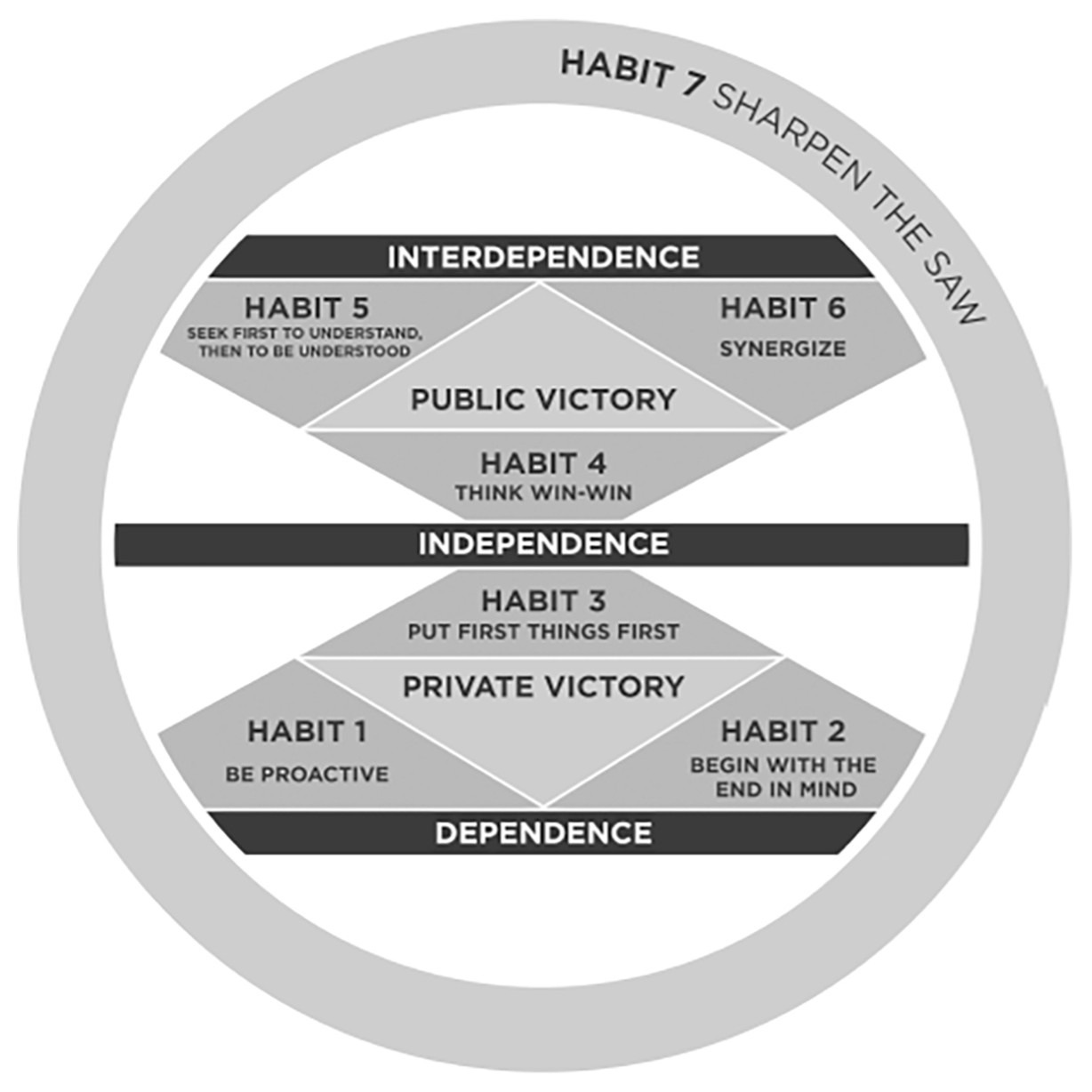
Interdependence — the paradigm of “we” — is where things get interesting. Together, we can collaborate to create something neither of us could do alone. It’s a basic law of nature. Can you make a baby by yourself? The same principles applied to tribes. They still apply to families, teams, and entire organizations.
While dating my current wife, we agreed that a strong marriage is one where we want to be with each other — not need each other. She doesn’t “complete” me. I am a whole person on my own. More than 20 years later, I still want to be with her. We’ve built a loving, interdependent life together while still allowing each other the freedom to be ourselves.
Here's where character comes back in. This isn’t just a framework for relationships. It’s a character map. Dependent people are waiting for someone else to build their character for them. Independent people are building it — but only for themselves. Interdependent people have built enough character to invest it in others.
Personality tactics might get you to independence, but they won’t get you to interdependence. That requires something deeper. Something Covey calls a habit.
Covey defines a habit as the intersection of knowledge, skill, and desire.
Knowledge is the what and the why
Skill is the how
Desire is the want
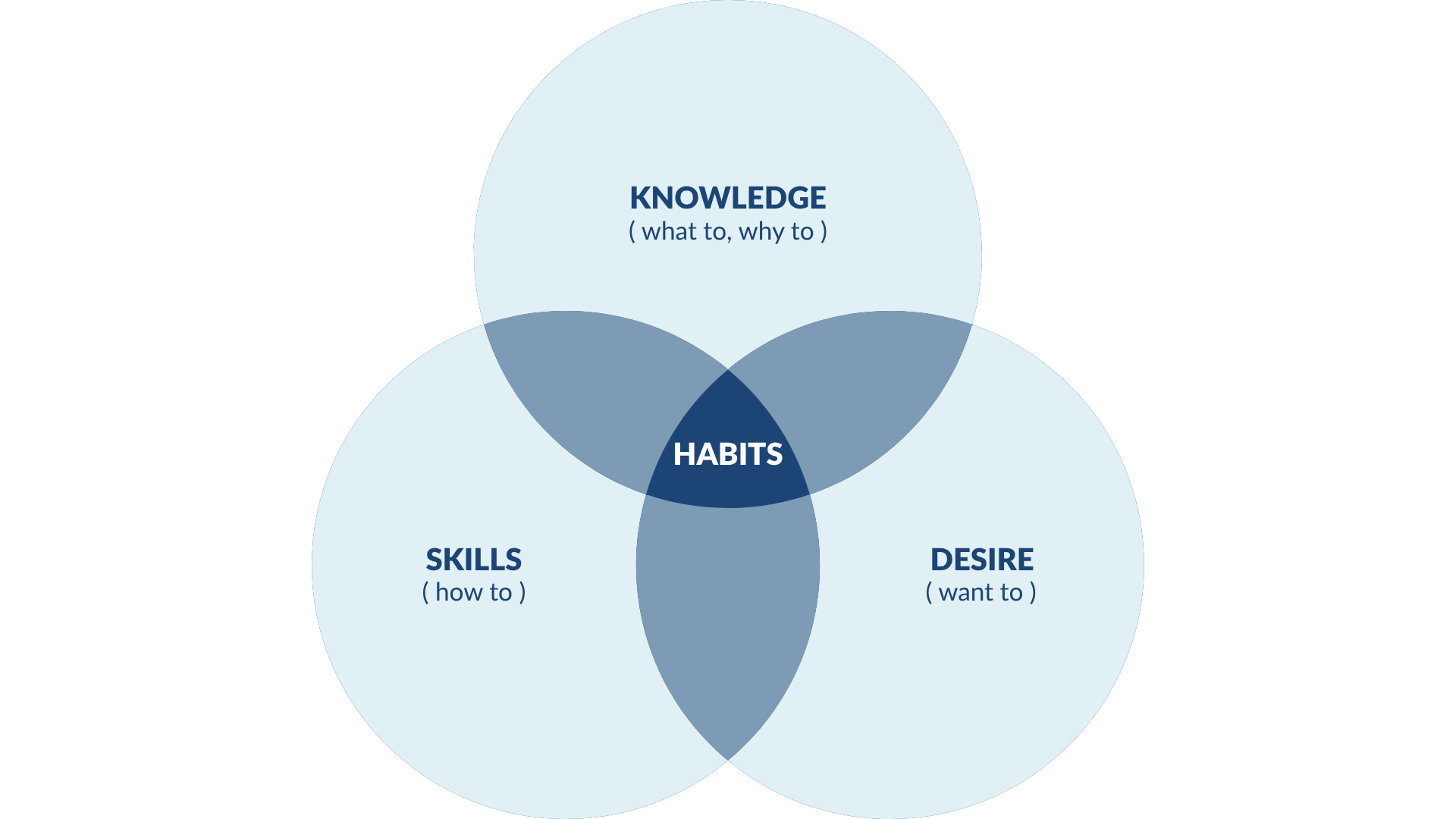
You need all three. Most people are missing at least one.
You may know WHAT to do and WHY it matters — exercise, for example. But none of that matters if you don’t WANT to do it badly enough to actually start. And keep going.
This is where paradigm shifts become essential. Wanting something different requires believing in something different first. You need a bigger, better “Why”. You can’t want your way to interdependence if your paradigm still says dependence is safer. You can’t want your way to striving if your paradigm still says comfort is enough.
Covey describes happiness as the ability to sacrifice what we want now for what we want later. That requires more than willpower. It’s built on clarity about what actually matters to you — your principles, your Why — not your moods.
That clarity is exactly what the 7 Habits are designed to build.
Most people define effectiveness as getting more done. Covey defines it differently.
Effectiveness is the balance between results and your capacity to produce them. Covey calls this the P/PC Balance — Production and Production Capability.
He illustrates it with Aesop’s fable of the goose and the golden egg. Kill the goose to get all the eggs at once and you’ve destroyed the very thing that produces them. Effectiveness isn’t just about the eggs. It’s about taking care of the goose.
Applied to your life: you can grind through a brutal work week and hit every deadline. But if you’re burning out your health, your relationships, and your energy in the process — you’re killing the goose. Short-term production at the expense of long-term capability is not effective. It’s short-sighted. It’s a slow death.
Put another way, it’s the difference between instant and delayed gratification.
The goal isn’t to produce as much as possible right now. The goal is to build the capacity to keep striving — and keep enjoying it — for the long haul.
Covey organizes the habits into two victories: the “Private Victory” and the “Public Victory” — the internal work and how you show up for others. The Private Victory builds integrity. The Public Victory builds relationships.
Habit 7, Sharpen the Saw, is the habit that never ends and most directly connects to enjoying your journey.
You can’t skip the Private Victory. The Public Victory won’t last. But most people try anyway. That’s why most people plateau prematurely.
The 7 Habits: Building Your Foundation (Article 1)
The Private Victory (Article 2)
Habit 1 — Be Proactive. Ownership.
Habit 2 — Begin With the End in Mind. Leadership.
Habit 3 — Put First Things First. Management.
The Public Victory (Article 3)
Habit 4 — Think Win-Win. Collaboration.
Habit 5 — Seek First to Understand, Then to Be Understood. Empathy.
Habit 6 — Synergize.
Habit 7 — Sharpen the Saw. Renewal.
Covey gave me the framework. Living the habits has given me so much joy.
Keep Striving ✈️
Eric
Comments
Nothing yet. Say the first thing.
Sign in to join the conversation.