
Skiing is one of the greatest gifts my parents ever gave me. It’s the only thing I’ve done consistently, every year since I was 8 years old. I thought I was just having fun, but now I know it’s been helping me be happier throughout my life.
Let’s take a look at skiing — or your favorite hobby — through the lens of positive psychology.

Positive emotions are the most obvious way hobbies contribute to happiness—but they’re also the most misunderstood. Skiing isn’t just “fun” for me. It’s the rush of excitement at the top of a challenging run. The awe of standing on a 13,000-foot, snow-covered mountain, taking in views that make everyday worries feel small. It’s the anticipation that builds up for months as we plan the next trip. And it’s the laughter that follows—retelling stories like the one about the photo above.
Those moments add up.
Hobbies don’t just deliver occasional highs; they strengthen our capacity for positive emotion over time. People who regularly make space for activities they enjoy report more frequent positive moods, fewer symptoms of anxiety and depression, and a stronger sense that their life is going well.
Skiing makes me happier — but happiness isn’t just about feeling good.
For those of us with wandering minds, skiing at speed forces you to hyper focus on just the piece of snow in front of you — making minor adjustments and decisions at speeds from 35-51 MPH. — Quote from my friend’s blog
Engagement is what happens when you’re fully focused, challenged just enough, and so absorbed that time seems to disappear. Many people call it “being in the zone.” Positive psychology calls it flow.
Skiing is practically engineered for flow. It demands complete attention. You’re reading the terrain, adjusting your weight, picking a line, and making dozens of micro-decisions every second.
What makes it work is the balance. Each run is just hard enough to require focus. Too easy and you’re bored. Too hard and you overthink every turn as panic sets in. Skiing isn’t unique in this way. Musicians, gamers, athletes, and gardeners all experience flow when their hobbies challenge them just enough.
I get out of my head completely when I’m skiing in flow. I’m not thinking — I’m feeling. The rhythm of shifting weight from edge to edge. Responding to what’s in front of me. Knees bent. Body loose. Unexpected mogul field? Bring it on.
I happen to love moguls. They’re a great metaphor for life. You don’t always see the bumps coming, but if you stay flexible and keep moving forward, you’re almost always better off on the other side.
Enjoying a hobby that fully engages you isn’t wasting time. You’re training your mind to enter a state that makes life feel more vivid, meaningful, and worth living. And the more you practice it, the easier it becomes.
When I took the photo above, I had just met that friend the day before — along with most of my ski buddies. A lifelong friend invited me to join them on a big trip to Jackson Hole. He ended up missing the trip, but I went anyway.
I spent a week skiing with four guys from Philly who I had never met before. So many things could have gone wrong. But they didn’t. Everything went right.
👉 If fear is holding you back, just say Yes.
Without skiing, I would’ve never met these guys. Most of them are now some of my best friends. We look for reasons to meetup throughout the year. Since then, we’ve not only skied together every year, but we’ve also traveled for golf, camping, whitewater rafting, and more.
Hobbies can widen your social circle, putting in the path of “your people”. People who share your identity, similar experiences, or common interests like skiing, gaming, and running. It’s easier to start conversations with people you just met who share your interests. Hobbies build bridges.
At first glance, skiing doesn’t seem especially meaningful. I’m not saving lives or curing diseases. We’re just sliding down a mountain, right? That’s what I thought until I went deeper.
Purpose and meaning are deeply connected, but different. At work, our purpose is to solve problems for others. Throughout our lives — including hobbies — purpose is the reason you show up again and again.
Purpose is the direction. Meaning is why it matters.
Meaning is about connecting your purpose with something larger than yourself. Usually — but not always — the more people you serve, the more meaning-filled is your purpose.
Meaning can also come from being in the presence of something awe inspiring. My friends and I often pause to take in the awe-some beauty of the mountains. (Look at that first photo again.) They were there long before we showed up. And they will be there long after we’re gone. From this perspective, it’s clear that we play a very small role in a much bigger story. Our problems are temporary and relatively small in the overall scheme of things.
Meaning can also flow through connections. Skiing connects me to:
My community of friends, who share my love for the sport and our time together
My childhood, where I have so many good memories with…
My parents, who gave me this amazing gift
My children, with whom I was able to share the same gift
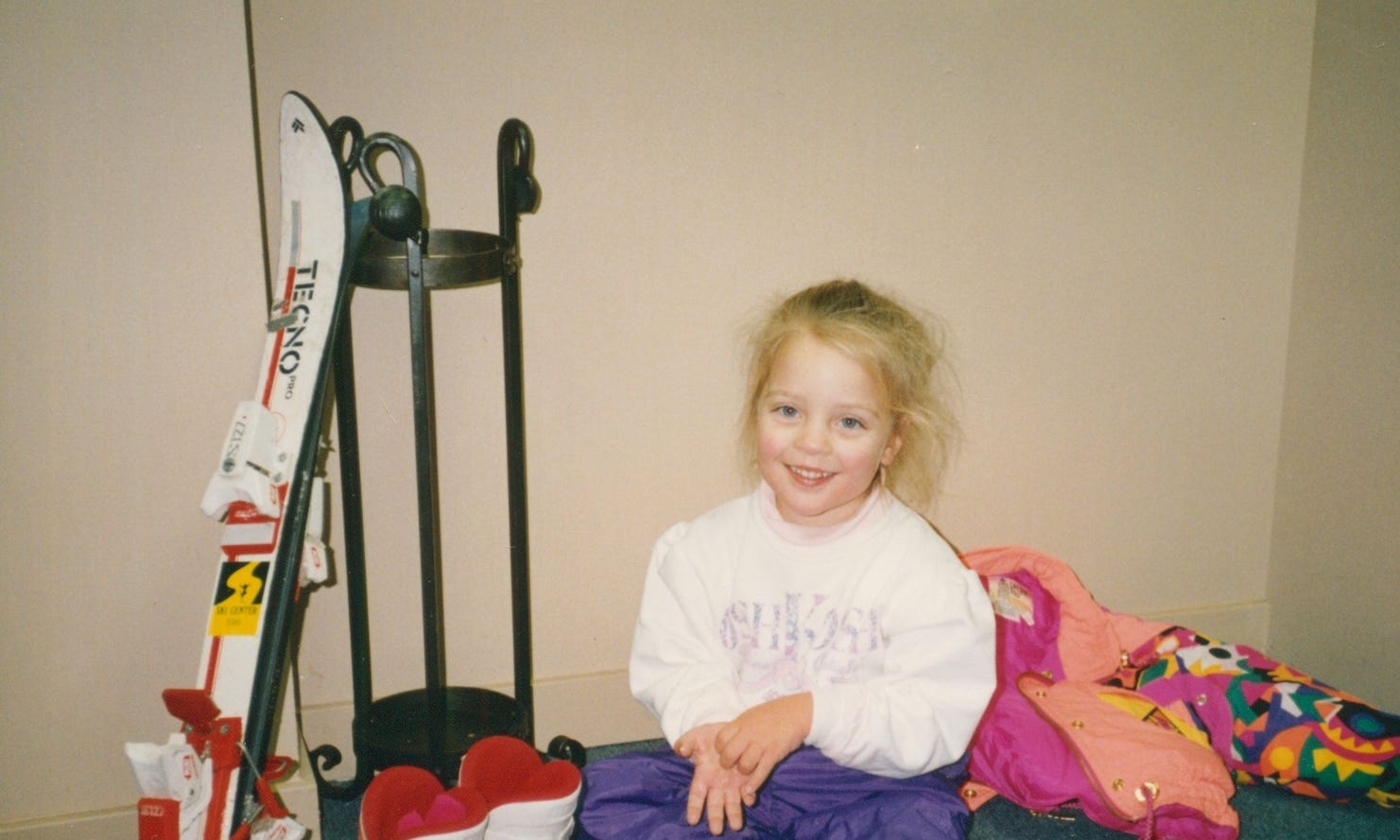
I had been skiing for 2 years when I decided it was time to finally, really learn how to ski. Enough was enough. I was tired of the “pizza wedge” on the bunny slopes. I went out by myself one day — on the more advanced blue trails — determined to figure out how to bring my skis together, parallel. I probably fell 100 times that day. But by the end of the day, I knew how to ski.
Achieving in our hobbies develops our Growth Mindset and self-efficacy. I learned first-hand that day that I can, in fact, develop my abilities if I put in the effort. Hobbies are the perfect training ground to struggle, fail, and try again without fear of judgment. You’re rewarded for persistence, not perfection. That’s rare in adult life, where work and society often emphasize outcomes over effort.
Achievement isn’t about winning. It’s about getting better. Beating YOUR best — not someone else’s. The only comparison that matters is against your past self. New PRs (Personal Records) in the gym are exactly that — personal.
Hobbies — and careers you love — are intrinsically motivating. You strive to do your best in them because they are inherently meaningful to you. You would do them even if you didn’t get paid.
Importantly, the self-efficacy I developed through hobbies and sports has served me well as an entrepreneur. I don’t know how you start a new business without it.
So, there you have it. That’s how hobbies help us be happier as seen through the PERMA wellbeing framework:
(P)ositive Emotions
(E)ngagement
Positive (R)elationships
(M)eaning
(A)chievement
If you’re curious, checkout my friend’s blog about the trip that inspired this article.
Comments
Nothing yet. Say the first thing.
Sign in to join the conversation.