

I took my daughter to preschool for the first time when she was three and a half. She melted down as we approached the classroom, sobbing as the teacher pried her out of my arms, reaching for me over the teacher’s shoulder.
Naturally, I went out to my car and cried my head off.
We agreed I’d come back in a few hours to check on her.
She was still crying. Not like sniffling or whining at a lower volume. I mean absolutely out of her mind. (The stamina was something else.)
We had just moved, things were a bit chaotic at home, she just wasn’t ready. And I hadn’t done anything to help her feel ready.
So when it was time to try again the following spring, I was afraid of a repeat. I thought a lot about how best to support her, and in addition to conversations about what to expect each day, and making sure she knew it was ok to feel scared and excited at the same time, I came up with something we called Strings.
Every morning outside the school, we’d pretend to pull a piece of string from our hearts and tie them together. Then we’d sing a little song about how no matter how far apart we were, we’d stay connected by that invisible string. It took less than a minute. We did it every day before I walked her inside.
It was exactly what her little brain needed to understand something abstract: that we could be apart and still connected.
Young children, especially sensitive ones like my daughter, need reassurance before they can part from us. Full presence and connection matter every day (you’ve heard me talk about this many times) but connection that becomes a touchstone—something repeated, something that happens like clockwork—matters most during anxious stretches like this one.
An activity like Strings that you do once is sweet.

Back-to-school season can throw a lot of anxiety in the air. And not all of it is your child’s.
For us grownups, all kinds of things come into play:
Maybe it’s embarrassment that your child is the one screaming while everyone else’s child skips happily into the classroom…
Sadness that the freedom of summer’s over…
Relief that you’re going to have some time to yourself…
Or grief about your child being another year older…
And maybe it’s all of the above, at the same time.
Your child can feel it. Kids are emotional sponges—they absorb our energy, whether it’s calm or chaos, and reflect it right back at us.
This is actually good news, because it means you have more control than it feels like in the moment.
You can’t directly manage your child’s nervous system, but you can manage yours, and that’s often the fastest way to change the whole dynamic.
So this post has two tools—one for your child, one for you.
I did this with my youngest at bedtime for years, and it was magical.
Your child can put all their worries into a pretend box, so they don’t have to carry anxiety in their minds. It’s not about fixing anything, it’s about lightening their mental load.
And it’s not just for bedtime, either; it works beautifully in the car before drop-off, or at breakfast on a hard morning when the new-school nerves are creeping in.
Imagine you have a little box in your hand.
It will hold all your worries.
Do you have a worry?
Say it out loud.
Then put it into the box.
Do you have another worry?
Say it out loud.
Then put it into the box.
Say all your worries out loud.
They can be big worries, or they can be small worries.
Put them all into the box.
Now put the top on tight!
Put the box somewhere safe, or let me hold it for you.
You don’t have to think about those worries now.
You can also have your child tuck the “box” in their pocket, and any time a worry pops up during the day, they can just put it in and close it back up tight. It’ll stay safe there until they get home, when you can help them with it.

Whatever the mix of feelings is for you, there’s a reason it feels overwhelming: your mind is doing a whole bunch of things at once—grieving something, worrying about something else, replaying the goodbye, already thinking ahead to your day.
None of that is actually happening right now, in this moment, in this spot. Bringing yourself back to the here and now gives your nervous system something to hold onto.
Naming what’s actually around you (what you see, feel, hear), gives your body current, harmless information to process, and that signals to your brain that you’re safe right now. This lets your heart rate and breathing start to settle.
It doesn’t change the situation, but it helps you feel steadier and calmer in it.
Use the 3-2-1 method.
First, look around you and name three things you can see. It can be anything in your immediate environment, from a glass on the table to a tree outside the window.
Take a moment to observe each thing.
Next, focus on two things you can physically feel. It could be the softness of your sweatshirt, the warmth of your mug, or the coolness of the counter.
Pause and really feel each one.
Finally, listen carefully and identify one specific sound you can hear. It could be the refrigerator humming, distant traffic noise, or even your own breathing.
Take a few long breaths in and out.
And this might feel weird, but try saying to yourself (out loud or in your head):
“I am here, it is now.”
The sobbing at dropoff, the crying in the car, none of it is forever. And neither is this particular hard season for you.
Remember, you can’t control how your child feels about starting school or make the tears stop on cue. But you can control how steady you are throughout the process. Get that part (mostly) right, and the rest tends to sort itself out.
Kira 💕
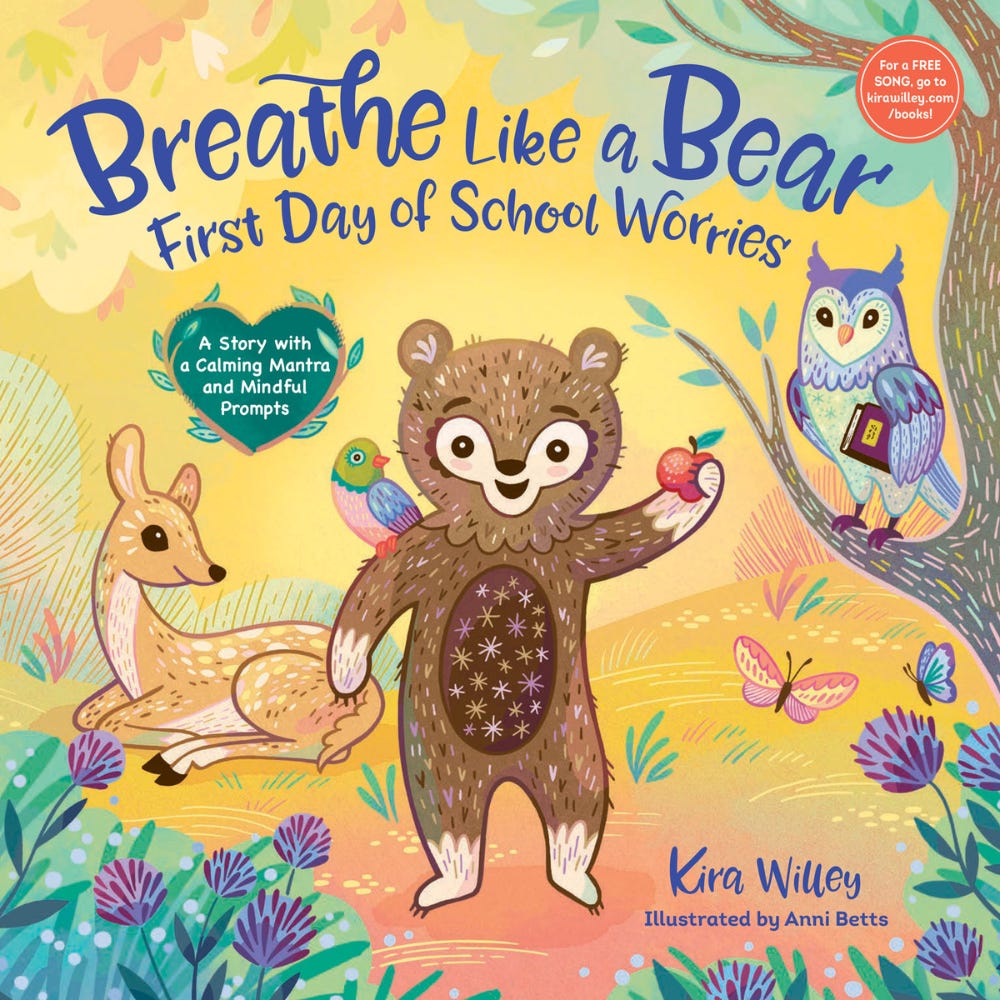
PS - If any of this hit home, my book Breathe Like a Bear: Back to School Worries was written for exactly this kind of new-school anxiety. Grab your copy here.
You might also love The Joyful Child, my new parenting book—it’s packed with activities like “The Worry Box” and “I Am Here, It Is Now,” and it will help you and your child build the steady, joyful relationship they need to thrive.

Comments
Nothing yet. Say the first thing.
Sign in to join the conversation.