
I finally read Middlemarch. I say read, but—in truth—I listened to it. Mary Ann Evans/George Eliot’s novel is truly mesmerizing in places. But the audiobook became necessary as one can stomach only so much detail when learning about the politics of choosing a new chaplain for the local hospital. Having my headphones in meant that, willing or not, the story of Dorothea, Lydgate et al carried on a-clip.
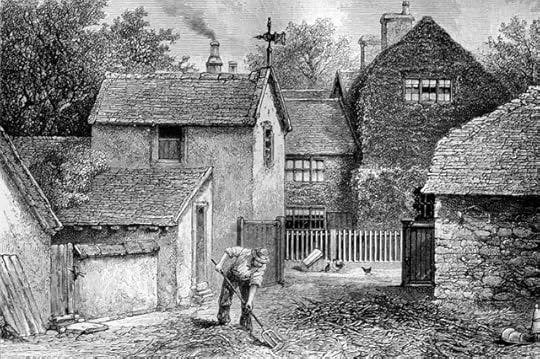
Eliot’s novel illustrates that life in a tightly-knit provincial town in 1830 shapes, constrains, and reveals the moral choices of its inhabitants. Characters are known to one another, even if they have not been formally introduced—and events that happen in Rome or London or even the seaside might as well be hearsay. What is tangibly real is what happens here. Middlemarch is what matters.
Eliot even makes this point herself, addressing the reader in Chapter 15, writing:
I at least have so much to do in unravelling certain human lots, and seeing how they were woven and interwoven, that all the light I can command must be concentrated on this particular web, and not dispersed over that tempting range of relevancies called the universe.
(God, I love her sentences. Do read it. It’s worth it.)
This question of boundedness is one I’ve grappled with for months. It came up again in Margaret Farley’s wonderful book on making, keeping, and breaking personal commitments, which I just finished as part of my research on covenant. In it, Farley describes what she means by ‘the present,’ writing,
“In my day, morning may be past, but it is not just a memory. Evening is still to come, but it is not a remote future. The whole day is my ‘present,’ and it reveals human time as a ‘field of presence.’ Morning and evening, my immediate past and immediate future, are my two horizons. Though I cannot touch them, they are both still present to me.”
Farley, a Sister of Mercy and a retired professor of Christian ethics, is drawing on the philosopher Maurice Merleau-Ponty, who looked at time as units of “primary experience.”
What I love is that these two horizons feel true in my own life. When meditation teachers talk about “this breath” or “the present moment,” I find myself desperately trying to keep up as thoughts and breaths fly by like cars on a highway. But Farley’s embrace of the present, stretching from morning to evening, makes it feel graspable; livable.
Like Eliot, this is a light I can command as I look at the complex web of life.
But these days, we live with phones and devices that both shrink time and expand space. Everything is now. Everywhere is here.
In this boundary-less world, to whom do I owe my loyalty? Where is the place that can count on my commitment? Perhaps philosopher Agnes E. Meyer was right when she argued:
It is impossible to create a stable society if something like a third of our people are constantly moving about. We cannot grow fine human beings, any more than we can grow fine trees, if they are constantly torn up by the roots and transplanted.
And though it may not be that simple—think of the people forced to wander, the refugee, or even the immigrant by choice (of whom I am one)—I do incline towards the thought that our lack of boundedness clouds our ethical lens.
Farley again:
My life is not like a roll of cinematographic film that can be stopped at any point and understood in still pictures, isolated frames. The meaning of the past is modified with each new present, and the meaning of the present can finally be understood only in the future.
We need constancy of time and place in order for our choices and commitments to bear fruit. That’s why this map of New York City neighborhoods pleases me; as does the idea of having chosen a neighborhood in the city and hoping to be here for the long haul. Indeed, the traditions of beating the bounds and keeping the canonical hours intrigue me—though they are two things that are far away from the life I live…
For all the lengthy details of Eliot’s prose, her characters knew who they were because they knew whose they were. They belonged to Middlemarch. They belonged to each other.
And when they died, as we are still wont to do, did the horizons of the day and the boundaries of the town better prepare them to meet their end? Eliot, characteristically, says it better than anyone:
“Here was a man who now for the first time found himself looking into the eyes of death—who was passing through one of those rare moments of experience when we feel the truth of a commonplace, which is as different from what we call knowing it, as the vision of waters upon the earth is different from the delirious vision of the water which cannot be had to cool the burning tongue. When the commonplace "We must all die" transforms itself suddenly into the acute consciousness "I must die—and soon," then death grapples us, and his fingers are cruel; afterwards, he may come to fold us in his arms as our mother did, and our last moment of dim earthly discerning may be like the first.”
No posts
Comments
Nothing yet. Say the first thing.
Sign in to join the conversation.