
You’re familiar with the dreaded question at a party or on a plane: “So, what do you do?”
If you’re a doctor or a priest, reactions might range from an unwanted trauma dump to a request for a diagnosis. But despite being neither of these, I still struggle to answer the Tell Me About Your Job question.
“I support the emerging field of spiritual innovation” doesn’t exactly roll off the tongue—and proclaiming “I’m a writer!” isn’t quite right, either. Maybe you, too, end up saying something bland like, “I work for a small non-profit” just to move away from talking shop.
But I may have found a key to unlock the problem in Mary E. Hunt’s wonderful book, Fierce Tenderness: A Feminist Theology of Friendship.
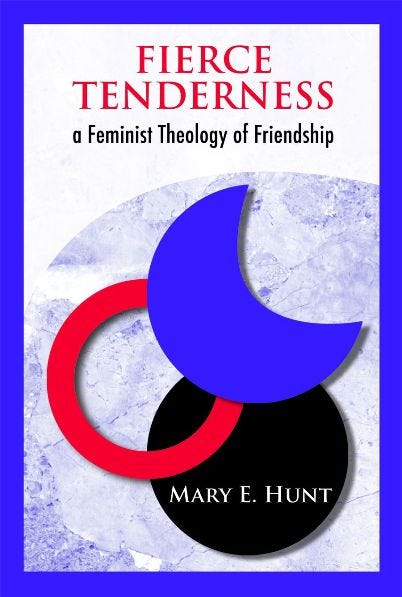
Hunt is a feminist Catholic theologian. So, she sits both within a long tradition of robust thinking about the nature of God—and challenges core ecclesial commitments still held by the Church of Rome. In her book, Hunt writes powerfully about friendship—especially female friendship. But what struck me this week is her definition of what it means to be a theologian:
“The task of a theologian is to look critically at the data of human experience in light of a faith tradition and to make claims that invite the whole community to new insights.”
I just love that. A theologian is someone who reflects on what is happening to them and their community—puts it into conversation with the stories and rituals and traditions of a spiritual lineage—and then makes claims about how we should live together.
This isn’t to say that only some trained and robed experts can do the theologizing—no. “Everyone can do theology insofar as we seek to ask and answer questions of ultimate meaning and value,” she explains. Nor is it something best done alone. “Theology is intended to be an interactive art, a participatory science, indeed a communal undertaking,” she writes.
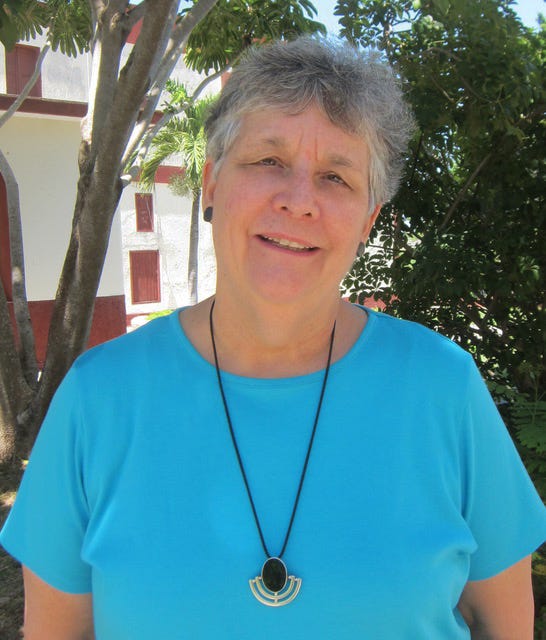
That’s why friendship is so central to Hunt’s academic inquiry. It isn’t in a solitary study that we find clarity on the divine-human interaction—but, rather, in our conversations together that we do our best theological work; what the columnist Anna Quindlen calls “digging for buried treasure” over lunch with her girlfriends.
So, if I’m bold, I am going to claim the role of a theologian.
And you can, too!
When we try and make meaning of a betrayal at work, not having enough money, experiencing a miscarriage, winning at life but still feeling empty—and we do it in the way Hunt asks us to (together, in the light of a tradition)—we are doing theology.
And the good news is that this job isn’t likely to be replaced by artificial intelligence or will ever be complete. Hunt writes,
“It is important to note that at best [theology] is a temporary solution to an unsolvable problem, not a final solution. After all, no language, however nuanced and metaphoric, is sufficient to name that which defies naming. That is the point. Theologizing just keeps going.”
So, next time I’m introducing myself, I still might not answer with “I’m a theologian.” But I’m gonna be thinking it.
No posts
Comments
Nothing yet. Say the first thing.
Sign in to join the conversation.