
“You’re telling me to scan a QR code at a memorial?!”
I didn’t say it out loud, but I sure was thinking it. I’d traveled to Cincinnati to attend a memorial for the great Biblical scholar Walter Brueggemann—a theological hero of mine. I was lucky to have been invited to speak on a panel, but before the conversation began, we were told to partner up with a stranger and to scan the code on our printed program.
The QR code took me to a web page with an audio track. I plugged in my headphones and pressed play. My buddy and I were instructed to head out of the church, and start walking down the road together. I had no idea what was in store, but the next 90 minutes proved to be one of the most meaningful, memorable, and innovative rituals I’ve had the pleasure to experience.
This was a Walkabout.
Creator Brad Wise describes a Walkabout as part-narrative, part-ritual, part-reflective practice—all set in motion. It’s a guided walk that you take with someone which offers prompts for noticing and sharing.
Drawing on the practices of pilgrimage, labyrinth, and walking meditation, Brad describes it as “a bit like WD-40 for your soul.” Which is exactly what it did for me.
The first thing the audio instructed me to do was to ground myself in the five senses: five things to see, four things to hear, three things to touch, two things to smell, and one thing to taste. Then, it invited me to find an object that represented the grief I felt at Brueggemann’s passing. I picked up a jagged-edged dead leaf.
I’d been resistant to feeling much—it had been a busy few days and I’m a classic Enneagram 3—but as we walked, and I slowed down, I felt myself melting into the experience. I was caught off-guard at how tender it felt to hear Brueggemann’s voice. How good it was to be outside. How nice to be near someone else who cared about him without having to interact with them (yet.)
Then, as we reached the top of the hill, Brad’s voice told us to look out for a small fountain. There, we were to stop and share what the object we’d found might symbolize in our life. So simple, and yet so rich.
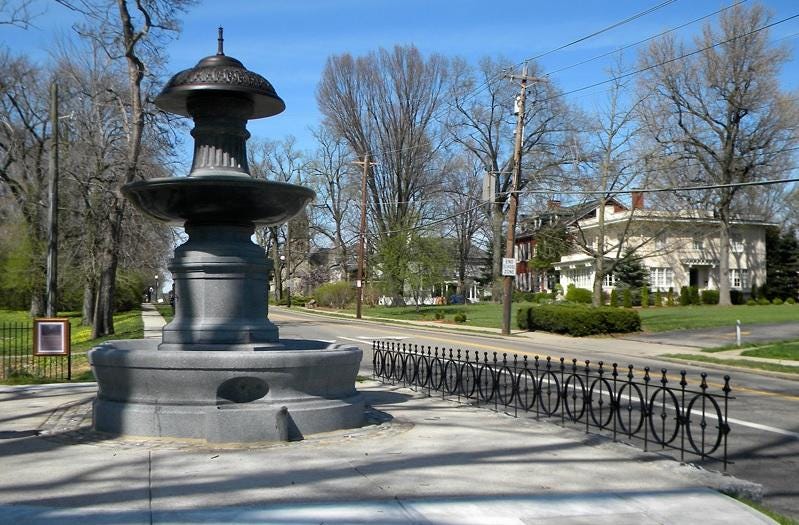
To my surprise, I found myself expressing pain and sadness I didn’t even realize I’d felt. The leaf felt like the political moment we were in: brittle and dead. I started to talk about how hopeless I felt about it all. Suddenly, the leaf and the walking and the wisdom of this hero of mine all intertwined and I found myself overcome and teary-eyed.
This didn’t surprise Brad at all when I told him about it afterward. “Walkabouts help shake the rust,” he explained. “I think remembering and becoming requires movement—and just enough guidance to feel like you’re being led into something special.”
The Walkabout continued. More clips of Brueggemann’s voice and more invitations to notice our inner landscape and the surrounding environment. It felt so intimate to have this very road and that exact tree described in the audio—and it made me want to create other memorials like this. Why sit in an uncomfortable pew when we could walk together, deep in reflection and honor?
I had come to Cincinnati wanting to honor a man I’d never met personally, but whom I’ve spent countless hours reading and listening to. And much more than anything I shared on the panel, I think he would have been most happy that this ritual returned us to our humanity—connecting and reflecting, talking and walking—together.
You can listen to the Walkabout described above here, but my invitation to you, dear readers, is to try a different one. The Walkabout below is designed for your next art museum visit. It’s a 30-minute, fabulously simple yet engrossing invitation to notice art that catches your eye and guides you around the gallery or museum. I did it at the Met in NYC and loved it.
No posts
Comments
Nothing yet. Say the first thing.
Sign in to join the conversation.