
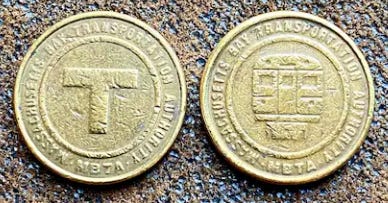
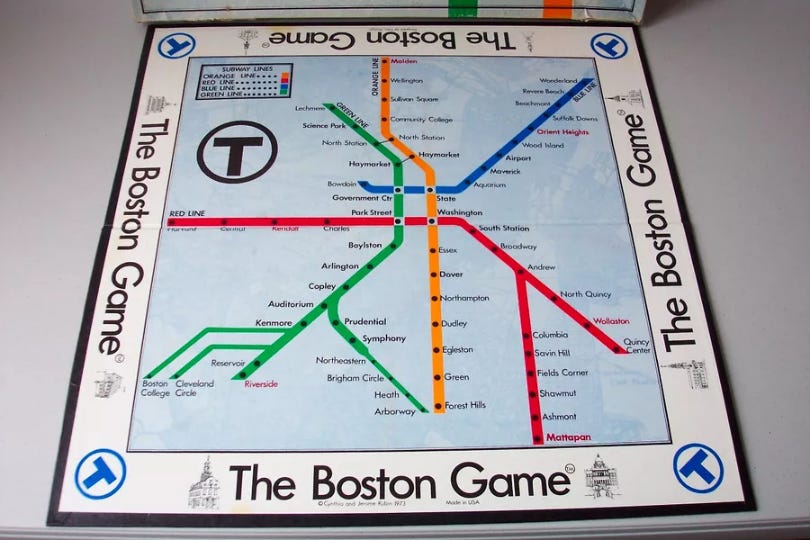
There was a time when the T was the most convenient way to travel around Boston, a simple and affordable public transportation system that used inexpensive tokens in order to ride the train. Anyone with experience watching Sesame Street could easily go anywhere in Boston using the color-coded maps posted visibly throughout the city. I was deliberately taught all of Boston’s subway routes by playing The Boston Game when I was a kid, a board game that my mom picked up as a way for me to become familiar with the public transportation map of the city.
When I moved to Boston not long after graduating from high school, I frequently used the T for transportation. As a student living in Brighton barely able to afford a donut at the time, I was still thin enough to conveniently slip through the T’s turnstiles while pretending to use a token. One afternoon at the old Auditorium stop, a T worker noticed me going right through the turnstile and began following me on the busy platform. I tried to duck through the crowd in an effort to lose him, quickly hopping onto a train as it was about to leave feeling a bit like the Artful Dodger. But the train waited at the station, finally reopening its doors to allow more passengers to board. I was pulled from the stairwell of the train, reprimanded by the T worker on the platform, and forced to cough up 60 cents for a token in order to board the next train. The irony was that a few miles out of town closer to Boston College, the B Line was always free to hop on, especially if you were heading outbound.
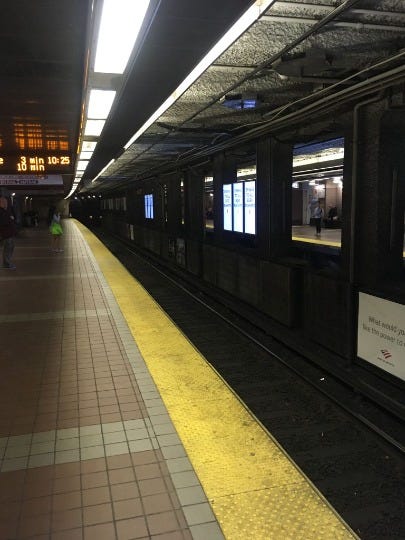
A serious romance brought me out of the city and back to the South Shore in 1990, summer evenings spent 4-wheeling around Saquish and Duxbury Beach in an old Jeep CJ-7. That is, until Maura suddenly rented an apartment just north of Boston in Malden, a location that was a convenient subway ride to her new management job at the Westin Hotel in Boston’s Copley Square. With a bag of clothes, a book, and an old guitar, I took the Red Line from North Quincy to Downtown Crossing, and then the Orange Line all the way to Malden Center. Following her lead, I quickly rented a Boston apartment for $395 a month, a studio overlooking the Green Line that included heat and hot water directly across from Northeastern University on Huntington Ave. The two of us relied almost exclusively on the T for transportation during those days, frequently traveling between Maura’s apartment in Malden and mine in Boston. Although quick and dependable, Boston’s subway system was not without incident. Maura was once robbed after working a graveyard shift early one morning, threatened at knifepoint on the Orange Line platform at Back Bay Station. While the assailant was walking away with her purse, she realized that he only had a butter knife, leading her to courageously confront him to take her pocketbook back risking the potential of being buttered in the process.
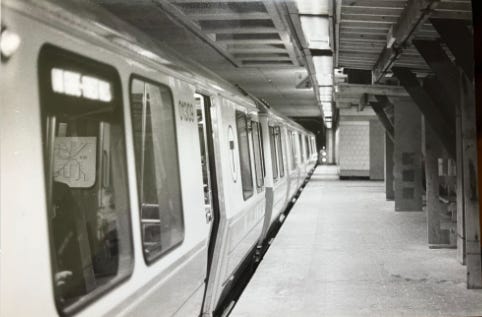
The two of us eventually rented an apartment together in Boston’s North End, an area with direct access to the subway. Working early morning shifts as a bellman at the Boston Marriott Copley Place, I could count on the Orange Line arriving at Haymarket Station at exactly 5:45 a.m. every morning like clockwork. Marriott employees were offered monthly T passes for $25, passes that would usually work for months despite their intended expiration date. The Orange Line was also perfect for getting to school when I was finally able to afford a return to Northeastern University, the Ruggles stop only a few minutes beyond the Marriott. The option of taking the Green Line from Haymarket required extra time for the train to wind its way through Government Center and busy Park Street Station before branching off from Copley Square in the directions of Boston College, Cleveland Circle, Chestnut Hill, or Huntington Ave. Taking the Green Line was necessary, however, when heading in the opposite direction from Haymarket toward Cambridge. I took a memorable trip to Lechmere Station during Christmas 1991 to pick up a piece of furniture from The Bombay Company at the CambridgeSide Galleria Mall as a special gift. With its unassembled contents weighing approximately the same as a Buick, I vividly recall fighting to carry the box back to Lechmere on a very cold night, and then traveling with it aboard the Green Line as the train stopped at Science Park and then the old elevated North Station stop before ducking back down into the underground tunnel at Haymarket.
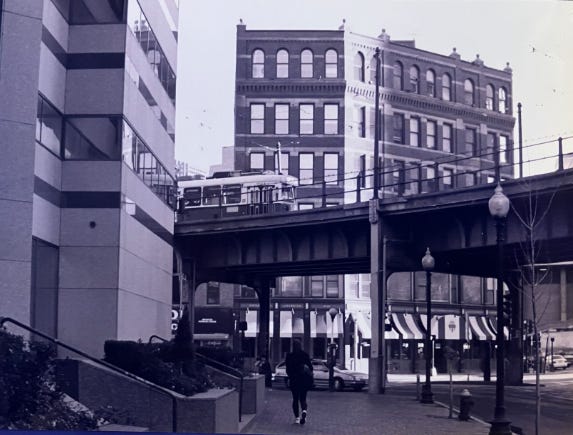
Taking the T back to the South Shore required using the Red Line to get to either Quincy Center or Quincy Adams. Although Braintree was the final stop, it was also the only T station that required passengers to pay in order to leave, something that I thought was a bizarre customer service practice. Later while pursuing a graduate degree at Boston College, I relied heavily on the Green Line catching the train at either Haymarket or Government Center, usually opting for the C Line out to Cleveland Circle but sometimes taking the D Line all the way to Chestnut Hill and walking to campus from there. With many Boston University stops along Commonwealth Ave., not to mention heavy traffic and stoplights, the B line was always the slowest of the three options out to B.C. despite the fact that it was labeled as the Boston College train. I eventually became so familiar with the T while living in the city that I had the boarding process down to a science, knowing exactly where to stand on each platform. When the train arrived the doors would open directly in front of me, allowing me to look up from my book as if I had been incredibly lucky to have picked that spot as opposed to the competitive crowd behind me attempting to push their way onto the train. Being one of the first passengers on a train wasn’t necessarily about finding a potential seat. It also meant immediate access to spare copies of the old Boston Herald that were often floating around Boston’s subway trains. I almost always carried a book to read, especially when taking the long ride out to Boston College. I read much of the John Jakes’ American Bicentennial Series while on the T, the conclusion of each book leading me back to the old Avenue Victor Hugo used bookstore on Newbury Street to search for the next paperback in the series.
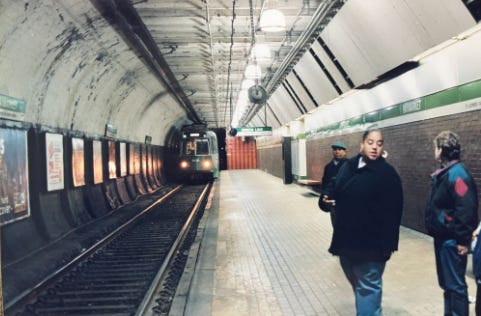
Years later while working late nights as a doorman at the Copley Marriott, I would often take the Orange Line back to the North End close to midnight sometimes riding along with some unsavory characters. One one occasion while heading back with a co-worker who also lived in the North End, a potentially drug-induced passenger sitting directly across from us on an otherwise empty train began pointing his finger in our direction labeling the two of us as either Mr. Brown or Mr. Blue, most likely citing lines from the film, Reservoir Dogs, although it crossed our minds that he could be dangerously delusional. After a couple of stops, we looked at each other and made the executive decision to get off the train several stops early and walk the rest of the way. Both musicians, the two of us would sometimes use the subway platforms to practice, an interesting dynamic that requires only a limited setlist since anyone listening usually leaves on a train within minutes. We typically played tunes like “Just a Song Before I Go” by Crosby, Stills & Nash, “Train Leave Here This Morning” by the Eagles, Neil Young’s “Thrasher”, and the early Paul Simon song, “Red Rubber Ball”. At one subway station we played “Red Rubber Ball” continuously, occasionally changing the color of the ball in an effort to keep things interesting. Attempting to play without a permit meant we were sometimes chased out of a few choice spots by extremely competitive musicians, one whose menacing approach once caused us to pack up our guitars and quickly jump onto an arriving train in an effort to escape.
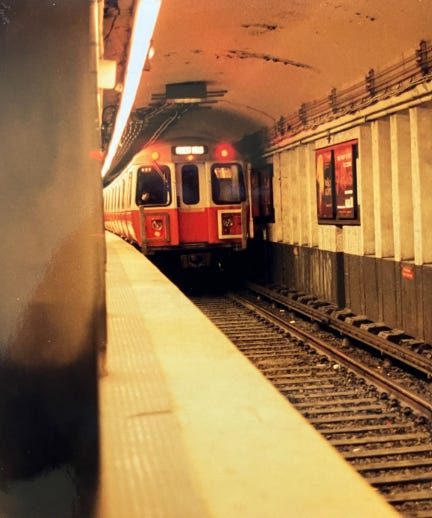
During my last years living in the city, a colleague from the Marriott began working for the T and most often on the Orange Line. While Orange Line operators were already known for the entertaining way that they sometimes announced stops such as, “Community College - Your stop for knowledge”, I would occasionally be surprised to hear my name over the train’s PA as we pulled into a station with announcements like, “Haymarket… Jay - This is your stop! Get-off-the-train.”
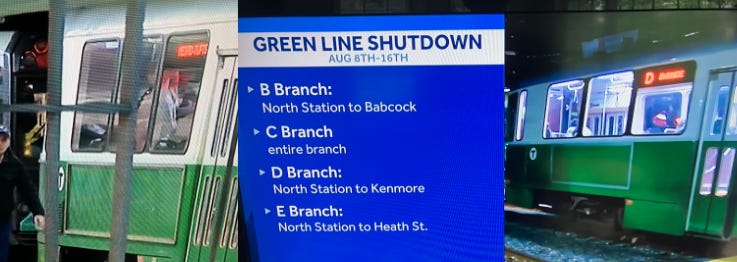
The dependable simplicity that the T was once known for is becoming harder and harder to remember. On top of the snow debacle of 2015 that led to the eventual resignation of MBTA General Manager, Beverly Scott, increasing fares and miscalculated figures for repairs have become somewhat expected even with new T leadership under highly respected CEO Philip Eng. For a full month at the end of the summer in 2022, the entire Orange Line had to be closed down for track repair and signal upgrades. Similar work was conducted on the Red Line this July forcing commuters onto shuttle buses from Alewife Station to Park Street. A reader recently commenting in the Boston Globe attempted to provide encouragement to frustrated Red Line commuters. “I went through this during all the work done on the Orange Line, but the end result was so worth it. MUCH better service now.” Boston’s Green Line currently has no service beginning at North Station that affects all four of its outbound routes with shuttle buses in place while the Symphony stop is closed for renovations until 2029.
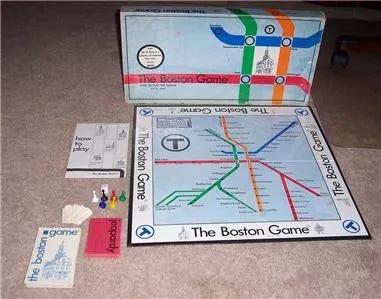
Learning Boston’s subway system 50 years ago by playing a simple board game was indicative of the T’s singular goal at the time: providing cheap and simple transportation - a system that was easy to understand, easy to use, and generally free of complications. Boston’s overexpanded train system now appears to be more expensive and frequently more inconvenient than driving. Although I loved living in the city, I can’t honestly say that I would have been quite as inspired to use the T if, while playing The Boston Game, I was continually drawing cards that forced me to take a shuttle bus.
If you like my articles, please hit the “LIKE” button. It will help to let me know that you are enjoying my writing.
I welcome and invite you to COMMENT.
And please SHARE these posts! This gives added support to my Substack page and also helps to add new readers.
Thanks so much to anyone who is reading Journeys with Jay!
No posts
Comments
Nothing yet. Say the first thing.
Sign in to join the conversation.