
I sometimes drive by the locations of old baseball fields, diamonds that I once played on as a kid.
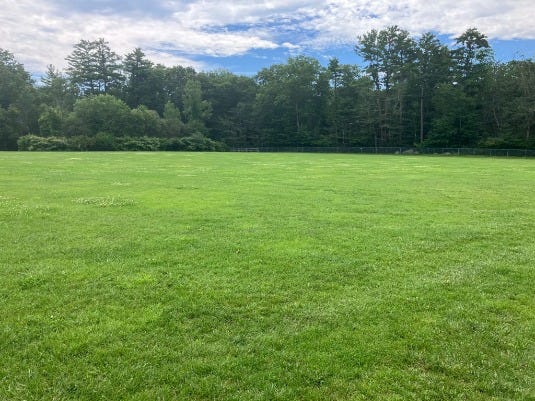
In the nearby town of Norwell, Massachusetts, there was a baseball field that I played on decades ago that was a considerable distance off the road. My friend’s dad would usually drive us to that field in his old Ford Torino, our uniforms on and gloves in hand pounding away during the trip while listening exclusively to sports talk on the car’s AM radio long before that genre was a popular norm. This regulation-size baseball field was a considerable distance behind the school, far enough back that getting to it from the school’s parking lot required a significant walk. Players were required to cross through several parcels of land until finally arriving at the field preparing to play a game that was essentially hidden from public view. Probably for good reason, the umpires always seemed to be the last ones to arrive at this diamond. One particular umpire who often ended up doing our games at this field usually arrived in dramatic fashion behind the wheel of an old faded-blue Cadillac convertible creatively inventing roads as he came racing in through center field along with an enormous cloud of dust. A good-natured older man with potentially limited use of his legs, this umpire would always humorously explain that he saw no reason to have to walk to the field. One afternoon while anxiously waiting for an umpire to arrive at this diamond, somebody suggested to one of our pitchers, Teddy George, that he call the umpires as we all milled about having already finished our warm-up routines. With the realization that we were essentially out in the middle of the woods, Teddy sarcastically attempted to call the umpires using the only method of communication he had, shouting, “Umpires!” in his uncharacteristically baritone voice. Within seconds, the umpire suddenly appeared blasting through center field in his convertible Cadillac.
I made an effort to find that old field in Norwell, but instead came across a redeveloped area behind the town’s old middle school with a new youth-sized baseball diamond, a field that was too close to the road for it to be the one that I remembered. Nearby I noticed a newly constructed raised walking trail built with pressurized wood that disappeared into the forest. I asked a public works employee driving a golf cart nearby if there were other fields further back along the walking trail while describing the field that I remembered from decades ago. The man stared back at me confused. “I don’t know of that field,” he said dismissively. He said that the small field we were at was the only baseball field, and clarified that I would find no other fields out along the walking trails. As I arrived back to the parking lot closer to my truck, that same golf cart swooped around in my direction. The man stopped and began to describe the massive addition that had been added to the town’s old middle school during renovations some years ago. He told me that long ago there was a baseball field quite a distance behind the old middle school, a field that has been gone for decades but could very well be the baseball field that I was describing. He pointed in the direction of a paved path behind the newer part of the school and encouraged me to explore. After walking along the path, I soon looked out toward an expanse that I immediately recognized as the location of the old baseball field where I had once played. Although the actual diamond no longer existed, it was easy to identify where the old backstop had stood with the curve of the trees forming a recognizable corner at the distant end of the field. I walked through the thick grass and stood where home plate once was, turning back in the direction of what would have been the outfield imagining that umpire driving in through center field in his old Cadillac.
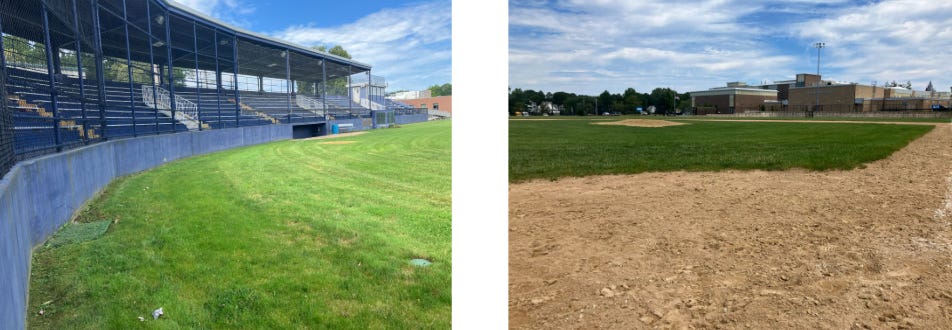
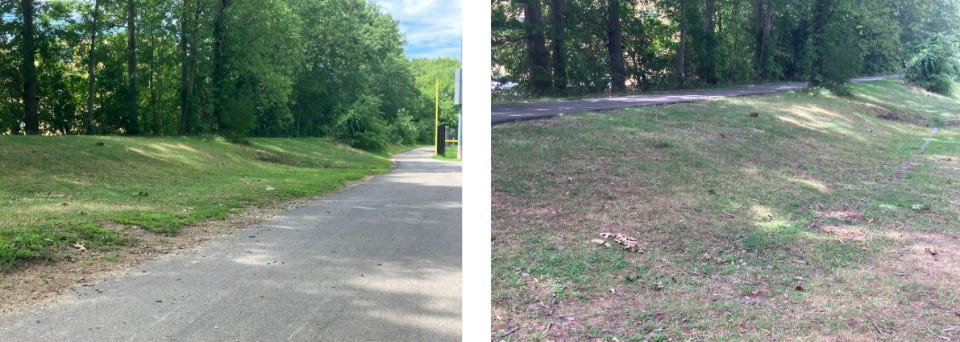
A few miles away in the town of Rockland, there was a memorable field tucked away behind an old school, a baseball field with train tracks on a raised mound creating a fence-like barrier along the far edge of the outfield with a factory on the opposite side of the tracks. The field was sandy with infield dirt often blowing up into small dust storms making games especially difficult to play on hot summer days. The train tracks around the outfield were a tantalizing draw for hitters, a home run target that appeared to be reachable while only the biggest kids on our team like Michael Cribben and Craig Richardson had the true potential to hit a ball that far. But when I arrived at the location where this field had been, there were no visible train tracks. While there was an existing baseball field on the same apparent footprint, it was a smaller diamond and it was positioned in an entirely different direction. The thought crossed my mind that I might be in the wrong location until I noticed Rockland’s Memorial Stadium while attempting to make my way out of the school complex. I took a walk out onto the Memorial Stadium field through an opening in the corner of the outfield fence. Memorial Stadium was built in 1922 to honor World War I soldiers from Rockland. Like a pared-down version of Detroit’s old Tiger Stadium, Rockland’s Memorial Stadium has always been a similar blue with tiny dugout enclosures. The field itself looked to be in decent shape. As opposed to when I played at Memorial Stadium as a visiting high school player, I stopped to read the commemorative plaques honoring Rockland’s veterans from World War I, and also the additional honors added for soldiers who served in World War II, Korea, and Vietnam. Rockland High School still stands beyond right field, a towering bullseye for left-handed hitters similar to the old warehouse in right field at Baltimore’s Camden Yards. While leaving the park, Rockland native Bob Hannigan arrived on a walking trail on the opposite side of the fence and stopped to talk. Although he told me that he now lived in a neighboring town, Hannigan was quick to engage about the area and was familiar with the old train tracks that I had hoped to find. “Long gone,” he told me. Hannigan explained how Rockland built a new school and had torn up almost everything in the process except for old Memorial Stadium. He pointed in the direction of some new basketball courts, and highlighted the somewhat elevated walking trail that had been built along the now diminished mounds that were once the location of the old train tracks. He pointed in the direction of someone riding a bike turning to the right who disappeared behind some trees. “Those are where the tracks were, where he is riding,” Hannigan said. He told me how Rockland’s old athletic track had been too small for regulation use and was replaced with a new one, and that most of the fields now have artificial turf. Hannigan mentioned how both football and baseball were once played at Rockland’s Memorial Stadium, but said that football is now played on a brand new field very close to the area of the old baseball field that I was hoping to find. He urged me to walk over and take a look, but cautioned me that most everything I probably remember was destroyed during construction. “Everything here has changed,” said Hannigan, before continuing his morning walk heading off in the opposite direction.
I drove a few miles to my hometown of East Bridgewater to visit Strongs Field, first noticing that the high set of bleachers that once stood behind the field’s first base dugout were gone. The dimensions at Strongs Field are similar to those at Fenway Park, with a high chain-link fence in left field resembling the Green Monster, a barricade that 40 years ago stood in front of a series of majestic pine trees out beyond left field that were not much higher than the fence back then but have since grown tall enough to dwarf the high fence in left field. I played my first game at Strongs Field as a youngster still accustomed to Little League-sized diamonds, roped into playing a game along with my friend’s older brothers and their friends as part of a team quickly assembled to challenge a barnstorming club that came to town. During one at-bat, I managed to loop an outside pitch into right field for a base hit off of a crafty southpaw, a guy who looked like he wasn’t adverse to enjoying a few cans of Schlitz, and probably did have a few during the game. I partially credit that hit to the Adirondack bat that I used, a bat that I had drilled out and corked using a Sports Illustrated article with former Detroit Tigers first baseman, Norm Cash, illustrating how to cork a bat using a drill, Elmer’s glue, and some sawdust. Strongs Field was also the venue where we eventually played our high school baseball games in East Bridgewater. We had a distinct home-field advantage at Strongs Field with a backstop that was well behind home plate, meaning that any ball that got behind an opposing catcher usually meant hustling for two bases. Our high school team was more than competitive playing behind legendary baseball coach, Pat Cronin, with multiple appearances in the state finals often playing into the summer on well-groomed Cape Cod Baseball League diamonds like Veterans Field in Chatham and Whitehouse Field in Harwich where we eventually lost to hard-throwing right handed pitcher, Pugga Routhier.
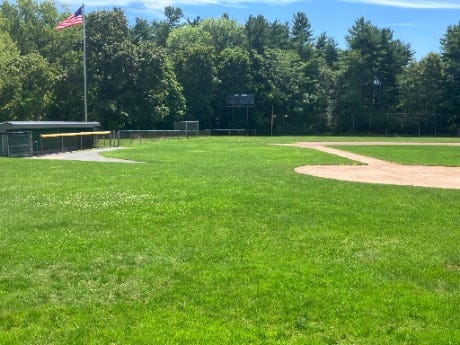
East Bridgewater’s state-of-the-art youth league baseball complex that had been built during the 1970s had a brand new field that was simply referred to as the New Diamond locally, but that entire complex was eventually sacrificed to make room for construction involving the town’s new high school and will be further affected with upcoming plans to build a new elementary school. A solitary old yellow town building that once stood adjacent to the New Diamond now sadly appears to be nearing demolition due to the construction. The neighboring town of West Bridgewater had a similarly active youth baseball program, famously hosting the annual All-Star festivities every June after the close of Little League season in the local area. Unlike East Bridgewater’s New Diamond, the youth baseball field in West Bridgewater remains essentially unchanged with its all-dirt infield, concrete dugouts, and a series of auxiliary fields beyond its outfield fence. Walking onto the field in West Bridgewater is like walking onto a baseball diamond that has been preserved in time, pleasantly identical to the last time I was on this field back in 1980.
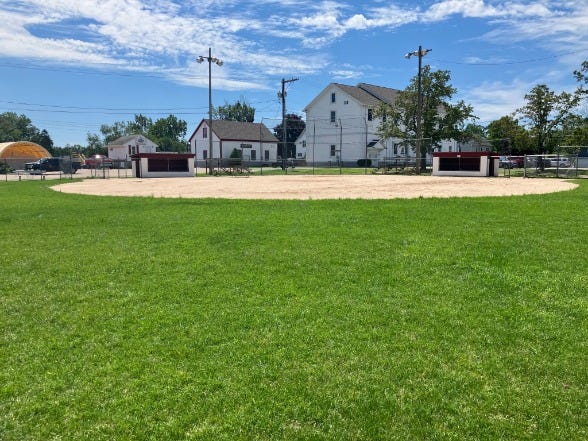
There was something memorable and magical about playing games on baseball fields tucked away in the woods, dusty fields surrounded by train tracks, or classic old little league fields like the one in the town of West Bridgewater where youth baseball is, thankfully, still being played. While new construction is typically interpreted as progress, the ability to revisit old baseball fields that still exist as opposed to those that have been reimagined caused me to reflect on a truth commonly attributed to Mark Twain: “We are always rushing after something new, and discarding what is good because it is old, only to find that new is not half so satisfying.”
If you like my articles, please hit the “LIKE” button. It will help to let me know that you are enjoying my writing.
I welcome and invite you to COMMENT.
And please SHARE these posts! This gives added support to my Substack page and also helps to add new readers.
Thanks so much to anyone who is reading Journeys with Jay!
No posts
Comments
Nothing yet. Say the first thing.
Sign in to join the conversation.