
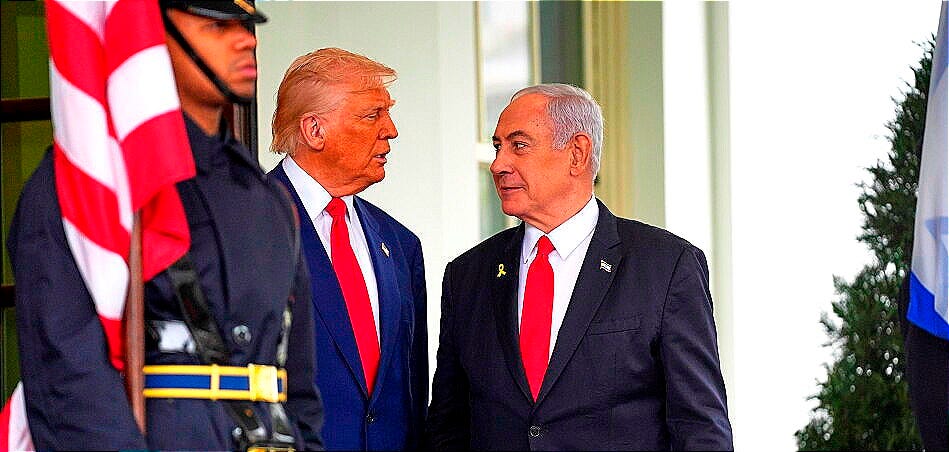
When Benjamin Netanyahu landed in Washington last evening, having taken off quietly from an Israeli air force base rather than Ben Gurion for reasons his office described as “security related”, the official framing offered to the American public was almost soothing in its ordinariness. The two leaders, we were told, would discuss keeping a “constant, constant watch” on Iran’s nuclear program, would review a framework for peace in Lebanon, and would explore expanding the Abraham Accords. President Trump, characteristically, described the gap between himself and the Israeli prime minister as “a little difference, but pretty close.” The vocabulary was the vocabulary of diplomacy, of managed allies and shared objectives, of a war essentially concluded and awaiting only its formal settlement.
The vocabulary does not survive contact with the map. What the meeting is actually about, and what the language of nuclear monitoring is designed to obscure, is a decision that has no good options: whether the United States should attempt to prosecute the next phase of its war against Iran from a dangerously narrow sliver of Israeli territory, having already been driven out of the constellation of Gulf bases from which American power in the region was projected for a generation. The interceptor magazines are running dry. The forward bases are, in the assessment of American commanders themselves, nearly uninhabitable. The Iranian missile enterprise, far from being destroyed, is regenerating during precisely the lulls that Washington has sold to the public as evidence of success. The purpose of this assessment is to explain, in plain terms and against the documentary record, why the comfortable story does not hold, and why the people responsible for that story, the president, his defense secretary, and his Israeli counterpart, have every incentive to keep telling it.
The war did not begin ambiguously. On the night of February 28, 2026, American and Israeli forces executed something close to nine hundred strikes in twelve hours, a coordinated opening barrage that targeted Iran’s missile production and storage, its integrated air defenses, its military infrastructure, and, most consequentially, its leadership. Supreme Leader Ali Khamenei was killed in that first night, along with dozens of senior officials. The scale and the audacity of the operation were presented, in the days that followed, as a demonstration of decisive advantage. The administration’s message to the American people was that the hardest work had been accomplished in a single stroke, that Iran’s capacity to fight had been gutted, and that whatever came next would be mop-up.
What came next was not mop-up. Iran answered with a sustained campaign of missile and drone strikes against American embassies, military installations, and oil infrastructure across an arc that ran through the United Arab Emirates, Saudi Arabia, Qatar, Kuwait, Bahrain, Iraq, Oman, and Jordan. A ceasefire brokered through Pakistani mediation took hold on April 8, held for a time, and then collapsed when talks in Islamabad failed to produce anything durable. By mid-July the United States had resumed its strikes, Iran was claiming attacks on tankers in the Strait of Hormuz, and the conflict had metastasized in directions that the February planning had not anticipated, reaching, by the last week of July, into the Caspian Sea. Each renewed round of American bombing has been narrated to the public as further proof of dominance. The more honest reading, the one available to anyone willing to place the sequence of events beside the geography of American basing, is that the repeated returns to the offensive are not the confident acts of a winning power. They are the improvisations of a force that has lost the ground beneath it and is trying to compensate from the air.
The gap between the narration and the reality is the central problem, and it is not a matter of spin at the margins. It is the difference between a war that is being won and a war in which the strongest military on earth has been progressively expelled from the region it was fighting to control.
Consider what the United States possessed in the Gulf when the war opened, and what it possesses now.
Roughly forty thousand American troops were deployed across the Middle East as the fighting escalated in late February, distributed across a network of major installations that had been built up over decades: Al Udeid in Qatar, the naval headquarters at Bahrain, the sprawling logistics and air operations at bases in Kuwait, Saudi Arabia, and the UAE, the forward positions in Jordan. This architecture was the physical expression of American primacy in the region. It was the thing that allowed Washington to say, credibly, that it could project decisive force anywhere from the Levant to the Arabian Sea.
That architecture has been shattered. American commanders, speaking through the reporting that has surfaced despite the administration’s preferred framing, have described roughly thirteen bases across Kuwait, Bahrain, Qatar, Saudi Arabia, and the UAE as having become nearly uninhabitable under the weight of persistent Iranian missile and drone attack. Central Command has been forced to disperse thousands of personnel away from its primary installations, not as a maneuver of strength but as a concession to vulnerability, because the bases that were supposed to project power turned out to be fixed targets within easy reach of Iranian short-range missiles. The Pentagon had in fact begun quietly evacuating some of these positions even before the war formally opened, having concluded that their proximity to Iran’s arsenal made them untenable. That prewar judgment is worth sitting with, because it means the vulnerability was understood in advance, and the war was launched anyway.
The direction of the American retreat tells the story that the official language will not. Power has flowed out of the Gulf and into Israel. Ben Gurion Airport outside Tel Aviv has, in the words of Israel’s own civil aviation chief, effectively become a United States military base, its civilian traffic disrupted by dozens of American aircraft, including the aerial refueling tankers on which any sustained air campaign against Iran depends. Ramon Airport in the country’s south, near Eilat at the head of the Red Sea, has taken on the same character, with American refueling aircraft deployed there and across Israeli military bases, and with hundreds of Israeli hotel reservations in Eilat canceled from May through November to make room for American troops. Israel’s own transportation minister, Miri Regev, has admitted the plain fact that both Ben Gurion and Ramon have become military bases “for all intents and purposes,” adding the revealing qualifier, “because we haven’t finished the job with Iran.”
Read that sentence as an American taxpayer rather than as an Israeli minister and its meaning inverts. The consolidation of American airpower into two or three fields in a single small country is not a sign that the job is nearly finished. It is a sign that everywhere else has been lost. A superpower that must stage its regional air war from the civilian airport of an ally, displacing that ally’s own airlines and tourists to do so, is not a superpower operating from a position of strength. It is a superpower that has been pushed back to the last ground available to it, ground that happens to sit well within range of the very arsenal it failed to destroy.
This is the strategic reality that the phrase “keeping watch on Iran’s nuclear program” is meant to paper over. The meeting today is not fundamentally about centrifuges. It is about whether the United States should attempt to run the next phase of a war from Ramon and Ben Gurion, knowing that to do so is to concentrate its remaining airpower into a handful of aim points that Iran already knows how to hit.
The reason the consolidation into Israel is so dangerous, rather than merely humiliating, comes down to a resource that receives almost no attention in the public discussion of the war and yet governs its outcome more completely than any other: the ballistic missile interceptor.
Modern missile defense is not magic. Each interceptor, whether an SM-3 fired from a warship, a THAAD round, or an Arrow, is an expensive, finite object, and defending against a saturation attack means expending them faster than they can be manufactured or delivered. Israel has now formally warned the United States that its own supply of interceptors is running dangerously low. This is not a projection about some future contingency. It is a statement about the present, delivered as the war entered its later phases, and it is compounded by the fact that Israeli stocks were already depleted from the previous round of fighting with Iran before this war even began. The defenders entered this conflict with magazines that had not been refilled, and they have been drawing them down ever since.
The significance of this becomes clear only when it is set against the offensive side of the ledger, which is where the administration’s story is most misleading. The public has been encouraged to believe that Iran’s missile force was destroyed in the opening barrage. The assessments tell a more complicated and more alarming story. Israeli military estimates put Iran’s ballistic missile stockpile at roughly twenty-five hundred at the outset, a number that had been drawn down to something on the order of a thousand by the April ceasefire through sheer expenditure in the earlier waves of the war. Those numbers are not the numbers of an arsenal that has been eliminated. They are the numbers of an arsenal that is being consumed on both sides of the exchange, and the critical question is which side can replace what it spends.
Here the trajectory matters more than any single figure. Before the war, Israeli intelligence had identified an Iranian effort to accelerate missile production dramatically, with the stated ambition of expanding the stockpile from roughly three thousand toward eight thousand within two years. Estimates of the current production rate range from the Israeli military’s assessment of dozens of ballistic missiles per month to Secretary of State Marco Rubio’s own figure of more than a hundred per month. Whatever the precise number, the direction is unambiguous, and it points to the single most important and least discussed feature of this war: every pause, every ceasefire, every diplomatic lull that the administration presents to the public as progress is also a window in which Iran regenerates the very capability the war was launched to destroy. The Iranian production line does not stop when the bombing stops. It runs fastest precisely when American and Israeli aircraft are not overhead.
Combine the two ledgers and the strategic predicament comes into focus with uncomfortable clarity. On one side, a defensive interceptor inventory that is finite, depleted, and difficult to replenish at the rate a saturation campaign demands. On the other, an offensive missile inventory that is being manufactured continuously and fastest during the pauses. A war fought on those terms is a war in which time favors the attacker, not the defender, and in which the concentration of American airpower into two or three Israeli fields is not a bold forward posture but an invitation. Should Iran choose to expend a meaningful fraction of its regenerating stockpile against Ben Gurion and Ramon at a moment when interceptor stocks are exhausted, the damage to American aircraft, personnel, and prestige would be severe, and there would be little to stop it. This is the calculation on the table today, and it is the reason the meeting is being held at all.
It is worth being precise about who authored the comfortable narrative and what they gained from it.
President Trump launched this war without authorization from Congress, a point made not by the administration’s fringe critics but from the floor of the Senate, where Senator Patty Murray stated flatly that the president had begun the war without congressional authorization or the support of the American people. A war entered on those terms carries a permanent incentive toward optimistic accounting, because the political cost of the initial decision can only be justified by continuous claims of success. Every admission that the Gulf bases have become uninhabitable, that the interceptors are nearly gone, that American forces have been driven back to a last redoubt in Israel, is also an admission that a war of choice, launched around the Constitution, has gone badly. The incentive to obscure is therefore structural, and it runs from the top.
Defense Secretary Pete Hegseth has been the public face of the financial case for continuing, warning that “without these funds, we face critical shortfalls” as he defended a defense budget request of a scale not seen in decades. The war has been estimated to cost as much as two billion dollars a day, and its acknowledged price tag had already reached tens of billions before the administration returned to Congress for more. The pattern is familiar to anyone who has studied how expensive wars are sustained politically: the cost of stopping is framed as unthinkable, the cost of continuing is framed as manageable, and the gap between the two is filled with assurances of progress that the battlefield does not support. A defense secretary telling the public that the shortfalls are the problem, rather than the strategy that produced them, is performing exactly the function the narrative requires.
Prime Minister Netanyahu occupies the third corner. His government has the strongest possible interest in keeping American forces committed, American airpower stationed on Israeli soil, and American money flowing, because the alternative is an Israel left to face a regenerating Iranian arsenal with its own depleted defenses and no superpower patron physically present to absorb the blows. His stated agenda for today’s meeting, the “constant, constant watch” on Iran’s nuclear program, is the language of a partner who needs the war to continue and needs Washington to believe that continuation is a matter of vigilant monitoring rather than a slide into a fight the coalition is not positioned to win. That his own transportation minister has already conceded that the job with Iran is unfinished, even as the airports fill with American aircraft, is the tell that the monitoring frame is a frame and not a description.
None of this requires imputing secret motives that cannot be observed. The observable facts are sufficient. The bases are uninhabitable, the interceptors are nearly gone, the airpower has retreated into Israel, the missile production continues through every pause, the war was launched without authorization, and the money being requested is historic in scale. The only thing that has been consistently misrepresented is the meaning of those facts, which have been narrated as success when they describe a strategic reversal.
The most revealing development of the past week, and the one that most clearly exposes the weakness beneath the confident language, is the sudden entanglement of the Ukraine war with the war against Iran.
For most of this conflict, Ukraine’s role was modest and defensive in character. Kyiv had lent technical and military expertise to help Gulf states and American bases counter Iranian drone and missile attacks, and in March, President Zelensky announced that Ukraine would send military experts to the Gulf. That was assistance at the level of know-how, the transfer of hard-won Ukrainian experience in shooting down Iranian-designed drones, and it did not make Ukraine a belligerent against Iran.
What happened in the last week of July is categorically different. Ukrainian drones struck two vessels in the Caspian Sea, ships that Kyiv said were carrying Iranian military cargo bound for Russia, and one Iranian sailor was killed. Tehran summoned Ukraine’s diplomats and denounced the strike as a “hostile and criminal act.” With that operation, a front that had been about Russia’s war suddenly became a front in the American war against Iran, opening a fourth body of water, after the Strait of Hormuz, the Red Sea, and the Bab el-Mandeb, on which the conflict is now being fought. The two wars, as the reporting has put it, are colliding on the world’s largest lake.
The timing is the point. Zelensky also arrived in Washington this week to meet Trump precisely as this new front opened, and the structure of the emerging arrangement is not difficult to read. A United States that has been driven out of its Gulf bases, that is running low on interceptors, and that is trying to prosecute a war from a narrow Israeli foothold has a strong interest in a partner willing to pressure Iran from the north, along the Caspian and the supply lines that connect Tehran to Moscow. Ukraine, for its part, has spent more than three years desperate for sustained American financial and military support and has every reason to make itself useful to an administration that holds the purse. The logic of the exchange presents itself: Kyiv opens and sustains a northern front against Iranian and Russian logistics, and Washington, in return, keeps Ukraine funded and armed. It is the oldest transaction in coalition warfare, a smaller power renting out its willingness to fight in return for the resources of a larger one, and it is being assembled in real time this week in two overlapping meetings with the same president.
The vehicle for all of it is money, and here the pieces connect. The administration has requested a defense budget of roughly 1.5 trillion dollars, more than forty percent above the prior year and the largest such request in decades, layered on top of a separate war supplemental of some 87.6 billion dollars that would funnel the overwhelming majority of its funds, more than three quarters, to the Pentagon, including tens of billions specifically to replace the munitions, the interceptors and the precision weapons, that the war has consumed. A budget of that magnitude is what makes it possible to contemplate simultaneously sustaining the war against Iran, refilling the interceptor magazines, staging airpower out of Israel, and financing a Ukrainian northern front against Tehran. The scale of the request is not a sign of confident abundance. It is the fiscal signature of a war that is costing far more, and going far worse, than the public has been told, and that now requires the resources of a second war, and a second desperate ally, to keep from collapsing.
Strip away the language of nuclear monitoring and Abraham Accords, and the decision on the table in Washington today reduces to a single, stark question. Having been expelled from the Gulf, having drawn its interceptor stocks down toward exhaustion, and having watched Iran’s missile production continue through every pause, should the United States commit to prosecuting the next phase of the war from Ben Gurion, Ramon, and the handful of Israeli fields now serving as its regional base of operations, accepting that to do so is to place its concentrated airpower within easy and undefended reach of a regenerating Iranian arsenal?
To say yes is to gamble that American and Israeli airpower can degrade Iran’s missile enterprise faster than Iran can rebuild it, and to do so from fixed positions that Iran has already demonstrated it can strike, at a moment when the shield that would protect those positions is nearly spent. To say no, or to hesitate, is to concede that a war launched with nearly nine hundred strikes in a single night, sold to the public as decisive, has instead driven the strongest military in the world out of a region it dominated for half a century and into a corner from which there is no obviously good exit. Neither answer resembles the version of events that has been offered to Americans, in which the war is essentially won and the remaining task is vigilant observation.
The bringing of Zelensky into the picture, and the search for a Ukrainian front on the Caspian, should be understood as what it is: not the confident expansion of a winning coalition but the recruitment of additional pressure by a coalition that has run short of the ground, the interceptors, and the strategic options it needs. When a superpower begins renting fronts from a smaller power that has itself spent three years pleading for support, and financing the arrangement out of the largest military budget request in generations, the honest description is not victory. It is a war in trouble, being sustained by money and by allies because it can no longer be sustained by position.
That is the meeting’s real subject, however desperately Trump and Netanyahu may try to bury it beneath boasts, euphemisms, and presidential stagecraft. The map has already rendered its verdict. All that remains is Trump’s familiar fraud of declaring victory over a reality he neither understands nor controls. The question is not whether the United States is “winning,” but how long Trump can keep selling failure as triumph, and how much blood and money will be spent protecting his vanity from the truth.
No posts
Comments
Nothing yet. Say the first thing.
Sign in to join the conversation.