
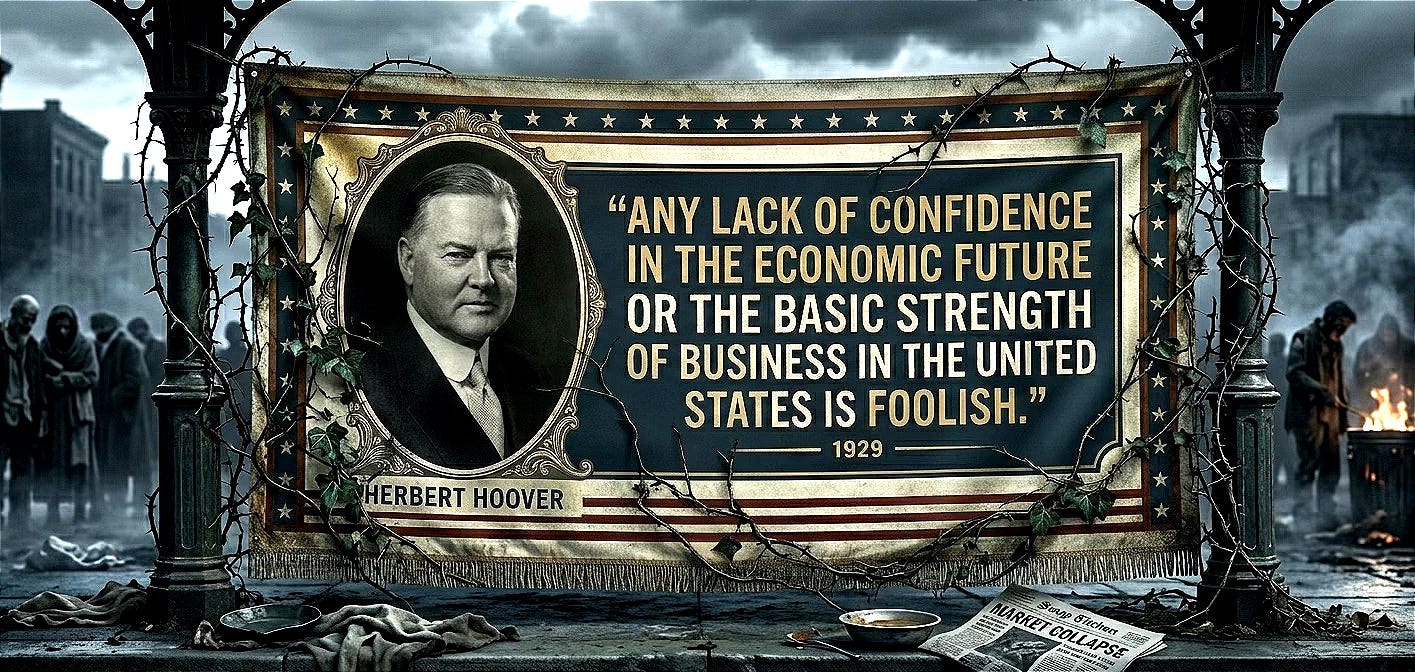
“Any lack of confidence in the economic future or the basic strength of business in the United States is foolish.” Herbert Hoover – 1929
Somewhere in Ganzhou, in southern China, a mid-level official at the Ministry of Commerce holds the authority to slow the production of an F-35 in Fort Worth, Texas. He does not need to fire a shot, sever a cable, or board a ship. He needs only to decline a magnet export license. The fighter’s fin actuators, its radar, its targeting package, all depend on heavy rare earth elements that China refines and the United States cannot, and under the licensing regime Beijing imposed in retaliation for the present administration’s trade war, the permission to obtain them now runs through his desk. This is the single most important fact about the American economy in the spring of 2026, and it is the fact the President’s communications operation has worked hardest to keep out of the evening news.
The story that follows is not the story of one catastrophic mistake. It is the story of a sequence, five interlocking acts of strategic self-sabotage executed across sixteen months, each one intensifying the damage of the last while narrowing the country’s remaining margin for correction. The President initiated a confrontation with the nation that controls the refining capacity for the minerals underpinning the modern technological economy, and in doing so jeopardized the material inputs essential to his own defense industrial base. He then treated the most strategically important island on earth as a negotiable asset on live television, publicly converting the security architecture of the Pacific into a transactional bargaining chip. His signature tariff regime, sold domestically as economic warfare against Beijing, functioned in practice as a transfer of leverage toward Chinese manufacturers before parts of it were invalidated by his own Supreme Court. The conflict he escalated in the Persian Gulf destabilized the fifty year financial arrangement that has anchored dollar supremacy since the 1970s. Beneath all of it, the American worker he promised to restore has been quietly deteriorating behind employment numbers that flatter the surface while concealing the erosion underneath: weakening full time work, declining labor quality, mounting household strain, and an economy increasingly dependent on statistical appearances rather than durable strength.
None of these failures exist independently. They form a single mechanism of cumulative exposure in which each decision compounds the vulnerabilities created by the one before it. The result is not merely policy drift or ordinary mismanagement. It is the gradual construction of an economic and strategic environment increasingly favorable to Beijing and increasingly dangerous to the United States.
The President was warned at every stage by the relevant agencies, outside economists, military planners, market analysts, and officials within his own government. The warnings are public record. They did not constrain his decisions. The consequences of those decisions are now beginning to constrain the country itself.
Begin with the chemistry, because the chemistry is the trap. The seventeen rare earth elements are not, despite the name, geologically rare. They are scattered through the earth’s crust on every continent. What makes them strategically scarce is separation: the elements occur together in ore bodies, chemically near-identical, and pulling them apart at industrial purity demands hundreds of sequential solvent-extraction stages, prodigious volumes of acid, and an operational expertise that takes decades to accumulate in a workforce. China has built at least fifty rare earth separation plants in the last ten years. Outside China, there are three facilities capable of industrial-scale separation: Mountain Pass in California, the Silmet plant in Estonia, and the Lynas plant in Malaysia. Three, against fifty. China controls roughly 70% of global rare earth extraction and approximately 90% of the world’s refining capacity, and the asymmetry is not a problem of capital or geology. It is a problem of accumulated industrial knowledge that the West, operating on the political horizon of a single congressional session, never built.
Into this dependency, on April 2, 2025, the President detonated what his operation rebranded Liberation Day. He declared a national emergency on foreign trade and announced tariff rates not seen since 1909, against countries that had previously faced an average rate of about 2.4 percent. Two days later, on April 4, Beijing answered with its first round of export controls on heavy rare earths and permanent magnets. The response was not natural market dynamics, nor pandemic disruption, nor the green transition outpacing supply. It was the direct, retaliatory, and entirely foreseeable countermeasure of a state that had identified the one lever on which it held both an absolute advantage and an asymmetric pain function, and it deployed that lever with surgical precision.
The numbers buried in Chinese customs data tell the story more economically than any essay. Over the thirteen months since the controls began, Japan, the largest rare earth magnet maker outside China, received just 4% of the dysprosium it had imported the previous year. Germany received none. Prices for the materials that did clear licensing soared four- and five-fold for dysprosium and terbium, and in the most extreme case roughly one hundred and forty-fold for yttrium. Within weeks of the controls, Ford and General Motors were warning suppliers that magnet shortages could shut production lines inside sixty days, and the defense primes, who have learned over two decades to keep such warnings out of the trade press, routed their alarm through classified channels to a White House that had been told this would happen.
The trap closed on a single number that should keep the National Security Council awake at night. Under the controls Beijing reimposed and expanded in October 2025, foreign entities now require a license to export any product containing more than 0.1 percent of minerals sourced from China. Read that threshold again. A finished good made in Germany, using a Japanese motor, containing a magnet whose neodymium passed through a Chinese refinery, cannot be sold to the United States without Chinese permission if the mineral content exceeds one part in a thousand. This is not a tariff. It is a global licensing regime, administered from Beijing, that touches every advanced manufactured good produced anywhere on earth. The trigger sits in Ganzhou.
The administration’s answer is to point at the Mountain Pass buildout, the only operational rare earth mine on American soil, now performing integrated separation and refining on site under MP Materials. The progress is real, and the credit belongs to a bipartisan coalition across three administrations, not to the President currently in office. The decisive financing, a $150 million Department of Defense loan paired with $1 billion in commercial debt from JPMorgan Chase and Goldman Sachs, arrived in July 2025, after the export controls had exposed the vulnerability the President’s own policy triggered. The response was reactive, and the arithmetic is brutal. Mountain Pass produces around 1,000 tonnes of annual magnet output, aiming for 10,000 by 2028. American demand exceeds 30,000 tonnes a year and is rising. Even at full buildout, the domestic base supplies a minority of need, and throughout the buildout the country remains hostage to the regime its trade policy provoked. The administration did not build a strategic mineral base because it foresaw the necessity. It is scrambling to build one because it created the crisis that revealed it, and unfortunately, the building will not be finished in time.
“It’s a very good negotiating chip for us, frankly. It’s a lot of weapons.”
— Donald J. Trump, on the $14 billion Taiwan arms package, Fox News, May 16, 2026
If the mineral floor is the foundation, Taiwan is the keystone, and the President placed it on the open market on Saturday morning. He had just returned from his second summit with Xi Jinping in eighteen months, a Beijing meeting at which Xi had warned, in a closed-door session, that the two powers could collide or even enter into conflict over the island, calling Taiwan the most important issue in China-U.S. relations. Asked by Bret Baier whether he would approve the $14 billion arms sale awaiting his signature, the President answered with the offhand fluency of a man describing a real estate deal: I’m holding that in abeyance and it depends on China. It’s a very good negotiating chip for us, frankly. It’s a lot of weapons.
The metaphor was not figurative, and he was not misquoted. To anyone fluent in the strategic vocabulary of the past half-century, the meaning was unmistakable. The defense commitment of the United States to a democracy of 23 million people, the island that fabricates more than 90% of the most advanced semiconductors on earth, was a commodity the President was holding back as leverage against the one country most plainly interested in seizing it. In the same breath he called for Taiwan’s chip industry to come into America, reviving his old accusation that Taiwan had stolen the sector decades ago. Xi had demanded American concessions on Taiwan seventy-two hours earlier. Xi got his answer on cable television, broadcast worldwide.
Understand what was conceded. Every Nvidia accelerator driving the artificial intelligence boom is designed in Santa Clara and fabricated in Taiwan. Every Apple processor, the radar in the F-35, the guidance in the Patriot interceptor, the signal processors in the Aegis Combat System, all touch a Taiwanese fab. TSMC builds its most advanced chips on 2-nanometer nodes at home; its Arizona plant has only recently begun producing 4-nanometer chips, with 2-nanometer capability not arriving at scale before 2028 at the earliest, and then at a fraction of Taiwanese volume. This is not a gap that closes with capital or exhortations. It reflects three decades of accumulated tacit knowledge in an engineering workforce that cannot, by any plausible mechanism, be relocated to Arizona in the volumes required. A modern fab depends on more than ten thousand specialized suppliers, most within a one-day truck route of Hsinchu. The President’s demand that the industry simply move is a demand for the impossible, and worse, it signals to Taipei that the American defense commitment is now conditional on a concession Taiwan cannot make even if it wished to.
The chip remark did not stand alone. Before the summit, the President had already agreed to sell Nvidia’s advanced H200 AI chips to Chinese tech companies while suspending the Taiwan arms package, accelerating Chinese AI capability at the precise moment American AI leadership was the principal residual American advantage. The trade is concrete. Beijing gets American chips and a freeze on Taiwanese armament. Washington gets a partial, discretionary, reversible relaxation of the rare earth controls Beijing imposed in the first place. This is not negotiation as previous administrations understood the term. It is a tribute system, and the tribute is flowing in the wrong direction. The strategic doctrine that protected Taiwan since the 1990s, the so-called silicon shield, rested on the certainty that the United States would treat the island’s defense as non-negotiable. The President placed that certainty on the negotiating table in his own words, and Beijing’s planners, who have spent thirty years preparing for exactly this moment, took the note. As one Georgetown analyst observed of the period, if China were to contemplate an attack, this might be the opportune moment to do it, with American carriers drawn off to the Persian Gulf and American attention consumed by a war the President chose to escalate.
The view from Taipei has already curdled past the official reassurances. The phrasing that has resonated on the island comes from the International Crisis Group: that Taiwan, instead of being at the negotiating table, is now on the menu. The recognition is dawning in a country whose entire postwar identity rested on the assumption of an American guarantee, and the rational response, across the next several electoral cycles, will be a slow drift toward accommodation with Beijing. That is precisely the outcome the President’s remark accelerated. In the same interview, asked whether Taiwan had come up at the summit at all, he said it never did. The record holds both statements. Beijing and Taipei have already converged on the second.
“U.S. tariffs don’t end Chinese exports. They reroute them.”
— Lu, a Chinese export vendor supplying Shein and Temu, to The Diplomat, January 2026
The tariff is the President’s signature instrument, the policy he calls the greatest thing ever invented, the lever he insists will punish foreigners, bring factories home, and refill the Treasury without asking Americans to pay for what they consume. Every clause of that promise is, on the available evidence, false. The tariffs are paid overwhelmingly by Americans. The factories are not coming home; they are leaving for Monterrey. The Chinese exporter, quoted above, understood the policy better than the President who imposed it.
Start with who pays. Goldman Sachs estimated that as of August 2025, tariff incidence fell 37% on U.S. consumers, 51% on U.S. businesses, and just 9% on foreign exporters. The combined burden on American economic actors was 88 percent. The Federal Reserve Bank of Dallas sharpened the picture in May 2026, finding a full pass-through of tariff costs to consumers and estimating that core inflation would have been 0.80 percentage points lower in March absent tariffs, coming in at 2.3% rather than the 3.2% recorded, the highest since 2023. The Tax Foundation puts the regime at the largest U.S. tax increase as a percent of GDP since 1993, an average of $1,500 per household in 2026. Economists estimate a lag of twelve to eighteen months before tariff effects reach consumers, which places peak pain between April and October 2026, the very months in which this is being written, and the months in which the administration is preparing for the midterms with no story yet developed to explain the rapidly rising cost of living.
Then consider what the tariff did to manufacturing, the sector it was purported to save. Manufacturing lost 77,000 jobs from April to December 2025, in the nine months immediately following Liberation Day, with payrolls still shedding jobs into April 2026. The losses were not random. The President’s theory assumes a two-country world in which an American tariff on Chinese goods forces production to relocate to Ohio. No such world exists. When the United States tariffs Chinese goods, the Vietnamese and Mexican factories that capture the displaced demand do not move to Ohio. They tighten their dependence on cheap Chinese inputs and ship the result to America at a higher landed price. The American tariff did not punish Chinese manufacturing. It converted Southeast Asian manufacturing into more deeply Chinese-dependent operations while raising prices on American shelves.
The rerouting was anticipated and is now measured. Brookings found Chinese exports to Thailand and Vietnam rising sharply and anomalously in early 2025, ahead of the tariffs, as if China knew they were coming. A Harvard, Duke, and Academia Sinica analysis documented more than $8 billion in Chinese exports rerouted through Vietnam to the United States in the first three quarters of 2025 alone. The President’s 40% punitive tariff on transshipped goods has proved nearly unenforceable, because the legal definition of substantial transformation is ambiguous enough that Chinese-owned operations in Vietnam can qualify for the lower Vietnamese rate with modest local value-add. Tariffs have changed where boxes are stamped, not where value and control actually lie. Meanwhile the accidental beneficiary is Mexico, which has positioned itself as the low-tariff manufacturing platform serving the American market. The factories are not coming back to the United States. They are leaving it, for Mexico, in response to the arbitrage the President’s own policy created.
Then, on February 20, 2026, the verdict. In Learning Resources, Inc. v. Trump, the Supreme Court ruled 6-3, in an opinion authored by Chief Justice Roberts, that the International Emergency Economic Powers Act does not authorize the President to impose tariffs, that the tariff power is a branch of the taxing power reserved to Congress under Article I, and that the President’s signature instrument was unlawful from inception. The majority included justices appointed by Republican presidents across three administrations, among them justices the President appointed himself. This was not a partisan ruling. The Court struck down more than $160 billion already collected and $1.4 trillion in projected revenue, money the federal government may now owe back to the very American businesses the tariffs were supposed to help. The President responded within hours by signing a new 10% global tariff under a different statute, which the Court of International Trade has since also ruled illegal and which is now on appeal. The greatest thing ever invented. The Chief Justice of the United States, writing for six of his colleagues, did not agree.
“It was not a bluff. The infrastructure was already in place.”
— Strategic Culture analysis of the UAE yuan threat, May 17, 2026
There is a sentence in international finance that, until April of 2026, every senior central banker understood to be both true and unspeakable: that American financial supremacy rested on an unwritten arrangement made in 1973 between Washington and Riyadh. The United States military would guarantee the security of the Gulf oil producers. The producers, in exchange, would price their crude in dollars and recycle their surpluses into Treasury securities. This petrodollar system generated fifty years of structural demand for the American currency that the economy did not have to earn through productive output. It was the load-bearing wall of the modern American empire, and it broke in April 2026.
The breaking was not announced. It occurred in a Washington conference room, when the governor of the Central Bank of the United Arab Emirates, Khaled Mohamed Balama, raised with Treasury Secretary Scott Bessent and Federal Reserve officials the possibility of a currency swap line, and warned that the Emirates may have to price oil sales in Chinese yuan if they ran short of dollars. The press read it as routine technical liquidity talk. The deeper meaning, which the administration labored to keep off the front page, was that for the first time in half a century a Gulf central banker had sat across from a senior American official and named the alternative to the dollar out loud. The naming was the event. The infrastructure behind it is operational: the UAE has held a yuan swap line with the People’s Bank of China since 2012, Saudi Arabia signed its own in 2023, and both have joined Project mBridge, the Chinese-led platform that lets central banks settle in their own digital currencies, bypassing the dollar entirely. The yuan swap network now reaches more than forty countries. The Federal Reserve’s permanent network reaches five.
What brought a loyal ally to that table was the war. U.S. and Israeli operations against Iran since February 2026, branded Operation Epic Fury, and the Iranian retaliation across the Gulf produced, by the Federal Reserve Bank of Dallas’s own measurement, the largest geopolitical oil supply disruption in history, between two and three times the magnitude of the 1973 shock. Brent crude jumped 51% in March, climbing from around $72 a barrel on February 27 to nearly $120 at its peak. Gasoline passed $4 a gallon. Beginning March 4, Iranian forces declared the Strait of Hormuz, through which roughly 27% of the world’s seaborne crude flows, closed, in an on-again pattern of intermittent closure and reopening that has shattered oil price stability. Vitol’s chief executive estimated a billion barrels of production would be lost. Missile damage to Qatar’s LNG complex will take up to five years to repair and has choked roughly a third of global helium supply, a critical input to the very semiconductor manufacturing the previous link in this chain identified as the keystone of American power. The administration has called the war a tactical victory. The tactical victory has cost the global economy a billion barrels, a fractured Gulf financial architecture, and the dollar’s unspoken privilege.
The bond market has rendered its verdict. The 30-year Treasury yield closed at 5.13% on May 15, 2026, the highest sustained level since the financial crisis, climbing not because the domestic economy is overheating but because foreign official sectors are finished accumulating dollars at any price the United States is willing to pay. Indirect bidders, the channel through which foreign accounts buy Treasuries, have pulled back from the long end for fourteen consecutive months. The auctions still clear, but only because the Treasury pays punitive yields to clear them, and federal interest expense, already past $1 trillion annually, is now on a trajectory to exceed the entire defense budget by 2027. The President’s response has been to attack the Federal Reserve Chairman, demand rate cuts that would crash the dollar, and nominate a more accommodating successor. The dollar’s reserve share is not collapsing in the catastrophic sense the old declinists predicted. It is leaking, steadily, into the renminbi and other nontraditional currencies, and the rate of the leak has accelerated under policies that treated a load-bearing wall as a relationship of convenience. The petrodollar arrangement, as it operated from 1973 to 2025, is over.
“I characterize that we’ve been stable without being good.”
— Austan Goolsbee, President of the Federal Reserve Bank of Chicago, on the American labor market, May 8, 2026
The President prefers a single number. The number is 4.3%, the unemployment rate, and in the technical sense it is accurate. In the sense in which a working family experiences the labor market, it is almost completely misleading. The number describes a country that does not exist. The country that does exist is one in which 4.9 million Americans are working part-time because they cannot find full-time work, an increase of 445,000 in a single month, the largest such jump outside a recession. It is a country in which the broader U-6 measure of labor underutilization has reached 8.2%, two full percentage points above its pre-pandemic level, and in which labor force participation has fallen for the fifth consecutive month to 61.8%, the lowest since October 2021. The employment-to-population ratio, at 59.1%, sits at a level the country has not seen, outside the pandemic emergency, since 2014, the trough of the post-financial-crisis recovery.
The headline holds at 4.3% only through a statistical sleight. In April 2026, the household survey showed total employment falling by 226,000 while the labor force shrank by 92,000. The unemployment rate did not rise, because the workers who would have raised it disappeared from the denominator faster than they raised the numerator. People who give up looking are not counted as unemployed; they are reclassified as out of the labor force and vanish from the headline. By the Bureau of Labor Statistics’ own combined measures, 6.1 million Americans who want a job are not in the labor force, on top of the 7.4 million counted as unemployed, which means the true count of Americans who want work and cannot get it is closer to 13.5 million, nearly double the figure the President repeats. KPMG’s chief economist put it plainly: employment has actually fallen when you call people and ask if they have a job, and all of it is a sign of underlying anxiety in the labor market.
The administration’s most direct contribution to the damage is the gutting of the federal workforce. Federal employment is down 348,000 positions, or 11.5 percent, since its October 2024 peak, a contraction unprecedented in modern history and dwarfing the Reagan, Clinton, and Obama reductions. The cuts have fallen disproportionately on agencies the administration politically dislikes, removing on a conservative estimate between $25 billion and $40 billion in annual household income from American communities, with a federal contractor base shedding perhaps another 100,000 to 150,000 jobs on top. While some of the cuts can be justified, many of the frozen contracts were the very ones building the diversified mineral supply chains and semiconductor capacity the earlier portions of this article identified as the load-bearing investments in American security. The administration eliminated many of the jobs that were directly involved in executing the policies it claims to support.
Underneath the labor data, the household balance sheet is buckling. Delinquencies on American household debt have risen to 4.8% of all outstanding balances, the highest since 2017, concentrated among borrowers aged 18 to 49, the demographic that delivered the administration its majority. Americans owe a record $1.68 trillion in auto loans, with subprime delinquencies at their highest in 32 years and the average monthly car payment up almost 40% since 2018 to around $680. Bankruptcy filings rose 10.6 percent year over year through September 2025. The clearest signal of all: Americans are now using buy-now-pay-later financing to purchase groceries and surrendering recently purchased vehicles they can no longer afford. The Federal Reserve, caught between an inflation it cannot ignore and a labor market it cannot abandon, voted 8-4 to hold rates at its most recent meeting, the highest level of dissent since 1992.
The case against the President is not that he created these vulnerabilities. The mineral dependency, the offshoring of semiconductor fabrication, the secular erosion of the dollar’s privilege, all predate him by decades, and the responsibility is bipartisan and spread across the entire post-Cold-War establishment. He inherited the vulnerabilities. The case is more specific, and more damning: that across sixteen months he took every available action to compound each one, and that the five compoundings are a single chain.
The mineral dependency makes the Taiwan question more acute, because the alternatives to Chinese-fabricated chips are constrained by the rare earth inputs the United States does not control. The Taiwan question makes the tariff war more dangerous, because Chinese leverage over the island is what rendered the trade escalation strategically suicidal. The tariff regime made the petrodollar fracture more probable, because the rerouting it accelerated fed the very commercial flows the post-dollar architecture was designed to capture. The petrodollar fracture made the labor market deterioration more severe, because the higher interest rates the bond market now demands have crushed the household balance sheets working Americans depend on. The labor market deterioration, in turn, makes the politics of fixing any of it more volatile, because the voters the President won on the promise of restoration are precisely the ones whose position has most acutely collapsed.
The market is at record highs. The market is at record highs because the artificial intelligence trade is concentrated in a handful of companies whose entire business model depends on Taiwanese fabrication, Chinese rare earths, dollar denomination, and consumer demand, every one of which this article has documented as compromised by the President’s own policies. The warning flare is bright. The flare is also, in the physics of these things, the last thing one sees before the dark.
The President was warned. The warnings are on the record, in the transition memoranda, in the Senate confirmation hearings, in the published analytical literature, in the private communications from career officials across every domain this chain has traced, in the briefings he is alleged to have skimmed or skipped. The warnings did not constrain his behavior. The behavior is now constraining the country, and the country, on the available evidence, will not have the time, the resources, or the political coherence to recover before the consequences become irreversible.
No posts
Comments
Nothing yet. Say the first thing.
Sign in to join the conversation.