
Imagine a journal avowedly on the right, yet highly critical of the finance-capitalism that has precipitated the present crisis. It meshes right-wing populism with strident regional and religious expressions: both Southern partisans and Catholic monarchists regularly appear. At times, it has positive things to say about the current president, including his authoritarianish experiments, and right-wing strongmen abroad. All of this comports with the journal’s global skepticism toward liberalism and democracy. In fact, the journal is so authoritarian and fascio-curious that it borders on endorsing fascism (whatever that means).
I am describing, of course, The American Review, which ran from 1933 until 1937.
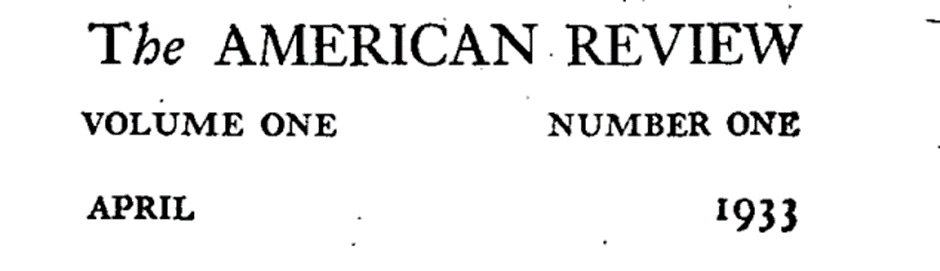
“A journal noted for the perversity of its brilliance,” according to John Patrick Diggins, the American Review brought together those “radically critical of conditions prevalent in the modern world” but from “a ‘traditionalist’ basis.”
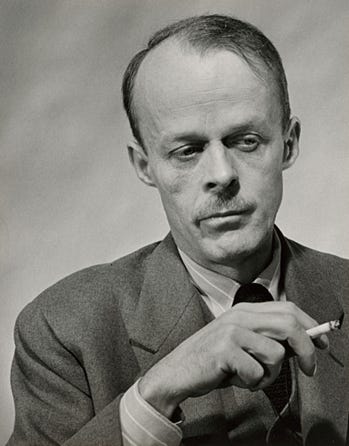
In many ways, the journal was the realization of the intellectual and to a lesser extent spiritual impulses of its owner, publisher, and editor, Seward Collins. His practice of soliciting specific essays, according to Albert E. Stone, generated a certain unity in the American Review despite its variegated contributors. Indeed, “each issue of his magazine was in effect the minutes of an ad hoc alliance of conservatives held together more by Seward Collins’ enthusiasm than by a true meeting of minds.”
Somewhat mousy and physically unimposing, Collins (born in 1899) was the heir to a substantial tobacco-store fortune. He was a socialite, literary gentleman and pornography collector, existing on the edges of writerly circles during his twenties. Before his later intellectual-political career, his primary claim to fame was as Dorothy Parker’s lover. In 1927, Collins bought the national literary journal The Bookman, presently becoming its editor. In the crisis of the Great Depression, Collins’s politics drifted toward the right – not the right of the American Liberty League, but something altogether more radical.
In 1933 he closed The Bookman and in its stead launched the American Review as a venue for “Radicals of the Right”, or “Revolutionary Conservatives.” In part, Collins wanted simply to platform men whose ideas he admired, primarily the “New Humanists” Irving Babbitt and Paul Elmore More, cultural traditionalists and neo-classicists who he had promoted in The Bookman. Beyond this pair (Babbitt died shortly after the first issue of American Review), Collins saw three other streams of radical traditionalist critics of modernity. First, English Distributists, like the Catholics Hilaire Belloc and G. K. Chesterton, who argued for reforms to regenerate a land-owning, liberty-loving yeomanry. Second, the Southern Agrarians, fairly fresh off their mythopoetic cri de coeur I’ll Take My Stand: The South and the Agrarian Tradition, almost all contributed to the magazine. Finally, Collins saw space for neo-Scholastic Thomists, although in practice this group was least represented. I would add that a coterie of generally authoritarian-leaning writers like Hoffman Nickerson also regularly wrote for the journal.
All stood against the “well-nigh universal liberalism, radicalism, and false conservatism of our organs of opinion” and, to a greater or lesser extent, shared an interest in key themes.
Far more than our ultimately comfortable discourse today, the American Review was a journal composed in the face of crisis – real crisis. The present political moment called for radical thought and action. The utter failure, from the vantage point of 1933, of capitalism dominated the scene. The financial monstrosity’s death spasms threatened to bring liberalism and democracy down with it. The tripartite failure of capitalism, liberalism, and democracy opened space for reactionary critiques and reactionary politics. The American Review circle had no patience for liberals, “busy collecting the pieces of Humpty Dumpty and trying to fit them into a less gruesome shape,” according to Herbert Agar. Nor for business-oriented conservatives. They had greater sympathy for the disastrously wrong Communists who nonetheless knew what time it was.
“The obvious task for conservatives is to redefine the historic purpose of America, to scotch forever the association of this purpose with the obscenities of Big Business, and to show how it can be attained in politics,” wrote Agar. “Reaction is the most radical of programs,” his fellow Agrarian Allen Tate was quoted in the journal. “It aims at cutting away the overgrowth and getting back to the roots. A forward-looking radicalism is a contradiction; it aims at rearranging the foliage.”
It’s hard to overstate the thoroughgoing repudiation of finance-capitalism from across the traditionalist spectrum of the American Review. The writers were universally scathing and desperate for the wholesale replacement of a regime they considered fundamentally anti-human. “Capitalism was inhuman and repulsive enough in the heyday of its power,” Collins wrote in an important editorial in 1933. It was all the worse “in its decline.” Agar too expressed that while there was “a moral argument for communism” and “for private property,” there was “none for capitalism as we see it today.” Tate thought finance-capitalism was “necessarily hostile to the development of a moral nature.”
In large part, this was a product of the Depression at its peak: the market had been so discredited and the deprivations were real. But not solely. Each of the distinct intellectual traditions in Collins’s mélange had its own anti-capitalist, anti-materialist tradition that it brought to the table.
So crucial was the economic component to the American Review that the first article in issue one, volume one was “The Restoration of Property” by Hilaire Belloc. Despite their distinct cultural expressions, the Southern Agrarians and English Distributists shared the premise that small and widely held property was the foundational form and the “guarantee of citizenship” in the Western world. As Paul Murphy shows, the Agrarians saw their economic program as only a part of their larger “intellectual, political, social, and aesthetic” project. At the same time, Murphy argues, despite some later disavowals, the Agrarians were serious about a land-based economy. As Agar put it, “The root of a real conservative policy for the United States must be redistribution of property.”
As is clear by the various streams of contributor to the journal, Collins and the American Review had a faith in “tradition,” rather than a specific tradition itself. The Distributists were generally Catholics; the Agrarians elevated a mythic conception of the American South; Collins described himself as “a pagan.”
Yet, what’s striking about the American Review’s writing about tradition is its sophisticated and even critical stance toward it. In the essay “Tradition and Orthodoxy,” for instance, T. S. Eliot contrasts the unspoken habits of life (tradition) with an active and rigorous (usually religious) orthodoxy. Such is its ubiquity and unconscious place in our lives that we only become aware of traditions when “they have begun to fall into desuetude, as we are aware of the leaves of a tree when the autumn wind begins to blow them off—when they have separately ceased to be vital.” Eliot cautioned against indulging “a sentimental attitude towards the past.” Likewise Tate thought tradition said little to people today, and had no time for “week-end traditionalists.” To him, a traditional society, like the once (and future) South, was one in which people “lived in a social and economic system that permitted them to develop a human character that functioned all the time [and] in every level of life, from the economic process to the county horse-race.”
In a way, Eliot and Tate approached the question of culture and the economy from contrasting directions. Eliot thought the question was a cultural one. “When anything is generally accepted as desirable, economic laws can be upset in order to achieve it,” he wrote. Tate saw the need for an economic basis: “The kind of property that sustains the traditional society is not only not hostile to a unified moral code; it is positively the basis of it.” Regardless, both saw culture and economics as deep in conversation and were deeply unhappy with the cultural acid of the free market.
And the cultural acidity the market brought with it extended into culture and politics, via its political corollary liberalism. As well as anti-capitalist, the American Review circle were anti-liberal and anti-democratic. In their view liberalism had corroded tradition, but also the authority of the state and of authority itself. They universally saw the interwar experiments in liberalism and democracy as degraded and broken failures, and largely looked toward fascist Europe for inspiration.
As Ross Hoffman, a young Catholic historian at New York University and self-described member of the “extreme Catholic Right,” diagnosed that the “revolution which destroyed throne and altar, external authorities, went on to extinguish internal authority as well: the authority of reason.” It was an article of faith for many American Review writers that modern democracy had been exposed as facilitating a cacophonous and corrupt political regime. Hoffman imagined a new political regime – modelled on “early mediaeval monarchies and the Holy Roman Empire” – that restored relations between property, liberty, and the state and properly ministered to human nature. Hoffman prescribed a surgeon dictator who could perform the painful but necessary interventions on the body politic. A restored state would be nothing like a modern bureaucratic one. Men would be at liberty, undergirded by property ownership, but the state would have dramatic powers to censor falsehood. Those opposed to the regime wouldn’t be punished, but would be excluded from public life. “A very different theory of intellectual liberty from the old liberal theory” would be needed, Hoffman wrote mildly.
Writing about the emergence of neo-monarchical regimes, Collins described how “democratic,” “humanitarian” (Marxist), and “moral” (Catholic) remedies to capitalism had all been attempted after World War I. Of these, only Marxism had made “conspicuous headway.” Collins put this down to the Soviet Union’s absolute monarch-like leaders. He saw the return of monarchy in Communism, Fascism, and Nazism, and generally cheered it. These states wrestled “with their problems with an energy and freshness not paralleled in any of the older governments.” “After a long interregnum, Europe is returning to its ancestral form of government,” he wrote after Hitler came to power. Europe was expelling the usurping force, capitalism.
To Collins, then, “the question of politics resolves itself” into whether fascism would replace “pluto-democracy.” This is how Collins in particular got himself into trouble. He developed a distinct personal definition of fascism and persistently used it, regardless of the actual performance of fascist states in the 1930s.
He knew the term was ambiguous: he identified at least three meanings of fascism himself. Was fascism “the ‘last stand’, brutal and ruthless, of Capitalism and imperialism”? Or “merely collectivism in a non-Marxian form”? Or did it, as he preferred, betoken “the revival of monarchy, property, the guilds, the security of the family and the peasantry, and the ancient ways of European life.”
Collins wasn’t alone in this fascination, although he adopted the term fascism more readily. Hoffman, for example, readily praised Italian fascism, which the American Review preferred over the more ambiguous Nazis. It was “fundamentally Italian, Catholic, and realist, and hence linked inseparably with the soundest traditions of our civilization.” Where both Hitler and Stalin, with their apocalyptic, party-over-state politics represented ersatz religions, “Mussolini is a man of tradition,” Hoffman wrote. Someone “with whom Aristotle or St. Thomas or Machiavelli might without too great difficulty feel at ease.”
Even if others shared his curiosity toward European authoritarians, Collins was the clumsiest in his willingness to admit fascist leanings (however he defined them) and in speaking to muckraking journalists. To one he told bluntly, “I am a fascist, of course.” In another, more damaging interview published in the Communist magazine FIGHT in 1937, he called himself a fascist, expressed admiration for Hitler and Mussolini, and blamed Jews for their persecution in Germany.
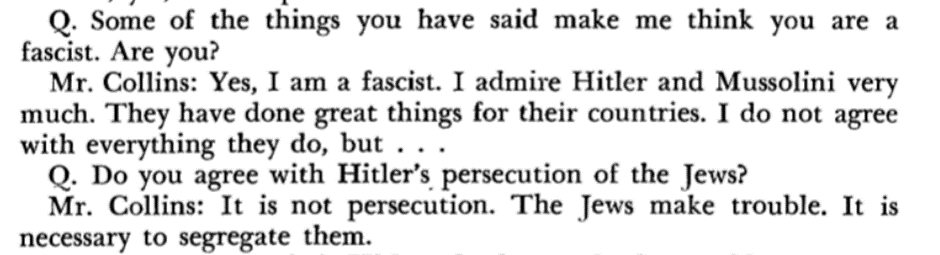
As expected, then, an undercurrent of anti-Semitic suspicion of Jews runs through the American Review catalogue, congruent in some respects with the dominant prejudices of the era. Although attacking Jews wasn’t the American Review’s main purpose, passing references describe them as alien to traditional cultures, threaded through the Communist threat, and regularly crying wolf. In his essay on tradition, Eliot noted that “reasons of race and religion combine to make any large number of free-thinking Jews undesirable” in an organic society. Collins treated Jewish persecution in the early Nazi regime as an example of American media gullibility and sensationalism. Even if reports were true, Collins thought “the fact would be almost negligible” next to the reality that the “victory of Hitler signifies the end of the Communist threat, forever” by showing that wherever Communism appeared, fascism would appear to crush it. In an exploration of German political culture, Brinkerhoff Jackson says Jews “as a race are materialistic and are also past masters of expression,” that is, verbalists.
Privately, Collins explained in 1934 how, when he was an unthinking left-winger, he “had noticed how many Jews were prominent in the ideas and activities I admired.” As he moved rightward, “I now found Jews to be prominent in every one of the movements I opposed,” and none among the thinkers he admired. He cited Belloc’s The Jews as helping him build on this noticing, although both rejected Nazi race science.
As the 1930s wore on, Collins’s embarrassing comments and comfort (or carelessness) with associating himself, and inevitably his journal, with fascism grew less tenable, especially for the Southern Agrarians. Although they were needed the money that Collins provided for contributions and were desperate for a national audience, they were confronted by Collins’s public statements. Agar withdrew his engagement. Tate, having been mentioned by Collins in an interview, wrote to the New Republic to disavow fascism, he opposed so thoroughly “that I would choose communism if it were the alternative to it.”
The American Review limped on for half a year after the FIGHT interview before shuttering. Collins disappeared into relative obscurity. He died in 1952, aged 53, virtually the same age as his father.
In the end, Collins’s efforts to create a pre-war radical conservative fusion failed. His biographer, Michael Jay Tucker, compares Collins in this respect to William F. Buckley. Where Buckley’s National Review more or less succeeded in reconciling divergent conservative impulses, Collins’s American Review did not. Tucker puts this partly down to the post-war conservatives’ embrace of capitalism, compared to Collins’s rejection of it. There is obviously something to this answer. Business interests provided one of the financial and political bases for post-war conservatism, while Collins’s enterprise was essentially self-funded. Tucker also blames Collins’s self-sabotaging commitment to his own understanding of fascism in favor of, say, Mussolini’s. Buckley, by contrast, was more careful and canny in his media appearances.
I would add, further, that Buckley embodied all of the conservative themes he published in his person, while the religiously heterodox socialite Collins did not. He was a strange champion of traditionalist ideas.
More broadly, the American Review’s failure suggests lessons for radical traditionalists. First, the certainty the journal evinced about modernity, democracy, liberalism, and capitalism proved utterly illusory. A declamatory tone is obviously one of the temptations of radical movements, including reactionary traditionalists. How do you motivate people to attack the mainstream if you don’t seem certain yourself? Yet, despite Collins’s and Hoffman’s and Agar’s protestations, capitalism and democracy survived and thrived. The American Review’s revolt came at the outset of the unparalleled dominance of American liberalism in the post-war period – the shadow of which we still live in. Traditionalists who regularly complain liberals show no epistemic humility regularly show little themselves.
Second, the siren call of foreign authoritarians is often damaging for right-wingers drawing inspiration overseas. Depictions of foreign leaders often say just as much about the people doing the depicting than they do about the leaders themselves. The American Review celebrated and defended warmongering European authoritarians whom they ultimately misunderstood. They also minimized the very real persecution of Jews. While they weren’t alone, Collins et al were easy scapegoats after the war for those looking to obscure their own fascism curiosity.
And third, the circle around the American Review was engaged in an elite project and had fantasy politics. Ross Hoffman hoped for a chivalric society of dedicated men committed to bringing about a kingly order. He was explicit that it would not be a shirt organization (like the Brown or Black or Silver Shirts). As he noted, “every such organization in America quickly becomes the prey of demagogues, fanatics, anti-Semites, Pope-baiters, and other scoundrels.”
It’s hard to take his call for a kind of Knights of Columbus for Revolution Party seriously. Across the board, the radical traditionalists reject democracy for ideological reasons. But foreclosing the possibility of mass mobilization leaves traditionalists praying for a benevolent dictator to be thrust upon them by history.
According to Collins’s son, Buckley knew about Collins. He even allegedly sought him out in order to purchase the American Review name for his own magazine, not realizing Collins had died three years earlier. In any case, Buckley settled on National rather than American Review. An older, and perhaps chastened, Ross Hoffman even found a home in the new magazine as a contributor. While the fusionism pursued by Buckley differed greatly from Collins’s revolutionary conservatism, the traditionalist critique of materialism nonetheless persisted. It came to the fore in the Catholic traditionalist magazine Triumph, which spun out of National Review’s intellectual universe, and we very clearly see echoes in postliberal discourse today. It may not be that Collins and the American Review had a direct, traceable influence (although perhaps it did). But the way traditionalist themes recur as a minority position on the right deserves deeper exploration.
Thanks for reading To Live Is To Maneuver! This post is public so feel free to share it.
No posts
Comments
Nothing yet. Say the first thing.
Sign in to join the conversation.