
The ascent of HHS leadership has revealed a critical flaw in the pre-2025 U.S. system of science and medical research. The flaw is evident in the extent to which misinformation, impunity, and ideology now govern decisions within HHS and shape national health policy. America’s science and medical research system may have been world-class before but did not have the institutional and legal safeguards to prevent a grievance-fueled takeover. This piece unpacks the COVID origins of that grievance and the imperatives for a transformation.
The threat of COVID in early 2020 catalyzed an increasing divergence in worldviews. On the one hand, many researchers and physicians quickly moved to take action in light of epidemic data from Wuhan that suggested a global catastrophe unfolding that could cause millions of deaths worldwide. On the other hand, a smaller group of researchers who had the chance to examine the same data concluded, instead, that this novel coronavirus was no more harmful than seasonal flu and would soon burn itself out with relatively modest impacts.
It is important to point out: only one of these viewpoints was correct.
COVID was catastrophic.
The pandemic led to ~20 million fatalities globally, of which 7M were documented, including 1.2M documented fatalities in the US alone.
These catastrophic impacts would have been far worse if not for efforts to control the spread initially through non-pharmaceutical interventions, later through test-trace policies, and finally via the large-scale distribution of safe and effective vaccines to billions worldwide.
Yes, COVID could have been even worse. It could have had a ‘W’ or ‘U’ shaped mortality risk profile putting infants and young adults at greater risk. Yes, Operation Warp Speed was an impressive technological feat that made it possible to design, produce, test, and scale-up the delivery of billions of doses of life-saving vaccines in a year’s time. The impact of this science-and technological-driven innovation is tempered by the fact that tens of millions chose not to get vaccinated in the US while billions worldwide never had the chance to make a choice. Yes, COVID restrictions often missed ‘end-goals’ associated with severe disease reduction, particularly in the post-vaccination period in a way that requires careful thought and reckoning.
There is ample space to have substantive discussions on many aspects of interpreting COVID data, modeling projections, non-pharmaceutical interventions, vaccine rollout, and the use of goal-setting in pandemic response. Instead, COVID revisionists within HHS leadership are disinterested in good-faith dialogue and improvements to our infrastructure. They are united by a grievance and intend to steer administration policy away from evidence and down a path of retribution.
Those who claimed that COVID was no worse than ‘seasonal flu’ were told publicly and repeatedly they were wrong. For many academic insiders, including Jay Bhattacharya, Marty Makary, Scott Atlas, and Martin Kulldorff, this kind of push-back mattered. They claimed critique was censorship (ironically while extolling the centrality of free speech and viewpoint diversity). Being confronted with evidence from Wuhan, Italy, New York City and beyond could have been an opportunity to change their minds. Instead, their dissent sublimated into grievance. Aggrieved, many turned to podcasts, blogs, and eventually, ‘objective’ outsiders to whitewash their revisionism. If COVID was no worse than the flu, then NPIs and the vaccination campaigns that shifted the tide of the response represented the greater harm.
The idea that interventions against COVID outweighed COVID’s threat is expressed most fully in Stephan Macedo and Francis Lee’s “In COVID’s Wake” (published by Princeton University Press, ironically and frankly, sadly, and now celebrated in many Contrarian circles). At no point in the book do Macedo and Lee substantively confront the actual harm of COVID, presumably because doing so would undermine their carefully packaged message. The celebration of this book by serious people suggests a type of groupthink, precisely the kind of groupthink that Macedo and Lee decry.
To understand the roots of COVID grievance, it is worth going back more than 20 years to the 2002-3 outbreak of SARS in Asia. SARS infections had high risks of mortality and ~1 in 10 infected individuals died. But SARS was contained in less than a year, rapidly controlled through conventional public health measures (and without vaccines) because most viral transmission occurred after symptom onset. As a result, individuals with symptoms could be isolated and contacts could be traced pre-emptively. The outbreak was serious and substantial, with ~800 fatalities in total. As Anderson and colleagues noted in a 2004 retrospective:
“For SARS, the timing of the onset of symptoms relative to peak infectivity is probably the most crucial factor in the success of simple public health interventions aimed at reducing transmission.”
SARS-CoV-2 aka COVID was different. COVID was far less dangerous to individuals than SARS, i.e., with an infection fatality rate somewhere closer to 1 in 100 to 1 in 150 (and not less than 1 in 1000 as Bhattacharya & colleagues claimed). Initial mortality estimates for COVID were revised downwards as more asymptomatic cases were detected, which Macedo and Lee suggest implies that public health experts over-stated the risk and that Bhattachary & colleagues were right.
Instead, the presence of asymptomatic transmission and downward mortality estimates are consistent with rapid information integration – and the difference between ‘case fatality rates’ vs. ‘infection fatality rates’. The former is often measured at the start of an outbreak as a case is associated with symptoms. Later, as testing increases, then infections are detected that never become a symptomatic ‘case’. This increases the denominator when counting fatality rates, adjusting the infection fatality rates downwards. In contrast to contrarian claims, asymptomatic infections suggested we were in even bigger trouble and made the public health challenge far more difficult than that for SARS-1. Silent spread made COVID harder to control and led to rampant spread and mass fatalities – all from a ‘less dangerous’ disease.
As of February 2020 it was already possible to estimate the potential impact of COVID. Given the viral strength of transmission and associated infection fatality rate, model estimates suggested that tens of millions might die globally from an uncontrolled pandemic and approximately 2 million might die in the US alone. This scope of impact was anticipated by an influential report from the Imperial College of London. Although flawed in some respects; the warning was correct in broad terms, and unfortunately the data bears out the prescient nature of the warning. That we did not reach even larger numbers of fatalities reflects the impact of effective (albeit imperfect) interventions, whose effectiveness was limited given the absence of a coherent, national policy, the intrinsic challenges of confronting rampant silent spread, and misinformation fueled narratives that fueled selective distrust in vaccines associated with hundreds of thousands of preventable deaths.
But this is not what Bhattacharya and colleagues claimed in early 2020 when speculating that COVID was nothing more than the flu and in follow-up interviews and discussions, e.g., as in the following Hoover Institution branded interview discussing their flawed survey of COVID antibodies in Santa Clara County:
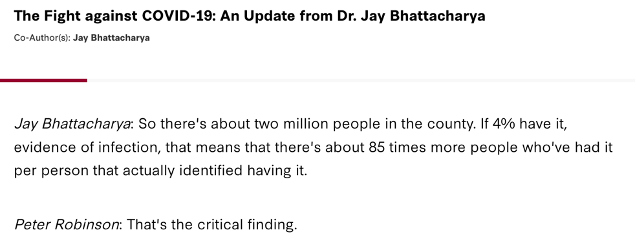
This level of missed infections implied that COVID might be comparable to seasonal flu and the danger would soon pass - but, again they were wrong:
The narrative that COVID was no different than seasonal influenza was already incompatible with large-scale mortality in New York City in Spring 2020, the request for refrigerator trucks in Texas to accommodate demand from morgues in Summer 2020, and soon, subsequent COVID surges in the Fall and beyond.
Notably, the CDC conducted a rigorous, serological survey in early 2020, finding that ~1 infection in 10 were detected during the first stages of the pandemic and even more were detected throughout the year as testing increased. These estimates diverged significantly from Bhattacharya’s claim that only 1 in 85 infections was detected. The leader of that CDC study, Fiona Havers, left federal service in Summer 2025, ‘saying she could no longer continue while the health secretary, Robert F. Kennedy Jr., dismantled the careful processes that help formulate vaccination standards.’
Bhattacharya is now the Director of NIH and the Interim Director of the CDC.
Grievance is now an industry. It is supported by journals (‘Journal of the Academy of Public Health’) made up of an editorial board of COVID minimizers allied with the Great Barrington Declaration of Fall 2020. It is supported by institutes that purport to offer a “Post-COVID agenda” for “Reforming Public Health Agencies” and offer platforms to COVID minimizers to question basic facts, e.g., as in Martin Kulldorff’s essay “Are the COVID mRNA vaccines safe?”. The proponents of these ideas see their moment. In a closed door MAHA summit attended by RFK JR, Marty Makary, Jay Bhattacharya and other members of HHS leadership in November 2025, the President of the MAHA Institute, Mark Gorton, felt emboldened enough to declare: “I’ve come to this anti-vax conference with a message that we need to be more boldly anti-vax.” Weeks ago, Bhattacharya described NIH as “the research arm of MAHA”.
HHS leaders share and amplify a common grievance. This grievance is animating policy decisions that are transforming the state and structure of American science and the health of communities. They turn to their grievance because it is the song that got them here. The hit to play at conferences and on podcasts for their fans. But the situation on the ground is changing and many are catching on. Measles is spreading nationally and efforts to curb the spread have been undermined by the same message that got them there. Undermining vaccines is a way to lose control of a vaccine-preventable disease. Claiming that healthy people don’t get infected or sick is nonsense and shameful; it blames victims for whatever ‘preexisting’ condition they might have had to get in such a predicament. None of this will ‘Make America Healthy Again’, but it will threaten the health and lives of children and families.
The roots of anti-science animus run deep. As Peter Hotez and Michael Mann explain in their recent book, anti-science can be seen as driven by the “Five P-s”, i.e., plutocrats, pros, petrostates, phonies, and the press (while keeping in mind that only a subset of journalists and the media landscape are actively involved in fomenting anti-science, but those that are active have an outsized influence). These forces have been present for decades, accelerated and fused with grievance. Post-COVID, the anti-science crowd have become the insiders. They are in control, and the buck stops with them – whether they want to accept the responsibility or not.
Since early 2025, public confidence in the NIH and CDC as custodians of public health has dropped by ~10%, a measles outbreak has reached levels not seen in 30 years, vaccine schedules have been disrupted as advisory committees have been disbanded and reconstituted with ideologues and anti-vaccination advocates, mRNA vaccine research has been cancelled, work to prevent HIV has been frozen or terminated, and the US intends to build a WHO alternative at a far greater cost and with reduced multilateral engagement. The White House continues to embrace the HHS takeover, entrusting NIH and CDC to Bhattacharya, the FDA to Makary and Prasad, and offering advisory roles to those who promoted unproven COVID cures.
Change is needed – in leadership, laws, and structure. We will not go back to the world before. Whatever the NIH, CDC, and FDA look like in a few years, it will take new leadership to support scientists and clinicians working in service of discovery and improved health outcomes. It will take new laws & oversight to ensure the independence of institutions from political interference. And, it will take new structures to build resilience into America’s world-leading science and medical research ecosystem to ensure it can flourish and remain a durable, public good.
p.s. There is much to do in the months to come. You can take concrete action in a few weeks by Standing Up for Science as part of a National Day of Action on March 7th.
Comments
Nothing yet. Say the first thing.
Sign in to join the conversation.