
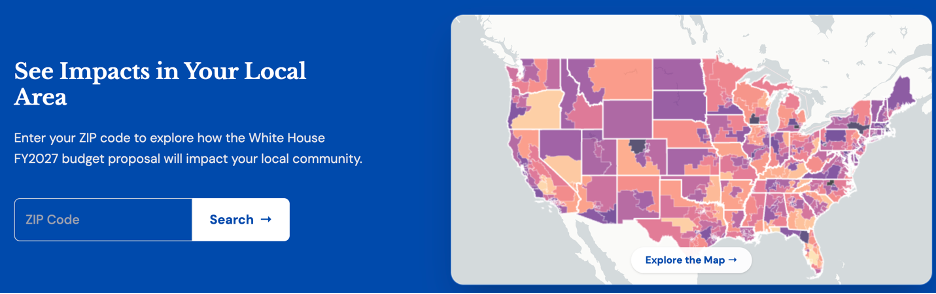
Today, our Science and Community Impacts Mapping Project (SCIMaP) team released an economic impact analysis of the White House’s proposed FY 2027 NIH and NSF budgets. If enacted, cuts to science and medical research are projected to lead to $35B in economic losses and 150,000 lost jobs in communities all across the US. This post unpacks what we found and why we have continued to focus on ways in which local communities will be impacted if the US turns its back on its long-term investment in science and medical research.
Despite Congress’ rejection of the FY 2026 budget, the stability of careers, programs, and institutions are increasingly under threat as ideology rather than evidence shapes funding and policy decisions for science and medical research. These threats permeate institutional decision making from the top and undermine the mission of science and health agencies. As but one example from this week, HHS leadership, including the former Acting Director of the CDC Jay Bhattacharya, delayed and then apparently halted the publication of a CDC-led report documenting the positive health impacts of COVID vaccines. When the political and the technical are in tension, it seems this administration will fit (or eliminate) the data to fit the narrative.
In other words: things are far from normal.
This may come as a surprise to some who heard the ‘good news’ earlier this year that Congress had approved budgets for NSF, NIH, NASA, and other science agencies that were seemingly consistent with recent appropriations. Yes, top-line funding was approved on a bipartisan basis. But, funding that has been approved is slow to go out the door (or not going out the door at all).
In practice, fewer awards have been approved and far too many promising projects have been left to wither on the vine. The slowdowns are due, in part, to newly imposed constraints on the review and award process. For example: multiyear funding has reduced award rates significantly, such that more labs face funding cliffs that could lead to permanent lab closing and an accelerated brain drain.
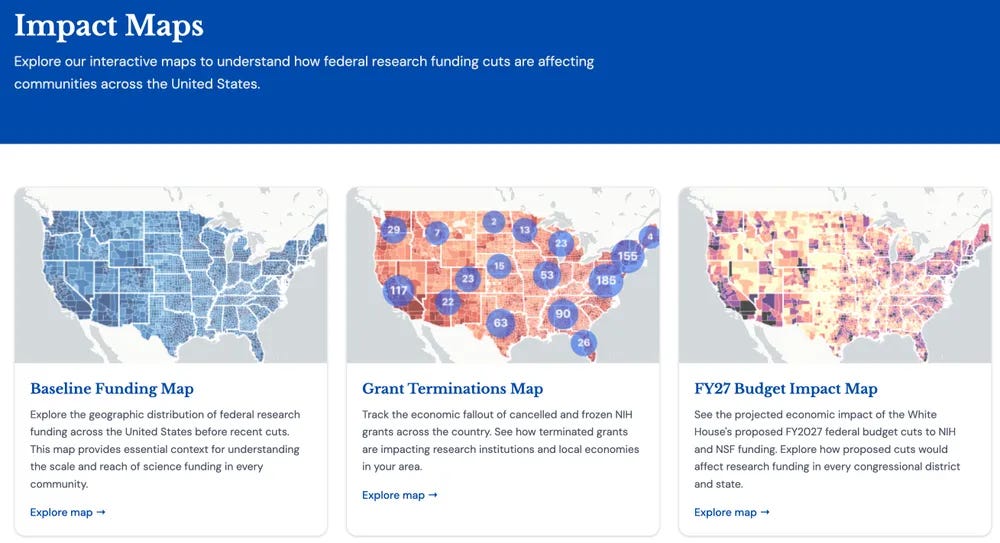
Broadly, the administration continues to implement a vision for a diminished network of independent laboratories working on publicly funded science in universities, hospitals, and research institutes. This vision is disconnected from ‘gold standard’ science, but it does come with consequences. The White House’s vision is supported by a policy agenda in which NIH and NSF (and other agencies) have reduced budgets, personnel, and capacity. The damage is real and growing. This is why our site includes:
New analysis of both the White House’s proposed NSF and NIH budgets in FY 2027 which would slash funding by billions, including in areas that are ostensibly administration priorities.
Ongoing assessment of the current and cumulative impact of grant terminations which short-circuits projects already underway and risks the future of early and established researchers.
Assessment of the White House’s proposal to slash research infrastructure support for medical research projects (yet again), even as such support remains vital to the facilities, compliance, safety checks, and management required to enable basic and translational research.
These analyses are harbingers of more to come, even as they share a particular (local) point of view.
Thanks for reading Science Matters. All posts are free, share and share away.
Our latest SCIMaP analysis confronts the narrative frame of the administration head-on by translating administration policies into local, real-world impacts. The updated website includes an analysis of the negative impacts of proposed budgets cuts AND an analysis of how investment in science and medical research catalyzes economic activity and jobs (in addition to long-term boosts to health & discovery). In each case we provide multiple scales of reference as the basis for assessing impacts.
We have focused on the impact of policy changes on local communities, precisely because of our team’s work (led by Allie Sinclair and colleagues) showing the impact of personalization and self-relevance in changing attitudes and motivating action-taking. There is more work ahead to analyze, visualize, and communicate the impacts that science and medical research has on our health, economy, and national defense in the near and long-term. Critically: those impacts are not in some faraway place, but in cities, regional hubs, and small towns throughout the US.
The centrality of localizations is precisely why we added a new feature, allowing anyone to rapidly zoom in to their local area, seeing how cuts to NSF and NIH impact communities near them. For the budget map in particular, we also include Congressional District fact sheets, connecting the research initiatives of universities, hospitals, and research institutes with catalytic impacts on economic activity and jobs.
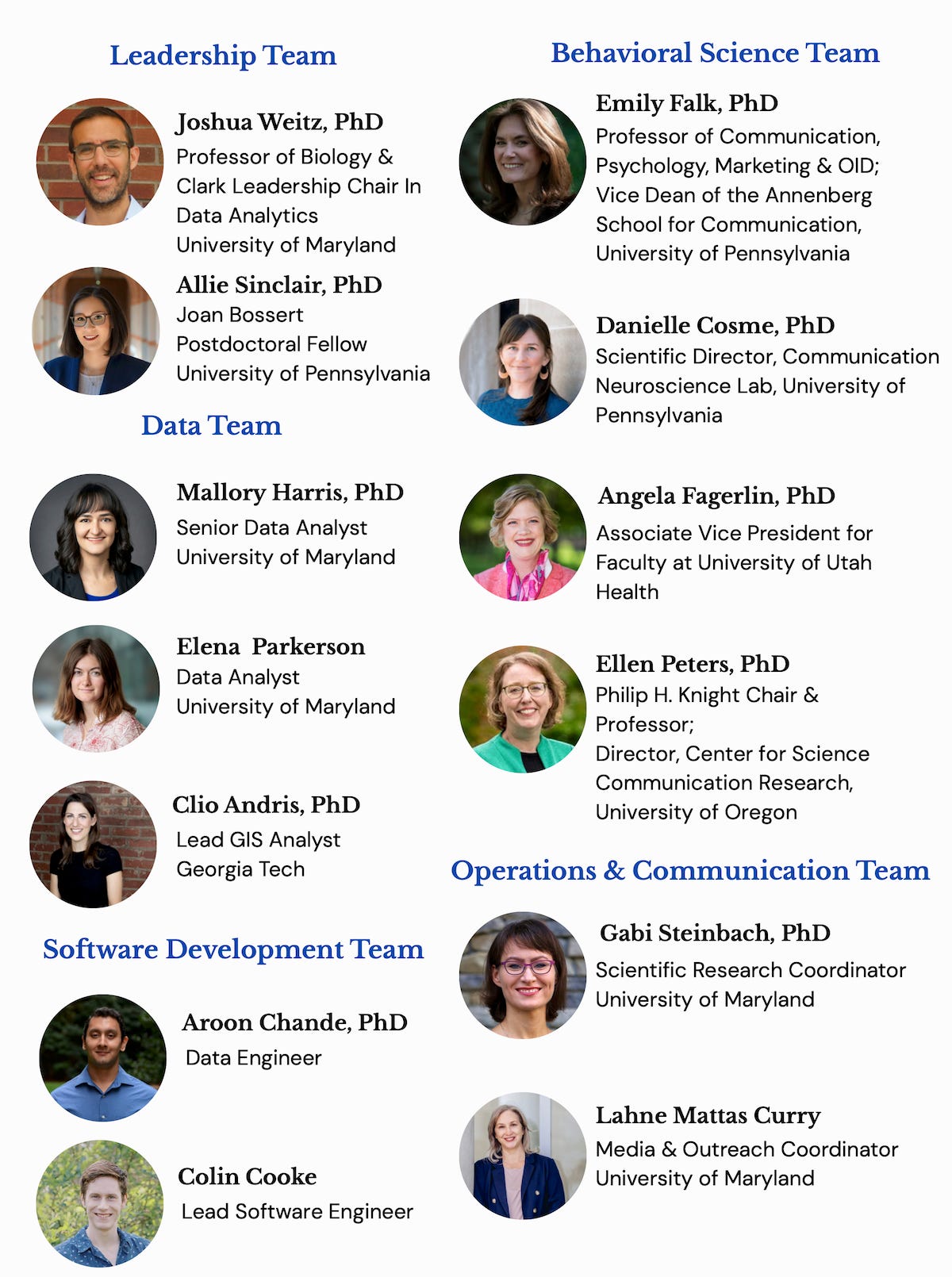
This has been a difficult year – for many and on many levels. Launched in March 2025, co-founded with Alyssa Sinclair (based at the University of Pennsylvania), and made possible, in part through support from Coefficient Giving and the Burroughs Wellcome Fund, our interdisciplinary team remains committed to broadening public access and understanding to the impacts of science and medical research. As always, I am deeply grateful for the work of the entire team spanning researchers at the U of Maryland, U of Pennsylvania, Georgia Tech, U of Oregon, and U of Utah & a core development group that made today’s release possible.
We have more to do & welcome the public to explore scienceimpacts.org and share what they discover with family, friends, colleagues, and elected officials. For readers here, I welcome any suggestions of features you would like to see in a future update. There is much left to do, both in analyzing budget impacts and in assessing the extent to which evidence rather than ideology shapes the present and future of science.
p.s. For those who want to dive in further, the SCIMaP project represents the collective work of an interdisciplinary team. Learn more about them on our website and in our Annual Report.
Comments
Nothing yet. Say the first thing.
Sign in to join the conversation.