
The mission of the National Academy of Sciences (NAS) is to recognize outstanding science, foster broad understanding of science, and provide counsel to government and society. But none of this was an offer today. Instead, in this third annual State of the Science address, Pres. Marcia McNutt shared a different view of the state & future of science – diminished, chastened, with aspirations to become industry sub-affiliates, a blueprint that (if followed) lays out a pathway towards American mediocrity.
Would a young student attending this event come away with a sense of wonder, curiosity, or interest in discovery despite efforts by the panelists at the end to ensure that is precisely what we need? The prepared remarks offered a host of examples of innovations taking place to change science at institutions nationwide, yet nearly all emphasized the need to collaborate with industry on what they view as important, reshaping education as job placement (again in industry), and valorizing the integration of AI to automate science itself. I am no longer so young, but it’s hard for me to imagine that the word ‘inspiring’ could be attached to this vision of science.
Would someone from abroad want to come to the United States to start their career in science when the NAS Presidential address repeated the structural risks of America’s apparent ‘over-reliance on foreign researchers’? Perhaps those at NAS headquarters should step out into labs and enter in conversation with global teams of discoverers whose members have made a giant leap of faith – and would stay here and build careers and lives if we see them for who they are: researchers, collaborators, friends, and community members.
Did today’s address suggest that NAS has our backs? The Presidential address only briefly mentioned the OMB regulation proposed this past Friday that would dismantle scientific independence and politicize the scientific process at its roots. The panelists were unable to muster opposition or even recognition of the stakes. But I suppose there was counter-programming in the afternoon spot reserved for courage. Stand Up For Science was holding an Emergency Science Meeting to facilitate a coordinated, timely response to the White House’s latest effort to implement their unitary executive theory and formalize political control of science (which certainly will not end well for science, scientists, and society).
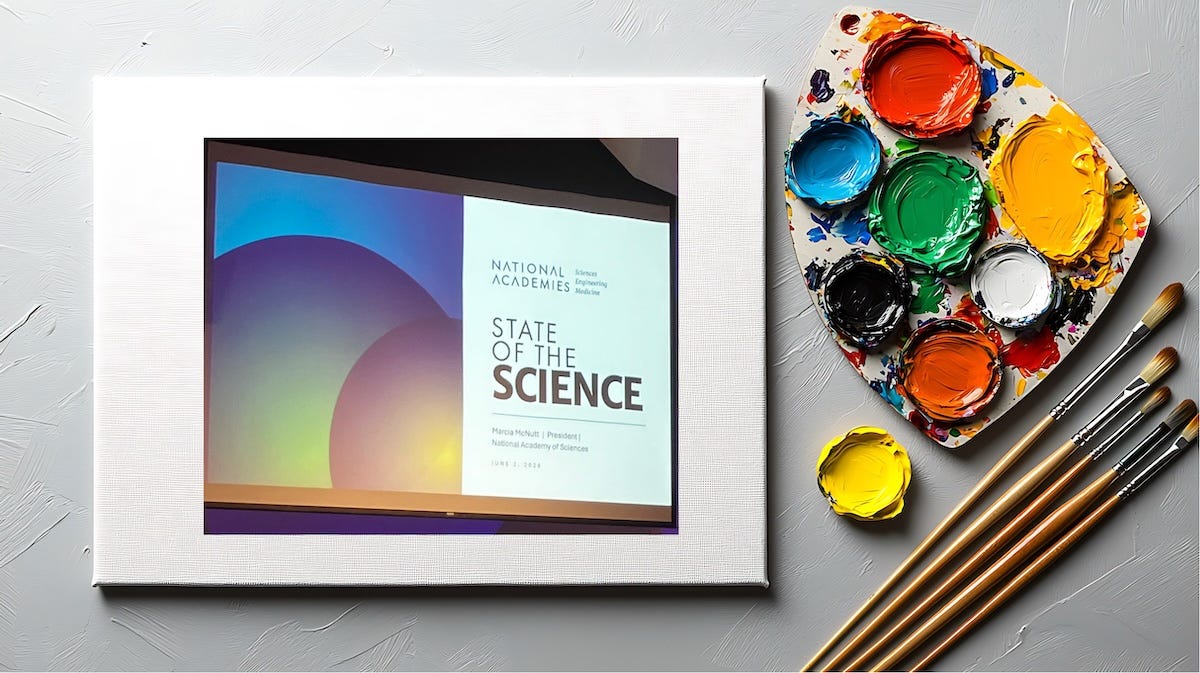
Instead, the central message of the address and the panel that followed is that we (science) have been doing things wrong, valuing the wrong things, and working with and from the wrong metrics. Apparently, it wasn’t worth mentioning that out there in the real world the current volatile trajectory of science (however imperfect it may be) stems, in significant part, to an intentional effort by this administration and allies to offer two alternative pathways: nihilism or neoliberalism capture of public funding for private industry. The panel did seem largely onboard with the industry angle – to make ourselves ‘useful’, and only rarely stepped back to explain exactly how useful science has been, quite often precisely by not trying to be useful at all.
Despite a group that included Stacie Bloom (President, Sloan Foundation), Sen. Roy Blunt, Elizabeth Bruce (Tech & Civic Engagement, Microsoft), Ethan Klein (Associate Director, White House OSTP) and Geraldine Richmond (VP for Research & Innovation, U of Oregon), the panel discussion was unfortunately, largely listless, meandering, unmarked by disagreement, and preoccupied by sharing pablum about AI. There was minimal applause in a room ready to respond forcefully if anyone could muster the courage (as Pres. Heather Wilson of UTEP did last year) to offer dissent and reinforce the need for scientific independence, evidence-driven decision making, and the rule of law until (and to his credit) the moderator Brandon Ogbunu (Yale) asked panelists to reflect on what they would tell basic scientists who have communicated their concern about the increasing role of politics in science.
A moderator offers a canvas on which others paint. The panelists in this NAS State of Science heard the question and skipped right on by, reflecting the tone and content of McNutt’s remarks, mostly painting with dull colors, blunted by an overly earnest and uncritical focus on AI, fealty to industry needs, and counseling us (despite our own eyes) to remain positive about the future while reassuring the audience that they cared about supporting the next generation of scientists.
We can in theory want to support young scientists, but it is not possible to remain uncritically optimistic on the State of the Science when leaders are unable to address what we all know: successes still occur, but they occur despite, not because of, administration policy and action-taking. In effect, the administration has become a hostile opponent to independent federal agencies, domain experts, and evidence-driven decision making. The White House has proposed research budgets that would slash the number of students and K-12 participants in science, terminated grants and fellowships, discarded advisory councils and panels, and disrupted the core pathways for entry into research careers – and they aren’t done yet.
In essence, today’s State of the Science sent a message that NAS will continue to practice strategic silence, espouse a limited theory of change that entails fixing things only within ‘our power’, thereby accepting ever-shifting baselines and not contesting the levers of power that are narrowing our choices. This way forward is a mirror, an automaton response that compiles with White House demands that we invest in what industry perceives to want now – what we study, where students spend their time, who we turn to for research funds, and how we train the next generation. Yet as was pointed out by panelist Stacie Bloom in a refreshing moment, there is a long flywheel of translation from basic discovery to real-world implementation that can stretch years if not decades. The incompatibility of present administration policy and (ostensibly) shared goals continues to reflect a failed premise: that we are engaging in good-faith negotiations with a good-faith partner (hint: we are not).
The members of NAS were elected, in large part, because they certainly would not have taken the advice on offer today. I did not come to this State of the Science to be inspired and I did not leave disappointed. But I did come to learn something. More than ever, the future of science lies with us – with the diversity of people, ideas, and systems that make science flourish.
If we are to reimagine the future, there is much work to do, we have a canvas, and if we want something brilliant, we will have to paint with bright colors.
Comments
Nothing yet. Say the first thing.
Sign in to join the conversation.