
This started as an article about data centers. More specifically, about the growing belief that AI data centers are consuming everyone’s water, overwhelming the electric grid and imposing costs on communities that never asked for them. While I am not interested in writing the industry’s defense brief, the more I read, the more I realized I was circling a broader question about how public policy debates turn into a search for the singular person or company “doing something to us,” and how quickly identifying that target starts to feel like a substitute for solving the real problems.
I am using “villain” as shorthand here, not claiming I can prove with a chart that politics became “17% more villain-centered post-2016.” People have always preferred an enemy with a name to a system with 12 causes and 6 decades of accumulated decisions. Sometimes the target has behaved badly too. Companies exploit weak rules, industries conceal costs, politicians protect donors, activists ignore consequences they do not want to own, and there are actual crooks and liars. Some of them should be punished, as I wrote about in my last post about public spending.
I just keep noticing that once we identify who behaved badly, we start acting as though we have also explained why the system produced the result. Asking what replaces the thing we stopped, who pays, what else gets worse or whether the supposedly “obvious fix” has worked anywhere starts to sound like an attempt to defend the guilty party.

Data centers are where I started because I have spent much of my career around cloud computing, which makes me both more sympathetic than average and also less inclined to take the industry’s word for anything. They create real costs: electricity demand, some heavy water use, substations, transmission lines, backup generators, large buildings and low-frequency noise. Virginia found that 29 percent of the operational properties it examined were within 200 feet of residentially zoned land, at least 15 sites had generated serious noise complaints, and under plausible growth scenarios a typical Dominion customer could pay another $14 to $37 a month by 2040 because of grid investment. The state also spent about $2.7 billion on its data center sales-tax exemption over the decade ending in fiscal year 2024, more than half of all state economic-development incentive spending during that period.
I would not want one built behind my house. A family should not have to absorb more noise, a lower property value or a higher utility bill because a company and county government liked the tax math, and communities should be able to reject projects that impose more cost than benefit. When a project does proceed, the people carrying a concentrated local cost should be compensated fairly. But those questions often become secondary and stopping the data center becomes the only proposal, instead of setting water prices, utility rate classes, setbacks, noise rules, impact fees or focusing on who pays for a substation built around a demand forecast that may never arrive.
AI tech companies made this harder by spending several years terrifying the public. Leaders promised extraordinary wealth, better medicine and transformed education while warning that whole categories of work would disappear. OpenAI CEO Sam Altman said jobs were “definitely going to go away, full stop.” Then in 2025, Anthropic CEO Dario Amodei said AI could eliminate half of entry-level white-collar jobs and push unemployment to 10-20% within 1 to 5 years. Amodei, Altman, Demis Hassabis and hundreds of others also signed a statement putting the risk of human extinction from AI alongside pandemics and nuclear war!
Then the same industry asks for hundreds of billions of dollars of infrastructure, new power generation, faster permits and public patience. You cannot tell people that your product may take their job and possibly kill everyone, then act baffled when a county planning meeting becomes tense. The public can reasonably conclude that the people building these systems are not in control of the situation, or at minimum that they used apocalyptic scale as marketing to establish the importance of their work, and economic abundance when it justified the infrastructure, which is a pretty convenient sequence and not the most reassuring set of slides ever presented.
There is a more charitable interpretation, which is that the technology is developing quickly, the effects are genuinely difficult to predict, and in May 2026 Altman said OpenAI had been roughly right about technical progress and pretty wrong about the social and economic consequences, including his own expectation that more entry-level white-collar jobs would have disappeared by now. People should correct themselves when the evidence changes. Still, “we are thinking out loud about whether our product destroys the labor market or humanity” does not produce much trust, and those statements do not vanish when the company later explains reclaimed water and minimum-demand charges.
Some of the anger is earned. Technology companies have too often bundled informed local objections with uninformed hostility, and treated the water line, substation, tax exemption, noise and disruption imposed on nearby residents as costs everyone else was simply expected to absorb. That was a mistake, but it still does not tell us whether data centers are the water problem we keep being told they are.
The standard version is simple enough: Data centers consume water to cool computers, AI requires more data centers, many places are already short of water, therefore AI is taking water from people and agriculture. Every sentence is true and the chain is still misleading, starting with the fact that “water use” describes several different things. A facility can withdraw water and return some of it, consume water through evaporation so it is no longer locally available, use water directly for cooling, or cause water to be consumed somewhere else because the power plants generating its electricity also use water.
First, that last category is much larger nationally. Lawrence Berkeley National Laboratory estimated that U.S. data centers directly consumed about 66 billion liters of water in 2023, roughly 17 billion gallons, while electricity generation for those data centers indirectly consumed nearly 800 billion liters, about 211 billion gallons. The indirect number is modeled using regional grid water intensity, so it does not capture every facility’s specific power contract or on-site generation, but the national result is still important: most of the estimated water footprint came from producing electricity, not from water running through cooling equipment inside the data center.
This creates an engineering tradeoff that disappears in the slogans. Evaporative cooling generally uses more water at the site and less electricity, while air cooling can bring site water consumption close to zero but use more power, and producing that power may consume water somewhere else. A rule can produce a “big beautiful local number” while shifting the water use to another county. That may still be the correct decision during a drought, but now we are discussing location, scarcity, grid composition and price, which unfortunately requires more than a photograph of a cooling tower with an angry caption underneath it.
I had also assumed the national data center number would be large, and somewhere around on-par with other heavy water-use industries, such as agriculture. It is not even close. The U.S. Geological Survey estimated that irrigation consumed about 73.2 billion gallons of water per day in 2015, roughly 26.7 trillion gallons over a year. Direct and modeled indirect water consumption for every U.S. data center in 2023 came to about 229 billion gallons, less than 1% of that older irrigation figure, and direct data center consumption alone was about six one-hundredths of 1 percent (0.06). These are different years and different methods, so I would not pretend that 0.86% is some precise universal ratio, but it gives us the order of magnitude and the order of magnitude is… not close.
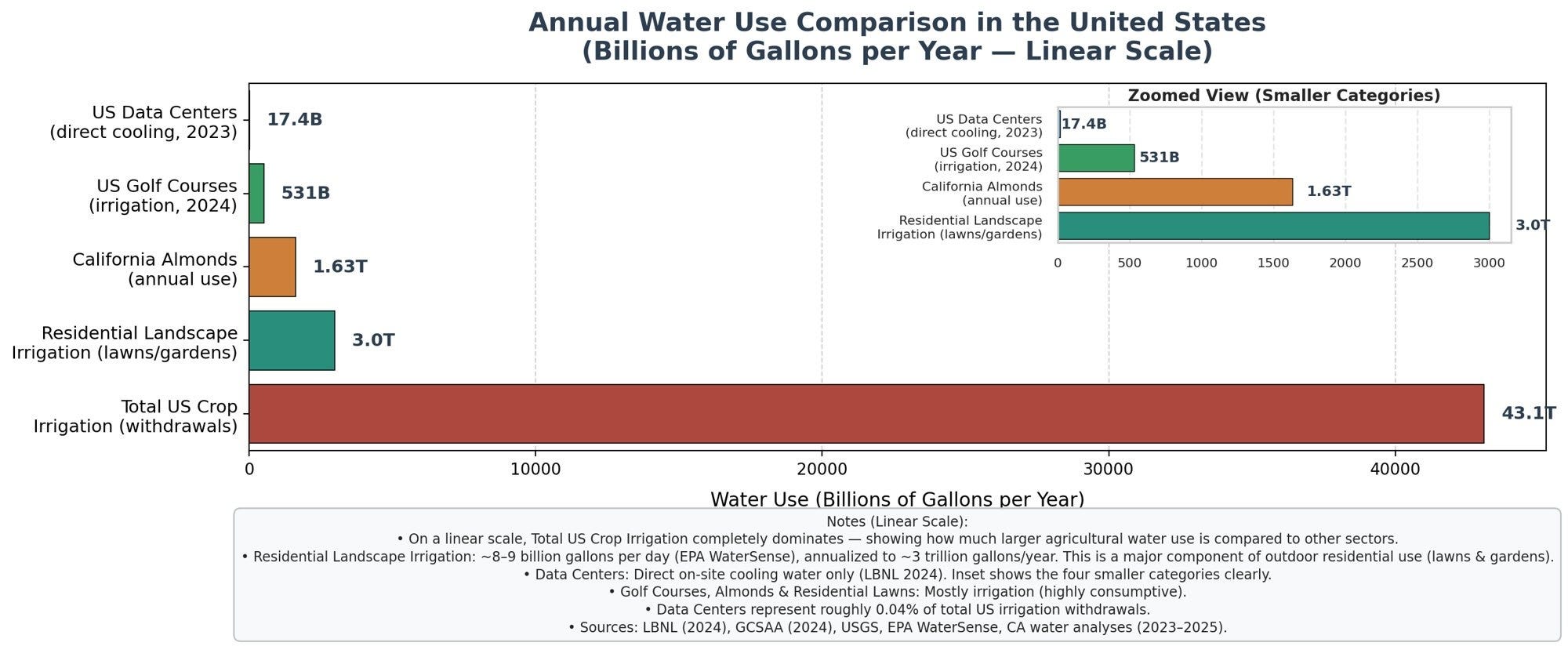
It is fair to say that national totals can mislead in the other direction too. Water in Oregon does not help a town in Arizona, and an annual average can hide peak demand or one unusually thirsty building. Even there, Virginia found that most data center buildings used no more water than a large office building (page vii), while 11 used more than 50 million gallons in 2023 and one used 243 million gallons. Now while a resident near that facility does not care that agriculture uses more nationally (nor should they), the question should be what a particular project consumes, from which source, during drought, and what the operator pays.
That ought to push the debate toward local prices, limits, reporting requirements and drought rules. Instead it often becomes a story about AI drinking the country dry, because the data center is new and visible and owned by a company everyone has heard of, while most water allocation to industries & residential uses was decided a long time ago through systems that require several evenings of reading before you can even become properly angry at them.
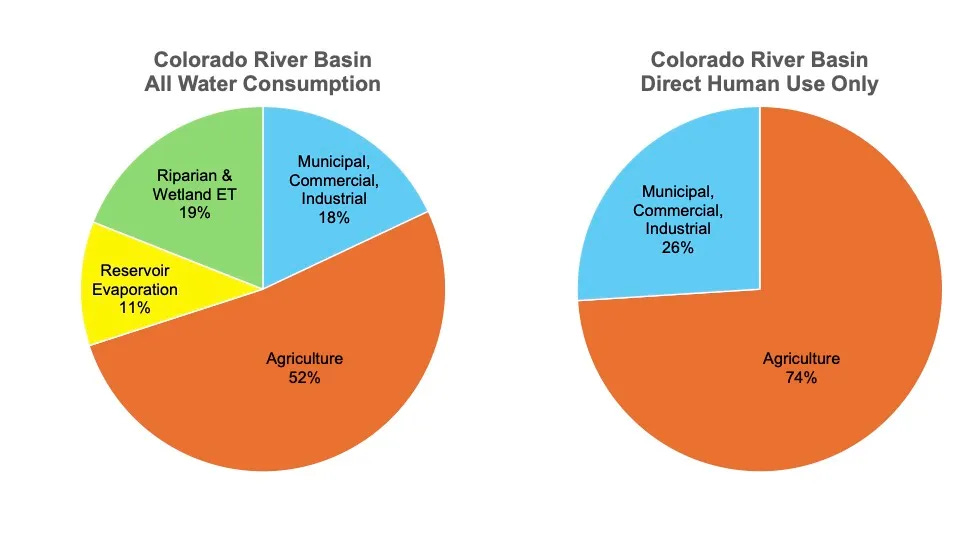
Arizona says irrigated agriculture consumes about 72 percent of the state’s available water supply. Across the Colorado River Basin, a 2024 accounting estimated that irrigated agriculture represented 74 percent of direct human consumption and 52 percent of all consumption once reservoir evaporation and other losses were included, with cattle-feed crops, mainly alfalfa and other hay, accounting for 46 percent of direct human consumption.
Alfalfa is almost designed to become a villain crop. It takes a lot of water, much of it feeds cattle rather than people directly, some is exported, and it is grown in a desert, which sounds insane until you remember that nearly all agriculture in the arid West sounds insane if you describe the climate and leave out the canals. The Imperial Valley makes the scale hard to ignore. University of California researchers reported that more than 170,000 acres of alfalfa in California’s low desert use more than 1 million acre-feet of water each year. All U.S. data centers directly consumed the equivalent of roughly 53,500 acre-feet in 2023, so this one agricultural region applies nearly 20x as much water to alfalfa as every U.S. data center directly consumes at its facilities.
I initially thought this was the killer comparison, and it is not quite, because these are not actually the same measurements. The alfalfa figure is applied agricultural water in one region, the data center figure is direct consumption nationally, return flows matter, the years differ, and none of it tells us whether a particular data center belongs in Phoenix. Despite that, it does tell us something about scale, and about which water users become national symbols. Agriculture is old and tied to land, food and communities. A data center has a powerful corporate owner, a planning application and a rendering of a large gray box that looks like the place in a movie where they manufacture the Terminator robots before everything goes terribly wrong.
Farmers also have reasons to plant alfalfa. It tolerates drought and interrupted irrigation, recovers quickly, fixes nitrogen in the soil, requires relatively little labor and supports a large dairy industry. The same Colorado River study that documented its enormous water share explained why farmers keep growing it, which means any serious attempt to reduce that acreage has to compete with those economics rather than announcing that hay in a desert is ridiculous and waiting for everyone to agree.
Then there are the rights. Arizona surface-water law follows “prior appropriation, first in time and first in right”, and those claims sit inside contracts, court decrees and local economies built around them for generations. “Charge farmers the real price” sounds sensible until you ask whether that means delivery cost, scarcity value, what a city would pay or the ecological value of leaving water in the river, and who absorbs the losses in a farm town and so on. We can answer those questions, but the answers reduce somebody’s real income or property value, so the debate usually finds a cleaner, newer target first.
Arizona found one recently in Fondomonte, a Saudi-owned company growing alfalfa for export on state land while pumping groundwater. The state canceled one lease and declined to renew others after finding violations, and there were good reasons to do that, but removing the company did not change the fact that agriculture consumes nearly three-quarters of Arizona’s available water. The Imperial Irrigation District tried something much less exciting in 2024: it paid farmers nearly $50 million to stop irrigating 154,145 acres of alfalfa and other grasses for part of the season, conserving 172,266 acre-feet, and its 2026 program pays $334 per acre-foot for verified reductions, including physically locking delivery gates during the conservation period.
Maybe the payment is too high, maybe temporary fallowing is not enough, maybe it damages farm towns if it expands too far, maybe paying people not to use a public resource they received cheaply generations ago makes you want to throw something. Fair enough. At least the program starts with the water we want to conserve, the people who control it, the price they will accept and a way to verify that the irrigation stopped. It is not a very rousing chant, but 172,266 acre-feet is more water than a chant usually saves.
I also kept coming across Indian Point in New York, because it shows what happens after the “frightening object” is finally removed. The nuclear plant sat on the Hudson about 25 miles north of Midtown Manhattan, its last two reactors supplied more than 2,000 megawatts, and it imposed real local costs. Its once-through cooling system could withdraw as much as 2.5 billion gallons of Hudson River water per day, and New York’s environmental proceeding estimated that it killed nearly a billion fish, eggs and other aquatic organisms each year. There were also legitimate concerns about an aging nuclear plant near a very large metropolitan area, even though the chance of a catastrophic accident was low.
When the shutdown agreement was announced in 2017, the Natural Resources Defense Council called it “great news” and said the plant would close without increasing carbon emissions because efficiency, renewable generation and transmission would replace it. Unit 2 closed in April 2020 and Unit 3 in April 2021. What came online around the same period included three natural-gas plants totaling more than 1,800 megawatts, and New York’s own greenhouse-gas report says emissions assigned to imported electricity rose after 2021 largely because Indian Point closed. The New York Independent System Operator now describes the retirement as the loss of a significant amount of round-the-clock, zero-emission generation.
I wanted to say closing Indian Point clearly raised everyone’s bill, but I cannot prove that. A retail bill includes fuel, transmission, distribution, taxes, weather, hedging decisions and a surprising number of other things available to ruin your afternoon. What I can say is that New York removed a major zero-carbon generator, replaced much of the near-term supply with gas and imports, and did not get the environmental outcome promised in 2017. Maybe protecting the Hudson and eliminating nuclear risk made the trade worthwhile? I just wish the celebration had included where the electricity would come from on Tuesday night after the press conference, because the grid did not accept the moral victory as a form of generation.
Housing makes this almost impossible to miss because the shortage is in front of us and we still spend most of the argument yelling about landlords, developers, investors or rich newcomers. Some landlords are terrible, developers exploit loopholes, and tenants need protections against unsafe buildings, harassment and fraud. None of that explains why New York City’s rental vacancy rate was 1.4 percent in 2023, the lowest since 1968, with about 33,000 apartments available citywide. There are not enough apartments, period, full stop.
But I recognize that rent regulation does something real for the person who already has one. It can keep a family in its neighborhood, protect an older tenant from a sudden increase and prevent a landlord from capturing every dollar of value created by a city the landlord did not build. The San Francisco rent-control study people cite in these arguments found that covered tenants were nearly 20 percent more likely to remain at their addresses, which is not a trivial benefit if the alternative is leaving your school, your job, your doctor and everyone you know. On the flip side, the same study found that affected landlords reduced rental supply by 15 percent through conversion and redevelopment, contributing to higher market rents.
That stability has another side that almost no individual tenant can reasonably be expected to solve. Once someone has an apartment renting far below the market, moving can become financially insane. A couple whose children left may stay in a three-bedroom they no longer need. Someone may keep an apartment nowhere near a new job, or decline to move in with a partner, because giving it up means trading a manageable rent for whatever fresh horror StreetEasy has prepared that morning. Nobody is behaving irrationally. The policy changes the cost of leaving, turnover falls, and the scarce apartments become even harder for a younger renter to find. New York’s comptroller has noted that lower rents guaranteed by stabilization discourage people from leaving and that stabilized vacancies fell nearly 40 percent after 2021, reducing the chance that a new Gen Z renter will find one.
The person receiving a rent freeze exists, can testify at a hearing and knows exactly what the vote means to them. The person who will need an apartment in 2031 is currently in college, living with parents, married to someone they may later leave, or in another city entirely. They do not show up. So New York’s Rent Guidelines Board adopted a zero-percent increase for one- and two-year stabilized leases beginning in October 2026, even though its operating-cost index said costs rose 5.3% in the preceding year, including fuel up 11% , insurance 10.5% and maintenance 6%. That does not mean every landlord is going broke (the finances vary enormously, and landlord groups are not famous for understating their suffering), but a zero increase against rising costs is not a program for producing housing. It is immediate relief for the subset of people fortunate enough to already occupy the regulated units, with the costs surfacing later through some mixture of lower returns reducing new development, deferred work, fewer improvements and an even wider gulf between the protected market and everyone outside it.
I also heard a popular claim on the other side that New York’s 2019 tenant law, that it caused landlords to warehouse some vast hidden inventory of apartments. The city comptroller found no evidence that the law produced a broad increase in stabilized vacancies or distress, and estimated that fewer than 2,000 low-rent units were being held off the market because owners could not afford repairs. That is still a problem worth fixing, but it is not a secret supply large enough to solve the housing problem, unless New York City has quietly shrunk to the population of a comfortable suburb.
In the end, you are not going to publicly finance your way to enough apartments in New York. Most of them will have to be built by private developers, including developers people viscerally dislike, and many of the new apartments will be expensive at first because new housing in New York is expensive to build. That does not mean poor people can wait 20 years for the market to work its way down. You still can consider vouchers, public housing, supportive housing and targeted subsidies for people an abundant private market will not serve. But without abundant private construction, those programs are fighting over a fixed and inadequate supply, which is how you end up spending more money to help each person while helping fewer people.
The research here is less mysterious than the politics. More housing supply reduces rents or slows their growth across a region, and the chains of moves created by new construction free older homes that are eventually occupied by households across the income spectrum. It does not happen instantaneously or perfectly. A luxury tower does not cause an affordable apartment to pop into existence three blocks away by Thursday. It adds homes to a market that does not have enough of them, and over time people move through the stock instead of all competing for the same aging set of apartments.
Boring and counterintuitive enough that it loses politically. A new tower looks like a gift to developers and rich tenants, while a rent freeze looks like help for ordinary people, even though the tower adds hundreds of apartments and the freeze adds zero. Then another tax, review, mandate, hearing or discretionary approval makes the next project harder, fewer projects start, and everyone is shocked (again) when the remaining apartments cost more. The person with the grandfathered lease thanks the politician. The family or newcomer refreshing listings gets another speech about greedy landlords, higher rent, or a new application form to fill out.
There is a much darker version of this habit: the search for “one true villain” behind all of society’s problems. An argument about data center water carries nowhere near the same moral weight as antisemitism or racial scapegoating, and I do not mean to suggest otherwise, but the comparison is about the method of explanation. A complicated system is reduced to a visible target, and every new problem becomes further proof of that target’s guilt.
Antisemitism has blamed Jews for wars, disease, financial crises, communism, capitalism and social disorder, often through mutually contradictory accusations. The contradictions do not weaken the theory because evidence was never the point. The United States Holocaust Memorial Museum describes scapegoating and conspiracy theories as recurring forms of antisemitism, especially during periods of social, economic and political upheaval.
There are also legitimate arguments about immigration levels, border control, asylum abuse and pressure on public services. Those arguments become something else when immigrants or minorities are treated as the explanation for all crime, unemployment, terrorism or cultural decline.
The stakes in these examples are very different, but the mechanism is familiar. Anxiety gets assigned to a visible group, and once guilt feels settled, explaining how the system actually works starts to sound like making excuses.
Most political factions have a preferred cast that supposedly explains everything: immigrants, Jews, billionaires, landlords, corporations, bureaucrats, developers, environmentalists, unions or police. Any one of them may deserve criticism for specific actions. None can explain the whole system. In the worst cases, the accusation is not an argument at all but serves as a reason to stop asking questions and decide whom to punish.
The boring response to data center growth is easy to describe and difficult to implement well. Put very large loads in a separate utility class, make them pay for the generation, transmission and new substations, require minimum payments before a utility builds around speculative demand, charge more for water where water is scarce, set drought rules before the drought, publish direct use and peak demand, enforce noise limits, establish setbacks, charge impact fees, compensate neighbors for measurable losses, end tax exemptions that cannot demonstrate a public return. Virginia’s analysts recommended versions of the separate rate class, minimum contracts and stronger cost allocation.
Agricultural water gets a different long paragraph (or three) with the same general character: buy, lease or retire rights where the public values water more than the crop, stop subsidies that contradict conservation goals, pay for verified reductions, measure the result and change the price when the result is not worth what we paid. Housing means allowing many more homes to be built and helping people who still cannot afford them, rather than trying to make a shortage affordable by freezing the price of whichever units happened to exist before the freeze. Energy means deciding what replaces a plant before celebrating its closure. Implementation would take another article and include bad rates, gamed measurements, corrupt fees, loopholes, unintended damage and probably three agencies arguing about whose spreadsheet is official.
Implementation is not even the first obstacle, and accurate pricing feels weak when what the public wants is punishment.
Nobody wants to hear about a minimum-demand charge when they fear the data center will become the headquarters of a robot apocalypse; or about building another 100k apartments when to them, developers are evildoers swimming across lakes of money à la Scrooge McDuck; or about replacing generation when the nuclear plant is seen is an environmental emergency.
The idea of “appropriate fair-market compensation” feels like surrender because it admits the activity you dislike will continue. The idea of measuring the impact & response is also dangerous because your side can turn out to be wrong, and nobody spent six months calling strangers murderers on social media in order to care to learn that the revised utility tariff was working pretty well.
This makes ordinary corrective policy feel morally inadequate, so officials produce bans, freezes, symbolic restrictions, subsidies for the favored side or nothing, and the system keeps producing the same outcomes. The data center load still gets served somewhere, usually in a more business-friendly, lower-regulation, even less-environmentally-minded state. New York still needs electricity at night, a family still needs an apartment after the hearing. The winner from a freeze or shutdown can say thank you today, while the person paying through a higher bill, a dirtier grid, a deteriorating building or an apartment never built may not know which decision did it, and may not have lived there when the decision was made.
To be fair, I understand why politics works this way. Most people do not have time to learn utility rates, consumptive water accounting, prior-appropriation law or housing filtering. I did not understand several of these details before I started looking, and this is the tech industry, which I thought I knew pretty well! A singular villain compresses the problem into something repeatable and gives us something satisfying to do. Sometimes the target deserves much of the anger. That still does not make the target a “model” for a system that would both satisfy needs and solve any real problems.
I wish we had more of the other kind of debate, where we admit that some data centers should pay more, a few should have their project revised to address noise or other complaints, and perhaps a few should be outright rejected. Just like some agricultural water should be bought back; some tenants need protection and many more apartments need to be built; nuclear power has risks and closing it can raise emissions; and none of those facts cancels the one beside it. I am increasingly convinced we will never have that debate, because discussing real tradeoffs leaves almost everyone somewhat unhappy and nobody completely innocent. It also requires letting some amount of the activity you dislike continue, which is difficult to put on a sign and even harder to celebrate at a rally.
By the time I got through the data center water numbers, Indian Point, rent freezes and the rest of it, I kept wanting one of these examples to produce a clean answer and none of them did. Every serious option leaves someone paying more, giving something up, accepting a risk or losing a benefit they had come to treat as permanent, and pretending otherwise is usually how we end up with the symbolic policy, the triumphant press conference (or tweet) and the same underlying problem five years later. Which is why I keep coming back to Thomas Sowell’s line: “There are no solutions. There are only trade-offs.”
If this was worth reading, share it
Comments
Nothing yet. Say the first thing.
Sign in to join the conversation.