
Reminder: there’s still time to pre-order my upcoming book and get my “Genius Toolkit” as a free bonus (details below). Huge thanks to all of you who’ve pre-ordered it already!
In 2001, I got a banjo for Christmas. It was my first year of medical residency, one of the most grueling years of my life. I was working 80 to 90 hours a week.
In other words, I had hardly any time to practice, and certainly no time for regular lessons with a teacher.
On top of that, other than being a music lover, I didn’t have a musical background. Neither of my parents played an instrument.
But I’d always loved the sound of the banjo. Just strumming the open strings of my new banjo sounded so good. I desperately wanted to learn how to play it.
But was I delusional to think that I could?
I decided to crowdsource this question. This was the early days of the internet, back when forums were big. And so I went onto the banjo forums to get the general consensus.
The verdict: don’t bother.
Not the answer I wanted.
To learn to play the banjo well, they told me, you needed to do three things. Start young. Have natural ability. Practice several hours a day.
Without those three, I might manage to feebly plod my way through a few simple tunes. But that was the best I could hope for.
Given my circumstances, I’d be better off just selling the thing. I’d probably get more joy from the proceeds than from playing it.
But part of me still wasn’t convinced. That skepticism came from a mix of my own experience with conventional wisdom and, more importantly, from what I’d learned about the brain.
I was a neuroscience major in college, and I was especially interested in learning and plasticity. The conventional wisdom on the forums was grounded in the idea of a fixed brain, one you’re issued at birth with a set of natural abilities and aptitudes.
The emerging research was showing something very different. It said I could learn to play.
So, against the advice of the experts, I gave it a go. I bought a book on how to play and set about my journey to guaranteed disappointment.
I practiced in the cracks in my day, rarely more than 20 minutes at a time, a few times a week at best. I knew that if this was going to work, I had to make the practice count. So I prioritized quality over quantity, taking what I knew about how the brain learns and building it into how I practiced.
And, lo and behold, I started getting better. In a matter of a few months, I could play things I never thought I could. Maybe the skeptics were wrong, after all!
But then came a rude awakening.
At a banjo camp, one of the instructors I admired asked me to pick a tune with him.
He kicked it off, and it might as well have been my first time ever touching the instrument. Everything I thought I knew was gone. Total train wreck.
Maybe the skeptics were right after all.
Maybe I could play well enough in the comfort of my living room, but making music with other people was reserved for the musically gifted.
Or maybe I just needed to change my approach. Maybe it wasn’t my ungifted brain that had let me down. Maybe it was how I’d been learning. So I changed up my practice.
I realized that if I wanted to reach my goals, I had to be able to play by ear, which I couldn’t do at the time. The books didn’t teach that. And I’d been told, in no uncertain terms, that you can’t learn to do that. That you’re either born with the ability to play by ear or you aren’t.
Once again, I thought the brain science was suggesting otherwise. And once again, the skeptics turned out to be wrong. My ear was the roadblock, and training it got me around it.
Through this approach, not only was I able to learn banjo, but also guitar, ukulele, fiddle, and piano, learning them all as an adult with a busy schedule.
It wasn’t the brain I was born with, but the brain I built. And if I could do it, so could anyone.
That was the spark that became the Brainjo Method of instruction, the company Brainjo, and later the book Anyone Can Play Music. Because of it, thousands of adult beginners all over the world are now making music they’d been told they’d never be able to make.
That decision to start — and stick with — the banjo has changed and enriched my life in more ways than I could’ve ever imagined.
Had I listened to the conventional wisdom, that typical story about music brains and natural aptitudes, I never would have started.
And when I got humiliated at that banjo camp, I would have taken it as proof that the story was right all along, that I just didn’t have it, that you’re either born able to play by ear or you’re not.
A different story is what changed my life.
That’s the same story I take aim at in my new book, The Genius and the Impostor. I call it the Special Brain Story.
It’s the story most of us inherited. It says we’re all born with different kinds of brains. Math brains, music brains, art brains, and so on.
It says we each come with a certain quantity of intelligence, like every brain is issued its own fixed amount of smart juice.
And the kind of brain you have, along with how much smart juice you got, determines what’s possible for you. It determines what you can do with your mind. The greatest minds, the Einsteins of the world, simply got the most.
This story is wrong.
That story was written before we understood the brain at all. Our whole account of human intelligence and potential was written without any regard for the organ that intelligence and potential actually comes from.
That’s like explaining how circulation works without ever studying the heart. Or how digestion works without ever looking at the stomach. Of course it isn’t going to be right.
I’ve studied the brain my entire life. And when you start with the brain, you end up in a very different place.
The special brain story is wrong. And whether you ever notice it or not, that story shapes the entire arc of your life.
And the special brain story reaches far beyond music, or any single endeavor. It shapes what you’ll take on and what you’ll walk away from, because you’ll never even start what you think isn’t possible.
But the accurate story, the one that actually starts with the brain, is a far more hopeful one. It says your capacity is something you build, in music and in everything else.
That’s what The Genius and the Impostor is about. Because understanding what you’re truly capable of begins with understanding how your own brain actually works, and who you really are.
The Genius Toolkit is my own field guide to getting into, and staying in, the brain state where your best work happens.
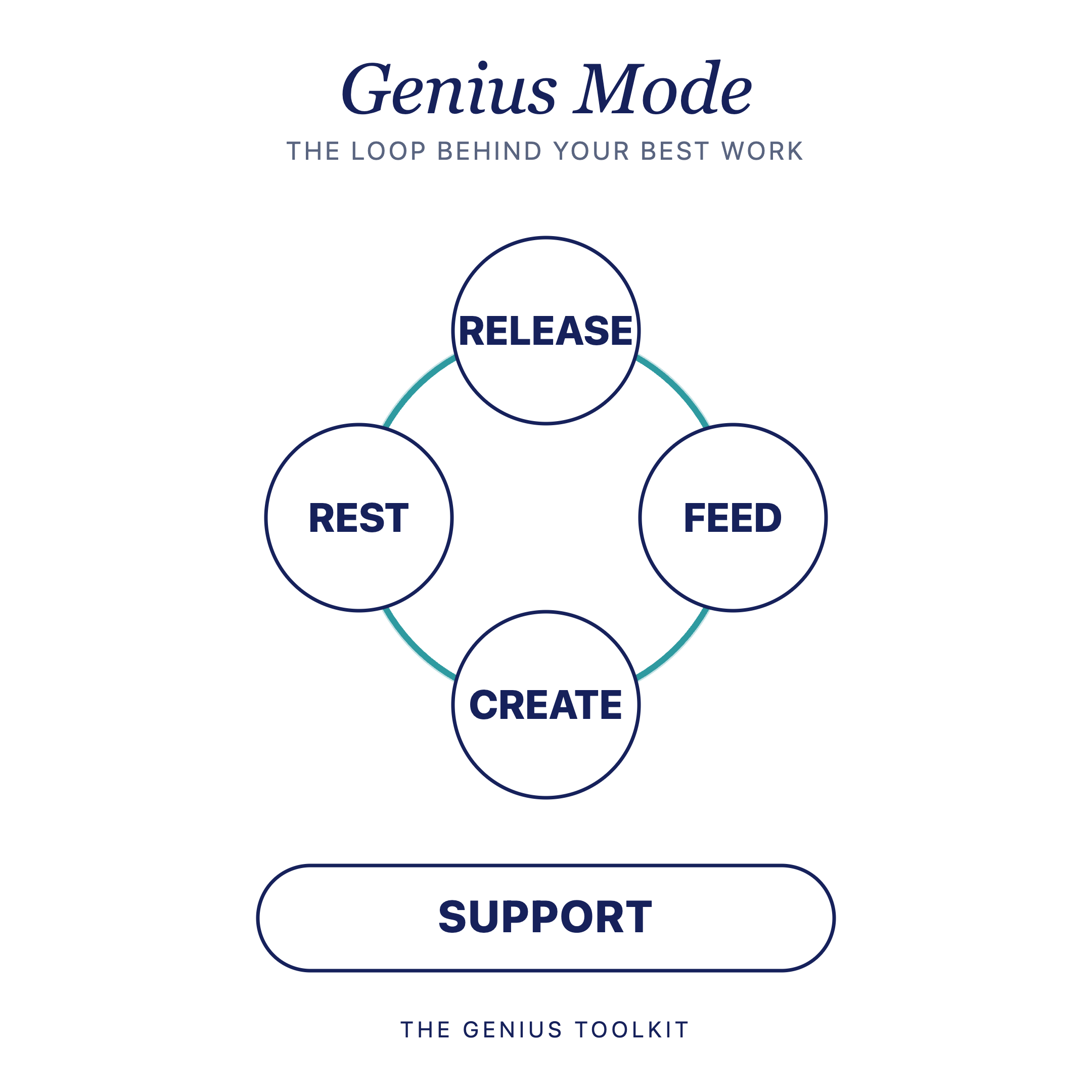
That’s the virtuous cycle for unlocking your Genius Mode. In the toolkit, I’ll walk you through each of the steps, and tell you what each of them looks like in my own life.
Pre-order the book → Amazon, Barnes & Noble, Bookshop
Forward your receipt to geniustoolkit@gmail.com.
I’ll email the toolkit right back.
That’s it! And when you read the book, I’d love it if you let me know what you think — that’s the part I look forward to most!
The Genius Toolkit is my thank-you for pre-ordering, and it’s only available until the book comes out on August 25. If you were going to read it anyway, ordering now is how you get the toolkit with it (and pre-orders are actually a huge help for a new book).
No posts
Comments
Nothing yet. Say the first thing.
Sign in to join the conversation.