
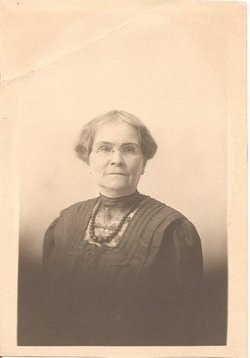
Earlier this week marked the birthday of my grandfather’s grandfather’s father, on my father’s side. His name was Charles Albert Simonds, and he was born in Whitefield, New Hampshire, on August 11th, 1849. I’ve learned a lot about him over the years by digging into my family history via Ancestry.com. Old records, photographs, and newspaper clippings have all helped me grow closer to him.
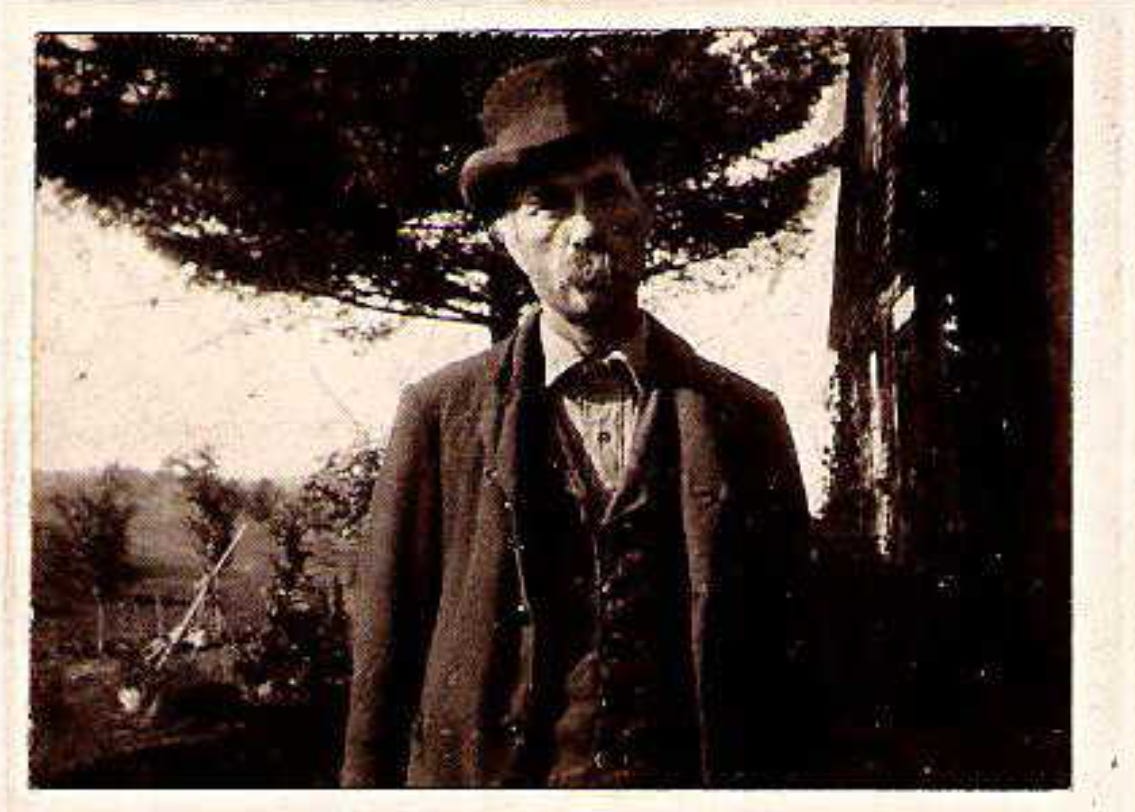
By doing that research, by doing that digging, I’ve found an enormous difference between understanding how he existed and actually knowing something about his life. On its surface, genealogy tends to reduce people to two dates with a line between them, telling us when somebody arrived in this world and when they left it. Sometimes we’ll find out who they married, and perhaps where they were buried. I love all that information and will happily lose hours of my life chasing it down, but those facts alone don’t tell me very much about a person. I want to know what they did during all those years between the dates, and with Charles, what kind of husband or father he was. I want to know where he went to work, who his friends were, what kind of trouble he got himself into, and what people remembered about him once he was gone.
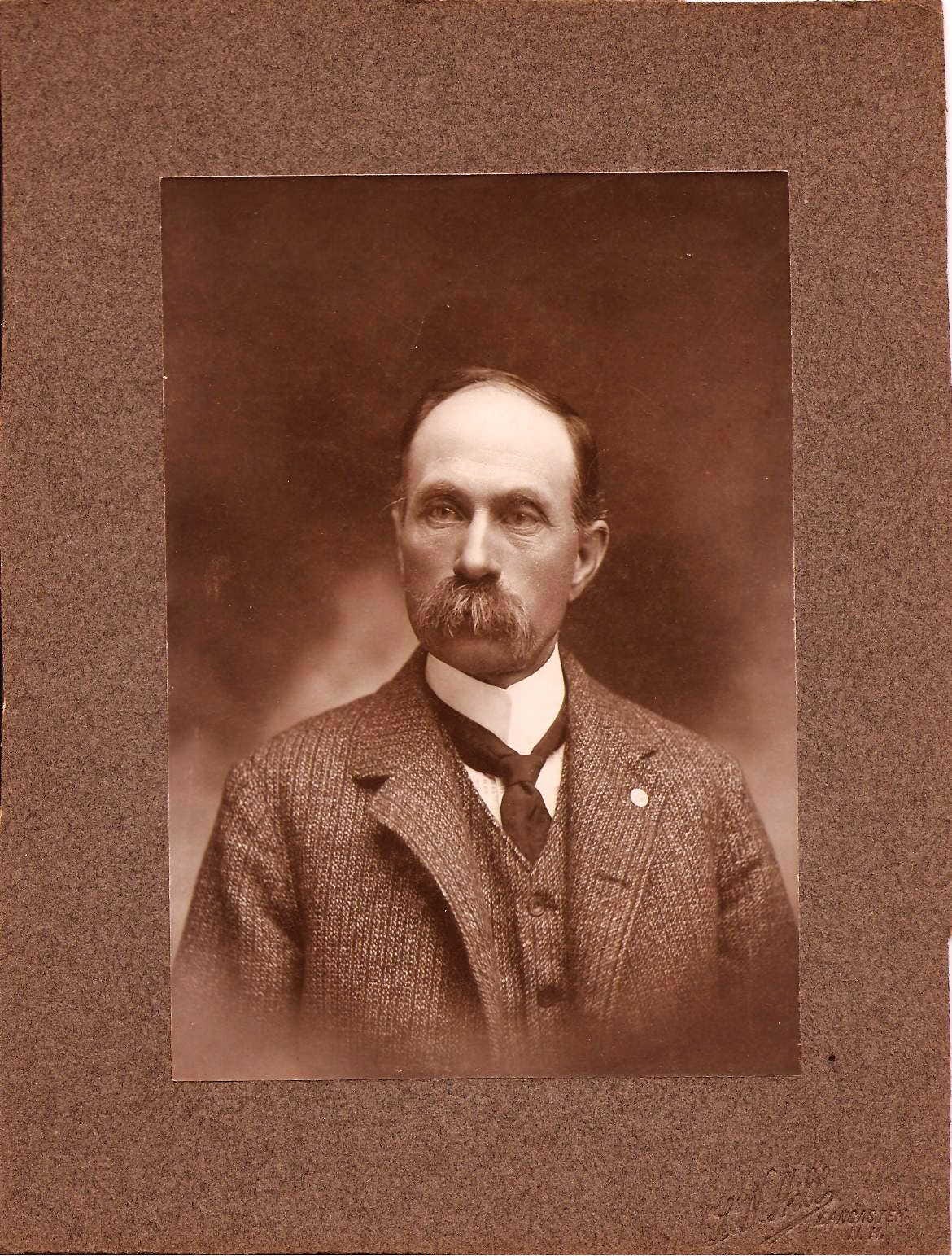
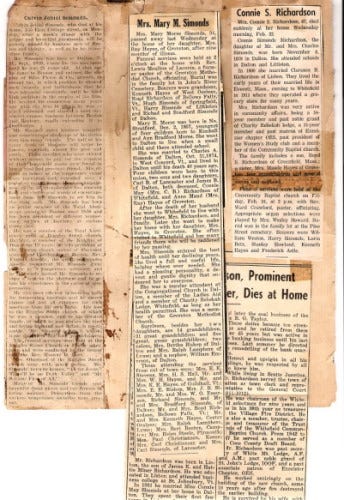
Charles died in Dalton, New Hampshire, on February 22nd, 1912, at the age of sixty-two. His obituary tells me that he was the son of Jehial and Harriet Barrows Simonds and that he was one of thirteen children, only three of whom were still living when he died. On October 31st, 1874, Charles married Mary E. Morse, the daughter of Kimball and Ann Bradford Morse, and together they had four children. When Charles died, all four of those children were still living, along with ten grandchildren.
I love having the obituary now because it gives me something that census records and family trees simply can’t. Whoever wrote it remembered Charles as “a most devoted husband and affectionate father,” adding that he had many friends and would be greatly missed. I can find a birth date anywhere, but that sentence is important because it shows that when this man died more than a century ago, people grieved him and thought it important for the newspaper to know that he loved his family and that his friends loved him.
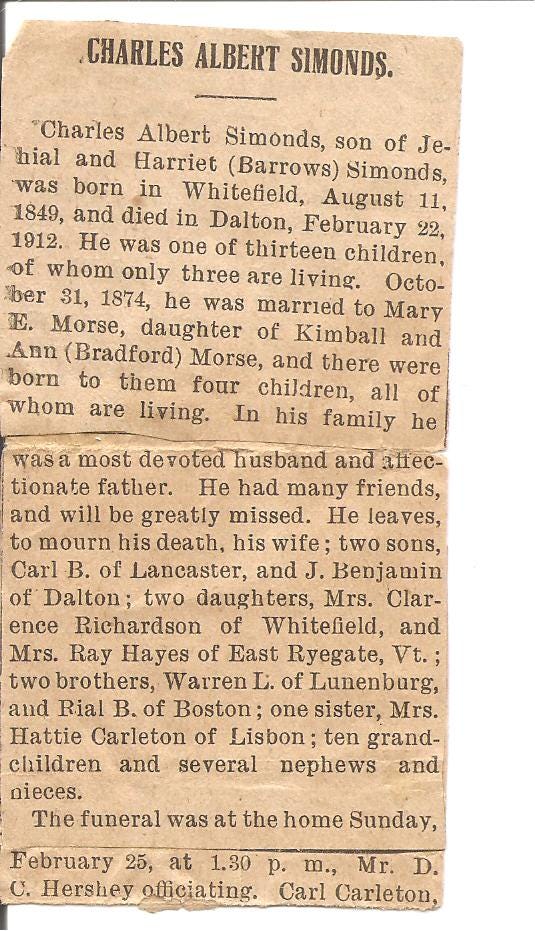
Mary was still there when Charles died. So were their sons, Carl B. Simonds of Lancaster and James Benjamin Simonds of Dalton, and their daughters, Mrs. Clarence Richardson of Whitefield and Mrs. Ray Hayes of East Ryegate, Vermont. His surviving siblings were Warren L. Simonds of Lunenburg, VT, Rial B. Simonds of Boston, MA, and Hattie Carleton of Lisbon, NH. Just that one obituary spreads the family out across northern New Hampshire and Vermont, into towns and places that are familiar to me today.
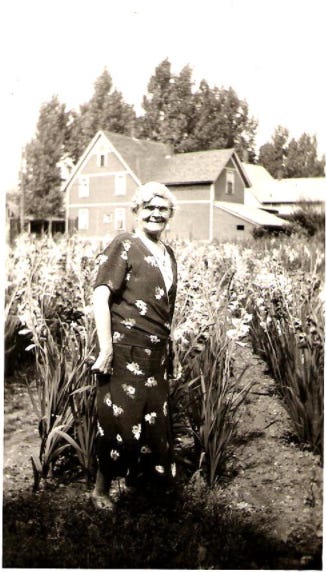
Mary’s life continued for another forty years after Charles died, a major accomplishment by any measure. It’s very easy when researching our ancestors, especially women, to allow someone to become nothing more than “the wife of” the man we originally went looking for. Mary E. Morse Simonds was born in 1857 and lived until 1952. Charles was an important part of her life, certainly, but he wasn’t the whole of it. She lived for nearly a century herself, raised four children, became a grandmother many times over, and lived through an enormous span of American history. That history included the Great Depression and both World Wars. Finding Charles has made me want to know Mary better too, and that is one of the things I love most about genealogy: I’ll start researching one person, and before long there’s an entire room full of people asking me not to forget them.
Charles also happens to have had one of the more interesting jobs I’ve found among my ancestors. He worked on the Mount Washington Cog Railway, including as a track inspector, and family photographs show him with something called the Devil’s Shingles.
If you’ve never heard of Devil’s Shingles, they may be one of the most wonderfully wild inventions in New Hampshire history.
The Mount Washington Cog Railway was already an extraordinary undertaking. Built in the nineteenth century to carry passengers up the western side of Mount Washington, it relies upon a center rack between the rails that allows the locomotive to climb grades that an ordinary train simply couldn’t manage. The railway remains one of the steepest railroads in the world, with portions approaching a thirty-eight percent grade.
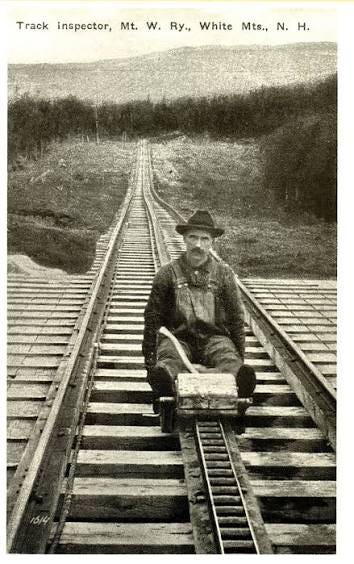
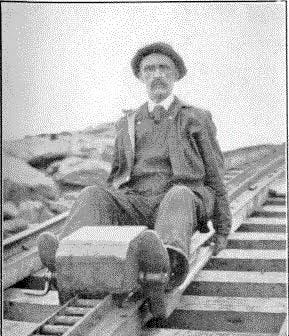
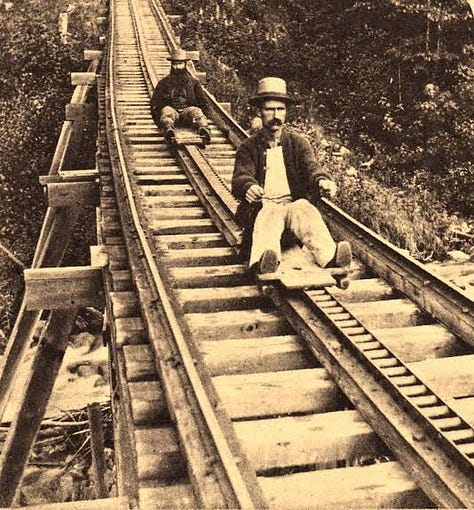
Apparently, after spending the day working on this incredibly steep railroad, some of the men decided that walking back down the mountain was entirely too sensible.
The Devil’s Shingles were homemade wooden slideboards, really little more than narrow planks designed to ride along the railway’s center rack. According to the Mount Washington Cog Railway’s own history, they were fitted with seats, footrests, and hand brakes that gripped the rack. Workers would climb on and ride them back down the mountain after a day’s work. A typical descent took around fifteen minutes, which already sounds terrifying enough, but naturally the men began racing one another. The record descent was two minutes and forty-five seconds, at an average speed of approximately sixty miles per hour. New Hampshire eventually outlawed these wild rides, presumably because even the “Live Free or Die” state had to draw a line somewhere.
Charles also owned a store, now in a building still standing on Rt 135 in Dalton, NH. I knew my father’s parents were farmers, and my own father eventually came to own his own business, but apparently the entrepreneurial streak runs deep in our family. Knowing he not only worked as a track inspector on the Cog Railroad, but also came to own a store that served his community means so much to me.
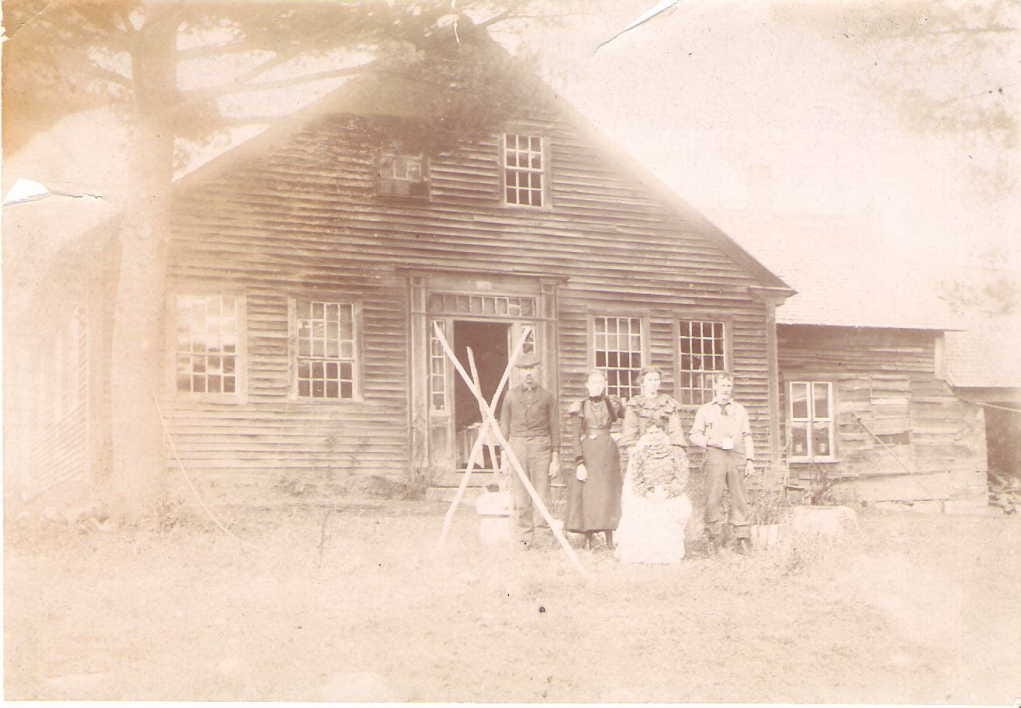
Still, for as much as I know about him and all my other ancestors, I want to go deeper. I can look at an old photograph of this man, knowing that he was somebody’s husband, somebody’s father and eventually my great-great-great-grandfather, and also know that at some point he climbed onto a homemade wooden contraption attached to a railroad track running down Mount Washington. Suddenly I’m not looking at an unsmiling nineteenth-century man in an old photograph anymore, I’m wondering what he was like. I’m wondering whether he was fearless, reckless, funny, or simply not bothered by a kind of danger that would horrify most of us today.
Maybe this is exactly why I find working with my ancestors so important.
When I talk about ancestor work, I know some people picture an intensely spiritual or ceremonial practice. They may imagine an ancestral altar covered in candles, offerings made to the dead, prayers spoken aloud, or someone attempting to communicate with those who came before them. I do believe in those parts of the process, and they’re part of my own practice, but I think ancestor work is much larger and more ordinary than all that.
Sometimes ancestor work is just looking for an obituary.
Sometimes it’s walking through a cemetery until you find the right stone, then clearing away the leaves so you can read the name. Sometimes it is writing down the maiden name of a woman who has spent the last hundred years identified only as somebody’s wife, or finding the names of children who died young and were almost lost from the family story altogether. Sometimes it is saving a photograph, asking an older relative a question while they’re still here to answer it, cooking a family recipe, visiting the town where your people lived, or just saying someone’s name again after decades of no one saying it at all.
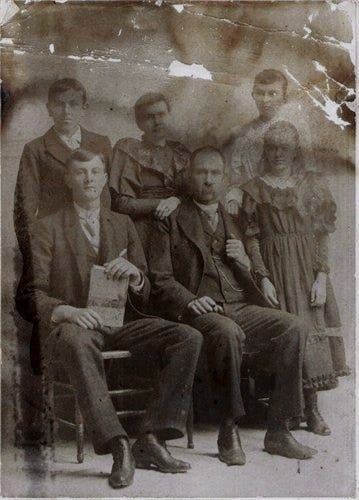
I think there’s something sacred about remembering people in the simple ways.
That doesn’t mean believing all of our ancestors were wonderful people simply because they’re dead. I’m not interested in turning my family tree into a collection of saints, because I don’t think that honors anybody either. Our ancestors were human beings, and some were loving, and some were cruel. Some were brave, and some were frightened. They made good decisions and terrible ones, carried wounds they never asked for, and sometimes passed those wounds along to the people who came after them. Working with our ancestors can mean appreciating what they gave us, but it can also mean recognizing what needs to stop with us.
I think that’s part of honoring them too.
There are days our ancestors survived that we no longer have to survive, and there are scars they never had the opportunity, language, or safety to heal from. Sometimes honoring them means carrying forward a tradition, a story, a recipe, a stubborn streak, or a particular way of loving the world. Sometimes honoring them means looking at something passed down through a family for generations and deciding it has traveled far enough.
The more genealogy work I do, the more aware I become that none of us simply appeared here. Behind each of us is an almost unimaginable number of ordinary people whose lives unfolded exactly as they did so we could exist. Most of them will never appear in history books. They farmed and worked railroads, raised children, kept stores, cooked meals, buried people they loved, survived winters, argued with their neighbors, and woke up every morning having absolutely no idea that somebody more than a hundred years later might be sitting at a computer reading their obituary.
Yet here I am.
A few years ago, Charles Albert Simonds was mostly a name in my family tree. Now I know that when he died, his community remembered him as a devoted husband and affectionate father. I know Mary was beside him for thirty-seven years of marriage and then carried on for another forty years without him. I know he had ten grandchildren by the time he died, that his brother Warren was living in Lunenburg, and that Charles apparently had enough courage, foolishness, or faith in nineteenth-century engineering to ride the Devil’s Shingles on Mount Washington.
Those may seem like insignificant facts, but to me they aren’t.
They’re pieces of a life coming back together.
For me, honoring my ancestors has never been about worshiping the past or pretending that everything that came before me was better. It’s about relationship, remembrance, and gratitude. It’s about understanding that I’m carrying a story that began long before I arrived, and that one day I will hand some version of that story to whoever comes after me.
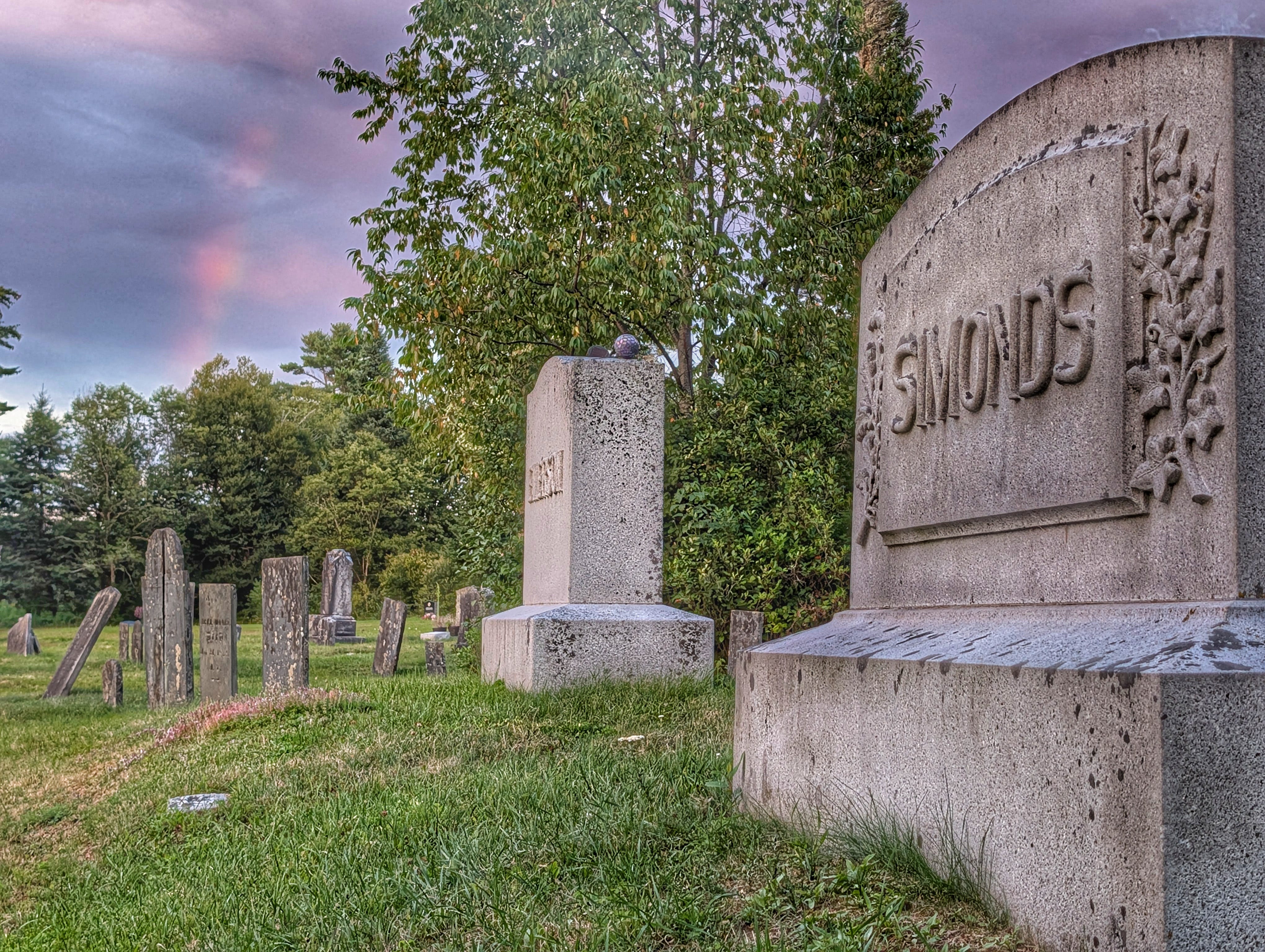
When I visited the cemetery on his birthday, making offerings of incense and maple syrup near his and Mary’s headstone, I wondered if he and my other ancestors were proud of me. Out of nowhere, a rainbow appeared in the sky. In the way I receive messages, I was told that I’m as bold as Charles was, dealing with the forces of nature and rocketing down the largest mountain in the northeastern United States. I’m bold when I stand in my sexuality unapologetically. I’m bold when I stand in front of crowds to channel Spirit, or even sit with people individually.
Maybe the simplest form of ancestor work is also the most important: refusing to let the dead be forgotten.
For the record, I absolutely would not have gotten on the Devil’s Shingles…but knowing the Simonds family, and most especially my Dad, I’m not entirely convinced I wouldn’t have been talked into it.
There’s a wild streak in us all.
No posts
Comments
Nothing yet. Say the first thing.
Sign in to join the conversation.