
[This article was written at the invitation of the INWO (Initiative Natürliche Wirtschaftsordnung) for publication in their journal Fairconomy. Since that is a German language publication, I am sharing it here in English.]
Human society is increasingly at odds with the natural environment that sustains it. We consume the bounty of nature at an unsustainable rate, and in doing so we jeopardize our own survival. The crucial question is why? Is it human nature to exploit natural resources at an ever accelerating rate until we destroy them, or are there are other causes that drive this kind of behavior? Is it possible for man to live in harmony with nature, or are we like a plague of locusts who are programmed by nature to destroy the means of our own survival?
Silvio Gesell answers this question in a way that is both logical and hopeful. He makes sense of what appears to be an inexorable human tendency to exploit nature in an unsustainable manner and shows that such behavior is not natural or unavoidable. Rather, he tells us, it is a straightforward, logical consequence of our irrational form of money. If his analysis is correct, the solution is clear; fix our system of money and we will eliminate the root cause of unsustainable behavior.
According to Gesell, the phenomenon which drives us to exploit nature in an unsustainable manner is interest. Therefore, if we want to solve the problem of unsustainable behavior, we need to focus on interest.
Is interest natural? Has a squirrel ever stored nuts for the winter and come back to find more nuts than he stored? No, that never happens. The opposite happens. A store of nuts in nature invariably decreases in quality and quantity over time. Some nuts get stolen, others get lost. Some nuts rot, others get consumed by insects. It is a nearly universal law of nature that stored wealth loses value with the passage of time.
So why does money behave in exactly the opposite manner? Why does money increase in value over time when virtually all forms of real wealth do the opposite? The answer to this question reveals why our society is at odds with the natural world, and it also reveals how we could bring our behavior into harmony with the laws of nature.
Silvio Gesell tells us that interest is not natural. Rather, he says, it is a consequence of our failure to understand the proper nature and function(s) of money and our use of an irrationally designed instrument as our generally accepted medium of exchange. Furthermore, he tells us that if we correct this mistake and transition to a rational form of money interest will eventually disappear.
The purpose of this article is not to evaluate Gesell’s diagnosis of the causes of interest. (We have done that elsewhere, including in our video course Silvio Gesell: Beyond Capitalism vs Socialism.) Rather, what we are concerned with here is to analyze the effects of interest on those who produce real goods & services, specifically those who draw upon renewable natural resources in order to do so.
In his book How to Fulfil the UN Sustainability Goals, economist Felix Fuders writes, “interest is the rhythm to which the real (productive) economy has to dance.” Analyzing how interest sets the “rhythm” for the real economy will help us understand how our use of an irrational form of money distorts the incentive structure facing producers of real goods and services and essentially forces them to engage in unsustainable behavior.
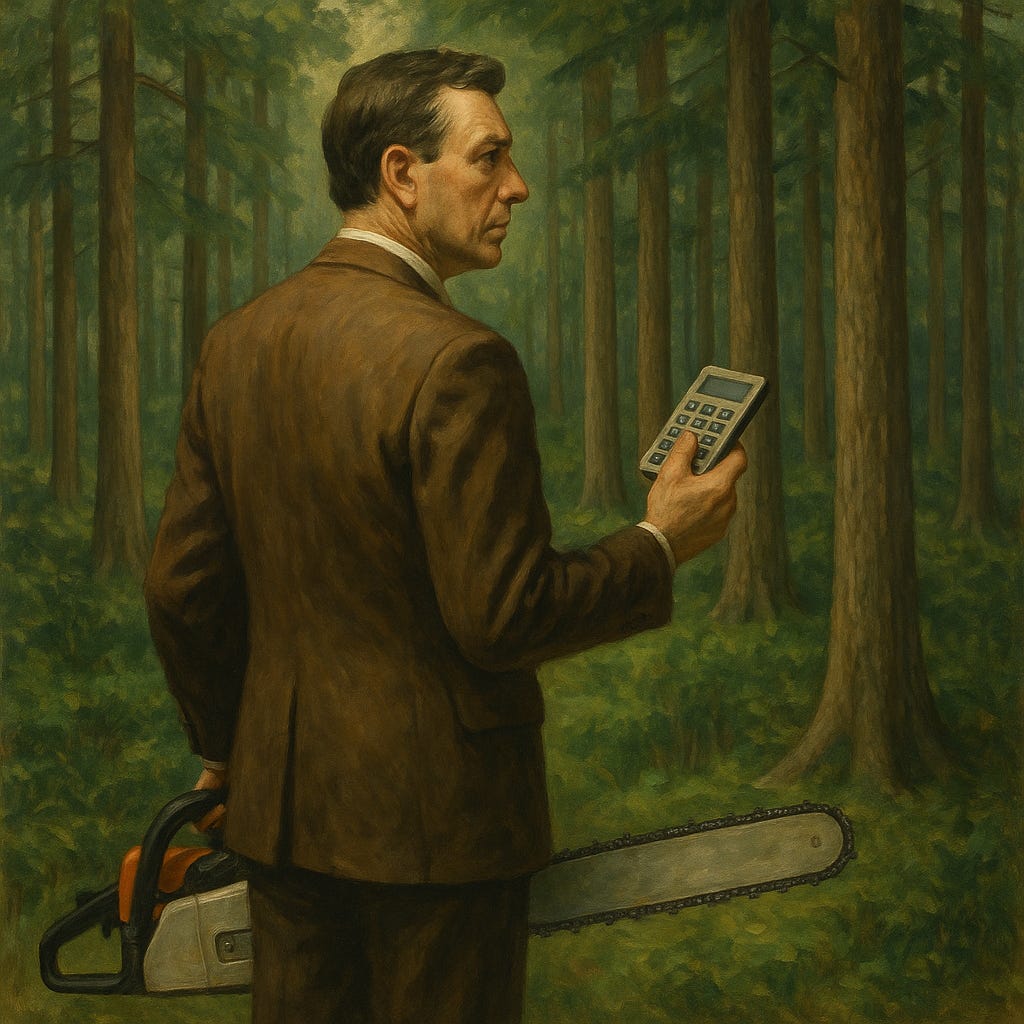
Let’s consider a hypothetical scenario from the forestry industry. Imagine an entrepreneur has a piece of land on which he grows trees which he harvests and sells in order to provide a livelihood for himself and his family.
How should the entrepreneur decide which trees to harvest and when? Would it make sense for him to cut down all of his trees and sell them immediately so as to maximize his income in the short-term? No. Doing so would provide him with a large immediate income but would leave him without a means to earn a livelihood in the future. Developing a rational strategy requires taking into account his well-being in the short-, medium- and long-term.
For the sake of illustration, let’s suppose the entrepreneur grows only one species of tree and that the life cycle of those trees is as follows: trees grow at a rate of 8% per year for the first 10 years of their lives, 6% per year for the second 10 years, 4% for the third decade, 2% for the fourth, and then stop growing once they reach 40 years old.
In order to develop an optimal strategy, the entrepreneur would need to take a variety of factors into account. What are his family’s current expenses? How does he expect his family’s needs to change over time? How many trees can fit on his property? How, when and where should trees be planted and harvested in order to maximize output over the long term? His answers to all of these questions will determine the optimal “rhythm” of his productive enterprise. In general, he will tend to harvest more of his mature trees than his younger trees, since the older trees grow slower and thus provide him with a lower return on his capital.
Now let’s introduce the elements of money and interest into the scenario and analyze how they affect the incentives facing the entrepreneur. Let’s say that he now has the option of investing any spare cash and earning 3% interest.
As before, he will take a variety of factors having to do with the specific circumstances of his family and his business into account. But now another important consideration is added into the equation. Since the entrepreneur now has the option to invest his money and receive a 3% return, the rate of interest represents an opportunity cost to his decision to hold wealth in the form of trees. He now has to choose between holding wealth in the form of trees or cutting those trees down, selling them for money and investing that money. And if his goal is to maximize his wealth, he will choose the option that generates a higher rate of return.
Suppose the entrepreneur can meet his family’s needs by only harvesting mature trees — that is, trees that are more than 40 years old and have stopped growing. Would it be a financially sound decision to only harvest 40-year-old trees and to allow 30-year-old trees to continue to grow at a rate of 2%? No. Doing so would be a suboptimal strategy from an economic perspective. The entrepreneur could increase his wealth by cutting down all of his 30-year-old trees that are growing at 2% and investing that money and earning 3% interest.
Now let’s suppose that the rate of interest rises to 5%. How will that affect the entrepreneur’s decision making process? By the same logic as before, it is now a bad financial decision to allow any trees which grow at less than 5% annually to continue to grow. Whereas at an interest rate of 3% the entrepreneur would be financially better off by cutting down all of his 30-year-old trees, at 5% he is incentivized to harvest all of his 20-year-old trees as well, because those trees only grow at 4% per year.
Now, what happens if the interest rate rises to 7%? What happens if it goes to 9%?
At an interest rate of 9%, it is now a good financial decision for the entrepreneur to cut down all of his trees immediately and put the proceeds into interest-bearing investments. His decision making process is no longer primarily about how to manage his productive assets in such a way as to balance his production with his family’s needs. The predominating consideration now is the opportunity cost of growing trees, which is the possibility of converting trees into money and earning interest. This opportunity cost is the “rhythm” to which Dr. Fuders referred in his book. The rate of interest is the hurdle that productive assets must exceed in order to justify their existence. Any assets which can’t keep up with the “rhythm” of interest cannot be justified from an economic perspective. At a high enough rate of interest it becomes a good economic decision to convert all productive assets into money and invest that money for interest.
Cutting down trees is not inherently unsustainable. What determines whether or not it is sustainable is the “rhythm” at which it is done. If trees are harvested at a rate that allows the forest to continually regenerate itself, that activity is sustainable and harmonious with the laws of nature. If, however, trees are harvested at a rate which exceeds the forest’s ability to regenerate, it will eventually be exhausted and destroyed.
In the absence of money and interest, owners of productive assets would be motivated to manage those assets in a way that maximizes their economic well-being over the short-, medium- and long-term. But when interest exists as an opportunity cost to real, productive activity, sustainability is no longer the predominating consideration. The hypothetical entrepreneur in our example would be economically better off passively earning 9% interest than dealing with the challenges of running a productive enterprise and earning a return of less than 9%.
And the same basic logic applies to countless other examples in which renewable natural resources are drawn upon for productive economic enterprise. Ideally, we would want the “rhythm” of each such enterprise to be determined by humans working in harmony with nature to achieve an optimal balance between economic benefit and sustainability. But the existence of interest changes the “rhythm” at which all productive activities must dance, and those which can’t keep up with the “rhythm” cannot be justified economically.
The theory of free-markets says that people will choose to manage their resources in a sustainable manner because it is in their self-interest to do so. But free-market theory does not take into account the influence of an irrational form of money which distorts the “rhythm” of nature and incentivizes humanity to destroy the renewable resources we depend on for our survival.
No posts
Comments
Nothing yet. Say the first thing.
Sign in to join the conversation.