
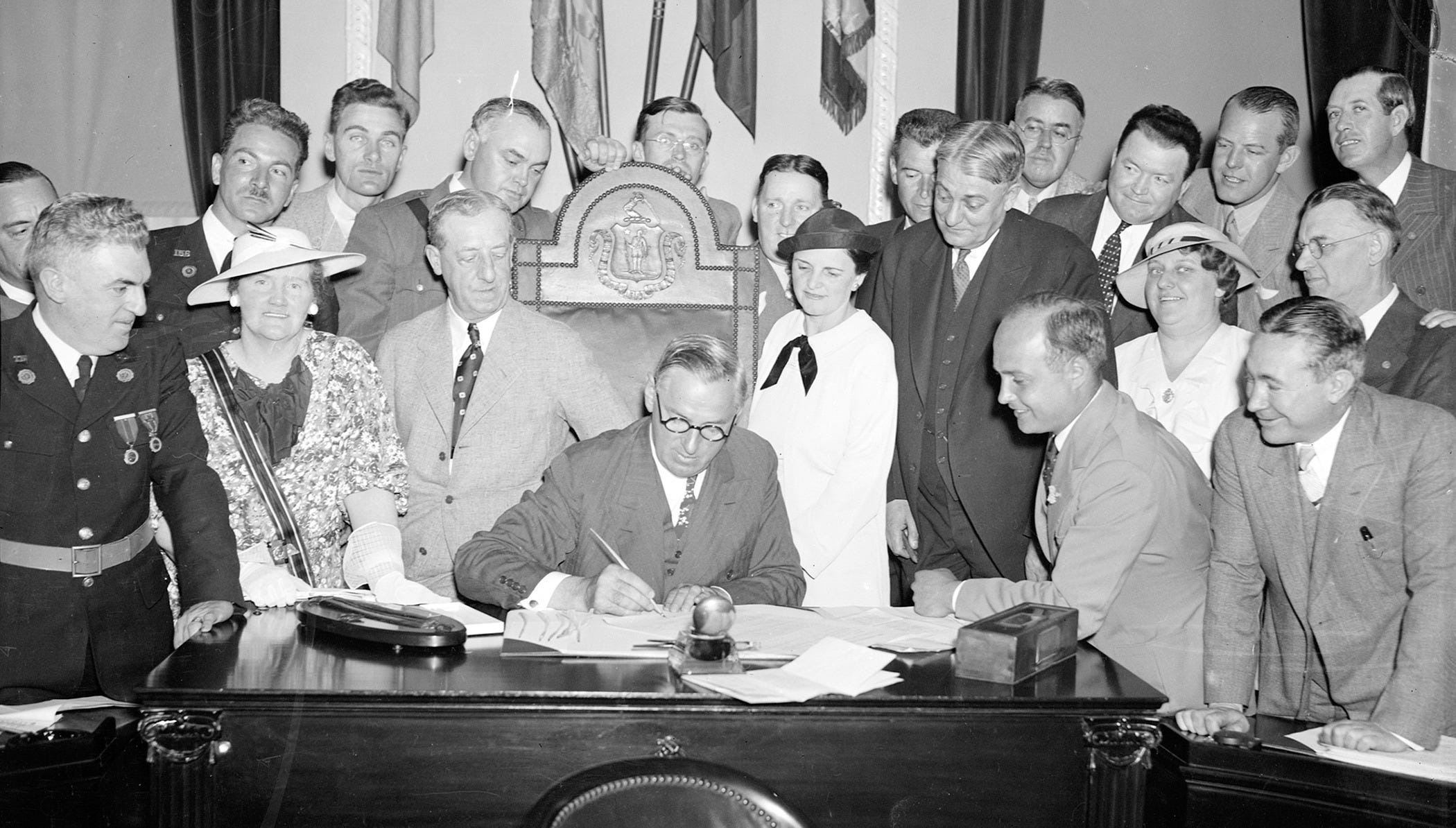
JUNE 26, 1935: Governor James Curley took the oath of office in January. Now he wanted Massachusetts to join a growing number of states requiring schoolteachers to sign a similar pledge. Despite bitter opposition from educators, Curley signed the “loyalty oath” bill into law in June, surrounded by legislators, American Legion members, and anti-communist organizations.
I do solemnly swear (or affirm) that I will support the Constitution of the United States and the Constitution of the Commonwealth of Massachusetts…
The new law required Massachusetts public and private school teachers and college professors to swear allegiance in writing to the state and federal constitution. A carveout was added for exchange professors and visiting teachers from other countries. The new law, which passed the House by a 122-81 margin and on a voice vote in the Senate, went into effect in October.
The hotly contested measure was designed to address concerns of a growing “subversive” element in public education. “If they want so much to preserve the Constitution, why do they object to swearing allegiance to the Constitution?” asked lead sponsor Representative Thomas Dorgon of Dorchester at a public hearing. “Taking the oath of allegiance means swearing to uphold the freedom of speech that is guaranteed by the Constitution.”1
Educators, including a group of influential college presidents, denounced the bill as unconstitutional. “You can’t make people loyal by law,” said one. “You cannot cast the imputation of disloyalty on educators and then expect them to help the laws,” added another.
Attending the Harvard Commencement exercises days before, Governor Curley was subjected to criticism for his support of the measure. He fired back with charges that the universities were censoring patriotic films and limiting student access to military service recruitment.
“When such a situation develops, I believe that steps should be taken to inculcate the principles of Americanism in our youth,” he said.2
The new law required teachers to sign the pledge and file a copy with their superintendent or college administrator, which would then be transmitted to the state commissioner of education. There was no enforcement mechanism or penalty in the original law, but educators who failed to take action could be barred from teaching.
Numerous attempts to repeal the teacher’s oath law failed and the requirement remained on the books until it was invalidated by the courts in 1967.3
1 Boston Globe, October 3, 1935, 3.
2 Springfield Weekly Republican, June 27, 1935, 3.
3 See Joseph Pedlosky vs. Massachusetts Institute of Technology, 352 Mass. 127.
Comments
Nothing yet. Say the first thing.
Sign in to join the conversation.