
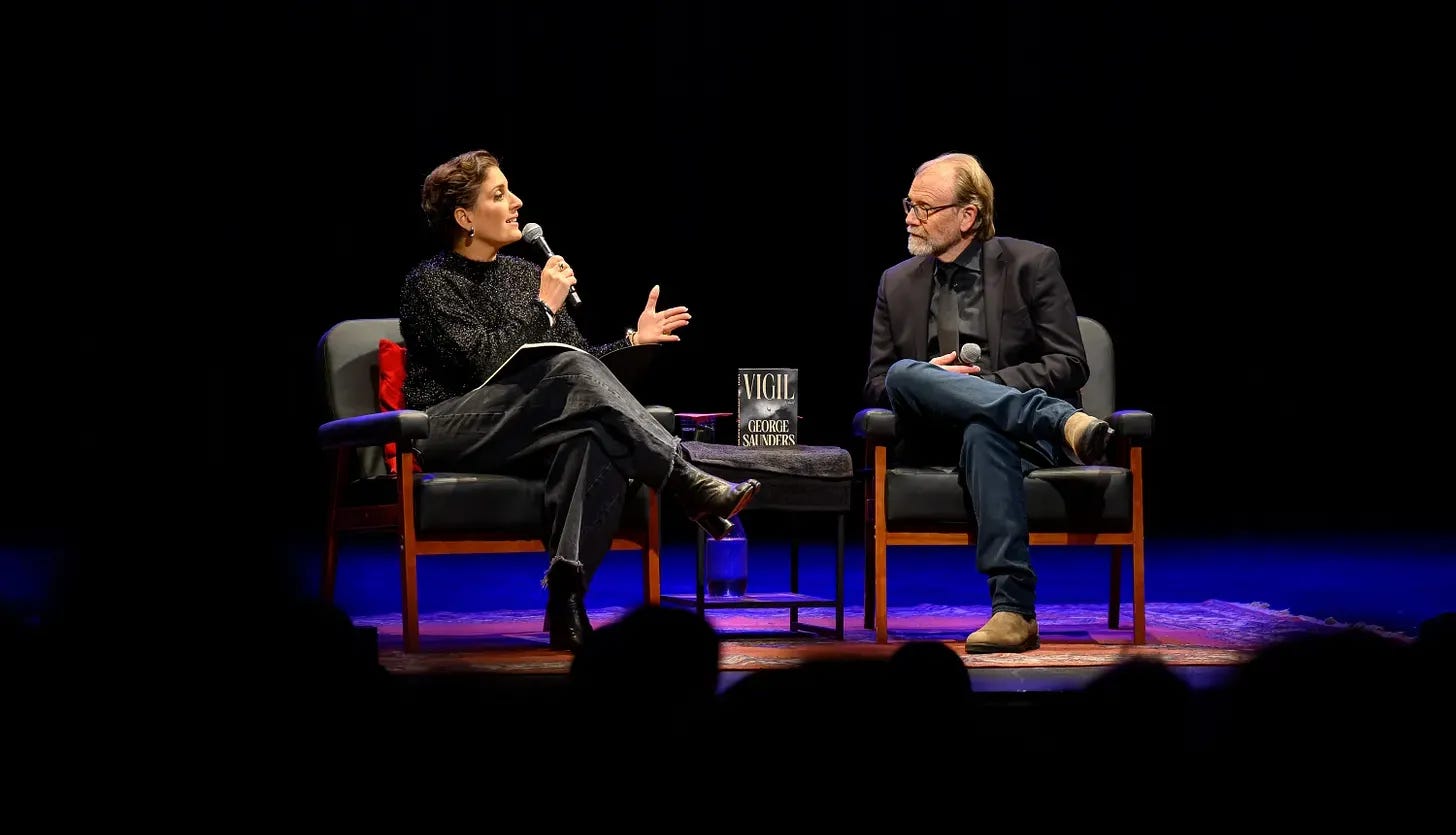
This week, I went to an event at Symphony Space for George Saunders’s new novel, Vigil. I’ve watched tons of author talks online before but never been to one in-person. Two little parentheticals:
People were incredibly nice. No huge surprise—it was a roomful of enthusiastic readers, and of George Saunders no less, who is clearly one of the nicest guys alive. I had a lovely conversation with the woman sitting next to me, a volunteer at PEN America who attends these things all the time. Everyone around us seemed to have struck up affable chats with their seatmates. So, just noting that to appreciate it.
Everyone looked the same. The. Exact. Same. I’m not saying we are the same, or that we didn’t represent a multiplicity of backgrounds and perspectives, but there are 715 seats in the Peter Jay Sharpe Theatre at Symphony Space and besides me there were 714 white liberals in attendance between the ages of 25 and 85. If we were being used for a scientific study or political poll, the results would be invalidated immediately.
That said, the event was great. Suleika Jaouad hosted, and Samantha Bee read an excerpt of the book. As I headed home, high on the fumes of George’s revision-intensive philosophical mindset, my thoughts drifted back to something that had been published earlier that day by a much inferior writer—me! So, here are some further/alternative thoughts on What Are You Holding? (Period.)
First, a few gaps in my train of thought:
The line I drew from ICE’s killing of Good and Pretti to historic examples of American cruelty and impunity (homes for unwed mothers, genocide and land theft of Native Americans, sham trials and executions) was…shaky. While the same awful consequence is rendered—the state determining a certain person is intrinsically worth more or less than another person, with deadly consequences—being killed in the street by a thug cosplaying as an officer feels dissonant with our expectations of American society. Same with getting killed for what you believe. Sure, American policing is often racist, and we deport too many people, and we’ve pockmarked the world over with drone strikes. But we’ve always maintained a line—let’s call it, say, basic adherence to law and order?—wherein individual officials face accountability for their lawless acts. That such oversight itself is occasionally lawless and unaccountable is the exception that proves the rule.
Which, like, yes, but only sort of.
(Here’s where the history lesson begins—sorry—but I found all of this pretty interesting. If anyone has fact-checks for me after reading, please don’t be shy!)
A more accurate point of comparison to what we’re seeing in Minneapolis is the Fugitive Slave Act of 1850, which has gotten a lot of air time recently. To briefly summarize: by the 1840s, several hundred enslaved people were successfully fleeing North each year, and though there was a pre-existing law on the books requiring the return of escaped slaves, free states largely ignored it—mandating jury trials before alleged fugitives could be moved, forbidding the use of local jails or assistance by state officials to make arrests, or outright refusing to convict people. Word of proliferating free Black populations in Northern states was getting around, and Southern slavers were desperate for legal means to recapture escaped slaves.
The 1850 law made law enforcement officials everywhere accountable for the capture and return of escaped slaves. It suspended Habeas corpus and empowered slave catchers to seize people without warrants. Noncompliant federal marshals were fined the equivalent of $37,800 in today’s dollars, and commissioners were compensated double for re-enslaving people than for letting them go free. If you were caught aiding an escape, you could be fined or jailed. Between 1850 and 1860, 97% of cases ruled in favor of slaveholders.
Another example, less discussed these days, is the Palmer Raids of 1919-20, during which Woodrow Wilson’s administration carried out raids to capture and deport hyphenated Americans suspected of being socialists, anarchists, or communists (mainly Italian-Americans, Russians, and Eastern-European Jews). Wilson warned these people had “poured the poison of disloyalty in the very arteries of our national life,” and that they “must be crushed out”—very similar to how the president has assailed immigrants for “poisoning the blood of our country.” Many people were arrested simply for having a foreign accent, just as folks today are being harassed for being Brown. Also like we’re seeing now, detainees were held in horrible conditions, and hundreds were deported without their families being notified.
Another good example is Japanese internment, which FDR’s administration carried out due to racist fearmongering over espionage by Japanese-Americans. Guess how many cases of sabotage the government uncovered? Zero! But it didn’t stop officials and the media from saying all kinds of horrible things about the Japanese, including this by a Hearst columnist:
I am for the immediate removal of every Japanese on the West Coast to a point deep in the interior. I don’t mean a nice part of the interior either. Herd ‘em up, pack ‘em off, and give ‘em the inside room in the badlands [....] Personally, I hate the Japanese. And that goes for all of them.
A final example: COINTELPRO. This was an operation in the ‘50s and ‘60s to “expose, disrupt, misdirect, or otherwise neutralize” feminist organizations, civil rights activists, anti-Vietnam War organizers, student groups, environmentalists, animal rights organizations, labor movements, and other elements of the broader New Left. Every Black student at Swarthmore was under surveillance. The FBI accumulated more than 500,000 domestic intelligence files with 26,000 names for potential internment in concentration camps in the event of a “national emergency.” They labeled MLK “the most dangerous Negro of the future in this Nation” and sent him an anonymous letter with secret recordings of his extramarital affairs, giving him 34 days “before your filthy, abnormal fraudulent self is bared to the nation,” concluding “[t]ere is only one way out for you”—widely interpreted as a suggestion that he commit suicide.
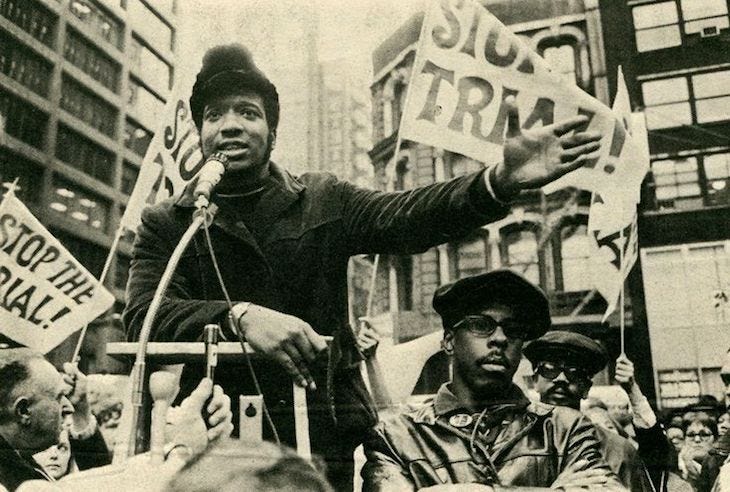
Among the grimmest, most ICE-like things on COINTELPRO’s résumé is what they did to Fred Hampton, the 21 year-old Black Panther leader. In 1969, an FBI informant provided a floor plan of Hampton’s apartment and drugged him with Seconal. Police then fired a hundred rounds into the apartment, shooting Hampton, asleep next to his pregnant fiancée, twice in the head. The Panthers fired only one shot in defense. A federal grand jury found the raid was “not a shootout” but a “planned assassination,” which Cook County determined a “justifiable homicide.”
Each of these examples contains good news for where we are now. To chew on one thing at a time:
Everyone’s talking about how terrible the Fugitive Slave Act was and how much violence it caused for Black Americans—and it was and it did. But fewer people are discussing how it was one of the biggest political backfires in American history. It was intended to provide stronger legal infrastructure for the recapture of enslaved people and require cooperation from Northern states, but what it actually accomplished was the massive radicalization of Northerners who had previously been indifferent to slavery by demanding their direct acceptance of the unacceptable practice of human bondage. (Remember how I mentioned that 97% of cases ruled in favor of slaveowners? Well, that was only out of 343 cases—thousands more fugitives were never prosecuted.) It accelerated the refinement of the Underground Railroad, destroyed the Whigs, and spawned the Republican Party (pro-Abolition at the time—how far they’ve fallen). And, by the way, it led to the Civil War and the nationwide end of slavery.
The Palmer Raids ended very badly for the bad guys. A. Mitchell Palmer, the Attorney General for whom the raids are named, lost his entire political career within a year of the raids’ conclusion. Louis Post, the Secretary of Labor, invalidated 70% of Palmer’s deportation orders due to insubstantial evidence, and when Palmer’s guys tried to impeach him, Post defended himself so well that even his opponents congratulated him. The huge cherry on top is that this catalyzed the formation of the ACLU, which filed more than 230 legal actions against the Trump administration in 2025 alone, with a 64% success rate.
Japanese internment was, unlike ICE, popular. A poll taken three months after Pearl Harbor showed that 93% of Americans supported relocation of Japanese non-citizens from the Pacific Coast. The same poll reported that 59% supported relocation of U.S. citizens with Japanese heritage, while 25% opposed. Right now, most Americans (about 60%) do not support ICE, and the proportion of unhappy Republicans has doubled in the last two weeks.
COINTELPRO’s joyride ended when activists broke into an FBI office and leaked documents to the Washington Post. J. Edgar Hoover was forced to end the program, and in 1975 the Senate spent sixteen months investigating abuses by the department. That investigation resulted in permanent oversight committees, the Foreign Intelligence Surveillance Act, a ban on political assassinations (how was this not a thing before?), and a 10-year term limit for FBI directors (Hoover served for 48 years). Senator Frank Church warned in 1975: “I know the capacity that is there to make tyranny total in America [...] we must see to it that we never cross over that abyss. That is the abyss from which there is no return.”
This deep dive is mostly for my own sake, to know that this country has weathered quite a lot and emerged scarred but improved. And just this week, the tide has begun to turn: Republicans are showing signs of splintering with Trump’s anti-immigration tactics, Bovino has been reassigned, Kristi Noem is under scrutiny, we’re hearing possibilities of de-escalation in Minneapolis, and, on Thursday, the Senate stopped a funding package related to ICE funding.
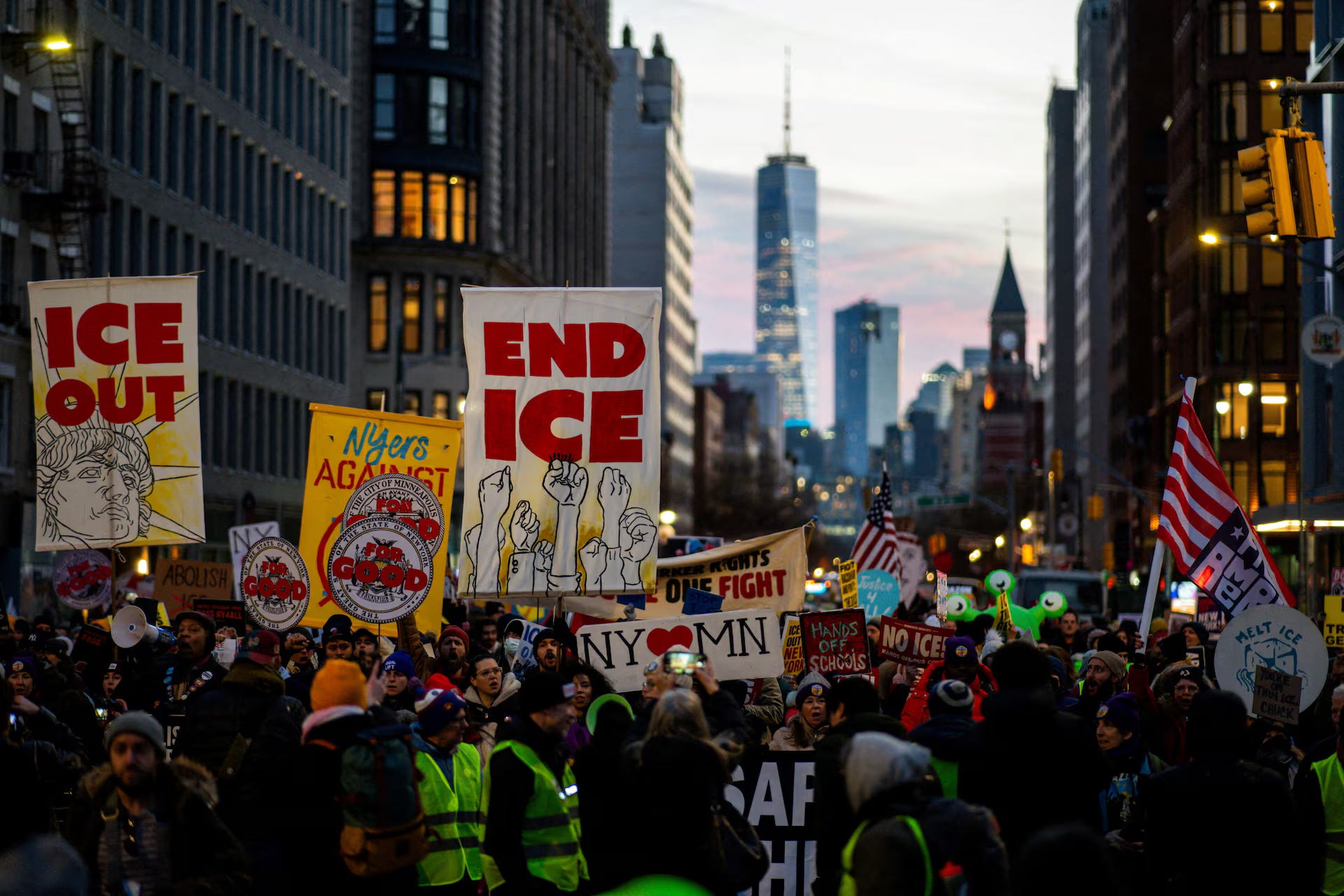
The bad news is, doesn’t it seem the Trump administration’s backpedaling is mainly a response to Republican objections, not the overwhelming public protests in Minneapolis and around the country? And doesn’t it seem that those objections are mainly about Good and Pretti’s deaths, and turn more or less a blind eye to ICE’s terrorizing of non-white and immigrant communities? Wouldn’t that suggest we’re still at a fundamental impasse? Am I being totally obvious right now?
One of the reasons I ask is because the other night, at the Vigil event, George was asked what role art and fiction have in such a nightmarish world—the same question I hinted at in Tuesday’s essay. And he gave a very well-reasoned answer which I will now botch, saying that fiction teaches us to overcome our tendency to judge, invites us to commune with a higher empathic intelligence, and prods us to exercise our truth-seeking muscles in a rising tide of untruths. And that by engaging in art and fiction together, we can access the only power that has ever yielded any good in this world, which is community. Someone tells a lie, and if I’m sitting next to you I can lean over and say, “I think that’s a lie.” If they tell it again, you elbow me and say, “that’s still a lie.” When the lie comes a third time, we look at each other and say, “nope, still a lie.”
I deeply want to believe in that idea. But all of us in that room listening to George talk were in agreement from the beginning. Somewhere, there’s another roomful of people nudging each other as they watch Ilhan Omar talk, or Alexandria Ocasio-Cortez, or Rachel Maddow, also saying, “that’s a lie.” They feel the same unity and power we feel.
I’m not saying art is a dead end because of this. Fascism or not, I still prefer to be the guy turning the final page of The Antidote rather than the guy doomscrolling Instagram reels. (As luck would have it, I am both.) But, I gotta say, it feels a little like we’re in an apocalypse movie in which we—the righteous who know good from evil, truth from lie—have written off the American Right as irredeemable zombies. (Certainly many of them—Stephen Miller, JD Vance, Candance Owens, Bill Ackman, Megyn Kelly, Tucker Carlson—are.) But what about the folks who listen to and vote for the zombies?
In Trump’s first term, I dug myself out of disillusionment by taking a tour through small towns, where I performed in bicycle shops, cafés, saloons, and the maximum-security prison to seek out folks with different perspectives from mine and see if we could understand each other. With pretty much everyone I came into contact with, I made incredible personal connections. In Gunnison, I wasn’t allowed to pay for a single meal. In Bayfield, a Trump-supporting, vaccine-denying Jew for Jesus took me to brunch after I played Bach on his porch, and by the time he signed the bill, he was reconsidering his notions about the Iran Nuclear Deal!
I wonder if that guy, eight years later, isn’t dug in significantly deeper now. I wonder if that tour would go the same way if I ran the experiment again.

Maybe it doesn’t matter. Only 15-20% of Americans identify as part of the MAGA movement. The No Kings Day protest in October 2025, which attracted as many as 7 million people, was the largest single-day protest in U.S. history. (The other No Kings Day in June 2025 was the second-largest.) Tuesday’s essay and this one contain clear evidence that America has always been home to hateful, irredeemable people. But in every case, those people were met by radical optimists who sustained their fight with the faith that justice was around the corner.
Renee Good and Alex Pretti were radical optimists. George Saunders is a radical optimist, as was the crowd at Symphony Space. All seem like pretty good company. By the way, what’s the alternative?
I’m curious to hear what you think. To the handful of folks reading this: what is getting you down these days? Where do you find hope? Are you getting outside of your bubble, and if so, how? What are you doing to help yourself or those around you?
Also to the handful of folks reading this: thank you!
No posts
Comments
Nothing yet. Say the first thing.
Sign in to join the conversation.