
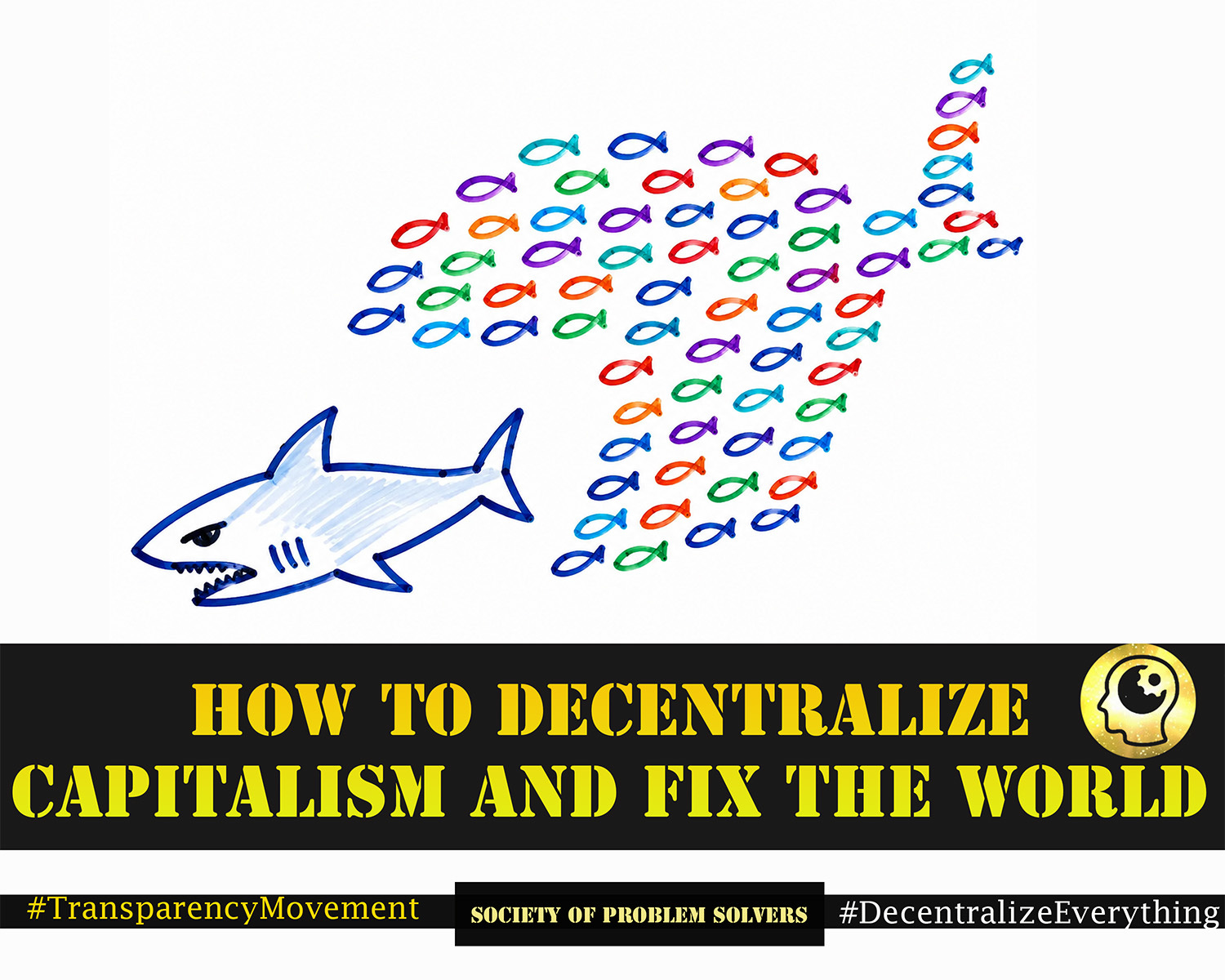
Aloha fellow Problem Solvers! We have a problem. i. Our World Is Broken
Right now humanity has two main systems working together that have become fully corrupted by the Epstein uniparty ruling class. These two systems - government and big business (mostly Wall Street) - have morphed into what most people generalize as the term “capitalism.” Whatever you call this monolithic corrupt structure, it is hard to argue that this is the best system for humanity currently, simply based on results.
The terminology here is not really that important. This is not going to be a debate about what is better - capitalism or socialism - because both systems are too easy to corrupt, and have both failed to help humanity reach its potential.
This is going to be about how to make a plan to fix our world by building a new system.
We can make a completely different kind of system - a system that restores power to the people in a way that is very hard to stop, and where nearly everyone benefits as both individuals and as a whole.
Everyone except the people corrupting our systems, that is.
Out of the two major corrupt systems at play - government and business - trying to fix the government side of the corruption is very hard. They divide us with group labels and military grade propaganda, and control the whole system with money, violence, and blackmail. BUT, we still have almost absolute control of where we spend our dollars - at least for now.
It doesn’t matter if you are left or right, red or blue, Muslim or Jewish, gay or straight…. we all must buy groceries, products, and services. All of us - no matter our group labels - often shop at the same exact places, and those dollars are votes that shape our realities. If we could organize our purchases into a new system that rewarded common values such as transparency, treating employees fairly, wellness, results, taking care of communities, avoiding Wall Street owned purchases, and protecting the environment…. we very likely would be able to fix our entire world.
How? …. We can decentralize capitalism by gamifying it.
The bad guys have gamed our systems. It is time we game them back.
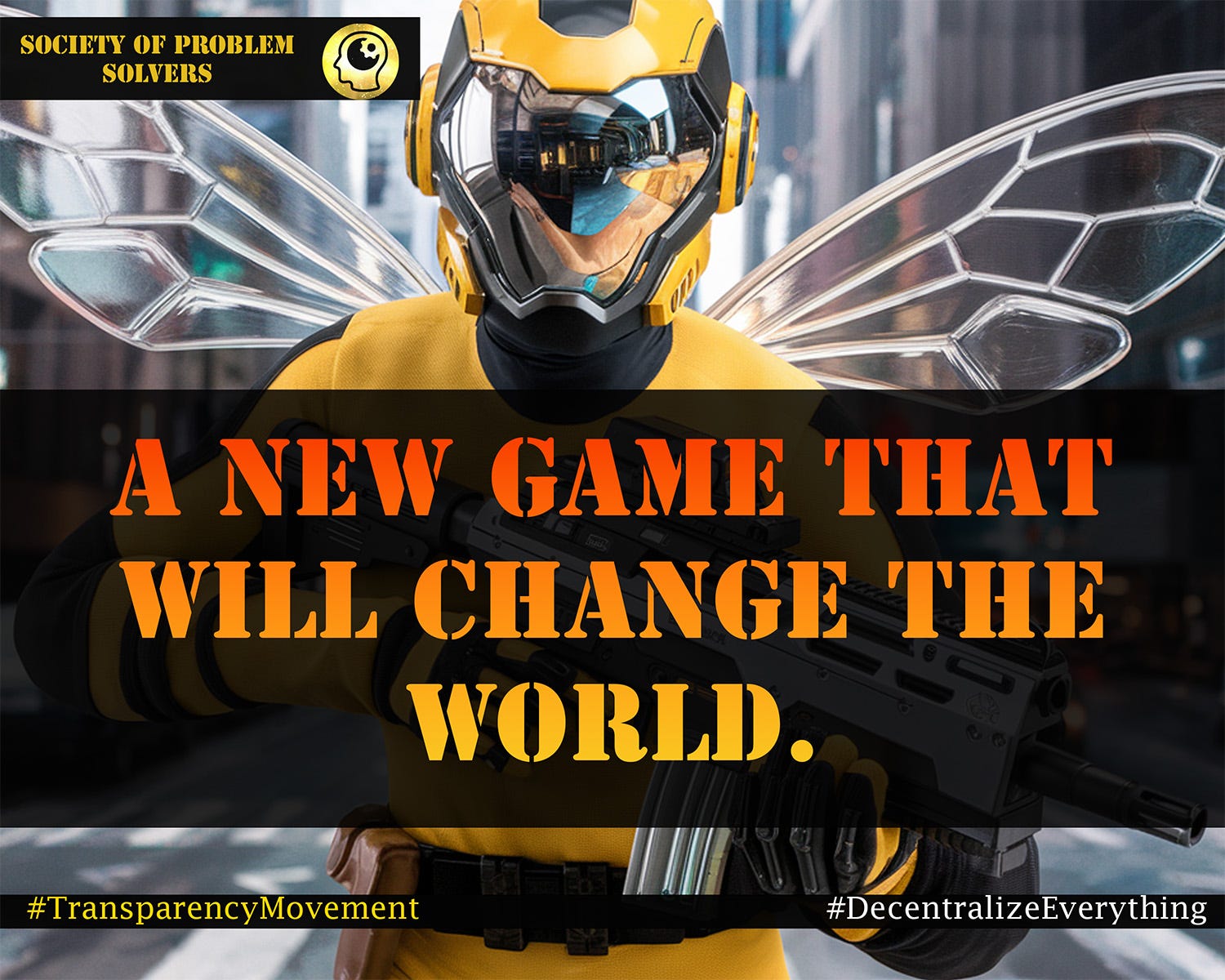
ii. A simple plan to fix the world:
Step One: We create a game.
Game Concept: Money in the Middle
A groundbreaking online game called “Money in the Middle” (or whatever we decide to call it) invites players to pool resources, collaborate, and use collective “swarm” intelligence to make real-world decisions that generate profit, buy businesses, fix corrupt systems, develop decentralized digital platforms, drive positive change in the real world, and empower communities and citizens worldwide. Think of it like Sim City or other civilization building games, but with real money and real results on the line.
iii Core Gameplay Mechanics:
1. Pooling Resources
Subscription Model- Players pay a $25 monthly fee (or whatever the collective players decide) to join the game, contributing to a collective fund called the “Impact Pool” If we have 1000 players that is $25,000 per month. If we have 50 million players that is $1.25 billion per month - think of that for a real force for change. You pay $25 as a customer and you get a say where your own money is spent, along with the $1.25 billion in the collective pool. Also, NOTE: by contributing $25 a month as a “customer,” it will enhance our collective intelligence outcomes as a group, since “Skin in the Game” enhances collective intelligence decisions. You can learn more about Skin In The Game concepts HERE.PMA Private Membership Association: We form a PMA. Most people have never heard of a Private Membership Association (PMA), yet they’ve probably belonged to one. Hunting clubs, yacht clubs, social clubs, and even Costco operate on the same basic idea: members voluntarily agree to a private set of rules. At its core, a PMA is an agreement between consenting adults to associate privately, establish standards, and cooperate under shared rules. That simple structure can be powerful. Members can pool skills, knowledge, money, and resources to start businesses, buy land, invest locally, educate one another, create mutual aid, and strengthen their communities - all through voluntary cooperation within existing law, while avoiding the red tape of “ownership” and the SEC. It is a way to form the subsription model withini the law. Like we wrote about HERE.
Dynamic Fund Growth: The Impact Pool grows in real-time as more players join, or as profits are made. People are free to donate extra to the fund as well, but only anonymously. Any businesses we buy, or compound interest we earn, the profits return to the impact pool to be controlled by the players in the game directly.
Transparency: Transparency is trust in a system, and unlike most systems in our world today, transparency will be one of our super powers. A live tracker will display the total funds and how they are allocated. We could use the Bitcoin ledger or other ledgers or wallets to do this as the group of players see fit. All of the paying members can see 100% of the ledger at all times. Players can - and should - make all of the systems they control better and harder to corrupt as the game evolves. Developing hard-to-corrupt systems is part of the game play, and it starts with transparency. If players (or voters) cannot see the whole system, then they cannot be trusted to guide the gameplay (sound familiar?).
Profits: All profits the game makes are 100% put back into the game to keep the systems and thus the collective impact growing. There is no owner that takes profits from this system. Just employees that work for the players in the game. In essence, this would be basically a “Customer Controlled Business.” Not technically “owned” because ownership requires dealing with all kinds of laws, the SEC etc. Rather, players would get to experience what it is like being an owner, the red tape, the taxes, etc. through gameplay as players. Learning what it is really like to run a business is part of the game play. It’s educational.
Fracturing: We can fracture into a network of many businesses, groups, non profits, or entities in order to achieve goals as long as funds are centrally pooled in a transparent kitty, decided upon as a collective swarm how to spend it, and adhere to the same over-arching code or rule set as the rest of the game. Eventually the game could have its own central bank, crypto currency, governing laws, marketing teams, etc. Staying decentralized makes us hard to corrupt.
Education - Part of the game will be educating players on how to behave in collective intelligence swarms (more on this in a second), and how this amazing new phenomenon works as a way to solve problems in groups, run businesses, and more. We will learn by doing.
IV. Decision-Making with Collective Intelligence
The System: We use high-trust collective “swarm” intelligence systems (start HERE and HERE if you are new to the term) to decide how to spend the money as a group. These systems must adhere to the principles we discuss often at The Society of Problem Solvers for collective intelligence groups. Namely: decentralization, radical transparency, skin in the game, a code of ethics, confidence scores, no labels when problem solving to avoid echo chambers and groupthink, etc. If you have never heard of these systems or rules, a deeper dive can be found in many of our articles). When done correctly, collective “swarm” intelligence simply allows many people to think and act as one person. Any decision a single person can make, a swarm can make. Swarms just do it on average much wiser, faster, and with less fallibility than individuals by a LOT - if - they have the proper high-trust and hard-to-corrupt systems in place.
Owners: The players act as owners of the business, non profit, or any other systems we control with the game. Ownership level questions are asked to the swarm, and the players answer as owners. For example, players could be asked what to spend the money on this month, and by using a collective intelligence game they answer (e.g., starting our own businesses, buying land, building systems that are harder to corrupt, or lobbying for policy changes). Our employees execute what the swarm decides.
Employees: One of the incentives of the game is getting hired by the game. Since there will be no owners to pay out, and since the business will be radically transparent where even our customers can see how much our employees make, these jobs will be well paid and coveted jobs - especially in the long run. For example, players who have earned the trust of the other players by participating in problem solving swarms, working in jobs or projects for the game, etc, will be the ones who are eligible for higher paying jobs, bonunes, “bounties” and more. So yes, even though the system will be decentralized, there will still be top-down structures that work for the decentralized swarm of players. (more on this “last hand on the bat theory of systems” found HERE). With the pooled money, players can hire employees, a CEO, independent contractors, a marketing team, accountants, managers, lawyers, coders, etc to do work for them. They can also interview potential employees as a group and ask difficult questions and make decisions on who to hire. Despite there being employees, the final say in all decisions will always be 100% controlled by the people - not in a tedious day-to-day kind of way, the employees will make those decisions. But rather in an ownership capacity. When possible, the swarm should try to hire existing players of the game for the jobs posted. Giving players real jobs working for the swarm builds more trust with the players, with added skin in the game. More on “trust” in a moment.
Bounties: There can be bounties (like with DAOs) to complete jobs or tasks. These can be completed by players for different incentives, or even subcontracted out and made open to the public.
A fascilitator / coach: The players can elect a fascilitator to help organize the swarm and bring questions to the swarm. This person or persons should be able to be removed at any point from their position and replaced as directed by the people. Good facilitators should be honored by the players based on results, and could receive financial compensation as well such as bonuses for missions completed, as well as the tokens and benefits that all game players receive.
Employees and Customers help us: We use collective intelligence not only to talk to the players as a swarm, but also talk to the employees and the customers as well. Since the players in this game will be both employees and customers, this makes an entire closed-loop ecosystem: Customer Controlled Businesses.
Digital World Map - as the players buy businesses and systems in the real world, we will make a digital map to see our progress and see what systems we control.
Funding is decided by the whole swarm. The swam can then break up into smaller swarms, with individual facilitators, transparent ledgers, budgets, and individual businesses.
V. Objectives
Decentralize Capitalism: The objective is to have as much real world positive impact as possible. Buying bad businesses - ones that pollute or sell bad chemicals etc, and turning them into good ones. (Basically all of Wall Street). The goal is to convert all corrupted systems into decentralized and transparent ones ones that work directly for the people.
A Code / Constitution: Since real money is being used, and we will become a force for change in the real world, it will require a code or constitution that the players adhere to. The code of conduct should be able to be updated by the people, like a constitution for the game. It should also have consequences that include removing of bad actors from the game, etc. We could have our own decentralized court systems as well to handle in-game disputes. (collective intelligence works very well for conflict resolution such as we saw with Muslims and Transgender athletes HERE).
Purpose: Our businesses and systems we purchase must also adhere to a purpose as well. Adhering to the 5 pillars of an ethical business is where we would initially begin and have seen good results with. But like all elements of the game, this is updatable by the swarm using high”confidence scores” (not votes) as a threshold for changes. With Collective intelligence decision making we like to have above 85% confidence scores when we use it in business. For government, the answer might be higher.
Peer-To-Peer Trust: Players build up individual levels of trust by receiving “badges” or “tokens” for doing acts of trust for the swarm, or participating in collective intelligence problem solving groups. This scoring system should be multifaceted, mixing some “trustless” ways to earn trust tokens, as well as some ways to earn them peer-to-peer. This could be set up like an ELO score in chess, or like the decentralized trust ratings found on Amazon or eBay. Lots of interesting possibilities here. Building high-trust communities and businesses is the second object of the game. Trust tokens will hold real value in the game as you might be invited to participate in other swarmed opportunities, receive bonuses, awards, prizes, or offered a job working for the swarm based on your rating. Decentralized trust is what the players aim to achieve, and our highest trusted players should receive both the highest compensation as well as the most responsibility and opportunity running our systems. In the real world and in game theory, there is something called the “Iterated Prisoner’s Dilemma.” This is part of the science that much of this game is built on. The idea is simply that people who cooperate and collaborate are MUCH more powerful than those who do not. In other words, high trust groups outperform ones that have no trust, or poor trust. Groups like Navy SEALS, the mafia, or teams, are exponentially more powerful than solo individuals. Understanding the dynamics of the iterated prisoner’s dilemma is the foundation for all of this.
Vouches - vouches are how the game keeps ai and bots out of it. When you meet someone from the game in person - in real life- you vouch for them and leave a review - again like Amazon or eBay. Each time you do this it creates a web of real people that will be very hard to break through for ai and bots. By mixing IRL and URL entities that only exist in the digital world will become obvious.
Real-World Implementation: Selected projects are executed, with regular updates and impact reports shared in-game by the employees of the game.
Collective Marketing: Players can participate in marketing that the group decides on. So if the group wants to tell the world about a new project, anyone who shares the info on their personal platforms can earn tokens as well. Imagine 5 million people sharing about the new decentralized and transparent health and wellness store opening, etc
VI. Gamification
Leaderboards: Players earn influence points based on their contributions to successful projects, innovative ideas, or participation in swarms or missions for the swarm. Also for employees that work directly for the game.
Owners (on paper only) - Players will be given the opportunities to be “owners” for smaller systems within the network. If they do that successfully for let’s say 1 year, they will earn more “trust badges” from the game, and thus eventually bigger paydays. This constant transfer of ownership from player to player will keep the game decentralized and hard to corrupt. Anyone who abuses ownership would likely be banished from the game for life.
Achievements: Milestones unlock badges and rewards, like access to exclusive projects, paid job positions, discounts, or awards that we honor as a “game society.”
Collaboration Challenges: Teams can form alliance swarms and “sub-swarms” to tackle large-scale initiatives, such as creating new businesses or combating corruption. People freely choose what swarms they want to be part of and participate in. It is a free market of ideas and problem solving.
Metrics - all rules, all laws, all business models, and all “missions” must be tied to metrics that we try to achieve. When you tie a law, rule, or business to metrics, it gamifies it. It also enhances collective intelligence swarming, and allows for error-correction and bad laws to be removed or sunset.
IRL Missions: Players can volunteer in funded projects or attend real-world events or community meet ups linked to the game. Here they can earn more vouches and trust tokens by meeting people in real life.
Live Updates: Players receive video, photo, and data updates on projects they’ve supported, creating a tangible connection between their actions and outcomes.
VII. Benefits of Playing the Game - Incentives
Real World Change - players will be able to see - and visit - all of the places that they control. Players get a “citizenship” card of the “game society” that gives them exclusive access. Imagine seeing food companies, hotels, schools, farms, hospitals, stores, energy companies, or new public parks that players own in the real world. Players would see positive real world change and get to use them.
Discounts - all players of the game will get discounts at the stores. The level of discounts will be based on the level of trust tokens and vouches and effort they have put into the game. Imagine getting free stays at air bnbs or hotels we own, free car rentals, or 50% off items at a swarm owned grocery or clothing store.
Fighting Corrupt Systems - People often feel powerless when the systems in the real world that they were supposed to trust become corrupted. We could pool resources in the game and build a decentralized investigative wing, private detective departments, decentralized news media, decentralized investigative journalism podcast - where we have guests on a show and use collective intelligence systems to ask them tough questions, etc etc. We could even form an entire new decentralized 4th branch of government 100% controlled by the game, and thus the people.
Better Companies - companies controlled by the game will adhere to a code and be transparent. That alone will mark a huge improvement over what we have now. Again, we specifically point to the 5 pillars of ethical businesses and how to fix any business using human swarm intelligence.
Opportunities for Better Jobs - we covered this earlier, but because all businesses run by the game will be 100% transparent, and decided by the crowd, we will be under scrutiny to offer better jobs. We can have bonus and merit based incentives with huge upside rewards for successful missions within the businesses. A meritocracy within the game. Often jobs will pay low to start and then radically increase in proportion to the system size increase, almost infinitely.
A Learning Center for All People Involved: The best way to learn is by doing. This will give all players of the game inside looks into how businesses really work, and they can all help problem solve and thus learn in real time as a group. For example, what kind of red tape and expenses businesses really have, and how difficult businesses can be to run. If the business is truly transparent, it will open up empathy between customers, owners and employees and find ways to solve problems where all 3 benefit and grow. Imagine if all businesses became transparent and did this.
Better products - again because of our radical transparency, this will require us to put out better, safer products. And because this will be a “Customer Controlled Business” the customer will really be always right. Imagine owning our own testing facilities for food, medicine, water, and chemical safety in products.
Better Governments - If the game grew large enough this would happen by default. The world is set up to be run by corporations. So if we suddenly had many large businesses controlled by this game, then fixing corruption in government would be as easy as lobbying for it. We could also nominate our own candidates from the game to run for real office, based on their trust, vouches, and other metrics of the game. We could also use collective intelligence to have a clearer say in our own self governance (we should do this anyway even if we never make this game). Especially with confidence scores installed in the decision making process. (NOTE: a confidence score asks the crowd how confident they are in answers. Instead of making decisions based on 51% of the vote, we set thresholds at higher confidence scores, for example 90% confidence. Then we can have the swarm criticize and improve decisions if the score isn’t high enough to implement). We could make politicians in the real world join a political arm of the game with us as an option as well. Like we wrote about in depth HERE. This ecosystem could be a new place to solve our collective problems that is not controlled by centralized (and thus corruptible) entities. In the past, people used to solve our collective problems in town halls, Congress, Academia, or the media, but all of those places have become centralized and corrupted. This game could create new places with higher expectations for results.
Spiritual Purpose - working with other high trust individuals with skin in the game and a code gives a sense of unity and purpose that is unmatched. Play the game and you will see. We do it in private business already and it has been described this way. When we help each other, and transform part of a city together, or system together, or business together, or country together, there isn’t much quite like it. Solving problems is happiness. Solving problems with and for each other is purpose.
Summary: The “Money in the Middle” will be like a central bank controlled by all players.
VII. ADDITIONAL IDEAS FOR THE GAME:
Players can volunteer labor and earn trust points for the game, or maybe exchange labor for the $25 monthly fee.
Watchdog Mode For Corruption: Players can collectively fund investigative journalism or transparency initiatives.
Public Accountability: AI can help track and display government spending and policy outcomes, giving players data to act upon. Including score cards and even digital accountability “shock collars” for politicians controlled by the players.
Ethical Safeguards: Transparent policies prevent misuse of funds, and a portion of the budget is reserved for audits.
Sponsorships and Partnerships: Collaborations with ethical brands or organizations generate additional revenue. We can collectively thank sponsors. So 1 million people tweeting about a brand is a powerful thing. But the companies would have to adhere to our codes, likely. Or better yet, some companies can choose to sell themselves to the game, or even donate their businesses to the game for us to run, and by doing so the former owners would earn trust tokens and future considerations.
Real Estate: Players purchase land to create affordable housing, balancing financial returns with social impact. This could be parks, boat launches, nature preserves, community farms, and more.
Charities: Nonprofits that exist in the real world could now be controlled by the collective intelligence swarm in the game. Instead of just giving our money away and hoping charities spend it well, donors could now literally directly decide what to do with the money like we discussed in this amazing concept VIDEO.
Testing: testing for food and product safety, air and water quality, with our own collective funding.
Decentralized Science: Innovations or tests funded by the game and run by swarms of scientists.
DNN: Decentralized News Network. Lots of possibilities here.
Low Hanging Fruit: Once we raise a decent amount of players, we can easily obtain several businesses that should already be decentralized. Uber, DoorDash, Spotify, and Amazon don’t need a centralized Wall Street profiting off of them. (people are already understanding this and decentralizing them like THIS). The game could create our own decentralized “swarmed” versions of these, all networked together, making profits, and those profits then would return to our “Impact Pool” of controlled resources.
A CLEAR EXAMPLE:
Imagine if within the game we raised enough money to start our own decentralized Amazon. We were able to make virtually the same exact company with the same prices, selection, benefits, etc. of the existing Amazon, except instead of being owned by Wall Street and Bezos, it was owned by the game. Picture tens of millions of game players tweeting and posting about our new online store (in order to earn trust tokens for collective marketing). So now all the world knows about it. Let’s say you didn’t play the game but just heard about it when everyone posted about it. Would you continue to spend your money with Wall Street and Bezos so he could buy another yacht and have a $50 million dollar 3rd wedding? Or would you choose to spend it with a 100% transparent company that is run like a game that takes care of its employees, its customers, its communities, itself, and everything it touches?
Game owned businesses would be hard to compete against. The law of supply and demand is on our side. As a “Customer Controlled Business” if we demanded more, we could absolutely change everything by decentralizing capitalism.
If you played the game with us, what would you do? Leave it in the comments!
Thanks for reading!
We are better problem solvers, together. It is testable using collective swarm intelligence systems. Subscribe to The Society and see! It is free:
“All problems that do not defy the laws of physics are solvable with the right knowledge - and……… solving problems is happiness!” David Deutsch
#SwarmAcademy #LEADERLESS #ResultsMatterMost #DecentralizeEverything #DemandTransparency CollectiveIntelligence #SwarmIntelligence
Message us to submit your articles for publication. We are a collective of writers and ideas. We are free but someday might take donations that we pool and let our readers decide how to spend using collective intelligence.
No posts
Comments
Nothing yet. Say the first thing.
Sign in to join the conversation.