
Note: There is a writing challenge at the end of the second section I’d love to see my fellow writers try!
Warning: Some early and mid-game item names spoiled within. No story spoilers.
What does it mean to role play? In a tabletop setting, our characters and the world around them are entirely imagined, and the possibilities are nearly endless. In video games, we’re limited by what’s been programmed into them. Even the best RPGs can’t account for every possibility, so how do the greats of the genre become so great? They leave room for that original tabletop mechanic: your imagination.
Some star blank slate characters like The Legend of Zelda’s Link or the Tarnished in Elden Ring. Others offer a wealth of character customization options like Baldur’s Gate III and Skyrim. There is another curious type of RPG, however, that gives us a full character to play.
One of the highest rated RPGs of all time is The Witcher 3, which follows Geralt of Rivia. Not only do we as the player not “create” Geralt at the start, the game’s developer, CD Projekt Red, didn’t create him either, as the games are based on a series of novels! Combat generally consists of sword fights supplemented by a preset offering of spells and various potions for temporary buffs. This seems like a strict set of characteristics for one of the most highly regarded RPGs of all time, no?
This question occurred to me while playing Hollow Knight: Silksong. The highly anticipated sequel is, like it’s predecessor, a 2D platformer with metroidvania elements, but “Soulslike” and “RPG” are also often assigned to it with varying levels of agreeability. Hollow Knight gives us the silent protagonist, The Knight, or The Vessel if you nasty. A perfect blank slate (or vessel) for the player’s characterization, The Knight fights through the cursed world of Hollownest without a word.
Hornet in Silksong by contrast is more like Geralt with a personality and dialogue all her own. What room is there for my imagination in Silksong? Like The Witcher III, one of the highest rated RPGs of all time, there is as much room as you can imagine.
Hornet, unlike The Knight, speaks! No dialogue options, either. Pieces of her personality have been decided by Team Cherry and are non-negotiable. She’s confident and competent. She will tout her own skills as well as recognize the abilities of others and what they might be able to teach her. Others recognize her as an impressive bug and will often express awe at her abilities, even referring to her as “special” in some way. Her response to this is modesty, owning her skill but commenting that she has much to learn, and has lost much of her strength after being kidnapped and brought here to the land of Pharloom.
She doesn’t know why she’s been brought here, but she’s determined to find out by ascending the dangerous path to The Citadel above, a holy place that is the destination for many devout pilgrims she meets early on. She learns they are responsible for bringing her here and will stop at nothing to reach them. Even at a point mid-way through the first act, Hornet has a chance to leave Pharloom and continue her life, but opts to stay, arguing she will forever be haunted by the question if she leaves.
Many of the NPCs she meets are devout pilgrims, seeking The Citadel for religious purposes. Hornet is quick to warn them of the dangers of the road, and a strange illness that has befallen many that came before, but is never disrespectful, even if she can’t understand their faith. She finds a kinship with Shakra, a warrior who’s landed in Pharloom on their own quest unrelated to the pilgrimage. It’s with Shakra she’s able to speak more freely about the religion, The Citadel, and later The Citadel’s industrialization, which Shakra abhors.
We learn about Hornet fairly quickly, and these personality traits persist throughout. Her confidence, determination, and kindness to the pilgrims paint a pleasing, likeable picture of our protagonist, but when we open up the menu, we can start to imagine more possibilities.
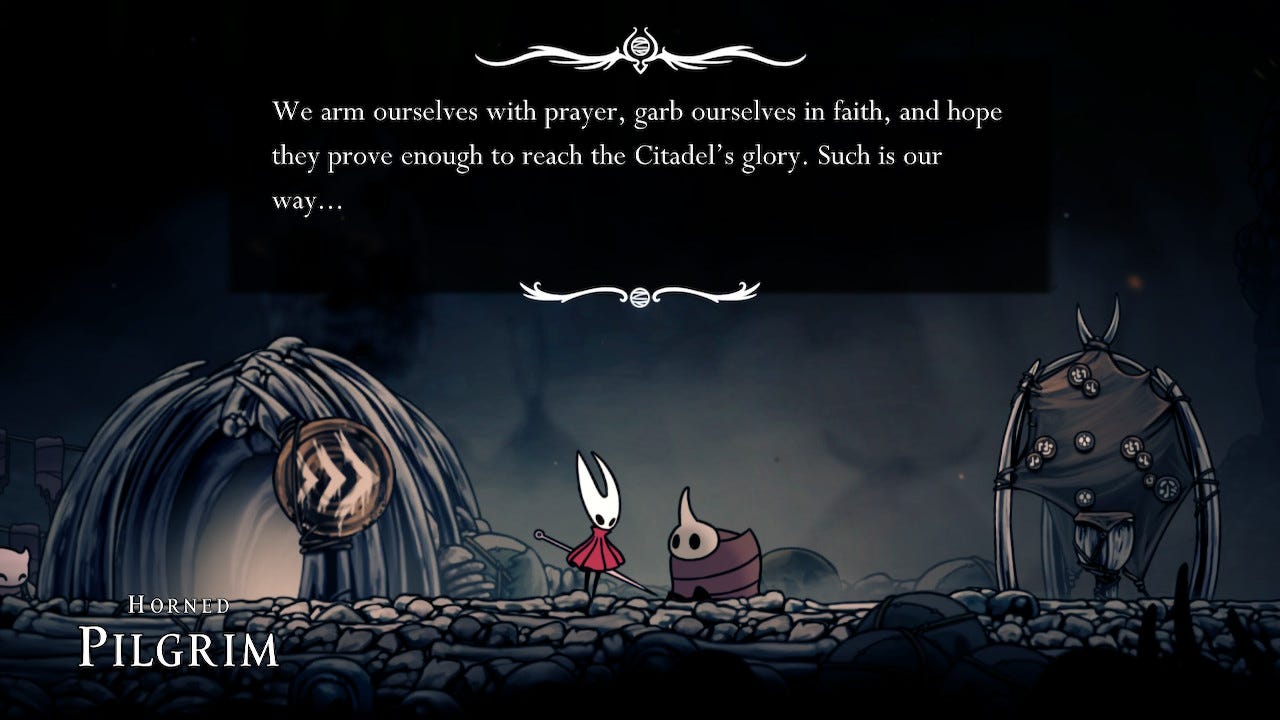
As a 2D action platformer, many of the upgrades Hornet acquires are a means of traversal. Air dashing, wall jumping, grappling, are all essential tools and much of the combat is, to me, best approached from a place of movement and positioning.
Your build will start with your chosen Crest of which there are several that can drastically change Hornet’s movement and combat style. Some deal quick, lighter hits like the Wanderer Crest, others deal heavy damage like the Beast Crest. For my play style, I stuck with the Hunter’s Crest with it’s balance of speed and power and, yes, the oft maligned diagonal pogo (I believe it’s just me and Margot in this camp, read her thoughts here). This decision made, my Hornet began to take shape.
My Hornet values efficiency especially in such a hostile, unknown place that she’s been whisked away to. She’s on a mission and The Hunter Crest’s balance allows for strong, moderately quick strikes, taking down enemies in her path with efficiency. Tacking on the Weighted Belt to reduce her knock back allows her to land more blows in succession. The Silkspeed Anklets increase Hornet’s running speed at the cost of Silk which has landed us in trouble, but again, efficiency is the name of the game.
To make up for the lost Silk, a valuable resource generated through landing attacks that is used for various purposes like healing and using certain items, Hornet holds close the Weavelight. The Weavelight increases the rate of Silk generation, making it the perfect complement for her heavy Silk use. Plus, when my Hornet holds this Weavelight she feels a strange connection to it. She can’t seem to let it go.
Added to her inventory of empowering relics is the Pollip Pouch, which applies poison to consumable tools. The Threefold Pins which come out extremely fast and in three directions, are useful for taking on multiple enemies, flying enemies, or dealing a final blow to a hard fought boss. A fast ranged move such as this with the added poison damage from the Pollip Pouch makes fights faster, showcasing Hornet’s competence, determination, and my custom trait of efficiency.
Through combat customization, Hornet’s personality can be imagined to fit that playstyle. The Wanderer Crest with its lighter hits may imply a more passive Hornet, hesitant to kill infected pilgrims, for example. Every choice can inform the character, likewise, what I’ve chosen not to use can mean just as much.
Writing Challenge: Which crest did you use in Silksong? What could that play style say about YOUR Hornet? Leave a comment!
Shakra spoke of The Citadel’s industrialization with disgust, their trinkets a symbol of the greed which caused so much despair. Hornet will eventually meet an automaton created by The Citadel, Twelfth Architect, who creates powerful tools Hornet can use. Hornet, respectful and kind, holds no ill will toward Twelfth Architect, but even so, my Hornet refuses to use The Citadel’s technology, despite being the most efficient tools for her journey. Perhaps her perception was colored by Shakra, or she saw that The Citadel did to the pilgrims who only wanted to worship them. These are theories my Hornet has thought up to mask her true fear. She’s afraid this broken kingdom might all be her fault.
In our journey through Pharloom we’ve met and helped countless other bugs. In our practical, efficient fashion, many of the wishes we grant to other bugs are justified through Hornet’s dialogue that what she learns or gains will be valuable to her on her own path, which makes her happy to help, but this isn’t always the case. Sometimes she’s just helping for helpings sake, like donating shards or rosaries to a town to help it rebuild. Hornet, textually, is kind. She grows to care about the people she meets and eventually inadvertently creates a haven for surviving pilgrims within The Citadel, but there’s something that gets harder and harder to ignore, a truth that is known to us, and everyone in Pharloom right from the start. Silk, the same Silk Hornet has the ability to generate, is what is used to infect the pilgrims, manipulate Pharloom to The Citadel’s whim. The pilgrims think this makes Hornet holy, special, but Hornet isn’t a believer. Is Hornet connected to this somehow?
As I, the player, approach the point of no return, I reflect on my time with Silksong. I’m loving it. It’s everything I wanted it to be after the long wait. Hornet’s acrobatic movement and combat feel even better to me than The Knight (Vessel), and the customization means any player can decide how they want to play, who Hornet is to them. Hornet and I both have doubts about who that is. Not ready to face the music, we turn back. We scour every inch of Pharloom below and The Citadel above and find poor bugs who need help and evidence of the destruction The Citadel had brought upon this land. We grew angry. It fueled us. We built up every rest stop along the road to give weary pilgrims a place to rest, to heal them, unsure if that wasn’t just fueling The Citadel’s ends in bringing more pilgrims to their doorstep.
One of those bugs was Greyroot who we’ve grown to trust since meeting them early on. It was Greyroot who gave Hornet the Pollip Pouch which became and invaluable staple of her arsenal, poisoning enemies and quickening fights. We returned to Greyroot after finding a poor, screaming creature, tangled in similar dark roots we found around their home. This is when everything changed.
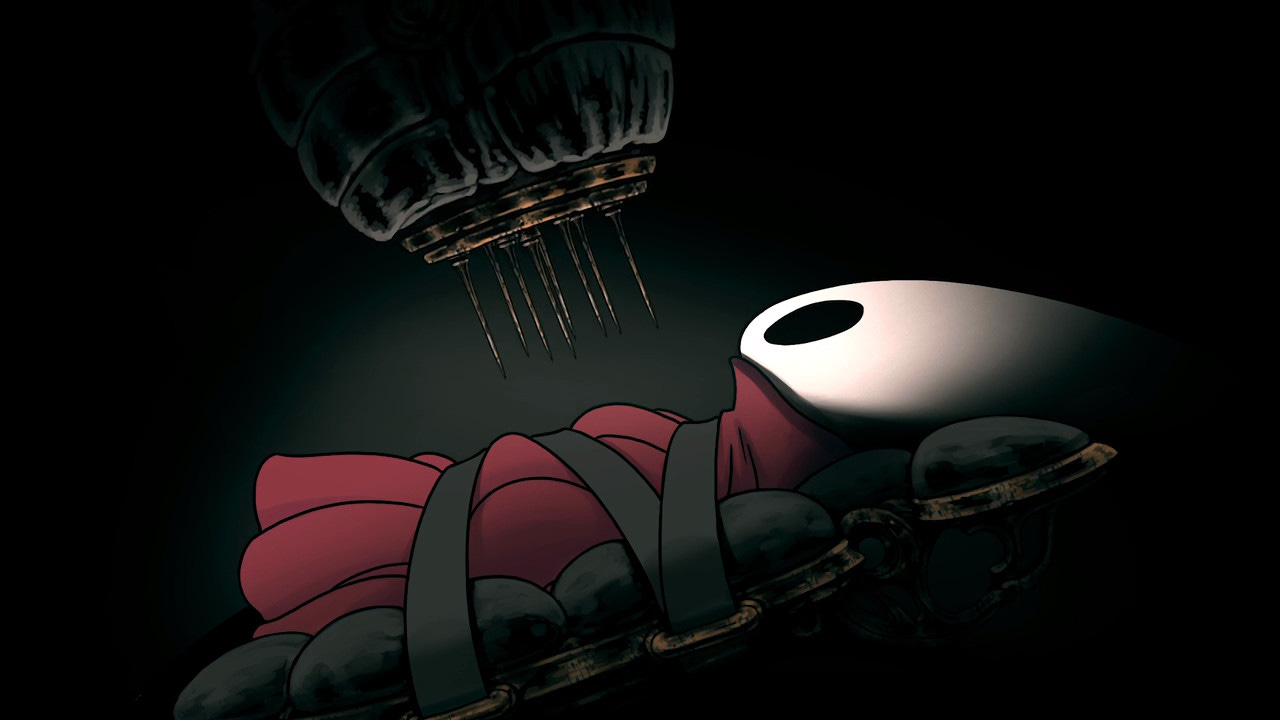
Greyroot incapacitates Hornet, embeds the creature in her shell and buries her to be overtaken by its curse. Again, she’s been taken and stripped of her abilities, the cursed tangle of roots blocking Silk generation. This time by someone she considered a friend. She eventually finds refuge, an outcast doctor who’s methods were deemed too dangerous and now lives in exile was all too eager to help. She is Hornet’s only hope. When the procedure is finished, Hornet is in agony, the pain greater than any she’s yet felt, but the curse is lifted. Even so, the dark roots still live within her as the Witch Crest, offering a new build option, and newfound motivations. Hornet takes to the new crest, how it allows for her to leave behind deadly traps when being hit. It’s the perfect crest for revenge.
No posts
Comments
Nothing yet. Say the first thing.
Sign in to join the conversation.