
There is an oft cited anecdote told by Hidetaka Miyazaki regarding the inspiration for multiplayer in his games. The originator of the unforgiving Soulslike genre, with titles like Dark Souls, and Elden Ring, implemented a summoning system where players could summon other players for assistance in an area of the game. The catch, however, is that as soon as the boss is defeated (or it defeats you) your companion disappears back to their own world.
In an interview with Keza MacDonald for Eurogamer in promotion for the first Souls game Demon’s Souls, Miyazaki says of his multiplayer mechanic:
“The origin of that idea is actually due to a personal experience where a car suddenly stopped on a hillside after some heavy snow and started to slip," says Miyazaki. "The car following me also got stuck, and then the one behind it spontaneously bumped into it and started pushing it up the hill... That's it! That's how everyone can get home! Then it was my turn and everyone started pushing my car up the hill, and I managed to get home safely.
“But I couldn't stop the car to say thanks to the people who gave me a shove. I'd have just got stuck again if I'd stopped. On the way back home I wondered whether the last person in the line had made it home, and thought that I would probably never meet the people who had helped me. I thought that maybe if we'd met in another place we'd become friends, or maybe we'd just fight...
"You could probably call it a connection of mutual assistance between transient people. Oddly, that incident will probably linger in my heart for a long time. Simply because it's fleeting, I think it stays with you a lot longer…”
This style of multiplayer is largely criticized even among die hard FromSoftware fans. It’s cumbersome, annoying to coordinate with friends, and it costs an in game consumable. If you and a friend keep dying to a boss, you may have to grind out more of these items before you can play together again. Yet, according to Miyazaki’s anecdote, this is precisely the point. These games are not meant to be played as multiplayer. These moments are supposed to be anonymous, transient encounters in which one person helps another and they part ways. He implies this is even the reason for the game’s difficulty: to encourage cooperation.
The multiplayer experiment culminates now in Elden Ring Nightreign, a fast paced, multiplayer first, cooperative experience with a closing deadly storm ala Fortnite. FromSoftware veteran, Junya Ishizaki, takes the helm for the first time, and is determined to change the minds of Soulslike fans who’ve shunned the multiplayer experience within the studio’s games. Now, you have no choice.
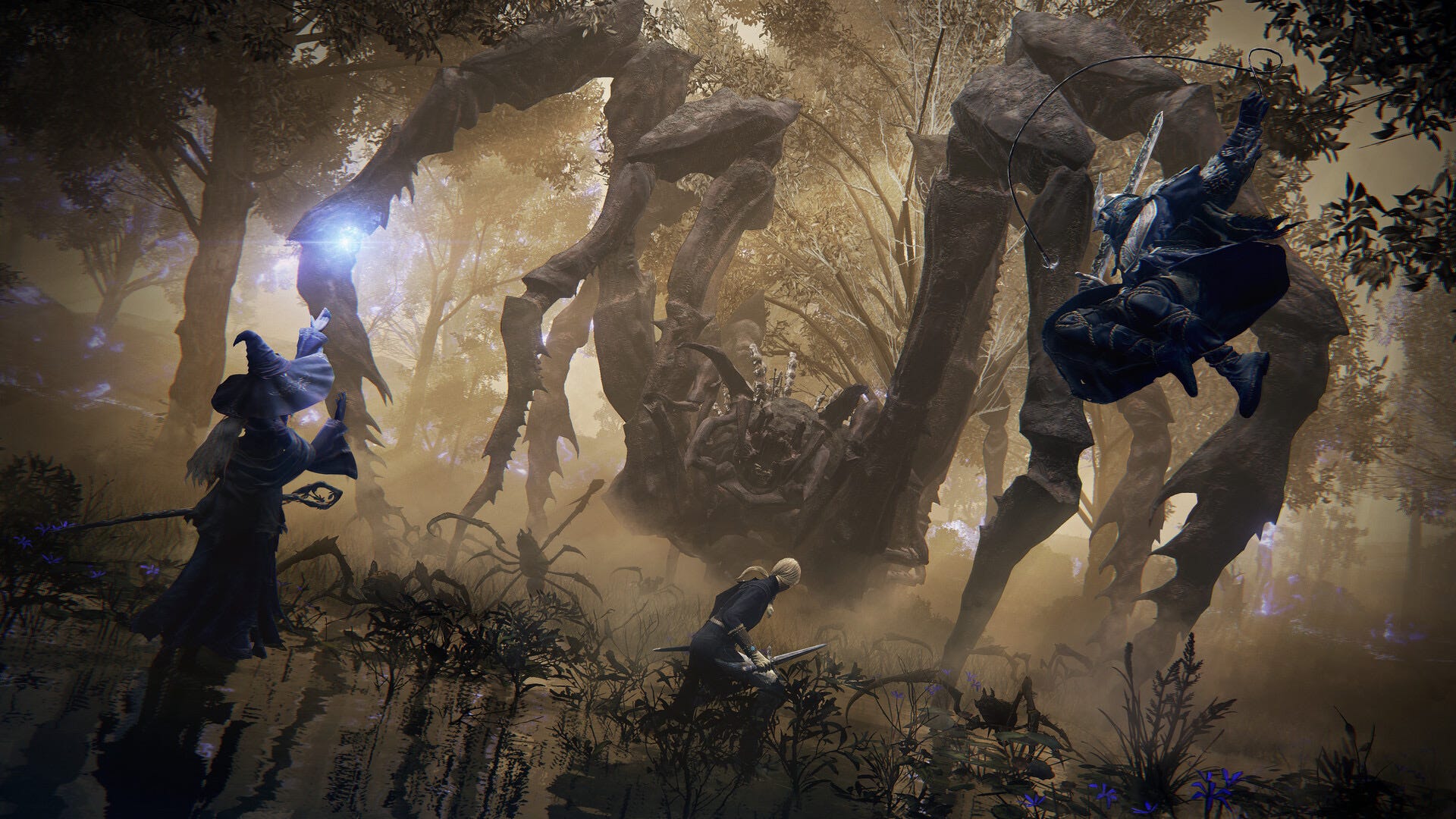
To begin with, and to the further disappointment of Souls fans, you choose your character. Gone are the personal builds players might be used to from the studio where they can tweak and perfect every stat of their character to their desired style of play. The game is fine tuned to most any grouping of 3 of the 8 available “Nightfarers.” These make up some of your classic Dark Souls/Elden Ring builds. The general strength character, the mage who attacks from afar with spells, the quick and nimble rogue type, and of course the parry sicko for the Sekiro heads out there (me).
My mains were these last two. The katana wielding Executor with a special block and parry mechanic that charges his sword for a powerful strike drew me in with its satisfying sword clangs. I’ve always said a good parry mechanic is dependent on its sound design and Nightreign delivers as swords meet, swipe, and deflect.
The Duchess is similarly dexterous but with a moveset all her own. She’s fast and has a passive ability that allows her to dodge in and out of close range combat with ease. Her swift dagger attacks allow for running in close, racking up damage, triggering her special ability that doubles that damage, then popping out of harms way. Since she also has decent stats for use of spells, she can also fire off attacks when at range, waiting for her next opportunity to strike from close quarters.
After choosing your character, and your two teammates choose theirs, its off to the races. In general, each run takes place over three day and night cycles. During the day, you defeat enemies and roaming bosses to collect resources to power up your character to defeat the big boss that spawns as night falls. Once that boss is defeated, repeat that cycle for day 2, then fight the ultimate day 3 boss to complete the run. During each day, a deadly storm closes in periodically, shrinking the playing field until ushering your party into the next boss. Simple enough, right?
As we fly in for day one, the Duchess player pings a nearby boss for us to take down right away. Nightreign favors quick, decisive thinking and having someone to regularly point out your teams’s next stop is an invaluable role.
We quickly dispatch a group of enemies and head under the ruins to fight the Fire Monk and collect some rewards before hurriedly running to the next ping, a Church of Marika which will grant us additional healing items.
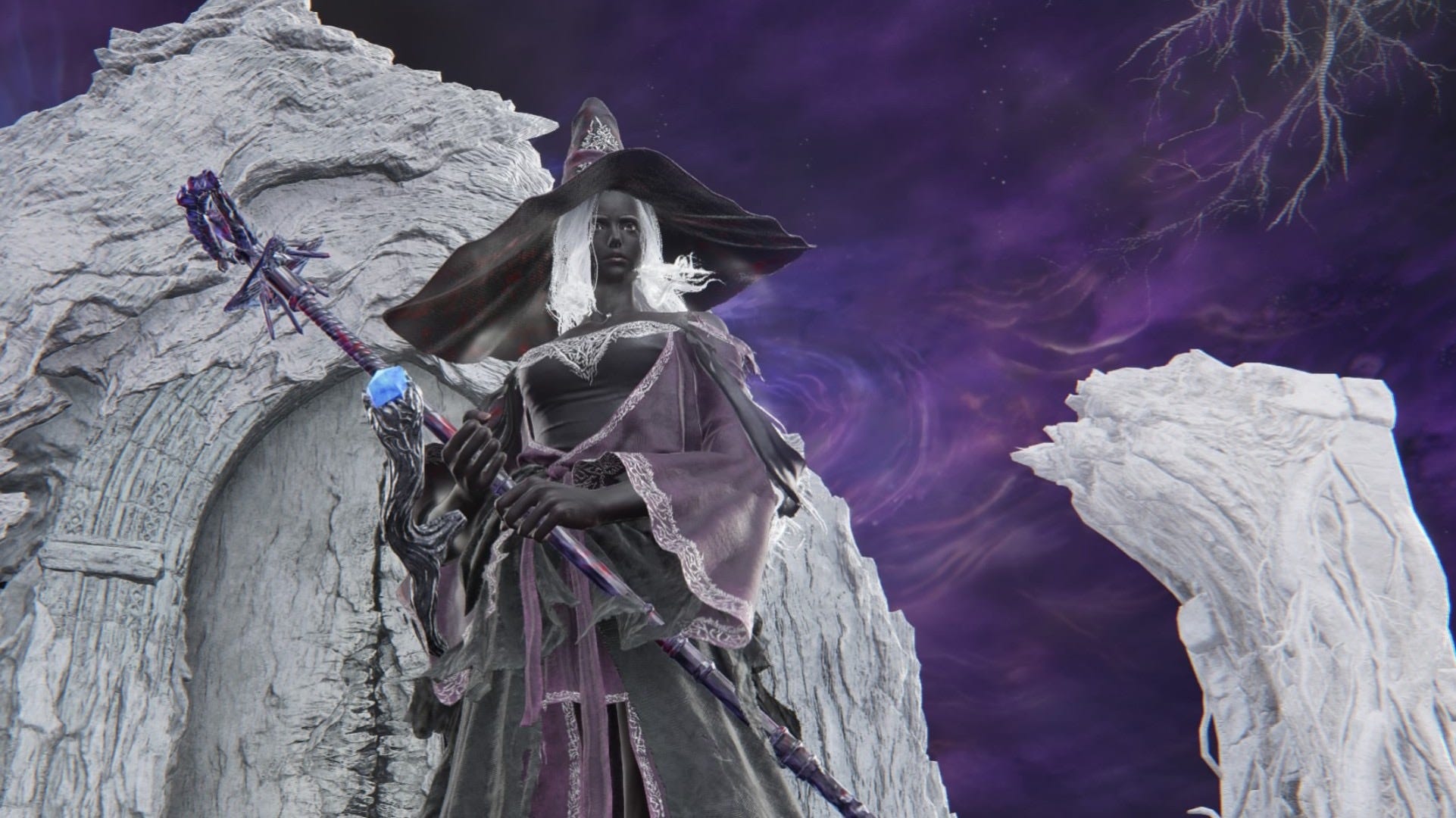
The Duchess is established as the guide of our party. I’ve chosen the parry-happy Executor, and our third member was the mage class, Recluse.
We’re progressing nicely, moving from boss to boss with ease during the early moments. This sense of security would ultimately lead to tragedy.
The first major boss is the Centipede Demon, an amalgamation of monstrous limbs and body parts that spews fire from a gaping maw on its belly. It leaps high into the air and crashes down with force to knock back even the tankiest Raider. Recluse, who’s been slinging spells from afar, is caught in the jump and falls.
When an ally is downed, their team can revive them in a unique way: attacking their bodies as they crawl around on the ground near death.
In an attempt to revive the fallen Recluse and dish out major damage, I activated my ultimate ability. Each character has their own ultimate ability or “Ultimate Art” that can be activated after being sufficiently charged. With the press of a button my Executor doubles over on all fours and transforms into a massive beast. My size now rivals that of the Centipede Demon and the force of my transformation alone while in the vicinity of my downed teammate was enough to revive them. I have a limited time in my new form so I immediately move to the Demon, swiping with long claw attacks and finishing with a piercing blow that left our foe vulnerable to a critical strike by Duchess.
The demon was defeated and Night One had been won. We had so far been nearly unstoppable, other than the one minor setback with Recluse. Even so, we picked up a strong victory with Duchess, our leader, dealing the final blow.
Having picked up some solid upgrades from the demon, we faced the second day with confidence. We do a classic run through of a castle which features several Crucible Knights that each give powerful rewards and upgrades. Our characters get stronger and stronger.
During this run, we get caught up in a tricky situation at the top of the castle. There are several giants who hurl magic pots from a distance that cover the ground in a magical flame that damages the player. They can be incredibly hard to avoid as taking out one requires being in the line of fire for another. The giants themselves are easy to defeat once you get there but in the fight, all of us are downed and require reviving.
If you’re unable to be revived in a certain amount of time, you respawn having lost a level, lowering your overall health and stats. These levels are precious as you make your way to Night Three and should be protected at all costs. Recluse and I had both lost levels to the Giants and their frustrating magic pots.
We defeated the giants but we considered that a loss with how uncoordinated we were. Not at all like the way we defeated the Centipede Demon on the previous Night. We needed a big win, so we headed below the castle. What waited there was much worse.
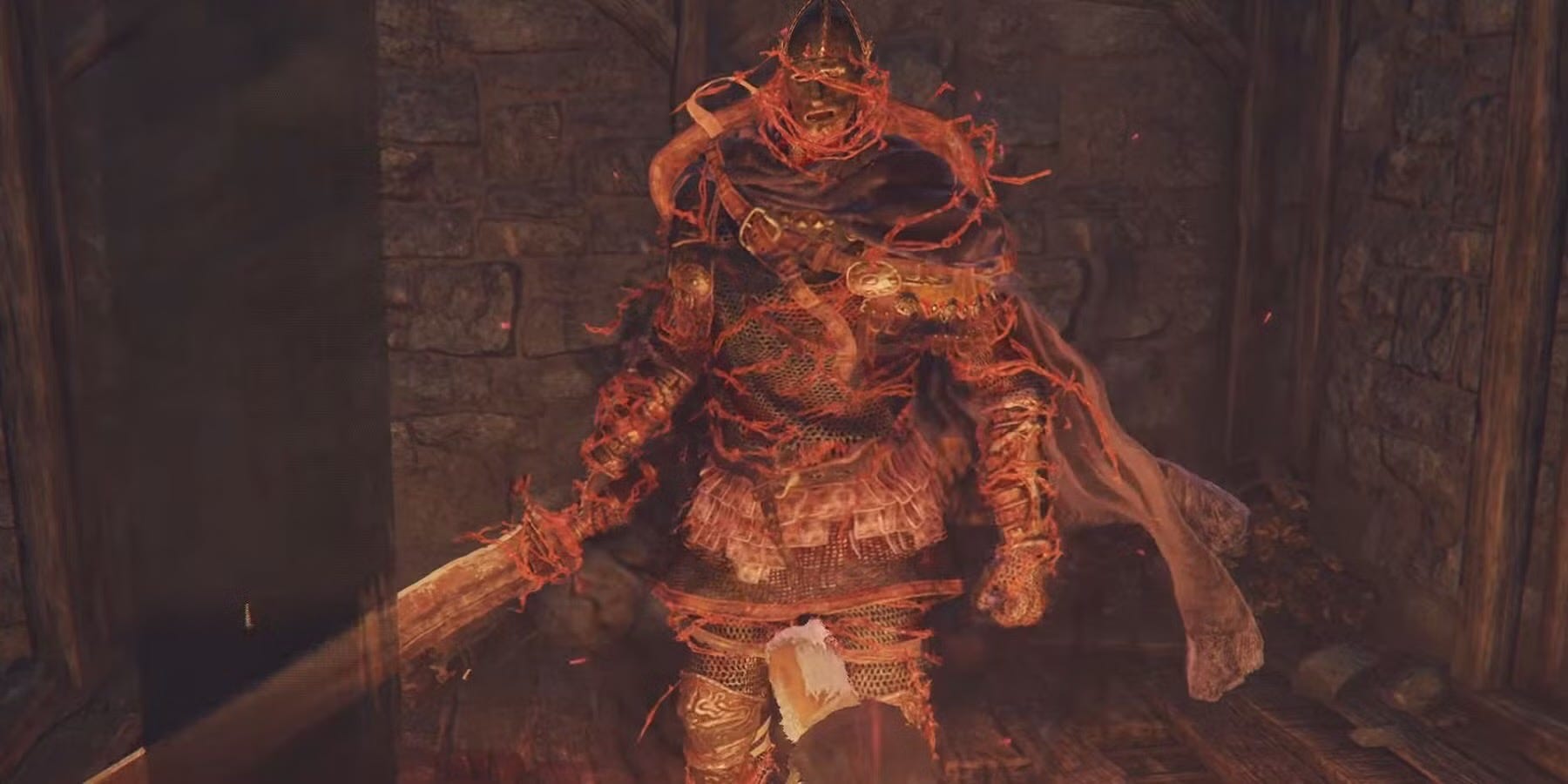
The night is closing in and we stare down the figure at the other end of the room. He’s heavily armored with a long cape and a sword big enough to hack through even my Executor’s beastial state.
The Bell Bearing Hunter is infamously powerful in Nightreign. It’s debated if it is ever worth it to go toe to toe with him on any run, at any level. His attacks are wild and can be unpredictable. He controls his massive sword with a red telepathy, allowing him to sling it across the battlefield to far away opponents, each hit dealing massive damage.
As an Executor, specializing in parrying, I would be tasked with holding the Hunter’s attention. A tall order, but it’s what you sign up for in this role.
My parry timing, if I may say, is quite good. Parries only work when the player hits the block button at the exact right moment, and Nightreign’s timing window is a little more forgiving than Sekiro or Lies of P, two games I love and have a lot of practice in, so I’m confident in my ability to pull it off. This was a special case.
The Hunter’s sword flies through the air at me back and forth from the left and right, and in the small battlefield under the castle, it disappears under the floor and through pillars scattered around the room. I can’t see the attacks coming. I block as best I can but my character’s stamina can’t keep up with the barrage of attacks. I fall, I’m revived, I fall again, revived again. I fall again but this time I’m not revived.
The deadly storm closes in to our location and my teammates take off running, leaving me to lose a level. When I respawn I immediately start running as the storm is close by. I see Recluse running ahead of me so I follow. But where is Duchess? There are no pings on the map advising our next location.
I look at the party and see Duchess is gone. The player disconnected, convinced after our failures that we would not make it through the nights to come. Recluse and I were left to take on the final two bosses alone.
Or so we thought.
Recluse and I ran from the storm until we were safe, frantically collecting as many runes as we could to regain the levels we’d lost. We would need them if we were going to defeat the final bosses, especially with only two players.
Nightreign is balanced so that each boss is sufficiently challenging for a 3 person team. Most runs end in failure even with a full party. We had our work cut out for us.
We were relegated to the small remaining area of the map, taking down bosses we hadn’t come across yet, not finding much of use other than runes to level up with. But something was different.
Duchess was a good leader, always pinging, deciding where to go next to optimize our time and effort to get the best loot possible. It can be necessary to run from place to place with little time between to think. But it is also hectic, stressful, and impersonal. Follow the path, grab the best loot, move on.
Since Duchess left, things were more calm. Recluse and I took time to explore all of the loot in an area, really inspect it. I could ping certain items for them I thought they might find useful and they even dropped a talisman they had equipped as it would have really helped my character by improving my stamina. Recluse and I became a real team then. This dynamic, the more personal, collaborative dynamic, actually made it seem like we had a chance!
This was it. We weren’t as prepared as we might have hoped but we had powerful weapons and items and were ready for the Night Two boss. The minions spawned on the battle field. The humanoid beasts with their electric powered weapons usually meant a dragon was coming as our boss. Not ideal. We dealt with the minions swiftly and waited for the dragon.
And waited.
And waited.
Recluse and I were perplexed. The boss didn’t spawn. We ran from end to end of the battlefield, surrounded on all sides by that deadly storm. The boss wouldn’t trigger, nothing we did worked. We met again in the middle and Recluse bowed. I bowed in return. It was a great run.
We had many setbacks and many triumphs. We overcame the odds, and were ready to face the Night as a team. We had fun. What more could we ask for.
The Night Two boss, it seamed, would not test our strength as a duo. Whether out of mercy or fear we’ll never know, but for now there was one thing left to do. We finished our bows and shows of respect and walked together into that deadly Night rain. Slowly it ate away at our health until we were both downed. With no one else to revive us we perished, ending the run for good.
There are players currently in Nightreign who will disconnect the moment they see you aren’t running the most optimal build for your chosen character, preferring not to waste their time with players who aren’t determined to win at all costs. If you fall too many times, take too long to choose your loot, aren’t timing your special abilities optimally, they might just disconnect.
There are players who will run into the storm to revive you even if it means dying themselves. They’ll share their loot with you if they find something that works best for your build, or run back to guide you back to the party if you’re lost. I’ve encountered them both and everything in between during my time with the game.
It made me think about the kind of player I am, the kind I aspire to be. So I’ll linger a little longer to let a player catch up, carry items that most see as useless if I think I can use it to help someone, and always prioritize reviving the team. It’s hard enough out here, we should be helping each other.
In that same interview from 2010, Miyazaki continues about multiplayer:
"It's a simple concept. But you don't know whom you will meet. Maybe the next person will be an enemy. That kind of encounter forms part of the larger storyline. There are constant surprises...
“Because Demon's Souls is a game with a lot of dying in it, surely that kind of fleeting cooperation should come out of all the death - 'We're all dead, so let's help each other out'," suggests Miyazaki.
Have you been playing Elden Ring Nightreign? How have you been playing and have any interesting stories emerged in your runs?
No posts
Comments
Nothing yet. Say the first thing.
Sign in to join the conversation.