
12/3/2025
Newsletter #807
The Crack of Dawn
I’ve watched many, many collections of what are now known as “Fails” videos on the internet. Some are funny; some are amazing; some are tragic. Unable to know in advance which are which, I stopped watching them. Amongst them all, I discovered Daily Dose of Internet, which is by far the best. It makes me laugh every single time I watch it. I never get hoodwinked into seeing something horrifying, that I’ll never be able to unsee. Although it’s extremely difficult to differentiate one collection of short internet clips from another, Daily Dose of Internet is brilliant, and I don’t use words like that lightly. The choice of clips, the editing, the length of the entire video, and the voice-over narration are perfect. This is no mean feat. Check it out for yourself
https://www.youtube.com/results?search_query=daily+dose+of+internet+best+of+2022
I found this video clever, funny and true.
Rod Serling Presents The Twilight Zone:
I worked with one composer for the first ten songs for my rock & roll band, Silver Nitrate (which doesn’t exist)— https://www.youtube.com/@CholyBeckerMusic —and now I’m working with another one. This new fella, Fredrick, is terrific, but he gets so carried away with the vocals that he slips out of English into gibberish. This is not a unique situation; many vocalists have done it before. As far as my mother was concerned, all rock vocalists did it. Anyway, it just occurred on our new song, “Rich People’s Problems.” This is what I wrote him:
Dear Fredrick,
I say this with all due respect, and a genuine fondness: I sent you the music video, and in the section that I indicated, you are not speaking English. Whatever you’re speaking is not a known language. You are certainly not the first vocalist to do this. Mick Jagger is famous for it.
Let’s say you’re from a country called, oh, I don’t know, how about Sing-a-ling-apore, right near the sunny beaches of Acapella (where you can score Acapella Gold). The vocalists of Sing-a-ling-apore can speak English, but they occasionally slip back into their native tongue of Sing-a-ling-apore-ian.
To aid you in translating Sing-a-ling-apore-ian into English, I am supplying you with a phonetic transcription of what you said, as opposed to what was written. This was by far the funniest part of making this song. I hope this is of some assistance to you in your translation.
Josh
Here’s what I wrote:
Rich People’s Problems
The poor oppressed rich woman
Said, “My dishwasher’s too loud
It’s givin’ me a nervous breakdown”
She complained furrow-browed
The problems of rich people
Are the worst problems there are
That poor people complain
Is utterly bizarre
My tap water tastes funny
My living room isn’t sunny
My maid is always late
Her behavior I abominate
“My Mercedes has a shimmy”
Said the rich white man
“Why’s this happenin’ to me
I don’t understand”
The problems of rich people
Are the worst problems there are
That poor people complain
Is utterly bizarre
Here’s what Fredrick sang, beautifully:
Rich People’s Problems
That poor people complain
Is utterly bizarre
My tap water tastes funny
Bah-dida room isn’t sunny
Un-dee-dee-zall-ways-gets
Goo-beezee-outta-unda-with me
Down-say-zatcha-chay
Say-koo-it’s my name
Why’s this happening into me
I don’t understand
The problems of rich people
Are the worst problems there are . . .

Josh Becker <jbeckerdga@gmail.com>
4:54 AM (1 hour ago)
to Fredrick
Hello Fredrick,
I am faced with the difficult (I’m kidding) decision of leaving those sections of the lyrics on the video blank; or putting in the phonetic version of what you sang, which would be ridiculous. Since I don’t want folks laughing when they’re not supposed to be, I’ll leave them blank. However, the upside is that it inspired me to write a newsletter--I have a free Substack newsletter called “The Crack of Dawn,” that I’ve been putting out regularly for the past three years, and this is #807--about phonetic writing (here’s the link if you care to check it out, and possibly subscribe -- https://joshbecker.substack.com/archive ). I will publish this newsletter imminently.
Hello Fredrick,
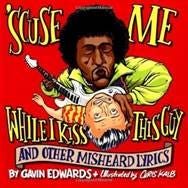
You damn near made it all the way through the Venice Beach video before, once again, slipping into Sing-a-ling-apore-ian. Please understand that I understand that music is not a literary form. Lyrics are a literary form, until someone sings them, that is, then they become part of the music and all bets are off. There are a number of books written on the subject of misheard lyrics, the first and best being, ‘Scuse Me While I Kiss This Guy, referring to Jimi Hendrix’s song, Foxy Lady, where he sings, “‘Scuse me while I kiss the sky.”
Venice Beach
My sister Pam has been giving me shit about this my whole life. We were sitting on the floor in her bedroom in front of her stereo listening to Donna Summer’s album Live and More, which has a great cover of Jimmy Webb’s classic song, MacArthur’s Park. Pam and I were heartily and happily singing along with Donna Summer, when Pam’s hand shot out and turned off the stereo. She said in a highly confrontational tone, “What did you just say?” I felt like a deer in the headlights and quietly replied, “What do you mean?” Pam pointed into my face and said, “What did you just sing?” I said, “When?” Pam said, “Just now.”
These are the lyrics to MacArthur’s Park: I recall the yellow cotton dress/foaming like a wave/on the ground beneath your knees/birds like tender babies, in our hands/and the old men playing Chinese checkers by the trees/MacArthur’s Park is melting, in the dark/all the sweet green icing flowing down/someone left their cake out in the rain/I don’t think that I can take it/cause it took so long to bake it/and I’ll never have that recipe again, oh no
Well, those are about as weird as lyrics get, so fucking them up wasn’t hard. Nevertheless, Pam was unrelenting. “What did you sing?” I said, “Uh, birds like tender babies, in our hands/and shiny stickers in the trees?” Well, Pam has never let me forget that incident.
In any case, I’ve experimented with phonetic writing, meaning, writing dialogue as it is actually said, as opposed to how it was written. This used to be a common practice, particularly for the dialogue of black people, termed Ebonics, that went like this, “Shut yo’ face, foo’,” meaning, “Shut your face, fool.” Well, it was offensive in the old days because it was meant to be offensive. Now it’s entirely unacceptable, and for good reason—it’s offensive. Oddly, the most extreme example I’ve ever encountered is in the novel, “Scarlett Sister Mary” by Julia Peterkin, that was absolutely not meant to be offensive, and if fact won the Pulitzer Prize in 1928. It’s the story of poor black farmers who still live on the plantation after the Civil War. I couldn’t believe my eyes as I read it, and it’s now so politically incorrect it’s painful. Here is a short example:
When Mary told June she was going to marry July, he drew his thick black eyebrows together and his hands doubled up into hard fists. Something like surprise filled his eyes. “July?” he asked. “You is gwine to marry July?” Then he grunted and shrugged his big round shoulders. “July ever was a lucky boy. E ever was. I never had a luck in my life.”
“Ain’ you glad I’m gwine to be you sister, June?” she asked him.
“Not so glad, Si May-e.” June smiled a wry smile and looked far away.
It’s not a particularly long book, but it was extremely difficult to read because of the phonetic writing. I had to reread lines over and over again to figure out what was being said. But since it won the Pulitzer Prize, and I had collected all of the Pulitzer Prize-winning novels, I had to finish it.
I experimented with phonetic writing in a couple of screenplays and books—not for black people—and I found it fascinating. Unfortunately, I was the only one because everybody else hated it. Here are two examples of phonetic Australian—Hoy means Hi, and Stike and Aygs, which means Steak and Eggs.
Anyway, here’s an example of my use of phonetic writing that everybody hated:
Cycles (2014)
Chapter Two
The police car pulled away from the Amarillo bus station. Luanne and the sheriff rode along in silence for a minute, but finally, the sheriff broke the silence.
“Y’all didn’t wanna believe me, but I tol’ ya so.”
The cold, defiant look returned to Luanne’s face. She crossed her arms.
“All right, ya tol’ me so. So what?”
“So, if you’d a listened t’ me ya coulda spared yourself the time an trouble of goin’ all the way t’ Albuquerque. I knew your Ma didn’t want ya there, she tol’ me so when she left.”
“I guess I jus’ had t’ find out fur myself.”
“I guess ya did. I tell ya though, girl, I don’t cotton t’ this runnin’ away bidness. Don’t do it again.”
“Aw, daddy, just lemme be,” said Luanne, lowering her chin to her chest. “I don’ much feel like talkin’ right now.”
“Ch’all don’ need t’ be talkin’, ya need t’ be listenin’,” said her father seriously. “From here on out when I tell ya somethin’, I ‘spect ya’ll t’ do it.”
“Why?”
“Why? ‘Cause I’m your father an’ I know what’s right for ya, that’s why.”
The defiance came bubbling back up. “Ya do? You know what’s right for me? I don’ thank y’all know what’s right for yourself, let alone me.”
The sheriff looked suspicious. “What’s that supposed t’ mean?”
Luanne turned and looked straight at her father. “You know ‘zactly what I mean.”
“What?”
Luanne looked at him a long time. “Aw right. Whatever happened after that feller that come into town last year an’ spoke at the Goodfellers Hall?”
The sheriff’s car swerved over to the side of Route 66 and screeched to a halt.
The sheriff turned to Luanne and the two of them glared at each other.
“What’re ya drivin’ at here, girl?
“Drivin’ at? All I know is that feller come ridin’ into town on his motorsickcle spoutin’ his kill‑the‑Nigras‑and‑Jews talk and the next thang ya know ever’body’s actin’ very peculiar.”
“Ya’ll get all this from your mama?” he said in an accusing tone
Luanne scoffed, “Mama didn’t tell me nothin’.”
“So y’all got it yourself. What of it?”
“So, what Nigra or Jew got lynched? Or was it one of them Japs down to the relocation center?”
“Nobody got lynched, no how, not a Nigra, Jew or Jap. Ya don’ know what’cha talkin’ ‘bout.”
“I don’t, huh? How come the next day the road out t’ Salt Crick got blocked off an nobody goes out there no more?”
Sheriff McMillan suddenly got very serious. “I don’ know where y’all got these silly notions of yours, but you best clear your head of ‘em right smart! Your dead wrong in what your sayin’! I don’ cotton t’ bein’ accused of thangs by my own daughter, an’ I won’t have no more of it, neither! An another thang, young lady, there ain’t no point in your runnin’ away no mo’. Yer mama don’ want’cha, ya gotta face up to that. Like it or not, you’re stuck with me. Ya may not believe it, Luanne, but I do love ya.”
Luanne sighed looking away. “I know ya do, daddy.”
The sheriff nodded, fine, it was all settled. He turned the steering wheel, pulled back onto the road and drove away.
I still kind of like it, but I do see people’s objections.
Anyway, I think I’ve rambled on long enough about this topic.
Y’all come back now, y’here.
Comments
Nothing yet. Say the first thing.
Sign in to join the conversation.